
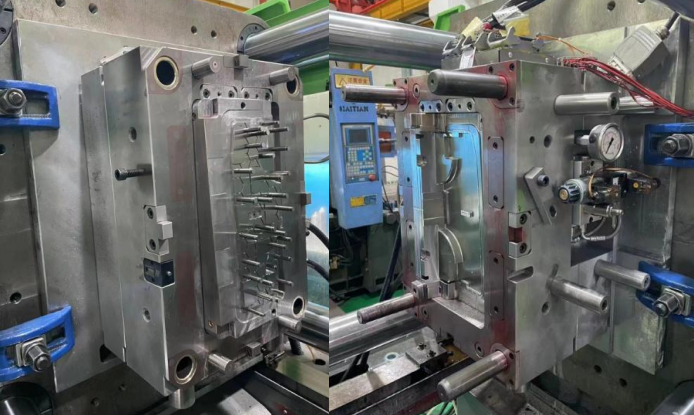
Choosing the right automotive plastic parts manufacturer is not only about comparing quotations.
For most plastic part projects, the supplier needs to do several things well at the same time: understand the product, build a reliable mold, select the right molding process, check the samples carefully, and respond quickly when problems appear.
A mold that produces acceptable parts during the first trial does not automatically mean it will perform well in long-term production.
This is especially important for automotive plastic parts, where clips, mounting features, housings, brackets, connectors, and structural components often need stable dimensions and reliable assembly.
Before selecting a supplier, buyers should look at the entire process rather than only the mold price or part price.
1. Start With the Part and Mold Design
A good plastic part starts with a mold that is designed around the actual product requirements.
Automotive plastic parts often include ribs, bosses, clips, mounting holes, deep cavities, side actions, sealing areas, and other functional features.
These details can directly affect:
- Gate location
- Parting line
- Cooling
- Venting
- Ejection
- Slide and lifter design
- Mold strength
- Dimensional stability
Before mold manufacturing begins, the supplier should review the 3D model and identify obvious risks.
For example, an unsuitable gate position may increase weld lines or warpage.
A thick rib or boss may create sink marks.
Insufficient draft may make the part difficult to eject.
A side feature may require a slider or lifter, and its structure needs to remain reliable after repeated movement.
The purpose of DFM is not to make the project complicated.
It is to identify problems early, while changes are still relatively easy and inexpensive.
At Fentormold, we normally review the part structure before mold manufacturing and discuss important tooling or molding concerns with the customer.
You can learn more about our Injection Mold Manufacturing capabilities.
Material selection should also be considered at this stage.
Common automotive plastics include PP, ABS, PC, PC/ABS, PA6, PA66, PBT, POM, TPE, and TPU.
Different materials behave differently during molding.
Shrinkage, moisture sensitivity, glass fiber content, mold temperature, and flow behavior can all affect the mold design and final part quality.
A supplier should therefore understand not only the mold, but also how the selected material may behave inside that mold.
2. Check Whether the Mold Is Suitable for Long-Term Production
A mold should not only work during T1.
It should continue producing stable parts after thousands or tens of thousands of molding cycles.
Some problems are easy to miss during a short mold trial because they may appear minor at the beginning.
During long-term production, however, these small problems can gradually become much more serious.
One example is air trapping.
During the first trial, poor venting may only create a small burn mark, slight short shot, or unstable filling in one area.
If the venting problem is not corrected, residue may gradually build up around the venting area.
As production continues, the trapped-air problem can become worse.
Eventually, the defect may become frequent enough to affect production stability.
Moving components also need to be checked carefully.
Slides, lifters, guide components, inserts, and other moving parts may work normally during the first few hundred cycles.
But wear can gradually increase if the fitting clearance, hardness, lubrication, or positioning is not suitable.
Over time, this may lead to:
- Flash around inserts or sliders
- Poor positioning
- Larger dimensional variation
- Scratches on molded parts
- Abnormal movement
- Increased maintenance
- Functional failure of molded features
Cooling problems can behave in a similar way.
A mold may produce acceptable samples during a slow mold trial.
During continuous production, however, mold temperature can gradually rise.
If cooling is unbalanced, problems such as warpage, shrinkage, or dimensional variation may become more obvious after the mold has been running for a longer period.
For this reason, the important question is not simply:
Can the mold produce a good sample?
It is:
Can the mold continue producing stable parts during normal production?
This is one reason why experience in both mold making and Injection Molding Production is useful.
The supplier needs to think about how the mold will behave in production, not only how it performs during the first few shots.
3. Use Mold Trials to Check Both the Part and the Mold
A mold trial is not only for producing plastic samples.
It is also an opportunity to inspect the mold itself under actual molding conditions.
During T1 and later mold trials, the molded parts should certainly be checked for visible defects such as:
- Flash
- Short shots
- Sink marks
- Warpage
- Weld lines
- Burn marks
- Surface defects
- Difficult ejection
But the mold condition is equally important.
Several mold-related problems should be checked carefully during the trial.
Water Leakage
Cooling circuits should be checked for leakage.
Even a small leak around a connector, water plug, O-ring, insert, or cooling channel can become a serious problem during production.
Water leakage can cause rust, unstable mold temperature, machine contamination, or production interruption.
It is much better to find and correct these problems during mold testing.
Galling and Rubbing
Moving mold components should not have abnormal rubbing or galling.
This is especially important around sliders, lifters, shut-off surfaces, guide components, and inserts.
A small interference may not immediately stop the mold from working.
After repeated cycles, however, the surfaces may become damaged.
This can eventually create flash, poor positioning, abnormal movement, or even mold failure.
Positioning
The positioning of mold components should also be checked.
Core and cavity alignment, slider positioning, insert positioning, guide components, and shut-off areas need to work consistently.
Poor positioning can affect dimensions and create wear in areas that should not be carrying excessive load.
Ejection
The part should eject smoothly and consistently.
Ejector pins, sleeves, lifters, and other ejection components should move without sticking or abnormal marks.
If a part is difficult to eject during the trial, the problem may become more serious once the mold runs continuously and reaches a stable operating temperature.
Venting and Cooling
The mold trial should also confirm that venting and cooling are working as expected.
These systems directly affect filling, surface quality, cycle time, warpage, and production stability.
A good mold trial therefore looks at two things together:
What is happening to the plastic part, and what is happening inside the mold.
That is much more useful than only checking whether the sample looks acceptable.
4. Check the Samples Against the Drawing
After the mold can produce reasonably stable samples, dimensional checking becomes important.
For most projects, the main reference should be the customer’s 2D drawing.
Critical dimensions, tolerances, assembly areas, hole positions, sealing surfaces, and other important features should be checked according to the drawing.
The 3D model is also useful for confirming the overall geometry and comparing the molded part with the original product design.
During early mold trials, however, it is usually more practical to focus first on the dimensions that matter most.
These may include:
- Overall size
- Assembly dimensions
- Hole positions
- Clip positions
- Sealing areas
- Critical wall thickness
- Key fitting dimensions
Not every dimension needs to be treated as equally critical.
The customer should clearly indicate the most important dimensions on the 2D drawing whenever possible.
This helps the supplier focus inspection on the areas that affect function and assembly.
Once the mold becomes more stable, more detailed dimensional reports can be prepared if the project requires them.
The purpose of inspection is not to create a large report for its own sake.
The purpose is to confirm that the molded part meets the actual requirements of the drawing and works correctly in the customer’s application.
For production projects, repeatability is also important.
A part may measure correctly during one trial but change later because of mold temperature, material conditions, holding pressure, cooling, or other process changes.
You can read more about this in our article on How to Maintain Injection Molding Dimensional Stability in Mass Production.
5. Pay Attention to How Problems Are Handled
No mold project is completely free from adjustment.
The important difference between suppliers is how they handle problems when they appear.
If a part has warpage, for example, the supplier should determine whether the problem is related to:
- Part structure
- Gate location
- Cooling
- Packing
- Material shrinkage
- Mold temperature
- Ejection
If flash appears around a slider, the solution should not automatically be to increase clamping pressure.
The real cause may be wear, poor positioning, insufficient support, or incorrect fitting.
If burn marks appear, the supplier should investigate venting and trapped air instead of simply changing machine settings.
This kind of problem-solving ability becomes especially important after the first mold trial.
A good supplier should be able to explain:
- What problem was found
- What is causing it
- Whether it comes from the mold, part design, material, or process
- What modification is recommended
- Whether the change may affect other areas
Clear communication during this stage can save a lot of time.
It also gives the buyer a much better understanding of how the supplier actually works.
At Fentormold, project communication is handled directly with the team responsible for the tooling and molding process.
Customers can review mold progress, sample results, dimensional issues, and required modifications without unnecessary layers of communication.
More information about our company is available on the About Us page.
6. Compare the Complete Project, Not Only the Quotation
Price is always important when choosing an automotive plastic parts manufacturer.
But a mold quotation should be considered together with the quality of the tool, the expected production life, communication, inspection, and the cost of future corrections.
A very cheap mold may become expensive if it repeatedly requires:
- Mold repairs
- Additional trials
- Production stops
- Part sorting
- Engineering changes
- Unexpected maintenance
At the same time, there is no need to make a mold unnecessarily complicated.
The correct solution depends on the part, expected production quantity, material, tolerance, and application.
A good supplier should try to find the right balance.
The mold needs to be reliable enough for the required production, but the tooling solution should also remain practical and cost-effective.
Before placing an order, buyers can ask several straightforward questions:
- Can you review the 3D model before mold manufacturing?
- Which areas of the part may create molding risks?
- How will the mold be checked during T1?
- How will you inspect the key dimensions on the 2D drawing?
- How do you check sliders, lifters, cooling, venting, and positioning?
- What happens if a problem appears during the mold trial?
- Can the mold be modified later if the product design changes?
- Can you continue with injection molding production after the mold is approved?
The answers usually tell you more about a supplier than the quotation alone.
Choosing the Right Automotive Plastic Parts Manufacturer
The right automotive plastic parts manufacturer should be able to support the complete process from mold development to stable plastic part production.
That means understanding the product, reviewing the mold design, checking the tool carefully during trials, inspecting the important dimensions, and solving problems before they become production problems.
Fentormold has more than 15 years of experience in injection mold manufacturing and plastic injection molding.
We support customers with DFM review, mold design, mold manufacturing, mold trials, engineering changes, and injection molding production.
Our approach is practical.
We try to identify risks early, keep the tooling solution suitable for the actual project, and solve problems while they are still manageable.
If you have an automotive plastic part under development, you can send us your:
- 3D CAD file
- 2D drawing
- Plastic material
- Expected production quantity
- Surface requirements
- Critical dimensions
We can review the project and provide a tooling and injection molding quotation based on the actual requirements.
For more information, visit Fentormold.