
Ejector marks are usually associated with the ejection stage of injection molding. However, some ejector marks are actually created during injection and packing.
When cavity pressure acts on the ejector system, an undersized ejector pin or insufficiently rigid ejector plate can deform or move slightly. Although the movement may be very small, the plastic part can reproduce this displacement on its surface, resulting in a visible ejector mark.
This article focuses on two specific causes:
- An ejector pin is too small and deflects under injection pressure.
- An ejector plate is too long or already deformed and moves under injection pressure.
1. Ejector Pin Is Too Small
When an ejector pin is too small for the pressure acting on it, injection pressure can cause the pin to deflect slightly.
The basic mechanism is:
Injection Pressure → Ejector Pin Deflection → Local Displacement → Ejector Mark
During filling and packing, cavity pressure acts on the exposed end of the ejector pin. If the pin diameter is too small or its unsupported length is too long, the pin may not remain completely stable.
Even a small displacement of the pin face can be transferred to the plastic surface, creating a circular or localized ejector mark.
This means the defect may be created while the mold is still closed, rather than during part ejection.
How to Fix It
The main objective is to increase ejector pin rigidity:
- Increase the ejector pin diameter.
- Reduce the unsupported pin length.
- Improve support behind the ejector pin.
- Use a more suitable ejector structure when necessary.
If the ejector mark becomes more visible as injection or packing pressure increases while ejection remains normal, the corresponding ejector pin should be inspected first.
Proper ejector design during the mold development stage can help prevent this problem before mold trials. Fentor mold provide the detailed analysis during the mold design stage to avoid this issue.
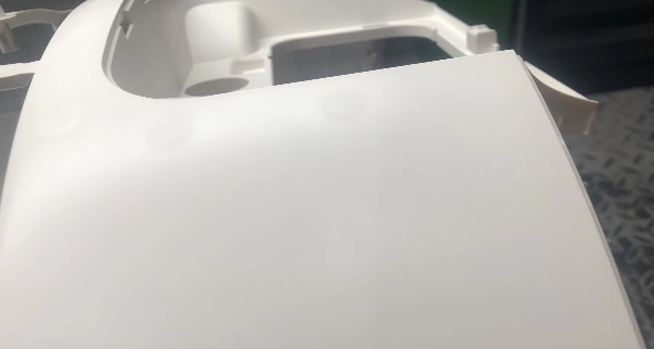
2. Ejector Plate Is Too Long or Already Deformed
The second situation is different from an undersized ejector pin. In this case, the individual ejector pin may be properly sized, but the ejector plate itself lacks sufficient rigidity.
If the ejector plate is too long, too thin, insufficiently supported, or already deformed after long-term production, the pressure transferred through the ejector pins can cause the plate to deflect.
This movement can cause the ejector pins to shift slightly relative to the mold surface, leaving marks on the molded part.
The mechanism is:
Injection Pressure → Ejector Pin Load → Ejector Plate Deflection → Pin Movement → Ejector Mark
If the deformation is elastic, the ejector plate may return to its original position after the injection pressure is released. This makes the problem difficult to identify during a static mold inspection.
How to Fix It
The main objective is to improve the overall rigidity of the ejector plate:
- Increase ejector plate rigidity.
- Increase plate thickness when necessary.
- Reduce the unsupported span.
- Add appropriate structural support.
- Check whether the existing ejector plate has permanent deformation.
If several ejector pins show similar marks, the ejector plate should be inspected rather than focusing only on individual pins.
For molds requiring replacement or precision machining of mold components, proper dimensional control is also important. Fentor mold provide the pricision Components Manufacturing to guarantee the main components precision
Ejector Plate Deflection Under Injection Pressure
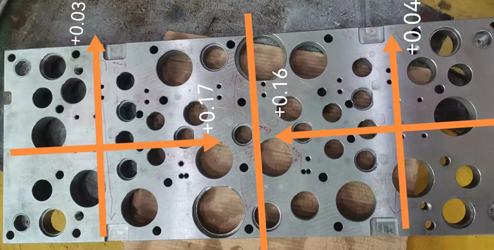
Show the force path as:
Cavity Pressure → Ejector Pin → Ejector Plate → Plate Deflection → Ejector Mark
A long or deformed ejector plate can deflect under injection pressure, causing ejector pins to move and leave marks on the molded part.
3. How to Prevent Injection Pressure-Induced Ejector Marks
These problems are best addressed during mold design rather than after ejector marks appear during trials.
Key design factors include:
- Ejector pin diameter
- Unsupported pin length
- Local cavity pressure
- Ejector plate thickness
- Ejector plate span
- Ejector plate support
- Overall ejector system rigidity
The goal is simple:
Keep the ejector system rigid enough to remain stable under injection pressure.
DFM, mold flow analysis, and proper mold structure design can help identify potential ejector-system problems before mold manufacturing begins.
4. Conclusion
Not all ejector marks are created during part ejection.
When injection pressure acts on an insufficiently rigid ejector system, the ejector pin or ejector plate can move slightly and transfer this displacement to the molded part.
Two specific causes are particularly important:
1. Undersized Ejector Pin
A small ejector pin can deflect under high cavity pressure, causing a local displacement that appears as an ejector mark.
2. Long or Deformed Ejector Plate
A long, insufficiently rigid, or deformed ejector plate can deflect under injection pressure and cause the ejector pins to move.
Therefore, if an ejector mark becomes more noticeable as injection or packing pressure increases, while the ejection process remains normal, the ejector pin and ejector plate should be checked for structural movement.
The key is simple: keep the ejector pins and ejector plate rigid enough to remain stable under injection pressure.
Fentormold provides precision injection mold manufacturing and injection molding solutions, with expertise in ejector system design, mold structure optimization, and high-quality plastic part production.