Injection mold project mistakes can cause serious problems even when the mold itself appears technically sound. An incomplete RFQ, unrealistic budget, unclear product requirements, poor supplier evaluation, late design changes, or inadequate T1 feedback can gradually turn a manageable project into one involving repeated modifications, unexpected costs, and production delays.
For buyers, the biggest risk is often not one major mistake. It is a series of small decisions that create larger problems later in the injection mold manufacturing process.
A successful injection mold project requires more than producing a mold that can make an acceptable plastic part. The mold must meet the required quality, dimensional, cosmetic, cycle-time, production-volume, and tool-life requirements within the agreed budget and schedule.
This guide explains 15 injection mold project mistakes that can cause costly problems and, more importantly, what buyers can do to prevent them.
Why Injection Mold Project Mistakes Lead to Failure
Most injection mold project mistakes do not happen during machining. They often begin during quotation, product design, supplier selection, or project planning.
A buyer may choose a supplier based on the lowest price, approve tooling before the product design is finalized, or fail to define critical dimensions. Each decision may appear manageable at the time, but the combined effect can lead to mold modifications, delayed T1 trials, additional tooling costs, or production problems.
The earlier a project risk is identified, the less expensive it usually is to correct.
1. Choosing an Injection Mold Supplier Based Only on the Lowest Price
Choosing a supplier only because it offers the lowest injection mold quote is one of the most common injection mold project mistakes.
Two suppliers may quote very different prices for what appears to be the same mold. However, their quotations may differ in mold steel, hot runner components, mold standards, machining accuracy, quality control, T1 trial conditions, documentation, modification support, and acceptance criteria.
A low quotation can become expensive if the project later requires extensive mold modifications or repeated trials.
Before selecting an injection mold manufacturer, buyers should compare:
- Mold steel and hardness
- Mold structure and complexity
- Hot runner or cold runner configuration
- Mold components and standards
- Expected mold life
- T1 and T2 trial arrangements
- Dimensional inspection requirements
- Cosmetic requirements
- Modification policy
- Delivery schedule
- Engineering and technical support
The goal should not be to find the cheapest mold. It should be to find the supplier that provides the best balance between tooling cost, quality, reliability, and project risk.
For buyers looking for a manufacturing partner, you can learn more about Fentormold’s injection mold manufacturing capabilities.
2. Sending an Incomplete Injection Mold RFQ
An incomplete RFQ creates uncertainty before the injection mold project even begins.
If the buyer does not provide sufficient information about the plastic material, annual production volume, part requirements, tolerances, surface finish, cosmetic areas, mold life, or production conditions, the supplier must make assumptions.
Those assumptions can later become disagreements.
For example, a buyer may expect a high-cavitation production mold with strict dimensional requirements while the original RFQ only specifies the part drawing and estimated quantity.
A strong RFQ should define the important project requirements before quotation.
At minimum, buyers should provide:
- 3D part files
- 2D drawings when available
- Plastic material and grade
- Estimated production volume
- Required mold life
- Critical dimensions and tolerances
- Surface finish requirements
- Cosmetic requirements
- Preferred mold standards
- Expected delivery date
- Required inspection documentation
A detailed RFQ makes it easier for suppliers to calculate tooling costs accurately and identify technical risks before manufacturing begins.
3. Starting Mold Manufacturing Before the Part Design Is Fully Frozen
One of the most expensive injection mold project mistakes is starting tooling while the product design is still changing.
A small product change can sometimes require a significant mold modification.
Changing a wall thickness, rib, boss, hole location, sealing surface, or cosmetic area may affect:
- Core and cavity machining
- Inserts
- Slides
- Lifters
- Ejection
- Cooling channels
- Gates
- Parting lines
If steel has already been machined, an engineering change can result in additional machining, welding, EDM, polishing, and rework.
Before approving mold manufacturing, buyers should establish a clear design freeze point.
If changes are unavoidable after this stage, the supplier should evaluate their effect on tooling cost and schedule before proceeding.
4. Ignoring DFM Recommendations
Design for Manufacturing is one of the most important risk-control stages in an injection mold project.
A mold manufacturer may identify potential problems involving draft angles, wall thickness, ribs, bosses, parting lines, gates, ejection, cooling, venting, or undercuts.
Ignoring these recommendations because they appear minor can create larger problems after the mold is manufactured.
For example, an insufficient draft angle may not prevent mold construction, but it can create difficult ejection, surface damage, sticking, or accelerated mold wear during production.
The purpose of DFM is not to make the product designer’s job more difficult. It is to identify problems while they are still relatively inexpensive to fix.
Buyers should therefore treat DFM feedback as a project risk review, not simply as a formality before mold design.
5. Failing to Define Critical Dimensions and Tolerances
Not every dimension on a plastic part should automatically receive an extremely tight tolerance.
Overly tight tolerances can increase mold manufacturing costs and make injection molding more difficult to control.
At the same time, failing to identify genuinely critical dimensions can create functional problems during assembly or production.
Buyers should distinguish between:
- Critical functional dimensions
- Assembly dimensions
- Cosmetic dimensions
- Non-critical dimensions
- General molding tolerances
The mold manufacturer can then focus precision machining and process control where they actually matter.
This approach helps prevent two common injection mold project mistakes: unnecessary tooling costs and unacceptable part variation.
6. Not Defining Cosmetic Requirements Clearly
A part can be dimensionally correct and still be rejected because its appearance does not meet expectations.
Cosmetic requirements should be defined before mold manufacturing whenever appearance is important.
Buyers should specify requirements such as:
- Surface texture
- Polish level
- Gloss
- Texture direction
- Visible parting lines
- Gate location
- Ejector marks
- Weld lines
- Flow marks
- Sink marks
- Acceptable cosmetic areas
It is particularly important to identify Class A or customer-visible surfaces.
If the buyer and mold supplier have different expectations about appearance, the problem may not become obvious until T1 or even later.
Clear cosmetic specifications reduce subjective discussions during mold acceptance.
7. Underestimating Mold Complexity
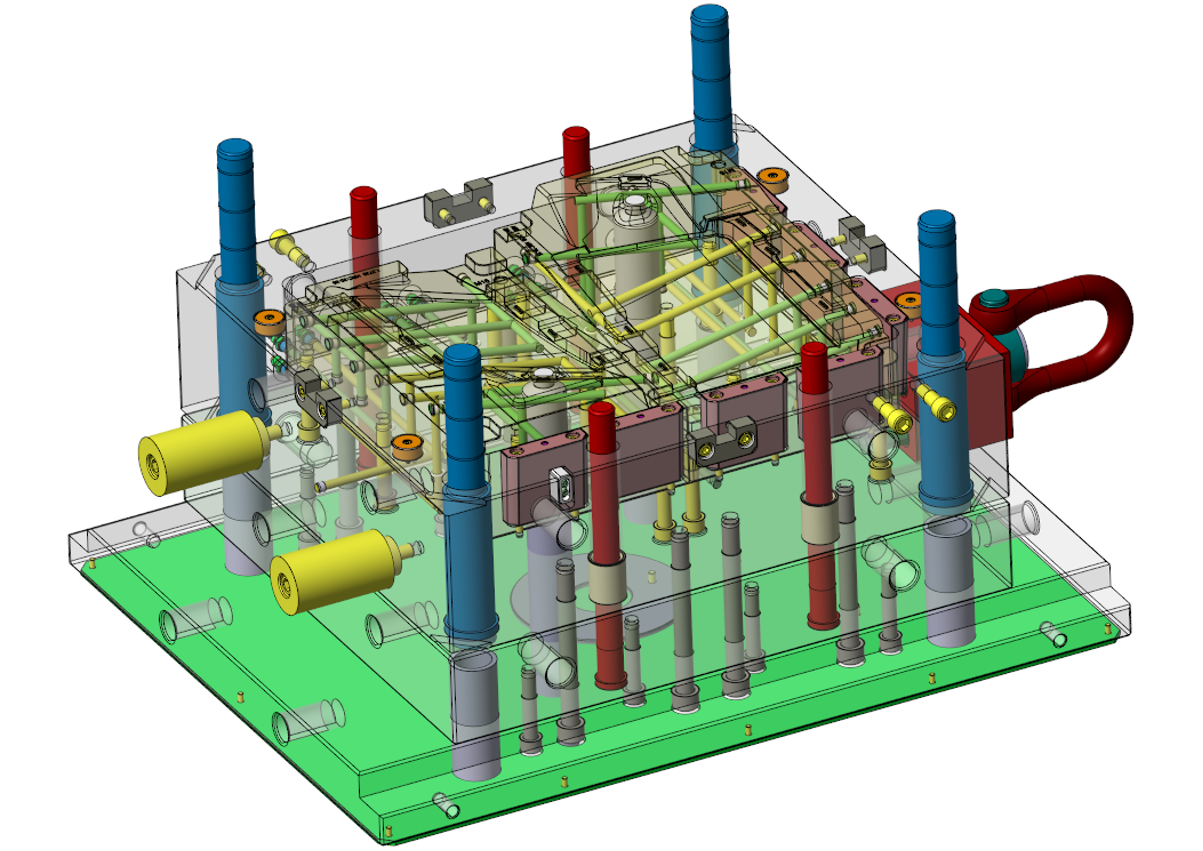
An injection mold may look simple from the outside while containing a relatively complex internal structure.
Slides, lifters, inserts, angled mechanisms, unscrewing systems, hydraulic components, hot runners, complex cooling channels, and multiple cavities can significantly increase manufacturing difficulty.
Complexity affects more than mold price. It can influence:
- Manufacturing lead time
- Machining requirements
- Assembly time
- T1 risk
- Maintenance
- Mold life
- Production cycle time
- Future repair costs
Buyers should therefore evaluate the complete mold structure instead of comparing quotations based only on cavity count or overall mold dimensions.
A technically simpler mold that meets the product requirements may sometimes provide better long-term value than a highly complicated solution.
8. Choosing Mold Steel Based Only on Initial Cost
Mold steel should be selected according to production requirements rather than simply choosing the cheapest available option.
Important factors include:
- Expected production volume
- Plastic material
- Mold geometry
- Wear resistance
- Corrosion resistance
- Surface finish requirements
- Required mold life
- Maintenance conditions
For a low-volume prototype mold, an economical steel may be appropriate.
For high-volume production involving abrasive or corrosive materials, a more suitable steel may provide significantly better long-term performance.
The correct question is not:
Which mold steel costs less?
It is:
Which mold steel provides the required tool life and performance at an acceptable total project cost?
9. Comparing Injection Mold Quotes Without Checking What Is Included
A mold quotation should never be evaluated based on the final number alone.
Different suppliers may include different items in their quotations.
For example, one quotation may include:
- Mold Flow analysis
- DFM
- T1 trial
- Dimensional inspection
- Mold modification
- Spare components
- Export packaging
while another quotation may exclude some of these services.
Buyers should request a clear quotation breakdown covering:
- Mold structure
- Mold steel
- Mold components
- Runner system
- Hot runner system if applicable
- Mold trial
- Inspection
- Packaging
- Shipping
- Modification and acceptance conditions
A transparent quotation makes it easier to compare suppliers fairly and reduces unexpected costs later.
10. Treating T1 as Final Production Approval
T1 is an important milestone, but it should not automatically be considered final production approval.
The first mold trial is intended to reveal how the actual mold performs and whether the molded parts meet the project requirements.
Potential T1 issues can include:
- Short shots
- Flash
- Warpage
- Sink marks
- Weld lines
- Dimensional variation
- Ejection problems
- Gate marks
- Cooling imbalance
- Filling imbalance
Some issues can be corrected through process optimization. Others require mold modification.
Buyers should establish clear T1 evaluation criteria before the trial instead of deciding whether the mold is acceptable based only on visual impressions.
For more information about avoiding unnecessary project delays during tooling and trials, see Fentormold’s Injection Mold Project Management guide.
11. Giving Incomplete or Late T1 Feedback
A mold supplier cannot efficiently correct problems if the buyer provides vague feedback.
Comments such as:
“The part does not look good.”
or:
“The dimensions are not correct.”
are usually not sufficient.
Useful T1 feedback should identify:
- The exact problem
- Location of the problem
- Measured dimension
- Required dimension
- Acceptance criteria
- Photos when useful
- Functional impact
- Priority of the issue
The buyer should also consolidate feedback from engineering, quality, purchasing, and the end customer before sending it to the mold supplier whenever possible.
Otherwise, the supplier may receive conflicting instructions from different people, creating another round of delays.
12. Underestimating Mold Modification Cycles
Many buyers calculate injection mold lead time as:
Mold design + machining + assembly = delivery date
In reality, a project may require:
Design → Manufacturing → T1 → Feedback → Modification → T2 → Feedback → T3 → Approval
The modification stage can become one of the largest sources of schedule risk.
A minor adjustment may take only a short time, while a major modification involving steel replacement, EDM, welding, or mechanism redesign can significantly extend the schedule.
When planning an injection mold project, buyers should therefore allow realistic time for trial, analysis, modification, and revalidation.
The fastest mold manufacturing schedule is not necessarily the fastest route to production.
13. Having No Clear Mold Acceptance Criteria
A project can become difficult when the buyer and supplier have different definitions of “finished.”
For example, the supplier may consider the mold complete because it produces a molded part, while the buyer may expect:
- All critical dimensions within tolerance
- Stable molding conditions
- Required cosmetic quality
- Approved cycle time
- Complete mold documentation
- Spare components
- Mold inspection reports
- Production-ready packaging
These expectations should be defined before the project begins.
A clear acceptance standard gives both parties an objective basis for deciding whether the mold is ready for delivery.
Buyers can also use the Injection Mold RFQ Checklist during the early project stage to make sure critical requirements are defined before ordering.
14. Failing to Validate the Mold Under Real Production Conditions
A mold may perform well during a controlled trial but encounter different conditions during mass production.
Production validation should consider factors such as:
- Actual injection molding machine
- Production material
- Production cycle
- Cooling conditions
- Injection speed
- Holding pressure
- Mold temperature
- Production operator
- Expected production volume
This is particularly important for high-volume production.
A mold should not only produce one good sample. It should demonstrate that the required part quality can be maintained consistently.
The ultimate objective of an injection mold project is not a successful T1 sample.
It is stable production.
15. Focusing on Mold Cost Instead of Total Project Cost
The most expensive injection mold project is not necessarily the one with the highest initial quotation.
A project with a low tooling price can become expensive because of:
- Repeated mold modifications
- Additional T1/T2/T3 trials
- Engineering changes
- Production delays
- Scrap
- Poor cycle time
- Excessive maintenance
- Premature mold wear
- Unplanned transportation
- Production downtime
This is why buyers should evaluate total project cost, not just mold price.
A more expensive mold may provide better value if it offers:
- Longer tool life
- Better dimensional stability
- Faster cycle time
- More reliable production
- Lower maintenance requirements
- Fewer modifications
- Better long-term support
The right purchasing decision is therefore not always:
“Which supplier has the lowest mold price?”
It is:
“Which solution gives us the lowest realistic total cost of achieving stable production?”
How to Avoid Injection Mold Project Mistakes
Most injection mold project mistakes can be prevented if the major risks are identified before they become expensive.
Before placing an order, buyers should confirm five areas.
1. Product Requirements
Make sure the part design, material, tolerances, cosmetic requirements, and production requirements are clearly defined.
2. Supplier Capability
Evaluate whether the supplier has the engineering, machining, mold assembly, trial, inspection, and project-management capabilities required for the project.
3. Mold Specification
Confirm mold steel, mold structure, components, runner system, cooling, ejection, mold life, and relevant standards.
4. Trial and Acceptance
Define T1 expectations, inspection requirements, modification procedures, and final acceptance criteria before manufacturing starts.
5. Total Project Cost and Schedule
Evaluate tooling cost together with engineering changes, trials, modifications, production requirements, delivery, and long-term maintenance.
By identifying injection mold project mistakes early, buyers can reduce unnecessary tooling costs, avoid preventable delays, and improve the likelihood of reaching stable production on schedule.
Final Thoughts
An injection mold project rarely fails because of one isolated mistake.
More often, failure develops through a chain of decisions: selecting a supplier based only on price, providing incomplete information, starting tooling too early, overlooking DFM recommendations, changing the product design after machining, failing to define acceptance criteria, or underestimating the time required for T1 modifications.
Understanding common injection mold project mistakes allows buyers to identify these risks before they become expensive problems.
A successful injection mold project should deliver more than a functioning tool. It should provide a reliable path from product design to stable, repeatable mass production.
That means evaluating the supplier, design, tooling specification, cost, trial process, quality requirements, and production conditions as one integrated project.
If you are planning a new custom tooling project, you can learn more about Fentormold’s injection mold manufacturing services or contact the Fentormold engineering team to discuss your project requirements.