
Introduction
Introduction
Many injection mold problems are not caused by poor machining, incorrect mold assembly, or insufficient testing. In many cases, the real problems start much earlier — during the product design stage.
A plastic part may look perfect in a CAD model, but once the design enters the injection mold manufacturing process, engineers may discover unexpected challenges such as difficult ejection, insufficient steel thickness, poor filling performance, excessive warpage, or expensive mold modifications.
This is why Injection Mold DFM Analysis is an essential step before mold manufacturing begins.
DFM (Design for Manufacturing) allows engineers to evaluate whether a plastic part design can be manufactured efficiently and reliably. By identifying potential risks before tooling starts, companies can avoid unnecessary design changes, reduce development costs, and improve the success rate of the first mold trial.
For companies developing new plastic products, working with an experienced injection mold manufacturer that understands both product design requirements and real tooling limitations can significantly reduce project risks.
A professional DFM review does not simply check whether a part can be molded. It considers how the product will be machined, assembled, tested, maintained, and produced in high volume.
What Is Injection Mold DFM Analysis?
Injection Mold DFM Analysis is the process of reviewing a plastic part design before mold construction to identify possible manufacturing risks and improve the overall mold design.
During a DFM analysis, engineers evaluate the relationship between the product design and the injection molding process, including:
• Draft angles
• Wall thickness
• Ribs and bosses
• Undercuts
• Gate location
• Cooling requirements
• Ejection system design
• Mold steel conditions
• Product tolerances
• Surface finish requirements
The goal is not simply to check whether a part can be molded. The goal is to identify possible problems that may affect:
- Mold cost
- Tooling complexity
- Manufacturing lead time
- Injection molding quality
- Long-term production stability
A good DFM analysis connects product design decisions with real mold manufacturing limitations.
Why DFM Analysis Should Be Completed Before Mold Manufacturing
Once a mold enters the machining stage, design changes become increasingly expensive.
For example:
A product designer may increase a rib thickness to improve strength. However, during mold design review, engineers may find that the thicker rib creates sink marks on the cosmetic surface.
At this stage, the problem can still be solved by modifying the CAD model.
But if the mold has already been manufactured, fixing the issue may require:
- Welding and re-machining steel
- Changing mold components
- Re-polishing surfaces
- Additional mold trials
- Delayed production schedules
A detailed DFM review helps prevent these unnecessary costs.
1. Review Draft Angles Before Tool Design
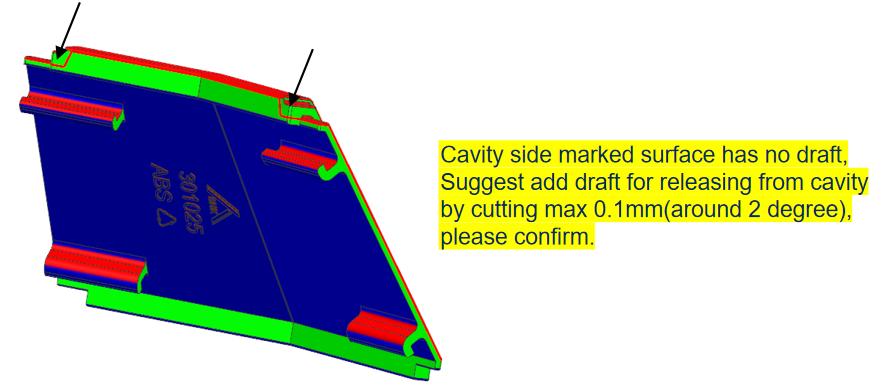
Draft angle is one of the most basic requirements in injection molded part design, but it is also one of the most common causes of tooling problems.
Without sufficient draft, the plastic part may stick to the mold cavity or core during ejection.
Potential problems include:
- High ejection force
- Surface scratches
- Part deformation
- Longer cycle time
- Damage to cosmetic surfaces
The required draft angle depends on several factors:
- Material type
- Texture depth
- Part depth
- Surface finish requirements
- Mold steel condition
For example, a polished surface may require less draft than a textured surface. A deep textured area usually requires additional draft because the plastic contracts around the texture during cooling.
During an Injection Mold DFM Analysis, engineers should review all vertical surfaces and confirm whether the draft angle is suitable for production.
2. Analyze Wall Thickness and Thickness Transitions
Uneven wall thickness is one of the biggest causes of injection molding defects.
When thick and thin sections exist in the same part, cooling rates become inconsistent. This can create problems such as:
- Sink marks
- Internal stress
- Warpage
- Poor dimensional stability
A common example is a plastic housing with thick mounting bosses connected directly to thin exterior walls.
The boss may require strength, but the thick section creates a cooling difference that affects the cosmetic surface.
Better solutions may include:
- Reducing boss thickness
- Adding ribs for reinforcement
- Creating smoother thickness transitions
A professional DFM review does not simply identify problems. It provides practical design recommendations that balance strength, appearance, and manufacturability.
3. Identify Undercuts and Complex Mold Mechanisms
Undercuts are features that prevent a part from being removed directly from the mold opening direction.
Common examples include:
- Side holes
- Internal hooks
- Snap features
- Hidden clips
These features may require additional mold components such as:
- Sliders
- Lifters
- Collapsible cores
Although these mechanisms are widely used in injection mold manufacturing, unnecessary complexity increases:
- Mold cost
- Manufacturing difficulty
- Maintenance requirements
- Risk of failure
During DFM analysis, engineers often evaluate whether a product modification can eliminate complicated tooling.
Sometimes a small design change can remove a slider completely and significantly reduce mold cost.
4. Evaluate Rib and Boss Design
Ribs and bosses are commonly used in plastic parts to improve strength and provide assembly features.
However, improper rib and boss design can create tooling and molding problems.
Common issues include:
- Sink marks
- Difficult filling
- Weak steel areas
- Difficult machining
For example, a very deep rib requires deeper cavity machining and may create thin steel sections inside the mold.
A proper DFM review considers:
- Rib thickness
- Rib height
- Rib location
- Distance from cosmetic surfaces
- Draft requirements
The goal is to maintain structural performance while keeping the mold practical to manufacture.
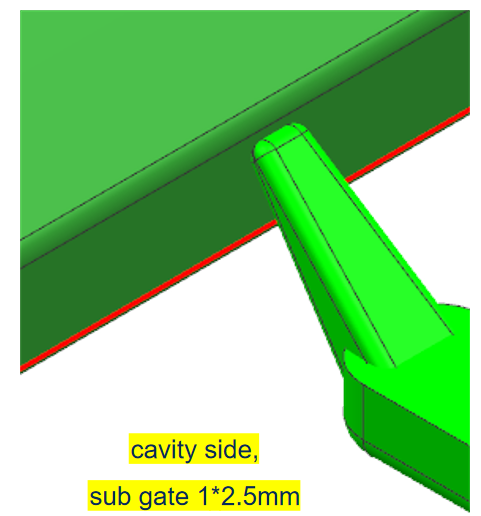
5. Review Gate Location and Filling Risks
Gate location has a direct impact on injection molding quality.
A poor gate position can cause:
- Weld lines in visible areas
- Air traps
- Short shots
- Uneven filling
- Excessive injection pressure
During Injection Mold DFM Analysis, engineers review:
- Material flow direction
- Part appearance requirements
- Structural areas
- Filling balance
For complex parts, Mold Flow simulation may also be used to predict filling behavior before mold construction.
A well-planned gate design improves both part quality and production stability.
Proper gate design is also closely related to final part quality and helps reduce common injection molding defects during production.
6. Check Ejection System Requirements
The ejection system must remove the molded part without causing damage.
A DFM review should evaluate:
- Ejector pin locations
- Ejection force distribution
- Part stiffness
- Potential deformation areas
Poor ejection design can create:
- Ejector marks
- Stress whitening
- Part deformation
- Difficult automatic production
Ejector locations should be considered together with product appearance requirements.
For cosmetic parts, engineers may need to adjust ejector positions or use alternative methods such as ejector sleeves or stripper plates.
7. Analyze Parting Line and Mold Opening Direction
The parting line affects:
- Mold structure
- Flash risk
- Cosmetic appearance
- Manufacturing difficulty
A poorly selected parting line can create unnecessary tooling challenges.
During DFM analysis, engineers review:
- Mold opening direction
- Product appearance surfaces
- Flash locations
- Slider requirements
A good parting line design simplifies mold construction and improves production reliability.
8. Review Cooling and Warpage Risks
Cooling performance directly affects injection molding cycle time and part quality.
Uneven cooling can result in:
- Warpage
- Dimensional variation
- Longer cycle times
- Production instability
During DFM review, engineers consider:
- Thick sections
- Heat accumulation areas
- Cooling channel accessibility
- Mold temperature control
A well-designed cooling system helps maintain consistent part dimensions during mass production.
9. Evaluate Mold Steel Conditions and Machining Feasibility
Product geometry directly affects mold manufacturing difficulty.
Certain designs create challenges such as:
- Thin steel areas
- Deep narrow cavities
- Difficult EDM machining
- Limited polishing access
For example, a deep narrow feature may look simple in the product model but may require complicated electrode design and additional machining time.
A DFM review helps identify these risks before mold construction begins.
10. Check Critical Dimensions and Tolerances
Not every dimension requires extremely tight tolerance.
Overly strict tolerances can increase:
- Mold machining cost
- Manufacturing difficulty
- Inspection requirements
Engineers should identify which dimensions are truly functional and which can use standard injection molding tolerances.
Proper tolerance planning helps balance quality requirements and tooling cost.
11. Review Venting Requirements
During injection molding, trapped air must escape from the cavity.
Poor venting can cause:
- Burn marks
- Short shots
- Filling problems
- Surface defects
DFM analysis should identify areas where air may become trapped, such as:
- Deep ribs
- Blind holes
- End-of-fill locations
Proper venting design improves mold performance and reduces trial-and-error during mold testing.
12. Consider Future Mold Maintenance and Modifications
A good mold design should not only produce the first parts successfully. It should also support long-term production.
Engineers should consider:
- Replaceable inserts
- Wear components
- Maintenance access
- Future product changes
This is especially important for products expected to run for many years.
A well-designed mold reduces downtime and makes future modifications easier.
How Professional DFM Analysis Reduces Tooling Problems
A professional Injection Mold DFM Analysis provides benefits beyond identifying design issues.
It helps companies:
- Reduce mold modification costs
- Shorten tooling lead time
- Improve first trial success rate
- Reduce injection molding defects
- Improve production consistency
Many expensive mold problems can be avoided when engineers review product designs before manufacturing begins.
This is why experienced mold suppliers usually complete a detailed DFM review before starting mold design.
What Should Be Included in an Injection Mold DFM Report?
A useful DFM report should include:
- Product design review
- Potential molding risks
- Recommended design changes
- Draft angle analysis
- Wall thickness evaluation
- Gate location suggestions
- Ejection recommendations
- Mold structure considerations
- Manufacturing concerns
A good DFM report should not only say “this design has a problem.”
It should explain:
- Why the problem exists
- What risk it creates
- How to improve the design
Conclusion
Injection Mold DFM Analysis is one of the most effective ways to prevent tooling problems before mold manufacturing begins.
Many injection mold failures, unexpected costs, and production delays start with design decisions that were not reviewed from a manufacturing perspective.
By evaluating draft angles, wall thickness, undercuts, cooling, ejection, tolerances, and mold structure early, engineers can create more reliable products and reduce unnecessary mold modifications.
A successful injection molding project is not only about building a mold. It starts with making sure the product design is ready for manufacturing.
Working with an experienced injection mold manufacturer that provides professional DFM support helps companies achieve better quality, shoWorking with an experienced injection mold manufacturer that provides professional DFM support helps companies achieve better quality, shorter development cycles, and more stable mass production. For early design verification, prototype injection molding can also help companies evaluate product performance before committing to full-scale tooling.rter development cycles, and more stable mass production.