A good ejection system is more than adding enough ejector pins.
The ejection position and ejection method must match the part design. Poor ejection design can cause ejector marks, deformation, sticking, or even part damage.Find a better solution at Fentormold.
1. Ejection Position Matters More Than Pin Quantity
The first step is to identify areas with high demolding resistance or a high risk of deformation.
Typical areas include:
- Deep cavities and deep ribs
- Bosses and deep holes
- Large thin-wall sections
- Areas that tightly grip the core
- Sections that may warp during ejection
These areas need enough ejection support.
However, not every area is suitable for an ejector pin.
Avoid placing concentrated ejection force on critical cosmetic surfaces, very thin walls, or weak edges whenever possible. Otherwise, the part may show visible ejector marks or local deformation.
Good ejection design is not about placing pins wherever there is space. It is about placing them where the part needs support.
2. Choose the Ejection Method for the Part Structure
Different structures require different ejection methods.
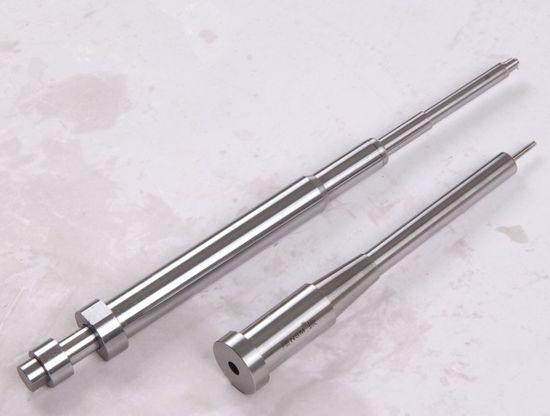
Round Ejector Pins
Round ejector pins are the most common option.
They work well for:
- General flat areas
- Thick sections
- Standard ribs
- Non-cosmetic surfaces
They are simple and flexible to use.
However, a small pin on a thin wall can create high local pressure and leave a noticeable ejector mark.
Flat Ejector Pins
Flat ejector pins are useful for long ribs, thin walls, and narrow areas.
They provide a larger contact area than a small round pin. This helps spread the ejection force along the rib or wall.
For long and deep ribs, a flat ejector pin can be a better choice than a small round pin.
Ejector Blocks
Ejector blocks provide a larger ejection area.
They are useful for:
- Large parts
- Thick sections
- Deep cavities
- Areas that are easy to deform
Their main advantage is better force distribution.
Sleeve and Tubular Ejection
For bosses, cylindrical features, and ring-shaped structures, ejector sleeves or tubular ejectors can be more effective than standard round pins.
They eject around the core and distribute the force more evenly.
This is especially useful for deep bosses.
Angle Pins / Lifters
Lifters are not simply another type of ejector pin.
They are mainly used for internal undercuts, clips, and side features.
During ejection, the lifter moves at an angle to release the undercut.
The lifter position and movement must match the part geometry. Poor design can damage clips, deform the part, or prevent proper ejection.
Ejector Plates
For some deep cavities, large thin-wall parts, or parts that need to be pushed out over a large area, an ejector plate can provide more uniform ejection.
It can also help reduce concentrated ejector marks.
However, it usually makes the mold structure more complex.
3. How Should You Choose Ejection Positions?
A simple approach is:
Find the sticking areas first. Then find the weak areas. Finally, avoid critical cosmetic surfaces.
For example:
- Deep rib tends to stick → Add ejection support near the rib
- Deep boss grips the core → Consider an ejector sleeve or suitable pin layout
- Thin wall may deform → Increase the contact area instead of simply adding small pins
- Large flat area may warp → Use multiple, evenly distributed ejectors
- Cosmetic surface cannot have marks → Move ejection to the inside or a non-cosmetic area
- Internal undercut → Use a lifter or another suitable side-action ejection method
The basic rule is simple:
The ejection method should follow the part geometry.
4. More Ejector Pins Do Not Always Mean Better Ejection
Adding more pins does not automatically solve ejection problems.
If the positions are wrong, ten ejector pins may perform worse than a few well-positioned ejectors.
A good ejection system should consider:
- Ejection force distribution
- Local part strength
- Demolding resistance
- Ejection contact area
- Ejector mark requirements
- Available mold space
Ejector rigidity is also important, especially under high injection pressure and holding pressure.
If an ejector pin deflects during molding, it can also contribute to ejector marks. For more details, see our article on Ejector Marks Caused by Injection Pressure.
5. What Makes a Good Ejection System?
A good ejection system should allow the part to:
- Release evenly
- Avoid significant deformation
- Minimize ejector marks
- Protect thin walls and ribs
- Protect critical cosmetic surfaces
- Run reliably in mass production
The basic principle is simple:
Where you eject controls the load. How you eject controls the result.
For this reason, mold designers should select round ejector pins, flat ejectors, ejector blocks, sleeves, tubular ejectors, lifters, or ejector plates according to the part geometry and demolding requirements.
The goal is not to use more ejectors.
The goal is to use the right ejectors in the right locations.
At Fentormold, mold design starts with the part structure, demolding requirements, and production needs. From DFM and mold design to injection mold manufacturing and production, our team can evaluate ejection risks early and help reduce ejector marks, deformation, and costly mold modifications.