
Introduction
Many buyers assume that once an injection mold is completed, the project is ready to move directly into mass production. However, completing the tooling is only one stage of the entire product development process.
Before a mold can be released for production, it must go through a proper validation process to confirm that it can produce stable, consistent, and acceptable plastic parts.
The Injection Mold Trial Process is the stage where engineers verify mold performance, evaluate molded samples, identify potential problems, and optimize production conditions before mass manufacturing begins.
For buyers, understanding how T0, T1, and T2 mold trials work can help avoid unexpected delays, additional tooling costs, and quality problems during production.
A reliable injection mold manufacturer should not only build the tooling but also support the complete trial and validation process, helping customers move smoothly from the first sample to stable production.
A successful mold trial is not about producing one perfect sample. It is about proving that the mold can repeatedly produce qualified parts under normal manufacturing conditions.
Why Injection Mold Trial Is Critical Before Mass Production
The purpose of a mold trial is to reduce production risks before large quantities of parts are manufactured.
Even when a mold is designed correctly, unexpected issues may appear during the first molding test.
Common problems include:
- Short shots
- Flash
- Sink marks
- Warpage
- Weld lines
- Dimensional variation
- Difficult ejection
- Unstable cycle time
Finding these problems during the trial stage is much less expensive than discovering them after mass production starts.
For example, if a cosmetic plastic housing develops visible sink marks after production begins, correcting the problem may require stopping production, modifying the mold, and delaying delivery schedules.
However, during a mold trial, engineers can still adjust:
- Mold design details
- Processing parameters
- Gate locations
- Cooling conditions
- Ejection solutions
This is why experienced suppliers perform detailed reviews before and during tooling development. A proper Injection Mold DFM Analysis can identify many potential risks before the mold enters manufacturing.
What Is the Injection Mold Trial Process?
The injection mold trial process is a series of tests used to verify whether a newly manufactured mold meets production requirements.
The typical workflow includes:
Mold Manufacturing Complete
↓
T0 Trial
↓
T1 Sample Evaluation
↓
Problem Analysis & Mold Modification
↓
T2 Validation
↓
Customer Approval
↓
Mass Production
Each stage has a different purpose.
A common misunderstanding among buyers is expecting the first trial sample to be identical to the final production part.
In reality:
- T0 confirms basic mold operation
- T1 identifies molding problems and improvement areas
- T2 verifies corrections and production readiness
The number of mold trials required depends on:
- Part complexity
- Mold structure
- Material requirements
- Appearance requirements
- Dimensional tolerance
- Production expectations
Simple molds may require fewer trials, while complex molds may need additional optimization before approval.
T0 Mold Trial: Initial Tool Function Check
The T0 mold trial is the first test after the mold has been completed and assembled.
At this stage, the main goal is not achieving perfect production parts.
Instead, engineers focus on confirming that the mold itself works correctly.
The main checks include:
Mold Opening and Closing Performance
Engineers verify:
- Mold alignment
- Guide pin movement
- Parting line contact
- Clamping condition
A mold must operate smoothly before engineers can evaluate product quality.
Any abnormal movement may indicate:
- Assembly problems
- Machining errors
- Component interference
Ejection System Verification
The ejection system is critical because every molded part must be released smoothly after cooling.
During T0, engineers check:
- Ejector pin movement
- Ejector plate operation
- Product release condition
- Possible sticking issues
Poor ejection performance can lead to:
- Ejector marks
- Part deformation
- Production interruptions
For example, incorrect ejector placement may create visible marks on cosmetic surfaces or increase the risk of part damage.
Slider and Lifter Testing
Complex injection molds often include sliders or lifters to release undercut features.
During T0, engineers verify:
- Slider movement
- Lifter timing
- Mechanical clearance
- Wear plate condition
These components must operate reliably because failures during production can cause significant downtime.
Cooling System Inspection
Cooling performance directly affects:
- Cycle time
- Part quality
- Dimensional stability
Engineers check:
- Water channel connections
- Leakage
- Cooling balance
- Temperature control
An inefficient cooling system can create problems later, including warpage and inconsistent dimensions.
T1 Mold Trial: First Sample Evaluation and Problem Identification
The T1 mold trial is usually the first stage where buyers and engineers evaluate actual molded parts.
Unlike T0, which focuses mainly on mold operation, T1 focuses on whether the molded parts meet product expectations.
During T1, engineers review:
- Part appearance
- Dimensional accuracy
- Filling performance
- Material behavior
- Defect risks
- Required mold modifications
It is important for buyers to understand that T1 samples are not always final production parts.
The purpose of T1 is to collect manufacturing data, identify problems, and determine what improvements are required before mass production.
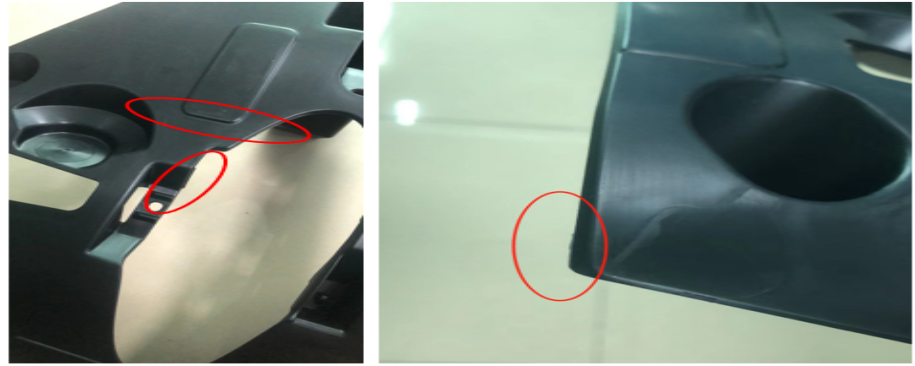
What Buyers Should Check During T1 Mold Trial
For buyers, the T1 trial is one of the most important checkpoints in the entire injection mold trial process.
A successful T1 evaluation should not only focus on whether the sample looks acceptable. It should also confirm whether the mold has the potential to achieve stable production.
1. Part Appearance and Cosmetic Quality
For cosmetic plastic parts, appearance requirements are often critical.
During T1, engineers usually check:
- Surface defects
- Flow marks
- Weld lines
- Burn marks
- Sink marks
- Gloss consistency
- Texture quality
A part may function correctly but still fail customer approval because of visible cosmetic issues.
For example, a consumer electronic housing may require a high-quality surface finish. Small defects that are acceptable for internal components may not be acceptable for visible parts.
Understanding common injection molding defects helps buyers better evaluate trial samples and communicate quality expectations with suppliers.
2. Dimensional Accuracy
Dimension inspection is another critical part of T1 validation.
Engineers compare molded samples against the original drawings, including:
- Critical dimensions
- Assembly areas
- Tolerance requirements
- Product fit
Some dimensional variation during T1 is normal because molding parameters may still require optimization.
Typical adjustments include:
- Injection pressure adjustment
- Holding pressure optimization
- Cooling time adjustment
- Mold modification
- Shrinkage compensation
A professional supplier should provide measurement data and explain the reason behind any dimensional differences.
3. Filling Performance
The filling process directly affects molded part quality.
During T1, engineers evaluate:
- Whether the cavity fills completely
- Filling balance
- Weld line position
- Air trap risks
- Injection pressure requirements
Problems such as short shots or incomplete filling may indicate issues with:
- Gate location
- Runner design
- Venting
- Processing parameters
- Material flow behavior
In many cases, these risks can be reduced during the design stage through proper engineering review.
Common Problems Found During Injection Mold Trials
Even with careful mold design and manufacturing, problems may appear during trial production.
The difference between an experienced supplier and an inexperienced supplier is not whether problems happen, but how effectively they can identify root causes and solve them.
Flash Problems During Mold Trial
Flash is one of the most common issues found during injection mold trials.
It occurs when molten plastic escapes from the parting line, ejector area, or other gaps in the mold.
Common causes include:
- Excessive injection pressure
- Incorrect mold alignment
- Damaged parting surfaces
- Insufficient clamping force
- Mold manufacturing accuracy issues
A good supplier should investigate the actual cause instead of simply reducing injection pressure, because incorrect adjustments may create other quality problems.
For more detailed information, buyers can review this guide about how to eliminate injection mold flash.
Short Shot Problems
A short shot happens when molten plastic does not completely fill the mold cavity.
Typical causes include:
- Poor gate design
- Insufficient injection pressure
- Incorrect material temperature
- Poor venting
- Restricted material flow
Solutions may include:
- Adjusting injection parameters
- Improving venting design
- Modifying runners
- Changing gate locations
Buyers can learn more about this issue through our article about injection molding short shot defects.
Sink Marks During Injection Mold Trial
Sink marks usually appear in thicker areas such as:
- Ribs
- Bosses
- Reinforced sections
They occur because thicker areas cool slower and shrink more than surrounding sections.
Possible solutions include:
- Improving wall thickness design
- Adjusting cooling conditions
- Optimizing holding pressure
- Modifying rib and boss structures
A good mold trial process identifies these problems before production approval.
Warpage and Dimensional Instability
Warpage is another common concern during injection mold validation.
It can affect:
- Product assembly
- Appearance
- Functional performance
Common causes include:
- Uneven cooling
- Material shrinkage differences
- Unbalanced filling
- Incorrect processing conditions
A stable production process requires both proper mold design and optimized molding parameters.
Buyers can learn more about controlling this issue through how to prevent injection molding warpage after cooling.
T2 Mold Trial: Final Optimization Before Production Approval
The T2 mold trial focuses on confirming improvements made after T1.
By this stage, engineers should already understand the main issues found during the first trial.
The purpose of T2 is to verify:
- Mold modifications
- Part quality improvements
- Dimensional stability
- Production repeatability
A successful T2 trial means the mold is approaching production readiness.
What Happens During T2?
During T2, engineers repeat important validation steps:
Mold Function Verification
Checking:
- Mold opening and closing
- Ejection performance
- Slider and lifter movement
Part Quality Inspection
Reviewing:
- Appearance
- Dimensions
- Assembly performance
- Functional requirements
Process Stability Confirmation
Evaluating:
- Cycle time
- Injection parameters
- Repeatability between shots
The goal is not only producing one acceptable sample.
The goal is proving that the mold can consistently produce qualified parts during mass production.
From T0 Trial to Mass Production: Complete Workflow
The injection mold trial process is not completed when a good sample is produced.
The final objective is to confirm that the mold can support stable and repeatable mass production.
The complete workflow usually includes the following stages:
Step 1: Mold Manufacturing Completion
After mold machining, assembly, polishing, and testing are completed, the tooling enters the trial stage.
Before the first trial, engineers normally check:
- Mold assembly accuracy
- Core and cavity condition
- Cooling system
- Ejection system
- Moving components
A well-controlled manufacturing process helps reduce unnecessary trial adjustments.
Learn more about the complete tooling workflow in our guide:
injection mold manufacturing process.
Step 2: T0 Trial and Basic Function Verification
The T0 trial confirms whether the mold operates correctly.
Main objectives:
- Check mold movement
- Confirm ejection performance
- Verify cooling system
- Identify obvious tooling issues
At this stage, the focus is mainly on the mold itself rather than final part approval.
Step 3: T1 Trial and Sample Evaluation
During T1, the supplier produces the first meaningful samples for evaluation.
The main purpose is to identify:
- Product defects
- Dimensional problems
- Process limitations
- Required modifications
The buyer should review trial samples together with the supplier and clearly define required improvements.
Step 4: Mold Modification and Optimization
After T1, the supplier analyzes problems and performs necessary modifications.
Typical modifications include:
- Polishing adjustments
- Gate changes
- Venting improvements
- Cooling improvements
- Dimensional corrections
The quality of this stage often determines whether the project can move smoothly into production.
Step 5: T2 Validation and Production Approval
During T2, the supplier confirms that previous problems have been resolved.
The buyer should verify:
- Final sample quality
- Required dimensions
- Production consistency
- Manufacturing capability
Once approved, the mold can move into regular production.
How Many Injection Mold Trials Are Usually Required?
There is no fixed number of trials required for every project.
The number depends on:
- Part complexity
- Mold structure
- Material selection
- Appearance requirements
- Dimensional tolerance
- Production volume
Typical situations:
Simple Plastic Parts
A simple mold may reach production approval after T1 or T2.
Complex Engineering Parts
Complex products may require additional trials because of:
- Multiple sliders
- Tight tolerances
- Difficult materials
- High cosmetic requirements
A supplier who promises that every mold will be perfect after the first trial may not be realistic.
Injection molding is a manufacturing process involving many variables, and proper validation is necessary to achieve stable results.
How Buyers Should Review a Mold Trial Report
A professional mold supplier should provide a clear trial report after testing.
A complete mold trial report normally includes:
Trial Information
Including:
- Trial date
- Mold number
- Injection machine information
- Material used
- Processing parameters
Sample Photos
Photos should show:
- Overall appearance
- Defect locations
- Modified areas
- Comparison before and after improvement
Dimensional Inspection Results
The report should include:
- Critical dimensions
- Measurement data
- Tolerance comparison
- Engineering comments
Problem Analysis and Solutions
A good trial report should explain:
- What problem was found
- Why it happened
- What correction was made
- Expected improvement
This allows buyers to understand the project status instead of simply receiving samples without technical explanation.
How to Choose the Right Injection Mold Supplier for Successful Trial Validation
The injection mold trial process is also an important way to evaluate a supplier’s technical capability.
Before selecting a supplier, buyers should consider several factors.
Does the Supplier Perform Engineering Reviews Before Tooling?
A professional supplier should identify potential risks before manufacturing begins.
Important areas include:
- Product structure
- Mold design
- Material selection
- Manufacturing feasibility
Early engineering communication can reduce expensive modifications later.
Does the Supplier Have Experience Solving Trial Problems?
Problems during mold trials are common.
The key question is whether the supplier can solve them efficiently.
A capable supplier should be able to analyze:
- Why a defect occurred
- Whether the issue is design-related or process-related
- What modification is required
- How the solution affects production
Does the Supplier Understand Mass Production Requirements?
A mold that produces one good sample is not necessarily a successful production mold.
The supplier should consider:
- Cycle time
- Long-term stability
- Maintenance requirements
- Production volume
For companies moving from prototype development to full production, prototype injection molding can help validate product designs before investing in final production tooling.
Injection Mold Trial Checklist for Buyers
Before approving a mold for production, buyers should confirm:
Mold Performance
✓ Mold opens and closes smoothly
✓ Ejection works correctly
✓ Sliders and lifters operate properly
✓ Cooling system is stable
Part Quality
✓ Appearance meets requirements
✓ Dimensions are within tolerance
✓ Assembly performance is acceptable
✓ Defects are controlled
Production Readiness
✓ Cycle time is acceptable
✓ Process parameters are stable
✓ Trial report is complete
✓ Modification records are available
Final Thoughts
The Injection Mold Trial Process is one of the most important stages between tooling development and mass production.
T0, T1, and T2 trials each serve a different purpose:
- T0 Trial: Confirm basic mold operation and identify initial tooling issues
- T1 Trial: Evaluate first samples and determine required improvements
- T2 Trial: Verify corrections and prepare the mold for production approval
For buyers, a successful mold trial is not simply about receiving samples. It is about confirming that the mold can deliver consistent quality, stable production, and predictable manufacturing performance.
Working with an experienced supplier that understands mold design, trial validation, and production requirements can significantly reduce project risks.
Fentor Mold supports customers from mold design evaluation and tooling development through mold trials and injection molding production, helping companies move from product concept to reliable mass manufacturing.