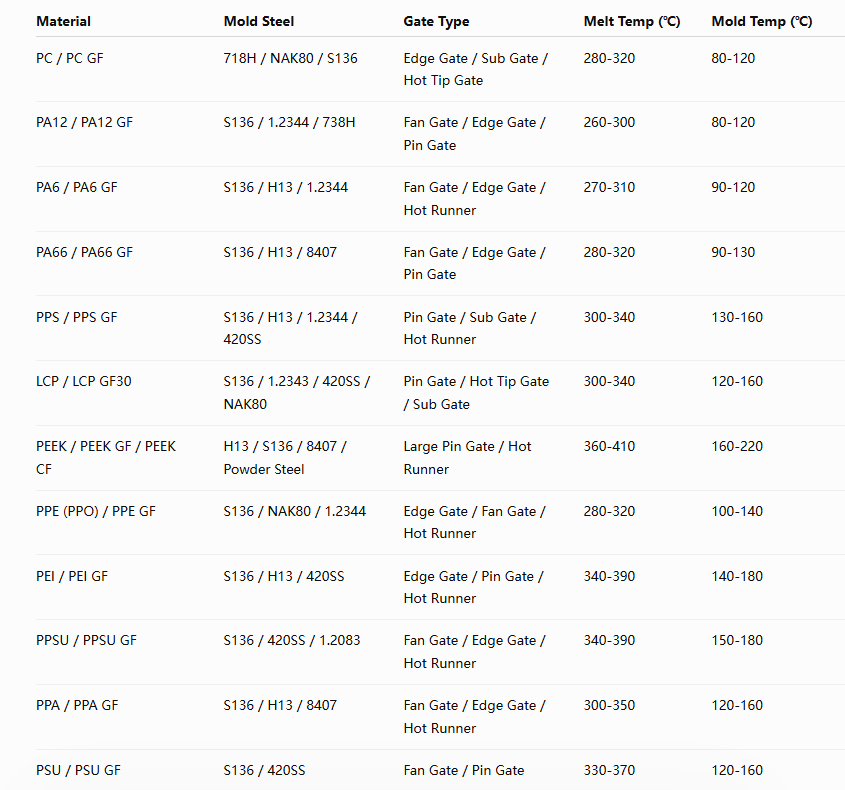
Introduction
High-temperature plastics are increasingly used for demanding applications where conventional materials cannot meet thermal, mechanical, or chemical requirements. However, injection molding these materials often fails during T1 trials because the mold cannot maintain a stable thermal balance during filling, packing, and cooling. Uneven mold temperature, insufficient heat transfer, and incorrect tooling material selection can create short shots, warpage, dimensional variation, and unstable cycle times. For engineering teams, the challenge is not only processing a high-temperature resin but controlling the complete heat-transfer system between the plastic melt, mold steel, cooling channels, and production environment.
Why Poor Mold Heat Balance Creates Injection Molding Failure With High-Temperature Plastics
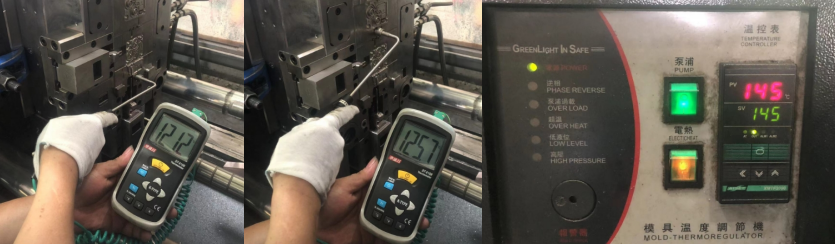
High-temperature plastics are widely used for parts that need strong heat resistance and high strength. However, these materials can create problems during injection molding trials.
Many T1 failures happen because the mold cannot control temperature well during filling, packing, and cooling. Uneven heat control can cause short shots, warpage, and unstable part dimensions.
The main reason is that high-temperature materials maintain higher melt temperatures and often require elevated mold temperatures to achieve proper flow and crystallization behavior. The mold is no longer only a forming tool; it becomes a thermal control system.
For example, when molding reinforced engineering plastics for automotive or electronic components, the cavity surface temperature directly affects filling behavior. A cold area inside the cavity can increase viscosity locally, causing hesitation marks or incomplete filling. Meanwhile, a hotter region may cool slower and create different shrinkage rates across the same part.
This problem becomes more serious in complex molds with thick sections, deep ribs, inserts, or uneven wall thickness. Without proper thermal design, the first T1 sample may appear acceptable in some areas but fail dimensional inspection after cooling stabilization.
For projects requiring stable production after tooling approval, engineers usually need to evaluate not only the part geometry but also the complete injection mold manufacturing process, including cooling layout, steel selection, and machining accuracy.
How Mold Temperature Variation Changes Plastic Flow Behavior
Mold temperature directly controls how long the molten plastic remains capable of flowing before solidification.
When the cavity surface is colder than expected, the polymer skin layer forms too quickly. This reduces the effective flow channel and increases injection pressure requirements. The result is often short shots, weld line weakness, and incomplete filling around thin ribs or complex features.
On the other hand, excessive mold temperature slows down solidification. Although this may improve surface appearance, it increases cooling time and can reduce production efficiency. More importantly, uneven cooling creates internal stress because different areas of the part contract at different speeds.
The engineering impact is clear: temperature variation changes the relationship between filling pressure, cooling time, and final part dimensions.
During mold trials, engineers should analyze temperature distribution together with filling simulation results instead of adjusting machine parameters randomly. A stable process depends on controlling the thermal behavior of the entire mold.
Why Cooling Channel Design Determines Production Stability
Cooling efficiency is often the limiting factor when molding high-temperature materials.
Traditional cooling layouts may work well for standard materials but fail when processing resins with higher processing temperatures. The reason is simple: the mold must remove significantly more thermal energy while maintaining a controlled cavity temperature.
Poor cooling design creates hot spots inside the mold. These areas cool slower than surrounding regions, causing uneven shrinkage and part deformation. In production, this can appear as inconsistent dimensions between early shots and later shots after the mold temperature reaches equilibrium.
A well-designed cooling system should maintain uniform heat removal across the cavity instead of simply reducing overall mold temperature.
For complex molds, engineers may need to combine conventional cooling channels with specialized heat-transfer solutions to reach difficult areas. This approach is especially important for molds containing deep cores, thin inserts, or complex moving components.
A precise cooling strategy also reduces the risk of repeated mold modification after T1, which is one reason experienced suppliers focus heavily on mold design optimization and DFM analysis before manufacturing begins.
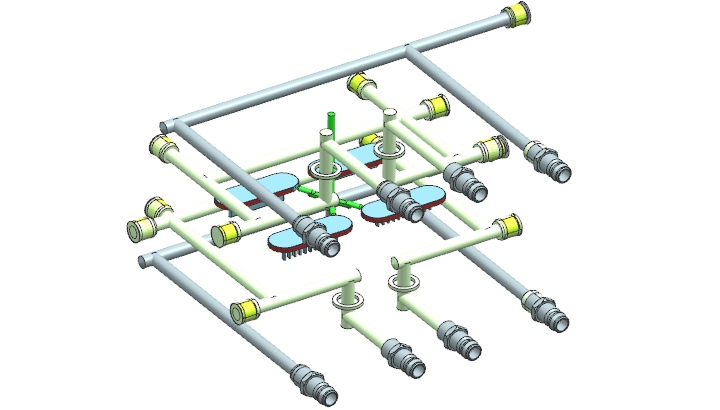
How Material Selection and Mold Construction Affect High-Temperature Plastic Injection Performance
The mold itself must survive repeated exposure to high temperatures, mechanical pressure, and abrasive fillers.
High-temperature plastics are often reinforced with glass fiber, carbon fiber, or mineral additives to improve mechanical performance. However, these fillers increase wear on mold components, especially gates, inserts, and sliding areas.
Selecting unsuitable mold steel may reduce tooling life and create unexpected maintenance problems during production. The correct material choice requires balancing hardness, toughness, corrosion resistance, thermal conductivity, and machining requirements.
For example, a mold insert designed for a reinforced high-temperature material may require higher wear resistance than a standard production mold. The wrong steel grade can lead to early polishing damage, dimensional drift, or surface defects after thousands of cycles.
This is why engineers evaluating tooling should consider not only initial mold cost but also expected production volume and maintenance requirements. A lower-cost mold may become more expensive if frequent repairs interrupt production.
For applications requiring precision inserts and long-term stability, understanding the best steel options for injection mold components helps prevent premature tooling failure.
How Tool Steel Thermal Properties Influence Part Quality
Different mold materials transfer heat at different rates, which directly affects cooling performance.
A mold material with poor thermal conductivity may require additional cooling design because heat remains trapped inside the cavity area. This creates longer cycle times and increases the possibility of dimensional variation.
However, thermal conductivity is not the only factor. A mold material must also maintain mechanical strength under repeated injection pressure and elevated temperatures.
The engineering challenge is finding the correct balance between heat transfer performance and durability.
For high-temperature plastic applications, mold inserts often need localized solutions because different sections of the same tool experience different thermal conditions. Core areas, thin walls, and deep ribs may require different cooling strategies compared with open cavity surfaces.
Real Engineering Scenario: T1 Failure Caused by Thermal Imbalance
A typical T1 failure occurred during development of a glass-filled engineering plastic housing used for an industrial electronic application.
The first mold trial produced a complete part, but dimensional inspection showed excessive warpage around the mounting area. The team initially attempted to adjust injection pressure and holding time, but the variation remained.
Further analysis showed that one side of the cavity had significantly higher temperature because the cooling channel distance was inconsistent. During filling, the hotter area maintained better flow, but during cooling it contracted later than the opposite side.
The solution was not increasing machine pressure. Instead, the mold cooling layout was redesigned, and the temperature balance between cavity sections was improved. After modification, the part achieved stable dimensions during repeated production cycles.
This case demonstrates that high-temperature plastic molding problems are often caused by thermal design issues rather than simple machine parameter errors.
Why Process Control After T1 Approval Determines Long-Term Production Quality
Passing T1 does not always mean the mold is ready for mass production. High-temperature plastics require consistent control of temperature, pressure, material preparation, and cooling conditions throughout the production cycle.
Small variations in resin drying, barrel temperature, mold temperature, or cooling time can create noticeable dimensional changes.
Production stability depends on maintaining repeatable conditions from shot to shot. Engineers should establish process windows based on actual mold performance instead of relying only on recommended material settings.
Advanced projects often combine mold trial data, dimensional inspection reports, and simulation results to create a reliable production standard.
For suppliers managing both tooling and manufacturing, controlling the transition from prototype validation to mass production is critical. Proper injection molding production management ensures that approved parts remain consistent after thousands or millions of cycles.
How Cooling Control Reduces Long-Term Manufacturing Risk
Cooling control directly affects cycle repeatability and part consistency.
If the mold temperature changes during production, the polymer cooling rate also changes. This influences shrinkage, crystallization, and internal stress distribution.
A stable cooling system reduces variation between different production batches and minimizes unexpected quality issues.
For high-temperature materials, cooling is not simply about shortening cycle time. It is about maintaining predictable part performance throughout the product lifecycle.
Engineering Conclusion
Injection molding high-temperature plastics is mainly a thermal management challenge. T1 failures and production instability usually occur when mold temperature control, cooling design, and tooling material selection are not considered as one integrated system.
The final part quality is determined by how effectively the mold controls heat transfer during filling and cooling. A successful high-temperature plastic project requires a tooling strategy that matches the material behavior, part geometry, and production requirements.