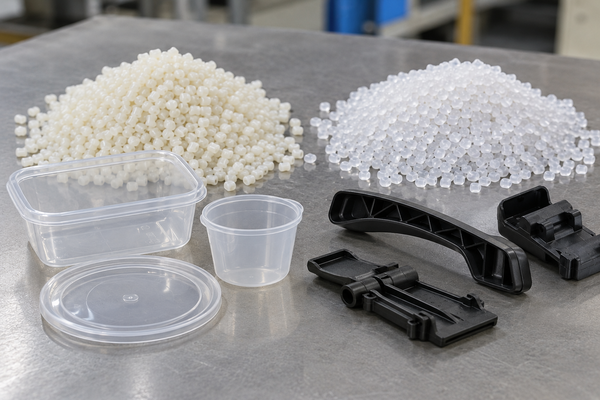
Choosing between homopolymer vs copolymer can affect the strength, stiffness, impact resistance, and cost of an injection molded part. Both materials are common in plastic manufacturing. However, they do not behave in the same way.
A homopolymer uses one main type of monomer. A copolymer uses two or more monomers. Because of this difference, their final properties can vary.
For example, homopolymers often provide higher stiffness. Copolymers, on the other hand, often offer better impact resistance and flexibility.
Therefore, the better option depends on the real use of the part.
At Fentor Mold, we review the material together with part design, wall thickness, working temperature, mold structure, and production volume. As a result, the resin choice is based on the whole project rather than on price alone.
What Is the Difference Between Homopolymer vs Copolymer?
The main difference between homopolymer vs copolymer is their polymer structure.
A homopolymer contains repeating units from one monomer. In contrast, a copolymer contains repeating units from two or more monomers.
This difference can affect:
- Stiffness
- Impact resistance
- Flexibility
- Heat resistance
- Shrinkage
- Surface finish
- Processing
- Cost
In polypropylene applications, the comparison often means PP homopolymer versus PP copolymer.
Both materials work well in injection molding. However, each one fits different product needs.
Homopolymer vs Copolymer: Basic Property Comparison
| Property | Homopolymer | Copolymer |
|---|---|---|
| Stiffness | Higher | Lower to moderate |
| Impact Resistance | Lower | Higher |
| Low-Temperature Toughness | Lower | Better |
| Flexibility | Lower | Higher |
| Heat Resistance | Often better | Good |
| Surface Hardness | Higher | Slightly softer |
| Dimensional Stability | Good | Good |
| Chemical Resistance | Very good | Very good |
| Cost | Often lower | Often slightly higher |
| Typical Use | Rigid parts | Tough or impact-resistant parts |
This table gives a general view. However, actual values depend on the specific resin grade.
Additives, fillers, melt flow rate, and molding conditions can also change the final result.
Homopolymer vs Copolymer Strength
Strength is one of the main reasons engineers compare homopolymer vs copolymer.
Homopolymer polypropylene often has higher stiffness and tensile strength. Therefore, it works well for rigid parts.
Common applications include:
- Caps
- Containers
- Rigid housings
- Household products
- Thin-wall parts
- Industrial components
Copolymer polypropylene usually gives up some stiffness. However, it gains better toughness.
As a result, it can be a better choice for parts that may bend, drop, or absorb shock.
Impact Resistance of Homopolymer vs Copolymer
Impact resistance is a major difference between the two materials.
Copolymer polypropylene usually performs better under impact. In addition, it keeps more toughness at lower temperatures.
Homopolymer can become more brittle in cold conditions. Therefore, it may crack more easily after a strong hit.
Copolymer is often used for:
- Automotive parts
- Storage boxes
- Hinged products
- Industrial containers
- Battery cases
- Durable housings
So, if the part may be dropped or hit during use, copolymer is worth considering.
Homopolymer vs Copolymer for Stiffness
If stiffness is the main goal, homopolymer often has an advantage.
It usually offers:
- Higher rigidity
- Better shape retention
- Higher surface hardness
- Good dimensional control
For example, this can help a large flat part resist bending.
However, more stiffness is not always better.
A very rigid part may crack under impact. In contrast, a slightly more flexible copolymer may survive repeated shock more easily.
Therefore, the right choice depends on the actual load.
Heat Resistance of Homopolymer vs Copolymer
Homopolymer polypropylene often offers slightly better heat resistance than standard copolymer grades.
Because of this, it can suit parts used at moderate temperatures.
Typical applications include:
- Household products
- Food containers
- Appliance parts
- Industrial components
However, the difference is not always large.
In addition, heat-stabilized copolymer grades are available.
So, designers should always check the real material data sheet before making a final choice.
Homopolymer vs Copolymer at Low Temperatures
Low-temperature performance is another important difference.
Homopolymer PP can lose toughness when temperature drops. As a result, the risk of cracking can increase.
Copolymer PP usually keeps better impact resistance in cold conditions.
For this reason, it is often used in:
- Outdoor products
- Cold-storage containers
- Automotive parts
- Transport packaging
- Refrigerated applications
Before tooling starts, it is useful to check the low-temperature impact data of the selected grade.
Random Copolymer vs Impact Copolymer
Not all copolymers are the same.
Two common PP copolymer types are random copolymer and impact copolymer.
Random Copolymer
Random copolymer polypropylene often provides:
- Better clarity
- Good flexibility
- Good appearance
- Lower stiffness
- Good sealing performance
Because of these properties, it is often used for:
- Clear containers
- Medical packaging
- Consumer products
- Food-contact parts
Impact Copolymer
Impact copolymer polypropylene focuses more on toughness.
It often offers:
- Better impact resistance
- Better low-temperature strength
- Higher durability
- Good fatigue resistance
Therefore, typical applications include:
- Automotive parts
- Storage bins
- Industrial products
- Battery housings
- Durable containers
So, when comparing homopolymer vs copolymer, the exact copolymer type also matters.
Homopolymer vs Copolymer for Injection Molding Processability
Both materials work well in injection molding.
However, flow behavior varies by grade.
Important factors include:
- Melt flow rate
- Melt temperature
- Mold temperature
- Injection speed
- Holding pressure
- Cooling time
For example, a high-flow PP grade can fill a thin-wall part more easily.
A lower-flow grade may offer better mechanical strength.
Therefore, the material should match both the part design and the molding process.
Fentor Mold reviews resin flow together with gate location, wall thickness, cooling, and part geometry during mold development.
How Shrinkage Differs Between Homopolymer vs Copolymer
Shrinkage is another important point in injection molding.
Polypropylene usually has relatively high mold shrinkage. However, the exact value depends on the material and part design.
Main factors include:
- Wall thickness
- Packing pressure
- Mold temperature
- Gate location
- Cooling rate
- Filler content
- Part geometry
Homopolymer and copolymer may show different shrinkage behavior.
Still, the real value should come from the resin supplier.
For precision parts, the mold designer should not use one general shrinkage value for every PP grade.
You can learn more about our custom injection mold manufacturing process, including DFM, mold design, machining, assembly, and mold trials.
Homopolymer vs Copolymer for Surface Appearance
Surface appearance can also affect material choice.
Homopolymer often gives:
- Good gloss
- Good hardness
- Sharp molded details
Random copolymer may offer:
- Better clarity
- Softer appearance
- Better transparency in suitable grades
Impact copolymer usually focuses more on toughness than on clarity.
Therefore, the best material depends on the final appearance target.
The mold surface and molding settings also affect the result.
Chemical Resistance of Homopolymer vs Copolymer
Both homopolymer and copolymer polypropylene offer good chemical resistance.
They resist many:
- Acids
- Bases
- Detergents
- Oils
- Moisture
Because of this, PP is common in food, medical, household, and industrial products.
However, chemical resistance can change with temperature and stress.
So, long-term exposure should always be checked with the selected resin grade.
Homopolymer vs Copolymer Cost
Cost is another part of the homopolymer vs copolymer decision.
Homopolymer is often slightly cheaper. It is also widely available.
Copolymer may cost more, especially when special impact modifiers are added.
However, material price is only one part of the total cost.
Other factors include:
- Scrap rate
- Cycle time
- Part failure risk
- Wall thickness
- Product life
- Warranty risk
For example, a cheaper material may crack more easily in use.
As a result, the initial saving can disappear quickly.
Homopolymer vs Copolymer for Automotive Parts
Automotive parts often need both stiffness and toughness.
Homopolymer can work well for rigid interior parts or parts with low impact risk.
Copolymer, however, is often preferred for components exposed to shock or vibration.
Typical applications include:
- Interior trim
- Battery components
- Air ducts
- Brackets
- Covers
- Storage parts
- Clips
Impact copolymer is especially common when toughness matters.
For filled PP grades, engineers should also review shrinkage and warpage.
Homopolymer vs Copolymer for Food-Contact Parts
Both material types are available in food-contact grades.
Common applications include:
- Food containers
- Lids
- Reusable boxes
- Kitchen products
- Packaging
Homopolymer can work well when stiffness is important.
Random copolymer, on the other hand, may be better when clarity or flexibility matters.
However, compliance depends on the exact grade.
Therefore, always check the material supplier’s EU or FDA declaration when required.
When Should You Choose Homopolymer?
Homopolymer is often a good choice when the part needs:
- High stiffness
- Good rigidity
- Good surface hardness
- Good shape retention
- Moderate heat resistance
- Lower material cost
Typical products include rigid containers, caps, household parts, and thin-wall components.
In many general PP projects, homopolymer offers a practical balance between performance and price.
When Should You Choose Copolymer?
Copolymer is often a better choice when the part needs:
- Better impact resistance
- Better low-temperature toughness
- More flexibility
- Better fatigue resistance
- Higher durability
Typical uses include automotive parts, hinges, storage boxes, and industrial bins.
In addition, the exact copolymer type matters.
Random copolymer and impact copolymer serve different needs.
How Mold Design Changes With Homopolymer vs Copolymer
Material choice also affects mold design.
Important points include:
- Shrinkage allowance
- Gate size
- Gate location
- Wall thickness
- Cooling layout
- Draft angle
- Ejection design
PP parts can warp if wall thickness or cooling is uneven.
For example, a large flat part may need ribs for support.
Gate location also affects flow and shrinkage.
For production projects, Fentor Mold can combine tooling development with injection molding production so mold design and process settings can be reviewed together.
Can Homopolymer and Copolymer Use the Same Mold?
Sometimes they can.
However, switching materials may change:
- Shrinkage
- Flow
- Part dimensions
- Cooling time
- Warpage
For simple parts, process changes may be enough.
For tight-tolerance parts, mold correction may still be needed.
Therefore, it is better to confirm the final material before steel cutting.
Homopolymer vs Copolymer: Which Is Better for Injection Molded Parts?
There is no single best answer in the homopolymer vs copolymer comparison.
Homopolymer often suits parts that need stiffness, rigidity, and lower cost.
Copolymer is usually better when toughness, flexibility, and impact resistance matter more.
Before choosing, consider:
- Mechanical load
- Impact requirement
- Working temperature
- Low-temperature use
- Surface appearance
- Chemical contact
- Dimensional tolerance
- Production volume
- Cost target
In addition, the resin should match the part design.
Even a good material can cause problems if the wall thickness, gate location, cooling, or mold structure is poor.
For this reason, reviewing the material and 3D design before tooling starts can reduce later mold changes and quality problems.