A hot runner mold uses a heated runner system to deliver molten plastic from the injection molding machine to the mold cavities without allowing the runner to solidify during normal production. Compared with a conventional cold runner mold, this approach can reduce runner waste, improve material utilization, and support efficient multi-cavity production.
However, a hot runner mold is not automatically the best choice for every injection molding project. The right solution depends on the plastic material, part design, cavity count, production volume, gate location, mold life, and overall tooling budget.
For purchasing teams and mold engineers, the key question is not simply whether a hot runner system is better than a cold runner. It is whether the additional tooling investment will provide enough production and material savings over the expected life of the mold.
At Fentormold, we evaluate the hot runner system together with the cavity layout, gate design, cooling system, ejection system, plastic material, and production requirements before finalizing the mold structure.
What Is a Hot Runner Mold and How Does It Work?
A hot runner mold uses a temperature-controlled runner system to keep molten plastic flowing between the injection molding machine and the mold cavities.
A typical system includes:
- Hot runner manifold
- Hot runner nozzles
- Heaters
- Thermocouples
- Temperature controllers
- Gates
- Thermal insulation components
The basic flow path is:
Injection Machine → Sprue → Hot Runner Manifold → Nozzles → Gates → Mold Cavities
The manifold distributes molten plastic from the main inlet to individual nozzles. Each nozzle then delivers the melt through a gate into a mold cavity.
Because the runner remains heated, it normally does not become a solid runner that needs to be removed from the molded parts after every cycle.
This is the main difference between a hot runner system and a conventional cold runner system.
What Is a Hot Runner System in Injection Molding?
A hot runner system for injection molding is more than a heated channel inside a mold. It is a temperature-controlled delivery system designed to manage molten plastic flow from the machine nozzle to one or more mold cavities.
The system needs to maintain appropriate melt temperature while also controlling pressure, flow balance, gate performance, and thermal expansion.
For a simple single-cavity mold, the hot runner arrangement may be relatively straightforward. Multi-cavity molds require more attention because the runner layout needs to deliver material consistently to each cavity.
An unsuitable hot runner configuration can cause:
- Unbalanced filling
- Different cavity pressures
- Weld lines
- Gate defects
- Material degradation
- Excessive pressure loss
- Dimensional variation
For this reason, hot runner selection should be considered during mold design rather than added as an isolated component later.
What Is a Hot Runner Manifold?
The hot runner manifold distributes molten plastic from the main inlet to multiple hot runner nozzles.
In a multi-cavity mold, manifold design has a direct effect on flow balance. Ideally, the melt should reach each cavity under reasonably consistent conditions.
A hot runner manifold typically needs to be evaluated for:
- Flow path length
- Cavity arrangement
- Temperature distribution
- Pressure loss
- Material residence time
- Thermal expansion
- Mold plate structure
- Maintenance access
Poor manifold design can create differences in filling time and pressure between cavities. This can make process adjustment more difficult and may affect part weight, dimensions, and appearance.
For this reason, manifold design should be developed together with the overall injection mold design.
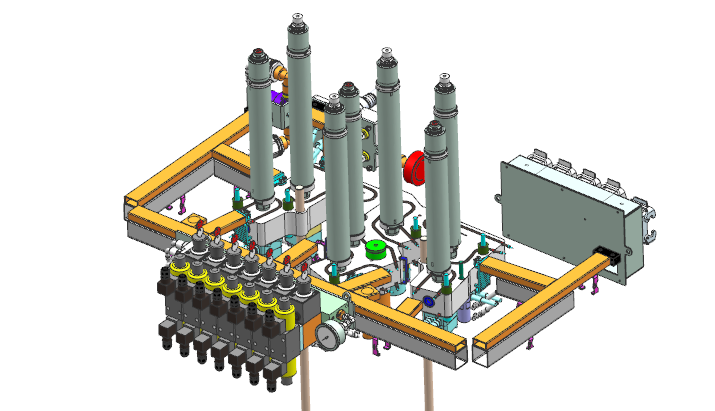
Hot runner manifold and nozzles distribute molten plastic to multiple mold cavities.
What Are the Main Components of a Hot Runner Mold?
Hot Runner Manifold
The manifold distributes molten plastic from the main inlet to the individual nozzles.
Its layout depends on cavity count, part arrangement, gate locations, material, and required flow balance.
Hot Runner Nozzles
Hot runner nozzles deliver molten plastic from the manifold to the mold gates.
Nozzle selection depends on factors such as:
- Plastic material
- Part geometry
- Gate location
- Cycle time
- Cosmetic requirements
- Processing temperature
Heaters
Heaters maintain the temperature required to keep plastic molten inside the hot runner system.
The heater configuration depends on the manifold and nozzle design.
Thermocouples
Thermocouples monitor temperatures at selected points in the hot runner system.
Reliable temperature measurement helps maintain stable processing conditions and can help prevent overheating or insufficient melt temperature.
Temperature Controller
The temperature controller regulates the heating zones and maintains the required operating temperature.
Stable temperature control becomes particularly important when processing engineering plastics or materials that are sensitive to excessive heat and residence time.
Gates
The gate connects the hot runner nozzle to the mold cavity.
Depending on the application, a hot runner mold may use different gate configurations, including thermal gates and valve gates.
Gate selection affects filling, packing, appearance, gate vestige, and part quality.
What Are the Benefits of a Hot Runner Mold?
1. Reduced Runner Waste
One of the biggest advantages of a hot runner mold is reduced runner waste.
In a cold runner mold, the runner normally solidifies during each cycle and must be separated from the molded parts.
A hot runner keeps the runner system molten, so there is normally no conventional solidified runner to remove after each cycle.
This can significantly improve material utilization, particularly in high-volume production.
2. Better Material Utilization
When less material is trapped in solidified runners, a greater percentage of the injected resin can become part of the finished product.
The benefit becomes more noticeable when:
- The resin is expensive
- The runner is relatively large compared with the part
- Production volume is high
- The mold runs continuously for long periods
For engineering plastics and specialty materials, reducing runner waste can have a meaningful effect on production cost.
3. Potentially Shorter Cycle Times
A cold runner must cool and solidify before it can be removed.
A hot runner eliminates this solidification step for the runner system. As a result, it can potentially reduce cycle time.
However, the actual cycle time still depends heavily on the molded part, material, wall thickness, cooling system, packing conditions, and machine settings.
Therefore, it is better to evaluate cycle-time savings from the complete process rather than assume that every hot runner mold will automatically run faster.
4. Better Multi-Cavity Filling
A properly designed hot runner system can provide controlled melt delivery to multiple cavities.
This is especially useful for high-cavity molds producing identical parts.
A balanced system can help maintain more consistent:
- Filling time
- Injection pressure
- Part weight
- Packing conditions
- Dimensional performance
5. Less Runner Handling
Because the system does not normally produce a solidified runner with every cycle, there is less runner material for operators or automation equipment to handle.
This can simplify automated production and reduce the need for runner separation.
6. Better Fit for High-Volume Production
Hot runner molds are often considered for high-volume applications where the additional tooling investment can be recovered through material savings and production efficiency.
Typical applications include:
- Automotive components
- Consumer electronics
- Medical components
- Packaging products
- Household appliances
- Consumer products
Hot Runner Mold vs Cold Runner Mold
Both systems have practical advantages. The right choice depends on the production requirements rather than the technology alone.
| Feature | Hot Runner Mold | Cold Runner Mold |
|---|---|---|
| Runner condition | Remains molten | Solidifies each cycle |
| Runner waste | Very low | Higher |
| Initial mold cost | Higher | Lower |
| Maintenance | More complex | Simpler |
| Temperature control | More demanding | Simpler |
| Cycle time | Potentially shorter | May be longer |
| Material utilization | High | Lower |
| Multi-cavity production | Very suitable | Also suitable |
| Initial investment | Higher | Lower |
For a low-volume project with inexpensive plastic, a cold runner mold may provide better overall economics.
For high-volume production or expensive engineering plastics, the material savings and production efficiency of a hot runner system may justify the higher tooling investment.
For a detailed comparison, see our Hot Runner vs Cold Runner Injection Mold guide.
When Should You Use a Hot Runner Mold?
A hot runner mold is worth considering when the production economics support the additional tooling investment.
High Production Volume
The larger the production volume, the more opportunities there are to recover the additional hot runner cost through material and production savings.
Expensive Plastic Materials
When resin prices are high, reducing runner waste can produce meaningful savings over the life of the mold.
This is particularly relevant for engineering plastics and specialty materials.
Multi-Cavity Molds
Hot runner systems are commonly used for molds with multiple cavities because they can provide controlled melt delivery to multiple gates.
The manifold and cavity arrangement still need to be designed for appropriate flow balance.
Automated Production
A hot runner system can simplify automated production by eliminating the need to separate a conventional solidified runner from the molded parts.
Complex Part Geometry
Large or complex parts may benefit from multiple gates or controlled gate locations.
However, the hot runner layout must be evaluated carefully to avoid excessive pressure loss, weld lines, hesitation, or uneven filling.
When Is a Hot Runner Mold Not the Best Choice?
A hot runner mold is not automatically the most economical solution.
A cold runner mold may be preferable when:
- Production volume is relatively low
- The mold is simple
- Tooling budget is limited
- Plastic material is inexpensive
- Maintenance simplicity is important
- The production run is short
- Material savings do not justify the additional tooling cost
The correct decision should be based on total production economics, not only the initial mold quotation.
How to Choose a Hot Runner System
Choosing the right hot runner system requires more than comparing supplier prices.
Before selecting the system, the mold designer should evaluate several factors.
Plastic Material
Different materials have different processing temperatures, flow characteristics, shear sensitivity, and thermal stability.
A hot runner system suitable for PP may not be the best configuration for a high-temperature engineering plastic.
Part Geometry
Part size, wall thickness, flow length, gate location, and cosmetic requirements all affect hot runner selection.
Cavity Count
The number of cavities determines the manifold arrangement and the number of nozzles and gates required.
Gate Type
Thermal gates and valve gates provide different levels of control and produce different gate marks.
The appropriate choice depends on part appearance, material, production volume, and molding requirements.
Production Volume
High-volume production generally provides more opportunity to recover the additional hot runner investment.
Maintenance Requirements
The system should allow practical access to heaters, thermocouples, nozzles, valve pins, and other components that may eventually require inspection or replacement.
Mold Life
A mold designed for long-term production should be evaluated differently from a tool intended for a short production run.
This is why hot runner selection should be part of the tooling strategy from the beginning.
How Much Does a Hot Runner Mold Cost?
A hot runner mold generally costs more than a comparable cold runner mold.
The additional tooling cost may include:
- Hot runner manifold
- Hot runner nozzles
- Heaters
- Thermocouples
- Temperature controller
- Valve gate components
- Specialized machining
- Assembly and testing
However, the initial mold price does not tell the whole story.
For high-volume production, the total cost of ownership may be more important:
Hot Runner Investment
vs.
Material Savings + Production Savings + Labor Savings + Reduced Runner Handling
The final cost depends on factors such as:
- Number of cavities
- Mold size
- Mold steel
- Part complexity
- Hot runner configuration
- Gate type
- Valve gate requirements
- Expected mold life
- Surface finish
- Tolerance requirements
For a broader explanation of tooling costs, see our Injection Mold Cost Breakdown.
What Plastics Can Be Used in a Hot Runner Mold?
Many thermoplastic materials can be processed with hot runner systems.
Common examples include:
- PP
- ABS
- PC
- PA
- POM
- PBT
- TPE
- TPU
- LCP
- Other engineering thermoplastics
However, material selection and hot runner design should be evaluated together.
Some materials are more sensitive to:
- Excessive residence time
- High temperature
- Shear
- Moisture
- Thermal degradation
The hot runner system therefore needs to match the processing characteristics of the selected resin.
Hot Runner Mold Design Considerations
A successful hot runner mold requires the heated runner system, cavity layout, cooling, ejection, and mold structure to work together.
Flow Balance
The runner layout should provide balanced flow paths whenever practical.
An unbalanced system can result in different filling times and pressure requirements between cavities.
Temperature Control
The manifold and nozzles need stable temperatures suitable for the selected plastic.
Temperature variation can affect viscosity and filling behavior.
Gate Location
Gate location influences filling, packing, weld lines, surface appearance, and deformation.
The gate should therefore be considered together with the part design rather than selected only after the runner system is finalized.
Valve Gate Timing
For valve-gated systems, opening and closing timing needs to be coordinated with the injection molding process.
Poor timing can affect weld lines, gate appearance, pressure, and filling behavior.
Thermal Expansion
The hot runner system expands as it reaches operating temperature.
The mold structure needs to account for this thermal expansion and maintain the required clearances and support.
Cooling System
The hot runner system adds heat to the mold, so the cooling layout needs to remove heat effectively from the molded part while maintaining suitable mold temperatures.
Learn more about Injection Mold Cooling System Design.
Maintenance Access
High-volume molds need practical access to components that may require inspection or replacement.
Maintenance access should therefore be considered during the initial mold design.
How Does a Hot Runner Mold Affect Cooling?
Hot runner components generate heat inside the mold, so cooling needs to be considered together with the hot runner layout.
The mold designer should evaluate:
- Cooling channel location
- Distance between cooling channels and hot runner components
- Mold plate temperature
- Part cooling requirements
- Thermal balance
- Required cooling time
The objective is not simply to make the mold as cold as possible. The cooling system needs to maintain suitable and consistent temperatures for both the molded part and the hot runner system.
An optimized cooling system can help improve cycle stability, part quality, and dimensional consistency.
Common Hot Runner Mold Problems
A poorly designed or improperly controlled hot runner system can cause several production problems.
Common issues include:
- Nozzle leakage
- Gate stringing
- Gate vestige
- Material degradation
- Unbalanced filling
- Heater failure
- Thermocouple failure
- Valve pin problems
- Temperature fluctuations
- Blocked flow channels
These problems can often be reduced through proper system selection, mold design, installation, process setup, and preventive maintenance.
Hot Runner Mold Maintenance
Although a hot runner mold can improve production efficiency, it still requires regular maintenance.
Typical maintenance tasks include:
- Checking heater resistance
- Checking thermocouples
- Inspecting nozzle tips
- Checking temperature controller performance
- Inspecting gates
- Removing degraded material when necessary
- Checking electrical connections
- Inspecting valve pins on valve-gated systems
Maintenance requirements should be considered when selecting the hot runner configuration.
A system that performs well but is difficult to inspect or repair may create unnecessary downtime during long-term production.
Is a Hot Runner Mold Worth the Extra Cost?
The answer depends mainly on production volume, material cost, cavity count, part design, and expected mold life.
A simple way to evaluate the decision is to compare:
Additional Hot Runner Cost
against
Material Savings + Cycle-Time Savings + Labor Savings + Production Efficiency
For a mold producing hundreds of thousands or millions of parts, a relatively small saving per cycle can become significant over time.
For a low-volume project, the additional tooling investment may not be recovered.
Therefore, the decision should be based on the total cost of ownership, rather than simply choosing the lower initial mold quotation.
Frequently Asked Questions About Hot Runner Molds
What is a hot runner mold?
A hot runner mold uses a heated runner system to deliver molten plastic to mold cavities while keeping the runner system molten during normal production.
What is a hot runner system in injection molding?
A hot runner system is a temperature-controlled material delivery system consisting of components such as a manifold, nozzles, heaters, thermocouples, and gates.
What is a hot runner manifold?
A hot runner manifold distributes molten plastic from the main inlet to multiple hot runner nozzles and helps control melt delivery to the mold cavities.
Does a hot runner mold reduce plastic waste?
Yes. A hot runner system can significantly reduce conventional solidified runner waste because the runner remains molten during the molding cycle.
Is a hot runner mold more expensive?
Yes. A hot runner mold normally has a higher initial tooling cost because of the manifold, nozzles, heating system, temperature controls, and other specialized components.
Are hot runner molds suitable for high-volume production?
They are often well suited to high-volume production because material savings, production efficiency, and reduced runner handling can help offset the higher tooling investment.
Is a hot runner mold always better than a cold runner mold?
No. A cold runner mold may be more economical for low-volume production, simple parts, inexpensive materials, or projects where the additional hot runner investment cannot be recovered.
Conclusion
A hot runner mold can improve material utilization, reduce runner waste, simplify automated production, and support efficient multi-cavity injection molding.
However, the benefits come with higher tooling cost and greater system complexity. The hot runner system, manifold, gates, cooling, cavity layout, and mold structure all need to be considered together.
For this reason, the right choice depends on the complete production requirement rather than one factor such as mold price or material waste.
If you are comparing a hot runner and cold runner solution, send Fentormold your 3D part file, plastic material, cavity requirement, and estimated production volume. We can review the tooling requirements and recommend a suitable configuration.
Contact Fentormold for Injection Mold Design and Tooling Support