
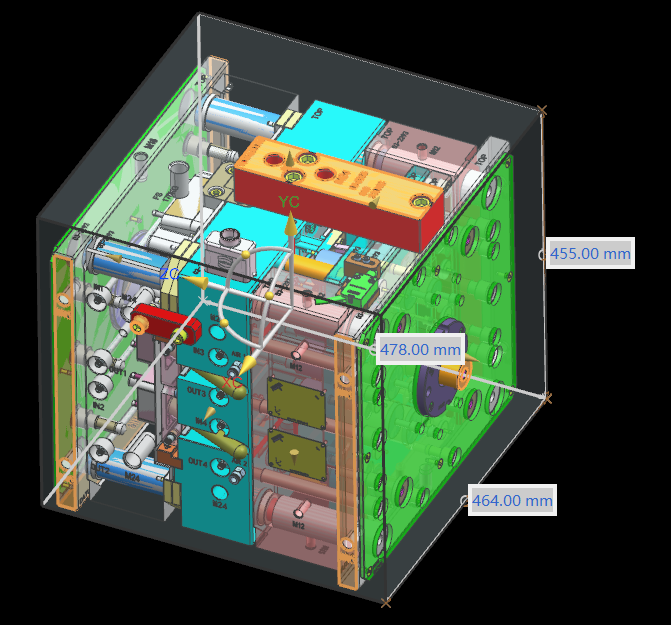
Injection mold size is an important specification during mold design, quotation, manufacturing, and installation. First, the mold must fit the selected injection molding machine. In addition, mold height, weight, tie-bar clearance, and opening requirements all affect machine compatibility.
For mold engineers and purchasing teams, checking injection mold size is not simply a matter of measuring length, width, and height. Instead, the mold must also match the machine’s platen size and tie-bar spacing. In addition, engineers need to confirm the minimum and maximum mold height, mold opening stroke, and ejection system.
This guide explains how to measure injection mold size, which injection mold dimensions matter most, how to specify mold size when requesting a quotation, and how to check whether a mold will fit a particular injection molding machine.
What Is Injection Mold Size?
Injection mold size refers to the overall physical dimensions and specifications of a mold assembly.
The basic dimensions normally include:
- Mold length
- Mold width
- Mold height or thickness
- Mold weight
However, a complete injection mold size specification includes more than these four measurements.
Depending on the project, engineers may also need to consider:
- Tie-bar clearance
- Platen dimensions
- Locating ring size
- Sprue position
- Ejector connection
- Mold opening stroke
- Maximum parting distance
- Minimum and maximum mold height
- Mold center position
- Cooling-water connections
- Hydraulic or pneumatic connections
Therefore, injection mold size should include both physical dimensions and machine-interface requirements.
For buyers requesting an injection mold quotation, these details can help the mold manufacturer evaluate the tooling structure and machine requirements at an early stage.
For projects that require complete tooling support, Fentor Mold provides custom injection mold manufacturing from DFM review and mold design through manufacturing, trial, and delivery.
How to Measure Injection Mold Size
The most basic way to measure an injection mold is to record its overall length, width, and height.
For a conventional rectangular mold, the measurements can be taken as follows.
Mold Length
Measure the longest horizontal dimension of the complete mold base.
The measurement should normally include the permanent mold structure that occupies space between the machine platens.
However, temporary lifting equipment or shipping accessories do not normally need to be included unless they remain part of the mold installation.
Mold Width
Measure the maximum horizontal width of the mold perpendicular to its length.
This dimension is especially important when checking the available space between the injection molding machine’s tie bars.
For example, a mold may fit within the platen dimensions but still be too wide to pass through the tie bars.
Mold Height
Mold height, also called mold thickness, is the total thickness of the mold when the mold is closed.
If the mold consists of multiple plates, the closed mold height is determined by the combined thickness of the mold assembly.
This is one of the most important injection mold dimensions because every injection molding machine has a specified minimum and maximum mold height.
Mold Weight
Mold weight is not a dimensional measurement. However, it is still an important part of the overall mold specification.
The machine and handling equipment must safely support and install the mold.
Mold weight also affects:
- Crane requirements
- Mold installation
- Transportation
- Machine handling
- Maintenance
- Mold storage
For large production molds, mold weight should therefore be confirmed before shipment and installation.
Injection Mold Dimensions That Matter Most
Not every mold dimension has the same importance when selecting an injection molding machine. Therefore, several key specifications should be checked before confirming machine compatibility.
| Specification | Why It Matters |
|---|---|
| Mold length | Determines available platen space |
| Mold width | Must fit between tie bars |
| Mold height | Must fall within the machine mold-height range |
| Mold weight | Must be within machine handling capacity |
| Tie-bar spacing | Determines whether the mold can enter the machine |
| Platen size | Determines available mounting area |
| Mold opening stroke | Must allow sufficient part and runner removal |
| Ejector stroke | Must match mold ejection requirements |
| Locating ring | Must match the machine platen interface |
| Sprue position | Must align with the injection unit |
These specifications should be considered together rather than checking only the overall mold dimensions.
Quick Mold and Machine Compatibility Check
| Check | What to Confirm |
|---|---|
| Mold width | Fits within machine tie-bar spacing |
| Mold height | Falls within the machine’s min/max mold height |
| Opening stroke | Provides enough space for part and runner removal |
| Ejector stroke | Meets the mold’s ejection requirement |
| Mold weight | Can be safely supported and handled |
How to Check Mold Length and Width
Mold length and width are usually the first dimensions checked when evaluating machine compatibility.
First, the mold must physically fit within the machine’s installation and platen area.
For example, a mold may have an overall size of:
500 mm × 450 mm × 550 mm
However, this does not automatically mean that every 500-ton injection molding machine can accept it.
In addition, the available tie-bar spacing and platen dimensions must be checked.
As a result, a mold that looks suitable based on platen size may still be too wide to pass between the tie bars.
A basic check is:
Mold Width < Available Tie-Bar Clearance
However, this should not be treated as the only machine-fit requirement. The actual mold installation should also consider mold orientation, locating components, clamping space, and other machine interfaces.
What Is Tie-Bar Spacing?
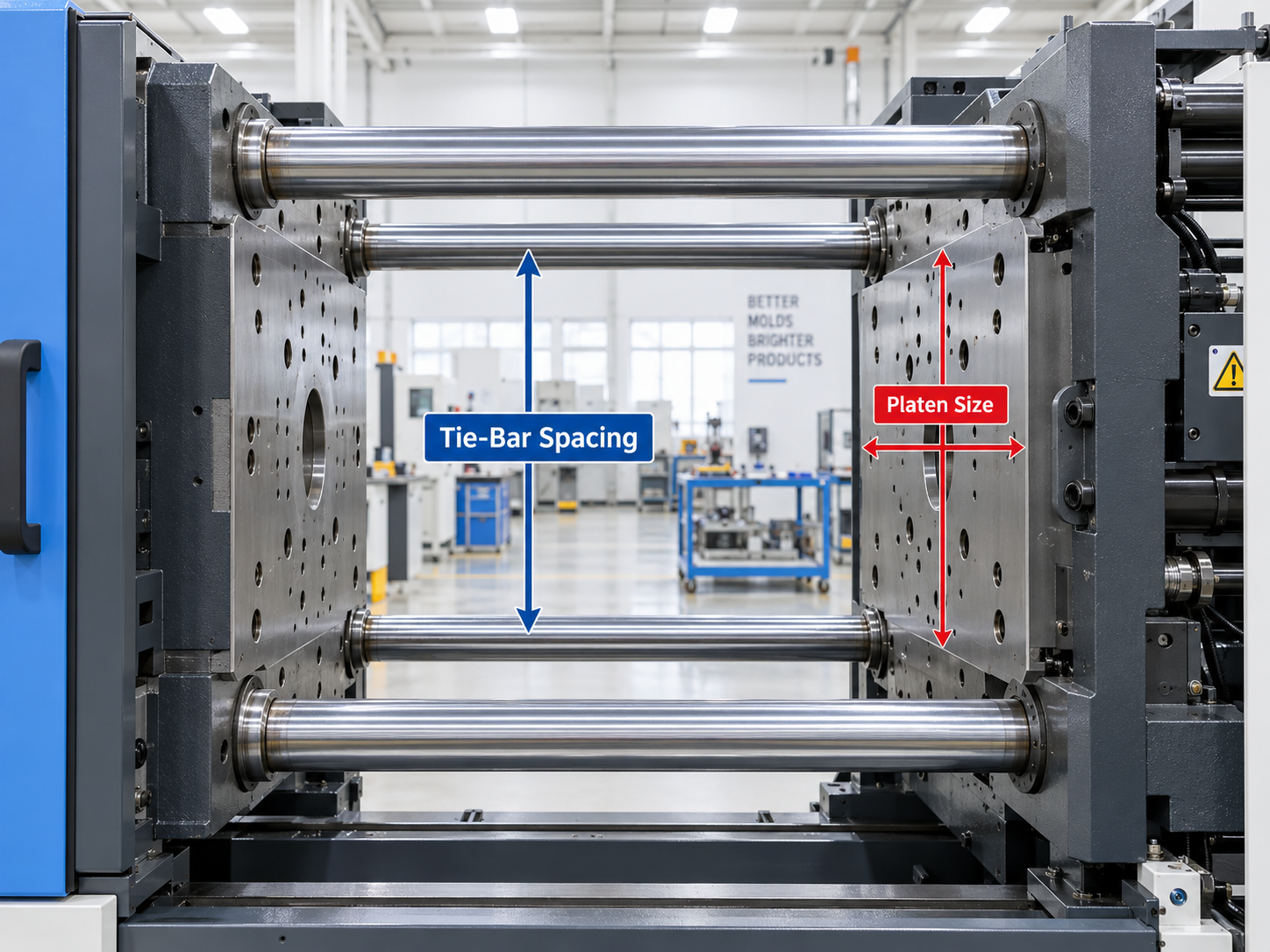
Tie-bar spacing is the distance between the machine’s tie bars.
It is one of the key specifications used to check whether an injection mold can physically fit into a machine.
For example, suppose a molding machine has:
- Tie-bar spacing: 560 × 560 mm
- Platen size: 820 × 820 mm
A 600 mm-wide mold may have enough platen area. However, it may still be impossible to install because it cannot pass between the tie bars.
This is why injection mold dimensions should always be checked against tie-bar spacing, not only platen dimensions.
For buyers, asking the supplier to confirm the mold size against the target machine before manufacturing can help avoid an expensive compatibility problem later.
Mold Height and Machine Mold Thickness Range
Injection molding machines normally have a specified mold-height range.
For example, a machine may support:
Minimum mold height: 250 mm
and
Maximum mold height: 650 mm
A 200 mm-high mold may be too thin for the machine.
By contrast, a 700 mm-high mold may exceed the machine’s maximum mold height.
Therefore, the mold height must stay within the machine’s allowable range.
When designing the mold, engineers should confirm the target injection molding machine before finalizing the mold base dimensions.
This is particularly important when a customer already has a machine and wants the new mold to run on that equipment.
Mold Opening Stroke and Mold Size
Mold size is also related to mold opening requirements.
A mold may physically fit inside a machine. However, production can still fail if the available opening stroke is too short.
Therefore, the machine must provide enough opening distance for:
- Part removal
- Runner removal
- Ejection
- Robot access
- Operator access when required
For molds with deep parts or long runners, the required opening stroke can be particularly important.
The mold design should therefore be evaluated together with the part geometry and ejection method.
You can learn more about mold ejection in our injection mold ejection system guide.
How to Match Injection Mold Size to a Molding Machine
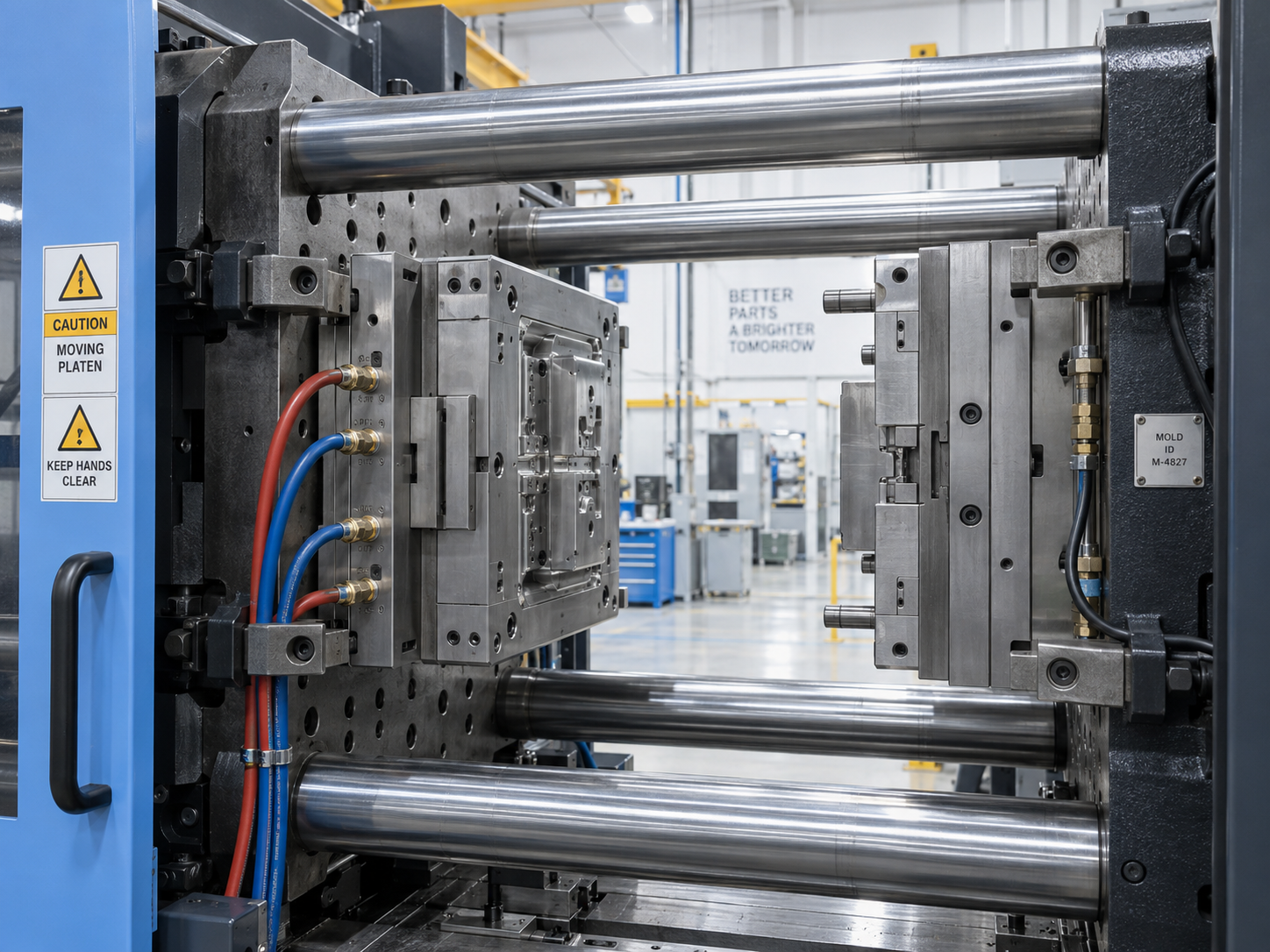
Selecting a molding machine based only on injection mold size is not sufficient.
Instead, machine compatibility should be checked across several parameters.
1. Check Tie-Bar Spacing
Start by confirming that the mold can pass between the machine tie bars.
The mold’s maximum width and length should be compatible with the available installation space.
2. Check Platen Size
Next, make sure the mold has enough mounting area on both the fixed and moving platens.
The available platen dimensions should also provide enough space for:
- Clamping
- Bolting
- Locating components
- Mold supports
3. Check Mold Height
Then compare the closed mold height with the machine’s allowable mold-height range.
4. Check Mold Weight
Also confirm that the machine and handling equipment can safely support the mold.
5. Check Mold Opening Stroke
After that, verify that the machine can open far enough for part and runner removal.
6. Check Ejector Stroke
The ejector system should provide enough stroke and the correct connection dimensions.
7. Check Locating Ring and Sprue
Finally, confirm that the locating ring and sprue match the machine platen and nozzle configuration.
These details should be confirmed before mold manufacturing begins.
If the mold will remain with the supplier for production, the tooling should also be matched with the planned injection molding production equipment before the mold design is finalized.
Injection Mold Size vs. Injection Molding Machine Size
A common mistake is to assume that a larger molding machine is always better for a larger mold.
However, machine selection actually depends on several factors:
- Mold dimensions
- Mold weight
- Part projected area
- Required clamping force
- Injection volume
- Plastic material
- Mold opening requirements
- Ejection requirements
For example, a mold may physically fit on a 500-ton machine. However, the machine may still be unsuitable because the required injection volume or clamping force is too high.
Therefore, injection mold size and machine tonnage should be evaluated separately.
First, the mold must physically fit the machine. Then, the machine must provide sufficient clamping force, injection capacity, opening stroke, and ejection capability for the part.
For production planning, these checks should ideally be completed before the mold design is finalized.
Does Injection Mold Size Affect Mold Cost?
Yes. Larger molds generally require more steel and larger mold plates. In addition, they often need more machining time and larger equipment.
However, mold cost is not determined by dimensions alone.
Other major cost factors include:
- Number of cavities
- Mold steel
- Part complexity
- Slides and lifters
- Hot runner system
- Cooling system
- Surface finish
- Tight tolerances
- EDM requirements
- Mold life
- Automation requirements
For example, a small four-cavity precision mold can be more expensive than a larger simple single-cavity mold.
You can learn more about tooling costs in our injection mold cost breakdown guide.
Injection Mold Size and Mold Base Selection
The mold base is one of the main factors determining the final injection mold size.
When selecting a mold base, engineers need to consider:
- Part dimensions
- Cavity layout
- Runner system
- Cooling channels
- Ejector system
- Mold components
- Slide mechanisms
- Lifter mechanisms
- Steel thickness
- Required mold strength
The mold base should provide enough space for all components. However, it should not be larger than necessary.
An oversized mold base can increase:
- Material cost
- Machining cost
- Mold weight
- Shipping cost
- Machine requirements
Therefore, a properly optimized mold base should provide enough structural support while keeping the mold as compact as practical.
How Mold Size Affects Mold Shipping
Mold dimensions also affect international transportation.
For export molds, suppliers need to consider several practical points:
- Mold length
- Mold width
- Mold height
- Mold weight
- Wooden crate dimensions
- Lifting points
- Center of gravity
- Shipping method
The final shipping dimensions may be larger than the actual mold dimensions because the mold requires packaging and protection.
In addition, large molds may require special handling equipment or specific transportation arrangements.
How to Specify Injection Mold Size on a Quotation
When requesting an injection mold quotation, providing basic mold size requirements can help suppliers estimate tooling cost and machine compatibility.
A useful mold specification may include:
| Item | Example |
|---|---|
| Mold length | 500 mm |
| Mold width | 450 mm |
| Mold height | 550 mm |
| Mold weight | 850 kg |
| Cavities | 2 |
| Mold steel | P20 / 718 / H13 |
| Runner | Cold runner |
| Injection machine | 350-ton |
| Part material | PP |
| Mold life | 500,000 shots |
However, the final mold size should normally be confirmed after mold design.
At that stage, the supplier can optimize the mold base according to the cavity layout, cooling system, ejection system, and selected machine.
For purchasing teams, it is useful to provide the target machine model or machine specifications when requesting a quotation. This gives the mold manufacturer a clearer basis for determining the appropriate mold dimensions.
If the target injection molding machine is already fixed, sending the machine model or datasheet together with the 3D part drawing can help the mold manufacturer confirm the mold size earlier.
Injection Mold Size Checklist
Before approving an injection mold design, check the following:
- Mold length confirmed
- Mold width confirmed
- Mold height confirmed
- Mold weight estimated
- Tie-bar spacing checked
- Platen size checked
- Minimum mold height checked
- Maximum mold height checked
- Mold opening stroke checked
- Ejector stroke checked
- Locating ring checked
- Sprue/nozzle alignment checked
- Clamping method confirmed
- Mold handling requirements confirmed
- Shipping dimensions estimated
This checklist can help prevent machine compatibility problems before the mold is completed.
Common Mistakes When Measuring Injection Mold Size
Measuring Only Length, Width, and Height
These three dimensions are important. However, they do not provide enough information for machine compatibility.
Tie-bar spacing, mold height range, ejector stroke, and opening stroke must also be checked.
Ignoring Mold Weight
A mold may fit the machine dimensionally but still create handling or installation problems if it is too heavy.
Therefore, mold weight should be confirmed before transportation and installation.
Checking Platen Size but Not Tie Bars
This is one of the most common mistakes.
A large platen does not guarantee that the mold can pass between the tie bars.
Measuring the Mold Without Considering External Components
Locating rings, hydraulic cylinders, connectors, water fittings, and other external components may affect the actual installation envelope.
Therefore, these components should also be considered when checking the complete mold installation space.
Choosing the Mold Base Before Confirming the Machine
The selected injection molding machine should be considered before finalizing the mold base dimensions.
Otherwise, the mold may require modifications or a different machine after manufacturing.
Frequently Asked Questions About Injection Mold Size
How do you measure an injection mold?
Measure the mold’s overall closed length, width, and height. Then confirm mold weight, tie-bar clearance, platen requirements, opening stroke, ejector stroke, and machine interface dimensions.
What is the standard size of an injection mold?
There is no single standard injection mold size. Mold dimensions depend on the molded part, cavity count, runner system, mold structure, production requirements, and injection molding machine.
How do I know if an injection mold will fit my machine?
Compare the mold dimensions with the machine’s tie-bar spacing, platen size, minimum and maximum mold height, mold opening stroke, ejector stroke, and mold weight capacity.
Does a bigger mold require a bigger injection molding machine?
Not necessarily. Machine selection also depends on required clamping force, injection volume, part projected area, material, and production requirements.
What information should I provide when requesting a mold quote?
Provide the part drawings or 3D CAD files, material, annual production volume, cavity requirements, expected mold life, preferred machine if known, and any dimensional or tooling requirements.
Conclusion
Injection mold size is more than the basic length, width, and height of a mold.
A complete evaluation should also include mold weight, tie-bar spacing, platen size, mold height, opening stroke, ejection requirements, and machine interfaces.
Therefore, engineers and purchasing teams should check these items before mold manufacturing begins. This can prevent installation problems, machine compatibility issues, and costly mold modifications.
The best approach is to confirm the target injection molding machine early. Then, the mold base and overall dimensions can be optimized around the real production equipment.
If you are not sure what injection mold size or machine configuration is appropriate for your project, providing the part drawing or 3D CAD file to an experienced mold manufacturer can help identify the required mold dimensions before tooling begins.
For complex or high-volume plastic components, Fentor Mold can support the project from mold design and mold manufacturing through injection molding production.
Need Help With Injection Mold Design and Sizing?
Fentor Mold can review your plastic part design, evaluate mold dimensions, and recommend a suitable mold structure and injection molding machine configuration.
Contact Fentor Mold for mold design and DFM support.