
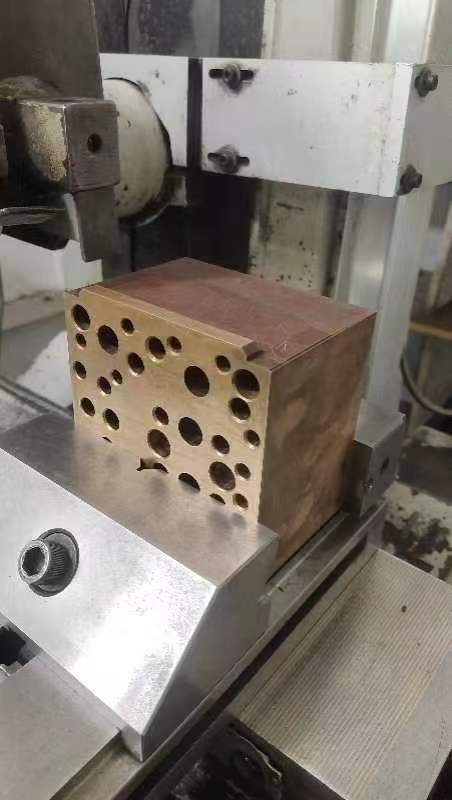
Beryllium copper mold inserts are used in injection molds when conventional mold steel cannot remove heat efficiently from certain areas. Because of their high thermal conductivity, these inserts can improve localized cooling and help reduce temperature differences inside the mold.
However, mold manufacturers normally do not make an entire mold from beryllium copper. Instead, they use beryllium copper mold inserts only in areas where heat is difficult to remove.
Typical locations include:
- Deep cores
- Ribs
- Bosses
- Narrow sections
- Corners
- Local hot spots
- Areas where cooling channels cannot get close enough
For mold engineers and buyers, the key question is not simply whether BeCu transfers heat faster than mold steel.
The more useful question is:
Can a beryllium copper mold insert improve cooling enough to justify the extra tooling cost?
This guide explains where BeCu inserts are used, how they affect cooling and cycle time, and when they are worth considering.
What Are Beryllium Copper Mold Inserts?
Beryllium copper, often called BeCu, is a copper-based alloy with high thermal conductivity, good strength, hardness, and wear resistance.
In injection molds, beryllium copper mold inserts are normally used as local components.
For example, a deep core may not have enough space for a cooling channel near its tip. As a result, this area can stay hotter than the surrounding mold.
A BeCu insert can transfer heat away from that hot area more efficiently.
Therefore, BeCu should be viewed as a localized thermal management solution, not as a replacement for the complete mold.
For projects that require special inserts or complex local structures, Fentor Mold provides custom injection mold manufacturing from DFM and mold design through machining and mold trial.
Why Use Beryllium Copper Mold Inserts?
The main reason to use beryllium copper mold inserts is better heat transfer.
During injection molding, molten plastic transfers heat into the mold. The cooling system must then remove that heat before the part can be ejected.
If one small area remains hot, it can become a thermal bottleneck.
As a result, the complete molding cycle may need to remain longer.
Improve Heat Transfer
BeCu transfers heat more efficiently than many conventional mold steels.
Therefore, it is useful when a cooling channel cannot be placed close enough to the molding surface.
The insert helps conduct heat from the hot area toward the surrounding mold and cooling system.
Reduce Cooling Time
Cooling is often a major part of the total injection molding cycle.
If one deep core or thick boss remains hot, the molded part may need extra cooling time before ejection.
In this case, a BeCu insert may help reduce the local cooling time.
However, the actual improvement depends on:
- Part geometry
- Plastic material
- Mold design
- Cooling layout
- Water flow
- Processing conditions
Therefore, high thermal conductivity alone does not guarantee a shorter cycle.
Improve Temperature Uniformity
Uneven mold temperatures can lead to uneven shrinkage.
For this reason, beryllium copper mold inserts can also help improve temperature balance in difficult areas.
A more balanced mold temperature can support better dimensional stability.
Help Reduce Cooling-Related Warpage
Cooling imbalance is one possible cause of part warpage.
If one area stays hotter than another, different sections may shrink at different rates.
A BeCu insert can help address this thermal imbalance.
However, warpage may also come from:
- Part geometry
- Wall thickness
- Material shrinkage
- Fiber orientation
- Packing pressure
- Mold temperature
Therefore, BeCu should not be treated as a complete warpage solution.
Where Are Beryllium Copper Mold Inserts Used?
Beryllium copper mold inserts are most useful where standard cooling channels cannot remove heat efficiently.
Deep Cores
Deep cores are one of the most common applications.
The deeper the core, the harder it may be to place a drilled cooling channel near the molding surface.
A BeCu core insert can provide a shorter thermal path for heat removal.
Ribs and Bosses
Ribs and bosses can create local heat concentration.
In addition, thick areas often cool more slowly than nearby thin walls.
A properly positioned BeCu insert can improve cooling around these features.
Narrow Areas
Some mold features are too narrow for conventional cooling channels.
For example, a narrow core may not have enough steel thickness for a drilled water line.
In this case, a high-conductivity insert can provide another way to remove heat.
Corners and Deep Pockets
Complex corners and deep pockets can also be difficult to cool.
Therefore, BeCu may be useful when the geometry prevents good cooling-channel placement.
High-Volume Molds
High-volume molds are more sensitive to cycle time.
If one hot spot adds even a small amount of cooling time to every cycle, the total impact can become large over long production runs.
Therefore, BeCu is often easier to justify when production volume is high.
For more detail about water-line layout and cooling efficiency, see our Injection Mold Cooling System Design guide.
Beryllium Copper Mold Insert Material Grades
Different BeCu alloys are available.
Common industrial grades include:
- C17200
- C17510
- Commercial mold alloys such as MoldMAX®
The correct grade depends on the required balance of:
- Thermal conductivity
- Hardness
- Strength
- Wear resistance
- Corrosion resistance
- Machinability
- Mold operating conditions
For example, C17200 is known for combining strength, hardness, and thermal conductivity.
However, material selection should not be based on conductivity alone.
The insert must also withstand the mechanical load and wear conditions of the mold.
Beryllium Copper Mold Inserts vs Mold Steel
BeCu and mold steel normally perform different jobs.
Mold steel is used for most of the mold structure. By contrast, BeCu is normally used only where better heat transfer is required.
| Feature | Beryllium Copper Mold Inserts | Mold Steel |
|---|---|---|
| Thermal conductivity | Very high | Generally lower |
| Heat transfer | Excellent | Good to moderate |
| Strength | Good to high, depending on grade | Generally high |
| Wear resistance | Depends on alloy and treatment | Depends on steel grade |
| Typical use | Local cooling areas | Main mold structure |
| Cooling performance | Excellent for hot spots | Good with conventional cooling |
| Material cost | Higher | Generally lower |
| Use strategy | Localized | Main structure |
In many molds, the practical solution is:
Mold steel for the main structure + BeCu inserts for difficult hot spots.
This approach can balance cost, strength, and cooling performance.
Beryllium Copper Mold Inserts vs Conventional Cooling
Before using BeCu, engineers should first check whether conventional cooling can solve the problem.
A good cooling design can often provide enough temperature control without special insert materials.
However, cooling channels have physical limits.
Their position may be restricted by:
- Core geometry
- Wall thickness
- Ejector pins
- Inserts
- Parting lines
- Mold strength
- Water connections
- Available mold space
If the water line cannot get close enough to the molding surface, beryllium copper mold inserts may provide a useful alternative.
Therefore, this decision should ideally be made during DFM and mold design, not after the mold has already been completed.
How Beryllium Copper Mold Inserts Affect Cycle Time
Cycle time is one of the main reasons to consider BeCu.
A typical injection molding cycle includes:
- Mold closing
- Injection
- Packing and holding
- Cooling
- Mold opening
- Ejection
Cooling can take a large part of this cycle.
Suppose most of the part cools quickly, but one deep core stays hot. In that case, the slowest area may determine the total cooling time.
This is where beryllium copper mold inserts may create value.
For example, a deep internal core may be difficult to reach with a conventional water line. Therefore, the core tip stays hotter than the rest of the mold.
A BeCu insert can improve heat transfer from this area.
As a result, the mold may achieve a more balanced temperature and possibly a shorter cooling period.
However, cycle-time savings should still be confirmed by analysis or mold trials.
If the mold will remain with the supplier for volume production, cooling performance should also be evaluated together with the planned injection molding production process.
Beryllium Copper Mold Inserts and Warpage
Warpage can come from many different sources.
Common causes include:
- Uneven wall thickness
- Different shrinkage rates
- Fiber orientation
- Packing pressure
- Mold temperature
- Cooling imbalance
- Part geometry
- Material properties
Therefore, beryllium copper mold inserts are not a universal warpage solution.
Their main role is to improve localized heat transfer.
If one section of the mold remains hotter than another, improving that area can help reduce the thermal part of the warpage problem.
However, part design, material, cooling layout, packing, and processing conditions should still be reviewed together.
How Are Beryllium Copper Mold Inserts Designed?
BeCu inserts should be considered during the initial mold design stage.
Several factors are important.
Insert Location
The insert should be close enough to the hot area to remove heat effectively.
However, it must still have enough support.
It should also avoid interference with:
- Parting surfaces
- Ejection components
- Core and cavity alignment
- Cooling channels
- Mold assembly
- Maintenance access
Insert Size
A larger insert does not automatically provide better cooling.
Instead, the size should match:
- Heat-transfer requirements
- Available space
- Mold strength
- Machining requirements
- Expected mold life
Cooling Channel Position
The BeCu insert and cooling system should work together.
A useful thermal path is:
Plastic → Mold Surface → BeCu Insert → Mold Steel → Cooling System
If the cooling channel is too far from the insert, some of the thermal benefit may be lost.
Insert Fit and Tolerance
The contact between the BeCu insert and surrounding mold steel is important.
Poor fitting may lead to:
- Poor heat transfer
- Mechanical instability
- Flash
- Parting-line problems
- Insert movement
- Maintenance problems
Therefore, machining and fitting accuracy are critical.
For more detail about insert design and supplier capability, see our Injection Mold Inserts guide.
Wear and Maintenance
The plastic material should also be considered.
For example, glass-filled plastics are more abrasive than many unfilled materials.
Therefore, the BeCu grade, hardness, surface condition, and insert design should match the expected production conditions.
Beryllium Copper Mold Inserts vs Conformal Cooling
BeCu inserts and conformal cooling improve mold cooling in different ways.
Beryllium copper mold inserts improve heat transfer through the insert material.
By contrast, conformal cooling uses cooling channels that follow the shape of the molded part more closely.
| Feature | Beryllium Copper Mold Inserts | Conformal Cooling |
|---|---|---|
| Main principle | High thermal conductivity | Geometry-following channels |
| Manufacturing | Machined insert | Often additive manufacturing |
| Local cooling | Excellent | Excellent |
| Design flexibility | Moderate | High |
| Tooling complexity | Moderate | Usually higher |
| Best use | Local hot spots | Complex cooling geometry |
| Material cost | Higher than mold steel | Depends on manufacturing method |
| Maintenance | Insert can be replaced | Channels are integrated |
These methods are not always competitors.
Depending on the mold, engineers may use conventional cooling, BeCu inserts, conformal cooling, or a combination of these methods.
Are Beryllium Copper Mold Inserts Worth the Cost?
BeCu normally costs more than conventional mold steel.
Therefore, the decision should be based on production value rather than material price alone.
The key question is:
Can the cooling improvement create enough value to justify the extra tooling cost?
BeCu becomes more attractive when:
- Production volume is high
- Cooling limits cycle time
- The mold will run for many cycles
- Dimensional stability is important
- Conventional cooling cannot solve a hot spot
- A shorter cycle can increase production output
For a simple low-volume mold, the added cost may not be worthwhile.
However, for a high-volume project, even a small cycle-time improvement may become commercially important.
How to Select Beryllium Copper Mold Inserts
Selecting beryllium copper mold inserts requires more than choosing the highest thermal conductivity.
During DFM, review the following points.
Plastic Material
Different plastics have different:
- Processing temperatures
- Thermal properties
- Shrinkage
- Wear characteristics
Glass-filled plastics also require more attention to wear.
Part Geometry
Look for:
- Deep cores
- Thick sections
- Bosses
- Ribs
- Narrow areas
- Deep pockets
- Difficult cooling areas
These features may indicate possible BeCu locations.
Production Volume
As production volume increases, cycle time becomes more important.
Therefore, an extra tooling investment may be easier to justify for long production runs.
Cooling Requirements
Before adding BeCu, check whether standard cooling channels can solve the problem.
If conventional cooling is enough, a special insert may not be necessary.
Mold Steel
The BeCu insert and surrounding mold steel must work together.
Therefore, the complete mold structure should be evaluated rather than treating the insert as an isolated component.
Maintenance
The insert should be accessible for inspection and replacement.
This is especially important for long-life production molds.
Can Beryllium Copper Mold Inserts Be Used in High-Volume Molds?
Yes.
High-volume molds can be good candidates for beryllium copper mold inserts when a local hot spot limits production efficiency.
For example, if one deep core controls the total cooling time, improving heat transfer in that area may increase output.
However, high production volume alone does not mean BeCu is required.
If normal cooling already provides good temperature control, the added cost may not be justified.
Therefore, the decision should be based on the actual thermal bottleneck.
Are Beryllium Copper Mold Inserts Safe?
Finished BeCu inserts are used in industrial tooling.
However, machining beryllium-containing material requires special attention.
Grinding and other machining processes can create dust or airborne particles.
Therefore, manufacturers should follow applicable safety requirements and use proper:
- Ventilation
- Dust control
- Engineering controls
- Personal protective equipment
- Material handling procedures
Once the insert is properly installed, the machining-related exposure issue is different from normal mold operation.
For this reason, mold manufacturers should follow the material supplier’s safety information and local workplace requirements when machining BeCu.
Frequently Asked Questions About Beryllium Copper Mold Inserts
Do Beryllium Copper Mold Inserts Corrode?
Beryllium copper has good corrosion resistance in many mold environments.
However, performance depends on the alloy, surface condition, cooling-water chemistry, and operating environment.
What Hardness Can BeCu Mold Inserts Reach?
Hardness depends on the alloy and heat-treatment condition.
Therefore, engineers should use the material supplier’s technical data instead of assuming one hardness value for all BeCu alloys.
Can BeCu Be Used With Glass-Filled Plastics?
Yes, but wear needs more attention.
Glass-filled plastics are abrasive. Therefore, alloy grade, hardness, surface condition, and expected mold life should be reviewed carefully.
Can BeCu and Mold Steel Be Used Together?
Yes.
This is a common design strategy.
The main mold can remain conventional steel, while BeCu is used only in areas that need better heat transfer.
Is BeCu Always Better Than Mold Steel?
No.
BeCu has better thermal conductivity than many mold steels. However, it also costs more.
Therefore, the correct material depends on cooling needs, strength, wear, cost, and mold life.
Conclusion
Beryllium copper mold inserts are useful when localized heat transfer limits injection molding performance.
They are especially valuable for:
- Deep cores
- Ribs
- Bosses
- Narrow areas
- Corners
- Local hot spots
The main advantages are:
- Better heat transfer
- Better temperature balance
- Potentially shorter cooling time
- Better control of temperature-related dimensional variation
- Possible cycle-time improvement
However, BeCu should be used strategically.
In many molds, the most practical solution is:
Conventional mold steel + strategically positioned beryllium copper mold inserts + optimized cooling channels.
This approach can provide a good balance between tooling cost, cooling performance, mold life, and production efficiency.
Fentor Mold can review part geometry, cooling layout, insert location, and production requirements during DFM to determine whether BeCu is worth using in a specific mold.