
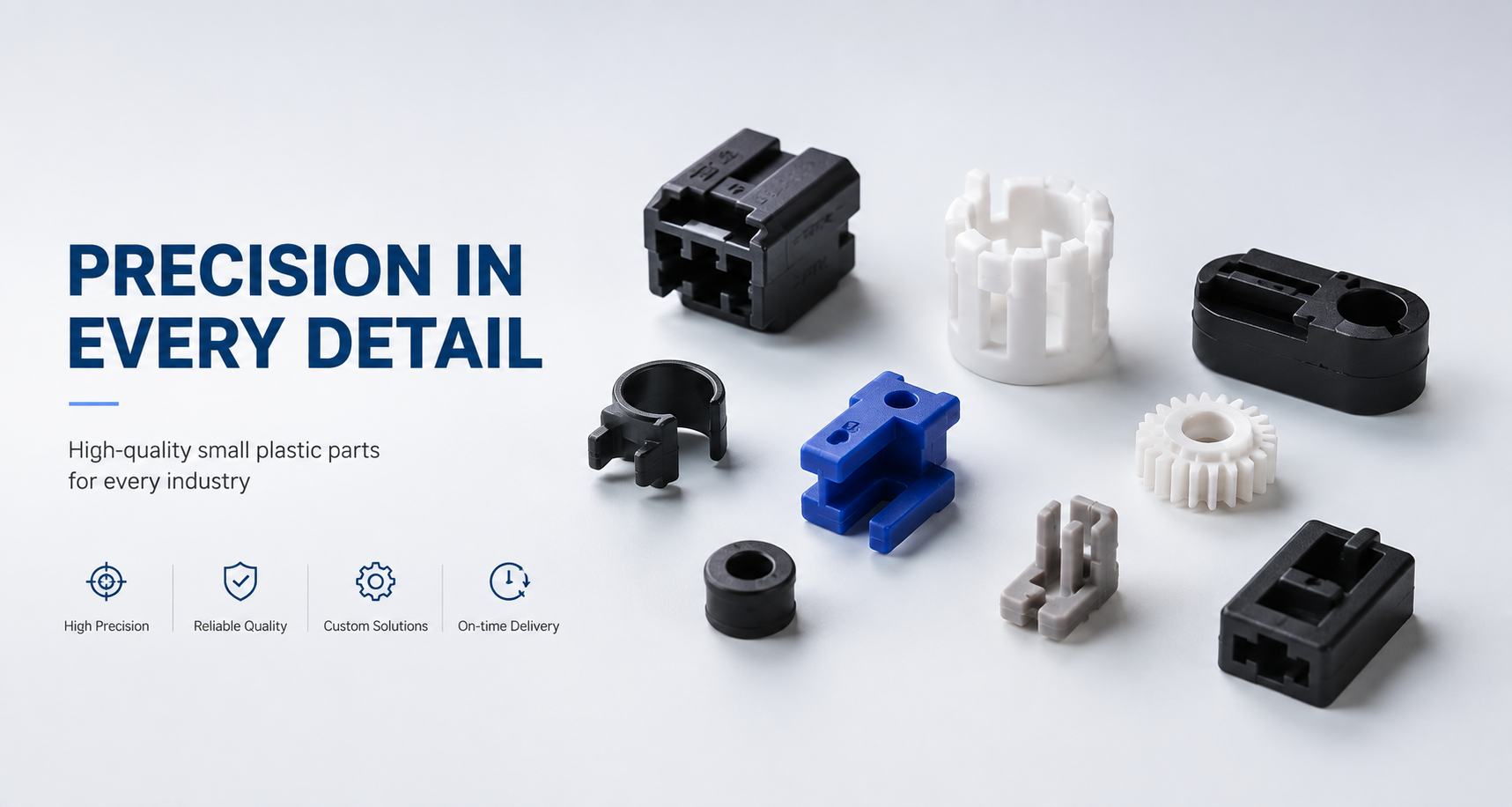
Finding a small plastic parts manufacturer is easy. Finding one that can consistently produce small, accurate plastic parts is much harder.
Small parts often look simple, but they can be difficult to mold. A tiny gate, thin wall, small hole, or tight tolerance can create problems during production. A supplier may produce a good first sample but struggle to maintain the same quality after thousands of cycles.
For OEM buyers and product engineers, the right supplier should offer more than a competitive quotation. You need good mold engineering, stable injection molding, proper quality control, and clear communication.
Here are the key points to check before choosing a manufacturer.
1. Check the Experience of a Small Plastic Parts Manufacturer
Start with the manufacturer’s actual experience.
Ask to see similar projects rather than only looking at factory equipment. A company may have modern machines but limited experience with small precision components.
Relevant experience can include:
- Small electronic components
- Connectors and clips
- Medical plastic parts
- Small automotive components
- Consumer electronics parts
- Precision mechanical components
- Small housings and covers
Pay attention to part size, material, tolerance, surface requirements, and production volume.
A supplier that has solved similar molding problems will usually understand the risks before the mold is built.
For example, small parts with thin walls may require careful control of injection speed and pressure. Parts with tight dimensional requirements may also need more accurate mold machining and better process control.
2. Check the Mold Engineering Capability
For small plastic parts, mold quality has a direct effect on part quality.
Small cavities leave less room for mistakes. Poor gate placement, insufficient venting, weak cooling, or an unsuitable ejection system can cause defects that are difficult to correct later.
A good manufacturer should review the part before starting tooling. The review should cover wall thickness, draft angles, undercuts, gate location, ejection, cooling, and potential molding problems.
You can learn more about this process in our Injection Mold Design Guide.
For complex small parts, DFM is especially important. It is much cheaper to change a part design before mold manufacturing than to modify a finished mold.
3. Check the Equipment of a Small Plastic Parts Manufacturer
Small plastic parts do not always require large injection molding machines.
The important factors are shot size, injection control, repeatability, machine condition, and whether the machine is suitable for the part and mold.
A capable small plastic parts manufacturer should be able to select an appropriate machine based on:
- Part weight
- Projected area
- Mold size
- Required injection pressure
- Material
- Production volume
- Cycle time
Using an oversized machine does not automatically produce better parts. In some cases, a properly sized machine can provide better control and lower production costs.
For very small components, process stability is often more important than machine size. The manufacturer should understand how the machine, mold, material, and process settings work together.
4. Ask How They Control Dimensions
Dimensional consistency is one of the biggest challenges in precision injection molding.
A small part may have several critical dimensions that affect assembly. Even a small change can cause a connector to become too tight, a clip to break, or two components to stop fitting correctly.
Ask the manufacturer:
- What tolerance can you normally maintain?
- How do you inspect critical dimensions?
- Do you provide dimensional reports?
- How do you control cavity-to-cavity variation?
- How do you monitor dimensions during mass production?
The answer should involve both mold precision and process control.
A good first article is not enough. The real test is whether the dimensions remain stable during continuous production.
Our article on Injection Molding Dimensional Stability explains why dimensions can gradually change after thousands of molding cycles.
5. Check Material Experience
The right material depends on the application.
Common materials for small molded components include ABS, PC, POM, PA, PP, PBT, LCP, PPS, and other engineering plastics.
Each material behaves differently during injection molding.
For example, POM is often selected for wear resistance and dimensional stability. PC provides good impact strength and transparency options. Glass-filled materials can provide higher stiffness but may increase mold wear.
Do not simply ask, “Can you mold this material?”
Ask whether the manufacturer has experience with the specific grade you plan to use.
Material selection can affect:
- Shrinkage
- Warpage
- Surface appearance
- Dimensional stability
- Mold wear
- Cycle time
- Part strength
A manufacturer with good material knowledge can often identify potential problems before production starts.
6. Look at Gate and Venting Knowledge
For a small part, the gate may be only a few millimeters or less. That does not make it less important.
Gate position affects filling, pressure, weld lines, appearance, and part deformation.
Venting is equally important. When air cannot escape properly, the result can be burn marks, short shots, poor filling, or unstable molding.
This is one area where practical mold experience matters more than a simple equipment list.
A good supplier should be able to explain why a particular gate type and location is suitable for your part instead of simply copying a standard mold design.
7. Check Quality Control Before Mass Production
Ask how the manufacturer validates the mold and the molded parts.
A typical process should include mold trials, sample inspection, dimensional checks, and necessary adjustments before mass production.
For precision parts, useful inspection equipment may include:
- CMM
- Optical measuring equipment
- Micrometers
- Digital calipers
- Height gauges
- Vision inspection systems
More importantly, the supplier should have a clear inspection method.
If your drawing contains several critical dimensions, those dimensions should be identified and monitored rather than checked randomly.
Quality control should continue during production. This helps identify changes in dimensions, appearance, or molding conditions before they become large batch problems.
8. Look for Engineering Support From a Small Plastic Parts Manufacturer
This point is often underestimated when choosing a supplier.
A technically capable supplier can still become difficult to work with if communication is slow or unclear.
During mold development, you may need to discuss:
- Design changes
- Material substitutions
- DFM comments
- Mold structure
- Sample problems
- Dimensional results
- Production schedules
For overseas customers, direct communication with an experienced project manager can save a lot of time.
At Fentormold, we work directly with customers during DFM, mold design, trials, inspection, and production. We provide injection mold manufacturing and plastic injection molding production for customers in different markets.
For a small project, this direct communication can be especially useful. You can usually discuss technical problems with the people who are actually managing the mold and production instead of passing every question through several departments.
9. Compare the Total Cost, Not Just the Unit Price
The cheapest quotation is not always the lowest-cost solution.
For small plastic parts, a few cents difference in piece price may look attractive. But a poor mold can create much higher costs through:
- High scrap rates
- Frequent mold repairs
- Long cycle times
- Dimensional problems
- Production delays
- Repeated tooling modifications
The mold price should also be evaluated carefully.
Ask what is included in the quotation and why the price differs between suppliers. Mold steel, cavity count, hot runner systems, inserts, tolerances, cooling design, and mold complexity can all affect the final cost.
A good supplier should explain the quotation rather than simply give you a number.
For overseas OEM projects, communication and engineering support can also have a real financial value. A supplier that identifies a tooling problem before production can save much more than the initial difference between two quotations.
10. Check Whether the Supplier Can Support Your Production Volume
Your production volume should influence the tooling solution.
A prototype or low-volume project may not need the same mold structure as a product that will run for several years.
For smaller production quantities, a simpler tooling solution may make more economic sense. For high-volume products, multi-cavity tooling, automated demolding, and cycle-time optimization may become more important.
The manufacturer should understand this difference and recommend a solution based on your actual production plan.
A good supplier should also be able to explain when a higher initial tooling cost can reduce the long-term production cost.
Questions to Ask Before Choosing a Small Plastic Parts Manufacturer
Before placing an order, ask these questions:
- Have you produced similar small plastic parts?
- Can you provide examples of precision molding projects?
- Do you perform DFM before mold manufacturing?
- What dimensional tolerances can you consistently maintain?
- Which materials do you have experience with?
- How do you inspect critical dimensions?
- How do you control quality during mass production?
- Who will manage my project?
- What is included in the mold quotation?
- Can you support both tooling and injection molding production?
The answers will tell you much more than a factory presentation or a low quotation.
Final Thoughts
Choosing the right small plastic parts manufacturer should not be based on price alone.
For precision components, the important factors are mold engineering, material knowledge, injection molding experience, dimensional control, quality inspection, and communication.
A manufacturer does not need to be a huge company to handle demanding plastic parts. In many cases, a focused supplier with experienced engineers and direct project management can provide faster communication and more practical support.
The right small plastic parts manufacturer should understand your part, identify potential problems early, build the right mold, and keep the process stable after production starts.
For OEM buyers, that combination is often more valuable than simply finding the lowest quotation.