
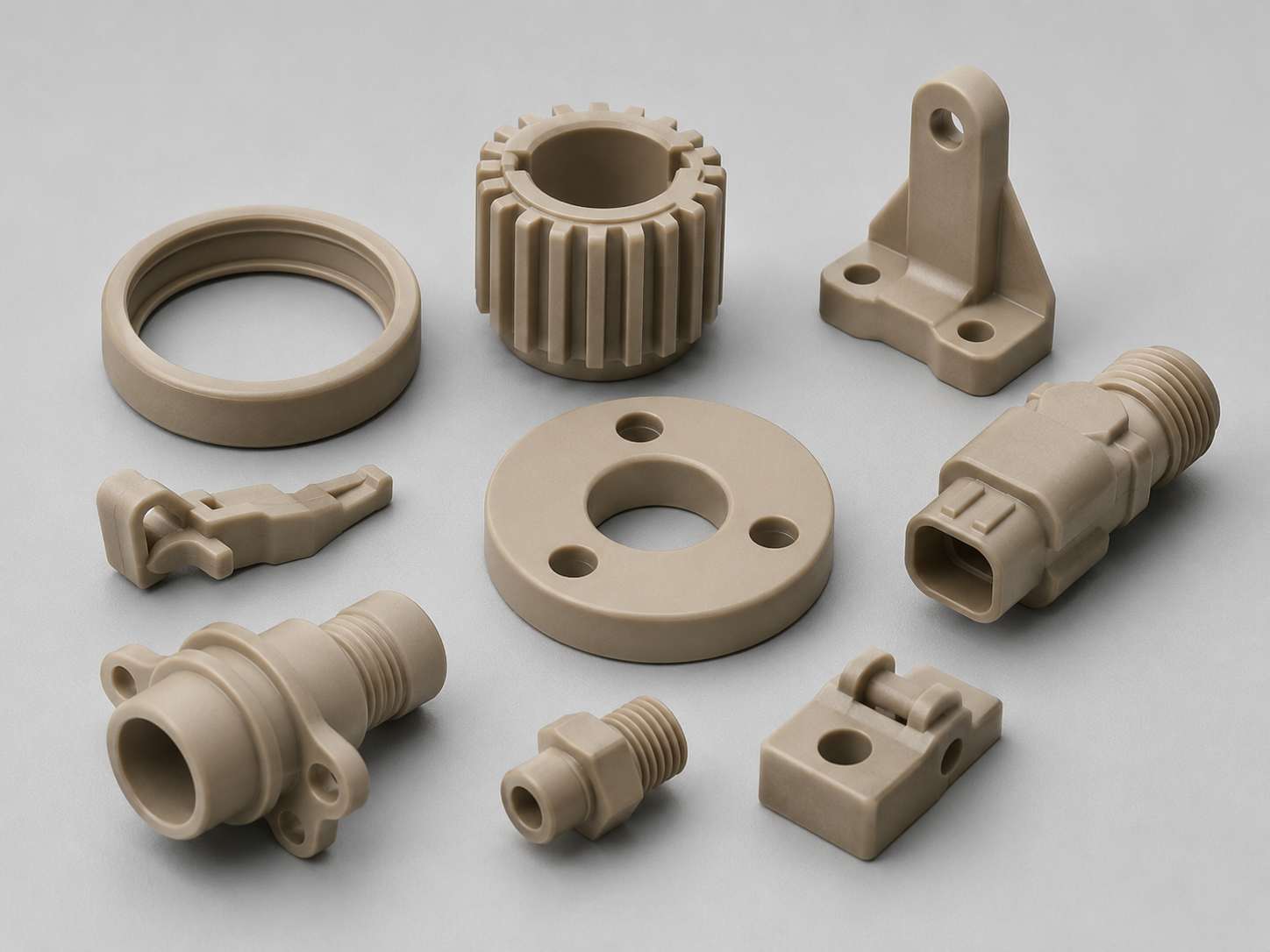
PEEK plastic injection molding is very different from molding common materials such as ABS, PP, or PC.
The material itself is expensive, processing temperatures are high, the mold needs to run hot, and small weaknesses in gate design, venting, heating, or process control can quickly show up in the finished parts.
A mold may fill successfully during the first trial but still produce unstable dimensions, poor surfaces, weak weld lines, excessive flash, or inconsistent appearance during later production.
This is why improving PEEK molding quality is not simply a matter of increasing injection pressure or adjusting a few machine settings.
Good results start with the material, part design, mold structure, and machine setup working together.
For buyers developing PEEK plastic injection molding projects, these are the areas worth checking before the mold reaches production.
Why Is PEEK Plastic Injection Molding More Difficult?
PEEK is a high-performance semi-crystalline engineering thermoplastic.
Its high-temperature capability, strength, chemical resistance, wear resistance, and dimensional performance make it useful for demanding components in industrial equipment, electronics, medical equipment, aerospace, and other engineering applications.
Those advantages also make the material more demanding to process.
PEEK melts at a much higher temperature than common injection molding plastics. Depending on the exact grade, processing may require melt temperatures around the high 300°C range, while mold temperatures are commonly kept well above those used for ordinary engineering plastics.
That changes almost everything around the mold.
The machine barrel and nozzle must be suitable for the material.
The hot runner, if used, must work reliably at the required temperature.
The mold needs an effective heating system.
Gate and runner dimensions need to allow the material to flow without creating unnecessary shear.
Venting must work correctly.
The supplier also needs to control the process consistently instead of relying on repeated trial-and-error adjustments.
The exact settings should always follow the material manufacturer’s recommendations because different PEEK grades can require different conditions.
Dry the Material Before PEEK Plastic Injection Molding
Material preparation is one of the first places to look when PEEK parts show inconsistent quality.
Even when the raw material does not appear wet, proper drying should not be skipped.
Moisture can contribute to surface problems and inconsistent processing, especially when the polymer is exposed to the high temperatures required during molding.
The material supplier’s drying specification should therefore be followed carefully.
For many commercial PEEK grades, drying is carried out at elevated temperature for several hours before molding. The dried material should then be protected from unnecessary moisture exposure before it reaches the machine.
The important point is not memorizing one drying temperature.
It is making sure the actual material grade has a controlled drying procedure.
For repeat production, this should become part of the standard molding process rather than something the operator decides each time.
Mold Temperature Has a Major Effect on PEEK Part Quality
PEEK requires a much hotter mold than materials such as ABS or PP.
This is not just to make the cavity easier to fill.
Mold temperature also affects how the semi-crystalline material develops its final structure.
If mold temperature is too low or uneven, the molded part may show differences in:
- Surface appearance
- Crystallinity
- Shrinkage
- Dimensions
- Mechanical performance
- Warpage
This is why a mold that is simply “hot enough to fill” is not necessarily running correctly.
Temperature also needs to be reasonably uniform across the cavity.
Consider a large PEEK component with one side of the mold running noticeably cooler than the other.
The part may fill completely, but the two areas can cool and shrink differently.
The result can be dimensional variation or warpage that cannot be solved simply by adding more holding pressure.
For PEEK plastic injection molding, mold heating therefore needs to be considered during tooling design rather than added as an afterthought.
Our Injection Mold Design Guide explains how temperature control, gate design, cooling or heating circuits, venting, and ejection need to be considered together before mold manufacturing begins.
The Mold Needs to Handle High Temperature Reliably
A normal injection mold and a PEEK mold may look similar from the outside, but the operating environment is different.
The mold will repeatedly work at elevated temperature.
That affects:
- Mold steel selection
- Insert fit
- Slider clearances
- Lifters
- Guide components
- Seals
- Heating components
- Lubrication
- Thermal expansion
Clearances that work normally at room temperature should still work when the mold reaches its production temperature.
This is especially important around moving components.
A slider that already feels tight during cold fitting may become more difficult to move after the mold is heated.
Repeated rubbing can then create wear, metal powder, seizure, or unstable movement.
Before production, the mold should therefore be tested at the actual intended operating temperature rather than judged only while cold.
For custom tooling projects, our Injection Mold Manufacturing service covers mold engineering, machining, assembly, trial, and modification before production.
Gate Design Can Make or Break a PEEK Project
PEEK should not be treated as though it were simply a more expensive version of ABS.
Gate size and position matter.
An unnecessarily small gate can increase shear and require higher injection pressure.
A poorly positioned gate may create:
- Long flow distances
- Hesitation
- Difficult filling
- Weak weld lines
- Excessive pressure loss
- Uneven packing
- Warpage
The correct gate depends on the geometry.
For a simple compact component, one gate may provide balanced filling.
For a long or complicated part, the mold may need a different gate position, multiple gates, or a more carefully designed runner system.
Gate location should also be reviewed together with the critical dimensions.
The direction in which the PEEK material flows can influence shrinkage and dimensional behavior, particularly with reinforced grades.
This is one reason gate position should be fixed during DFM and mold-flow review rather than chosen only according to where the gate mark is easiest to hide.
Keep the Flow Path Practical
Thin walls and long flow lengths make PEEK plastic injection molding more difficult.
If the product geometry creates excessive resistance, the machine must generate more pressure to fill the cavity.
Increasing pressure can sometimes produce a complete part, but it does not remove the basic design problem.
Higher pressure can also increase the risk of:
- Flash
- Mold deflection
- Difficult ejection
- Internal stress
- Gate stress
- Dimensional instability
Before mold manufacturing begins, check whether the wall thickness, gate position, flow distance, and part geometry are reasonable for the selected PEEK grade.
Where possible, avoid sudden changes from thick sections to very thin flow restrictions.
A small design adjustment made before machining can be far cheaper than trying to correct an extremely difficult filling condition after T1.
Venting Needs More Attention Than Buyers Expect
Poor venting can create serious problems in high-temperature engineering materials.
Air trapped ahead of the melt needs somewhere to escape.
Typical venting locations include:
- End of fill
- Weld-line areas
- Deep ribs
- Bosses
- Ejector locations
- Insert boundaries
- Parting lines
If air cannot escape effectively, the local gas can become highly compressed.
That may result in:
- Burn marks
- Short shots
- Surface defects
- High filling pressure
- Unstable filling
One common mistake is solving a burn mark only by reducing injection speed.
That may reduce the visible defect, but it can create another problem elsewhere if the underlying cause is trapped air.
Vent condition should always be checked before treating the molding parameter as the only cause.
Vents also require maintenance.
A mold that vents correctly during T1 may gradually develop problems after production residue accumulates around the venting areas.
This is a good example of why molding quality has to be evaluated over repeated cycles, not only from the first few samples.
Glass-Filled PEEK Changes the Tooling Requirements
PEEK is available in unfilled and reinforced grades.
Glass-fiber or carbon-fiber reinforced grades can provide much higher stiffness and different dimensional behavior, but they also change the way the mold runs.
Filled material can increase wear around areas such as:
- Gates
- Runners
- Small inserts
- Shutoffs
- High-flow surfaces
The mold steel and local insert design should reflect the expected resin and production volume.
If the material is highly abrasive and the quantity is substantial, areas exposed to repeated high-speed melt flow may need more attention to hardness, surface treatment, or replaceability.
Replaceable gate inserts can sometimes be useful where concentrated wear is expected.
Again, the correct solution depends on the project.
A mold designed for a small batch of unfilled PEEK parts does not necessarily need exactly the same specification as a long-running mold for reinforced PEEK.
Do Not Ignore Shrinkage Direction
Shrinkage is not always uniform.
This becomes especially important with fiber-reinforced materials.
Flow direction influences fiber orientation, and fiber orientation can influence the way the molded part shrinks and moves.
Imagine a rectangular component with long flow in one direction.
Its dimensional behavior along the flow direction may be different from the behavior across the flow direction.
If the component contains critical hole positions, flatness requirements, or sealing surfaces, this should be considered during mold design.
Do not simply take one shrinkage percentage and scale the entire CAD model uniformly without considering:
- Material grade
- Gate location
- Flow direction
- Part thickness
- Geometry
- Reinforcement
- Molding conditions
Material datasheets provide useful starting values, but the final dimensions still need to be confirmed through actual mold trials.
High Mold Temperature Makes Dimensional Checking More Important
The first sample should not be judged only by appearance.
PEEK components are often selected precisely because the application has demanding functional requirements.
That means dimensional inspection should be planned early.
At T1, check the critical dimensions from the 2D drawing and compare them with the actual mold condition and process parameters.
After measurement, corrections may involve:
- Steel adjustment
- Packing changes
- Mold temperature changes
- Gate optimization
- Cooling or heating balance
- Product design modification
It is normal for some precision tooling projects to require several rounds of measurement and correction.
The important point is to keep the CAD data, mold modification, measurement report, and final steel condition consistent.
Repeated changes without good revision control can create a mold where the physical steel and engineering data no longer match.
Check the Mold, Not Only the PEEK Parts
A good PEEK sample does not automatically mean the mold is ready for production.
During trial, also check:
- Water or oil leakage
- Heating system stability
- Heater connections
- Temperature distribution
- Slider movement
- Lifter movement
- Ejection
- Gate condition
- Venting
- Insert fit
- Parting-line condition
- Abnormal rubbing
- Positioning
Small tooling problems tend to become larger during long production runs.
For example, a moving insert that lightly rubs during trial may eventually develop severe wear.
A small venting problem can become worse as residue accumulates.
A slight heater instability can later create inconsistent mold temperature and dimensional variation.
The purpose of mold trial is therefore not simply to make a few acceptable samples.
It is also to determine whether the tooling can repeat the process reliably.
Be Careful With Residence Time
PEEK runs at high melt temperature.
Material should not remain unnecessarily inside a hot barrel for an extended period.
Machine size therefore matters.
An oversized injection unit using only a very small percentage of its shot capacity may leave material inside the barrel longer than necessary.
Long residence time at high temperature can make process control more difficult and may increase material degradation risk.
A suitable molding machine should match:
- Shot weight
- Mold size
- Clamping requirement
- Required injection pressure
- Temperature capability
Machine selection is therefore part of the quality plan.
It should not be decided only by whether the mold physically fits between the tie bars.
Do Not Solve Every Problem With Injection Pressure
When a PEEK part does not fill correctly, the quickest reaction is often:
“Add pressure.”
Sometimes pressure really is the issue.
But before increasing it significantly, check the actual cause.
The problem may come from:
- Material temperature
- Mold temperature
- Gate size
- Runner restriction
- Poor venting
- Flow length
- Thin wall
- Incorrect injection speed profile
If the basic flow path is poor, continuously increasing pressure can create flash or mold stress without producing a stable process.
Good PEEK plastic injection molding should aim for a reasonable processing window rather than one narrow machine setting where the part only just manages to fill.
A process with some operating margin is much easier to reproduce during future production.
Surface Quality Starts Before Polishing
When a PEEK part has a poor surface, buyers sometimes assume that the cavity simply needs more polishing.
That is not always the answer.
Surface appearance can also be affected by:
- Mold temperature
- Venting
- Injection speed
- Material condition
- Gate position
- Flow marks
- Weld lines
- Surface texture
- Crystallization behavior
Polishing cannot correct every processing defect.
The surface requirement should be defined before mold construction so that the steel finish and molding conditions can be developed together.
This is especially important for visible housings or functional surfaces where appearance must remain consistent across production batches.
Establish a Stable Process Before Approving Production
A good trial sample can sometimes be produced through many small operator adjustments.
That does not necessarily mean the mold is production-ready.
Before approving mass production, the process should become repeatable.
Key settings should be documented, including:
- Drying condition
- Barrel temperatures
- Nozzle temperature
- Mold temperature
- Injection speed
- Injection pressure
- Holding pressure
- Holding time
- Cooling or heating cycle
- Screw speed
- Back pressure
- Cycle time
The process does not need to remain absolutely identical forever.
Normal production still requires appropriate adjustment.
However, having a reliable starting window makes future batches far easier to control.
Our article on How to Improve Plastic Injection Molding Quality discusses how mold condition, processing, material control, and production inspection work together to maintain stable molded-part quality.
Production Inspection Should Focus on What Matters
PEEK parts can be expensive.
That makes scrap particularly painful.
However, inspecting every possible dimension on every part is rarely practical.
Instead, identify the important characteristics:
- Critical dimensions
- Sealing surfaces
- Assembly dimensions
- Hole positions
- Flatness
- Appearance
- Flash
- Gate quality
- Functional interfaces
Inspection frequency can then be matched to the production risk.
For a new mold, more frequent checks may be appropriate.
After the process becomes stable, production inspection can focus on the critical characteristics and periodic confirmation.
For projects continuing from tooling into repeat molding, our Injection Molding Production service covers mold trials, production setup, inspection, and repeat manufacturing of custom plastic parts.
How to Improve PEEK Plastic Injection Molding Quality
There is no single machine setting that guarantees good PEEK parts.
Quality comes from controlling the entire process.
Before mold manufacturing:
- Confirm the exact PEEK grade.
- Review wall thickness and flow length.
- Decide gate location carefully.
- Review critical dimensions.
- Plan mold heating and temperature control.
- Consider venting and material reinforcement.
During mold manufacturing:
- Control insert accuracy.
- Check hot-condition clearances.
- Pay attention to gate and runner surfaces.
- Make sure moving components operate reliably.
- Confirm the heating system before trial.
During trial:
- Dry the material correctly.
- Bring the mold to a stable working temperature.
- Record the molding conditions.
- Check filling and venting.
- Measure critical dimensions.
- Inspect the mold itself.
- Correct tooling problems instead of hiding them with extreme machine settings.
Before production:
- Confirm the final drawing revision.
- Establish a repeatable molding window.
- Approve representative samples.
- Define critical inspection points.
- Document the final process.
These steps matter more than simply trying to achieve one visually perfect shot.
Final Thoughts
PEEK plastic injection molding requires more attention than molding common engineering plastics, but the process does not need to become unnecessarily complicated.
Most quality problems still come back to a few basic areas: material preparation, temperature control, flow, venting, mold condition, dimensional control, and process stability.
The difference is that PEEK gives the process less room for careless decisions.
A small gate, uneven mold temperature, poor venting, unsuitable machine, or unstable heating system can quickly become an expensive problem because both the material and tooling costs are high.
The best approach is to review these risks before steel is cut.
Then use mold trials to measure the real part, correct the mold where necessary, and establish a process that can be repeated without constantly chasing parameters.
When material, tooling, and molding conditions are developed together, PEEK plastic injection molding can produce stable, high-quality engineering parts for demanding applications.