
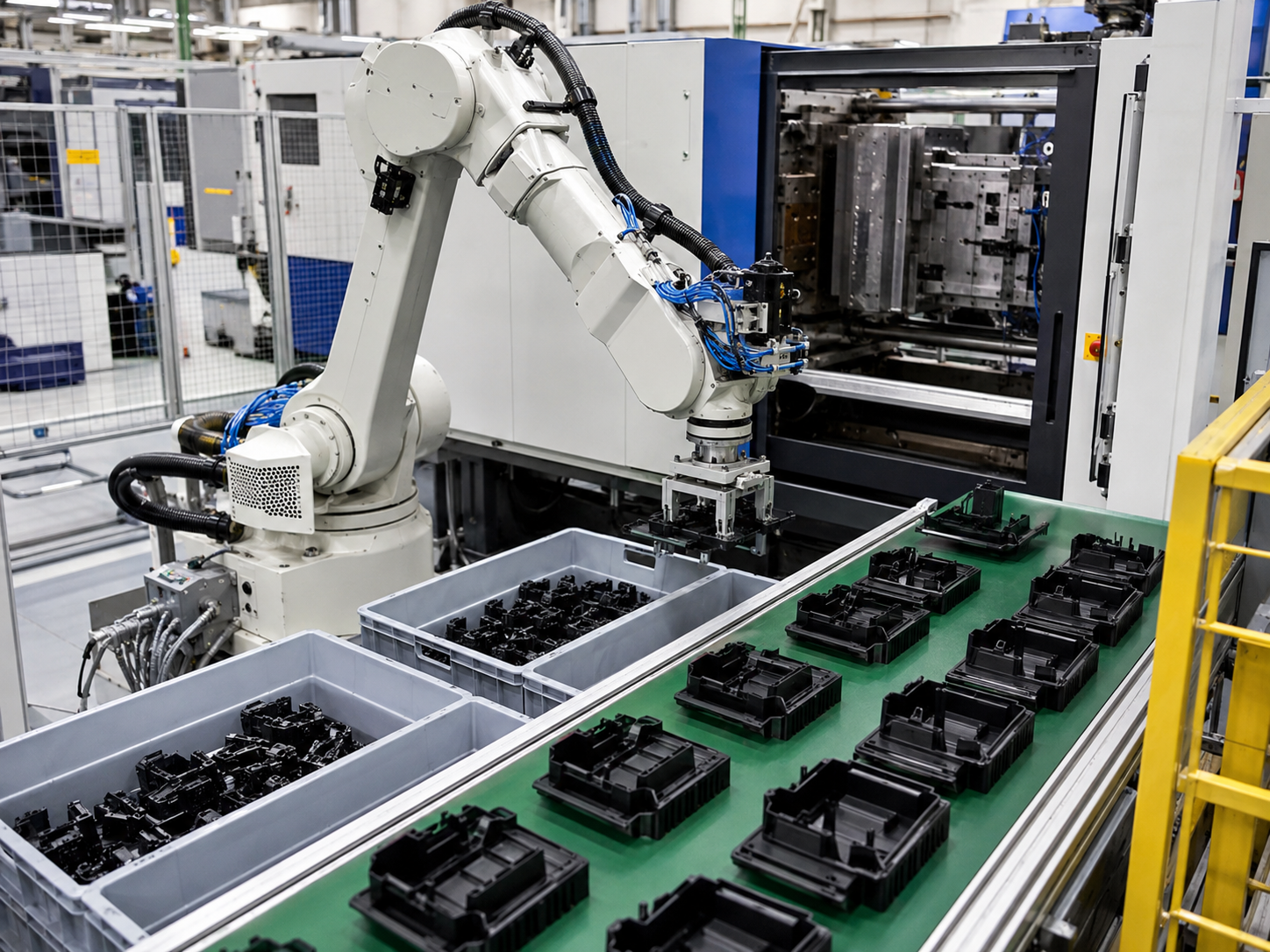
Plastic molding automation can improve production efficiency, reduce repetitive manual work, and make injection molding more consistent.
But automation does not automatically make every molding project better.
A robot added to an unstable mold will not fix poor ejection. Automatic part removal will not solve inconsistent dimensions. A fast cycle is also meaningless if parts frequently stick, deform, or require manual correction.
The best results usually come when automation is considered together with the mold design, part geometry, molding process, production quantity, and inspection requirements.
For buyers planning repeat production, the important question is not simply whether robots can be used.
It is where plastic molding automation actually saves time, improves consistency, and reduces unnecessary manual operations.
What Does Plastic Molding Automation Include?
Automation in injection molding can range from a very simple automatic ejection system to a highly integrated production cell.
Common examples include:
- Automatic part ejection
- Robot or sprue picker removal
- Conveyor systems
- Insert loading
- Part orientation
- Degating
- Vision inspection
- Leak testing
- Assembly
- Labeling
- Packaging
- Automatic counting
Not every project needs all of these.
For many molding programs, the biggest improvement may come from something much simpler, such as allowing the molded part to eject cleanly onto a conveyor without an operator opening the machine area every cycle.
For other products, a robot may be required because the part is cosmetic, fragile, hot, difficult to eject, or needs to be placed directly into another process.
The right level of plastic molding automation depends on the actual production problem.
Start With Reliable Automatic Ejection
Before discussing robots, first ask whether the part can eject automatically.
This is one of the most important points in production efficiency.
A well-designed mold should release the molded part consistently without requiring an operator to pull it off the core by hand.
Automatic ejection depends on factors such as:
- Draft angle
- Rib depth
- Boss design
- Surface texture
- Part shrinkage
- Ejector location
- Ejector quantity
- Ejector stroke
- Mold temperature
- Part stiffness
If the part stays on the core randomly, automation becomes difficult.
The robot may be waiting for a part that has not released, or the machine may continue cycling while the previous part remains inside the mold.
This can damage both the molded component and the tooling.
For that reason, plastic molding automation should start with a mold that can repeatedly complete its own mechanical cycle.
Our Injection Mold Design Guide explains how draft, ejection, parting lines, sliders, cooling, and gate design influence the way a mold behaves during production.
When Free-Drop Ejection Makes Sense
Some plastic parts do not need a robot at all.
If the product is relatively strong, non-cosmetic, and can fall safely after ejection, free-drop production may be the simplest solution.
The machine opens, the ejector pushes the part away from the core, and the part drops into:
- A collection box
- A chute
- A conveyor
- A separator
This works especially well for parts such as:
- Small internal components
- Clips
- Brackets
- Simple housings
- Industrial components
- Non-cosmetic parts
The advantage is simplicity.
There is no robot movement adding time to every molding cycle.
There is also less equipment to program, maintain, or stop production.
However, free-drop ejection is not suitable if falling can damage the part.
It may also be unsuitable when the cavity surface must remain scratch-free.
The automation decision should therefore consider both production efficiency and part quality.
When a Robot Is Better Than Automatic Drop
Robots become more valuable when simply dropping the product is risky or impossible.
A robot may be appropriate when:
- The part has a cosmetic surface
- The product is easily scratched
- The part may deform while hot
- The component is large
- The mold has several parts per cycle
- Parts need orientation
- Inserts need to be loaded
- Cycle consistency is important
- The component moves directly into assembly or inspection
A robot can remove the component at the same position and in the same way every cycle.
This reduces variation caused by manual handling.
For visible automotive, appliance, medical, or electronic parts, controlled removal can also prevent components from hitting each other after ejection.
The robot does not need to be complicated.
Sometimes its only job is to pick up the part and place it gently onto a conveyor.
That small step can already make plastic molding automation worthwhile.
Do Not Let the Robot Increase Cycle Time Unnecessarily
Automation should reduce production time, not create a new bottleneck.
A robot entering the mold area must complete its movement safely before the mold can close again.
If the robot takes too long to remove the part, the machine remains open.
That increases cycle time.
For example, imagine the molding process itself could run at a 30-second cycle.
If the robot requires several unnecessary movements before leaving the mold area, the total cycle may become longer even though the molding process has not changed.
The robot path should therefore be optimized.
The usual objective is:
- Mold opens.
- Ejection begins.
- Robot enters.
- Part is picked.
- Robot exits the mold area quickly.
- Mold closes.
- Robot completes secondary movements outside the mold area.
The mold should not remain open while the robot performs actions that could happen elsewhere.
This becomes increasingly important in high-volume production because even a small increase per cycle adds up over thousands of shots.
Mold Design Must Support Plastic Molding Automation
Automation works best when it is considered during mold design.
The mold needs to provide enough space for the robot or end-of-arm tooling to reach the part safely.
Potential problems include:
- Narrow robot access
- Deep cavity areas
- Sliders blocking pickup positions
- Fragile ejector positions
- Parts rotating during ejection
- Multiple components sticking together
- Sprues interfering with pickup
- Unstable product location
If the supplier knows automation is required before mold construction, these issues can often be addressed in the tooling design.
For example, the ejector system can be designed so that the product remains in a predictable position for pickup.
The sprue or runner can also be separated in a controlled way.
That is much easier than trying to add automation after the mold has already been completed.
For new tooling projects, our Injection Mold Manufacturing service includes mold design, manufacturing, assembly, trial, and engineering adjustments before repeat production.
Automatic Runner Separation Can Save Manual Work
Cold-runner molds often produce both molded parts and runner material during every cycle.
Someone then needs to separate them.
With simple tools, this may be done manually.
For larger quantities, this repeated handling can become expensive.
Depending on the mold design, runner separation may be handled through:
- Automatic degating
- Three-plate mold separation
- Tunnel gates
- Submarine gates
- Robot separation
- Post-molding cutting equipment
The correct method depends on product appearance and gate requirements.
A tunnel gate, for example, can separate automatically when the part ejects.
However, this does not mean a tunnel gate should always be used.
Poorly designed automatic degating can create:
- Large gate marks
- Gate whitening
- Gate cracking
- Product deformation
- Unstable gate breakage
The automation benefit must be balanced against part quality.
Insert Molding Can Benefit From Robots
Insert molding is another area where automation may have a strong impact.
Metal inserts such as:
- Nuts
- Bushings
- Pins
- Terminals
- Threaded components
may need to be positioned inside the mold before every shot.
For low production quantities, manual loading can be perfectly reasonable.
For higher quantities, manual loading can increase cycle time and introduce variation.
Problems can include:
- Missing inserts
- Incorrect orientation
- Incorrect insert position
- Operator delays
- Contamination
A robot can load inserts in a consistent sequence.
In more advanced production cells, sensors may confirm that each insert is present before the mold closes.
However, the economics depend heavily on production volume.
Building a complex automated loading system for a short production run may cost more than the labor it saves.
This is why plastic molding automation should always be evaluated against expected lifetime production, not just the first purchase order.
Automation Is Useful for Large Parts
Large molded parts often benefit from robotic handling.
A large housing, panel, or structural component may still be hot and relatively flexible when the mold opens.
If an operator pulls it unevenly from the mold, the product may twist or deform.
Large parts may also be awkward to handle repeatedly.
A robot can:
- Support the part evenly
- Remove it at a controlled speed
- Place it on a cooling fixture
- Transfer it to trimming
- Move it to inspection
This can improve both worker efficiency and repeatability.
However, robotic handling will only work well if the part already releases reliably from the mold.
A difficult ejection problem should still be corrected at the tooling level first.
Automatic Inspection Can Reduce Repetitive Checking
Not all automation happens inside the molding machine.
After molding, some projects use automatic inspection.
Typical checks may include:
- Part presence
- Color
- Shape
- Missing features
- Insert presence
- Short shots
- Surface defects
- Hole presence
- Basic dimensions
Vision systems can be especially useful for clear pass/fail features.
For example, a molded component containing four metal inserts can be checked to confirm all four inserts are present.
This can be faster than relying on operators to inspect every part manually.
However, automated inspection also has limitations.
A camera cannot automatically judge every cosmetic defect correctly.
Reflection, color variation, part orientation, lighting, and surface texture can affect the result.
Critical inspection systems need to be validated using real production parts.
Automation should make quality control more reliable, not simply create another machine that occasionally rejects good parts or passes defective ones.
Automatic Counting and Packing Can Improve Efficiency
For small molded components, counting can consume more labor than expected.
Imagine a production order requiring bags of 100 parts.
If every bag is counted manually, the handling time adds up.
Automation may use:
- Conveyor counting
- Weight-based counting
- Optical sensors
- Automatic bagging
This is especially useful for standardized repeat orders.
The system can allow molded products to move directly from the machine into packaging with limited operator contact.
That can reduce:
- Counting errors
- Handling
- Mixing
- Packaging labor
Again, this does not necessarily require an expensive production line.
Simple automation can often provide most of the benefit.
Plastic Molding Automation Can Improve Process Consistency
One advantage of automation is that it reduces cycle-to-cycle variation caused by manual handling.
Suppose an operator needs to:
- Open the machine safety gate.
- Remove the part.
- Cut the runner.
- Inspect the component.
- Place it in a box.
- Restart the cycle.
The time may vary from one cycle to another.
One operator might take 15 seconds.
Another might take 25.
The same operator may also become slower toward the end of a long shift.
That variation can affect mold temperature and cycle conditions.
With automatic production, the mold can run closer to a fixed cycle.
Stable cycle time can help maintain:
- Mold temperature
- Part cooling
- Shrinkage
- Dimensions
- Production output
This is one reason plastic molding automation can contribute to quality as well as labor efficiency.
Automation Will Not Fix an Unstable Molding Process
This is one of the most important points.
Automation should not be used to hide molding problems.
If the part has:
- Unstable warpage
- Flash
- Short shots
- Burn marks
- Sticking
- Ejection damage
- Dimensional variation
these problems need to be corrected first.
A robot simply produces unstable parts more automatically.
Before the mold enters unattended or semi-automatic production, the molding process should have a reasonable operating window.
The supplier should confirm that the mold can run repeatedly without frequent operator intervention.
This includes checking the mold itself for issues such as:
- Water leakage
- Slider wear
- Ejector problems
- Insert movement
- Poor venting
- Abnormal rubbing
- Gate damage
Small mold problems seen during trial can become much larger after continuous automatic cycling.
For repeat manufacturing, our Injection Molding Production service covers mold setup, process control, inspection, and ongoing production of custom plastic parts.
When Automation Does Not Make Economic Sense
Automation is not always the correct answer.
For small production quantities, manual production may be cheaper and more flexible.
Automation may not make sense when:
- Order quantities are low
- The product changes frequently
- Tooling is only for prototypes
- Cycle time is already long
- Manual handling is minimal
- Robot fixtures would be complicated
- Multiple products need constant changeover
Imagine a mold that produces only a few hundred parts per year.
Building custom robotic end-of-arm tooling and fixtures may never recover its cost.
The same money may be better spent improving the mold, adding another cavity, reducing cycle time, or simplifying the product design.
A realistic supplier should not recommend automation simply because automation sounds more advanced.
Compare Automation Cost With Lifetime Production
The correct comparison is not robot cost versus one month’s labor.
Look at the full production program.
Important factors include:
- Annual quantity
- Product life
- Cycle time
- Labor per cycle
- Number of shifts
- Scrap reduction
- Quality improvement
- Operator safety
- Required maintenance
- Changeover frequency
Consider a project that will run for several years at high volume.
Saving a few seconds of manual handling on every cycle can become significant.
For a short prototype project, the same saving may have almost no financial value.
This is why automation decisions should be made early, when expected production quantity is known.
Start With Simple Automation First
One mistake is assuming automation must begin with a complicated robot cell.
Often, the best production improvement comes from smaller changes.
Examples include:
- Automatic ejection
- Tunnel gate degating
- Simple conveyor
- Part collection chute
- Sprue picker
- Automatic counting
- Basic vision inspection
These systems can remove repetitive work without creating unnecessary complexity.
More automation can always be added later if production volume grows.
This approach is particularly practical for projects where initial quantities are uncertain.
Instead of designing the most advanced possible production line, design a mold and process that can support future automation if it becomes necessary.
How to Improve Efficiency With Plastic Molding Automation
Before adding automation, first identify where time is actually being lost.
Ask:
- Does the operator need to remove every part?
- Does the runner require manual cutting?
- Are parts being scratched during handling?
- Is insert loading slowing the cycle?
- Are operators repeatedly counting parts?
- Does manual inspection consume significant time?
- Does cycle time change from operator to operator?
Then solve the biggest problem first.
A practical automation plan may look like this:
Step One: Stabilize the Mold
Make sure filling, cooling, ejection, sliders, lifters, and other mold movements are reliable.
Step Two: Achieve Reliable Automatic Ejection
The part should release consistently without manual assistance.
Step Three: Remove Repetitive Handling
Use a chute, conveyor, sprue picker, or robot where necessary.
Step Four: Automate Simple Secondary Operations
Consider counting, degating, insert loading, or basic inspection.
Step Five: Measure the Result
Compare:
- Cycle time
- Labor requirement
- Scrap
- Output
- Downtime
- Maintenance
Automation is valuable only when the complete production process improves.
Final Thoughts
Plastic molding automation can improve production efficiency, but the most effective systems are not always the most complicated.
A mold that ejects reliably onto a conveyor may provide better economics than an expensive robot cell that adds unnecessary movements to every cycle.
Robots become more useful when parts are large, cosmetic, fragile, difficult to handle, or need to move directly into another operation.
Automatic insert loading, inspection, counting, and packaging can provide further benefits when production volume justifies the investment.
The key is to build automation on top of a stable mold and molding process.
First make sure the part fills correctly, cools consistently, and ejects reliably.
Then identify which manual operations are consuming time or creating variation.
When automation is applied to those specific problems, plastic molding automation can reduce labor, stabilize cycle time, improve repeatability, and make long-term production more efficient.