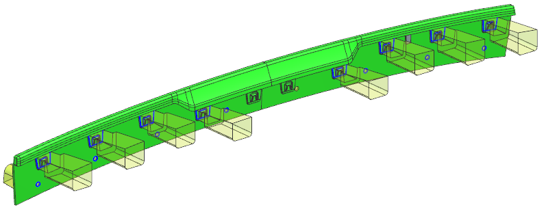
Undercuts are common in plastic parts, but injection mold undercuts can make mold design, ejection, and manufacturing much more complicated. Features such as side holes, snap-fit hooks, internal grooves, and recessed areas may prevent a molded part from being ejected directly from the mold.
When designing injection mold undercuts, the goal is not simply to remove the feature. A better approach is to find the simplest tooling method that can form the undercut reliably without adding unnecessary mold cost or maintenance.
For a product engineer or buyer, this matters because an undercut can affect the mold structure, tooling price, lead time, cycle time, and long-term reliability.
What Is an Undercut in Injection Molding?
An undercut is a feature on a plastic part that prevents the part from being removed from the mold in the normal opening direction.
A simple example is a side hole through the wall of a molded housing. If the hole is perpendicular to the mold opening direction, a conventional core and cavity cannot release the part without damaging the feature.
Common undercut features include:
- Side holes
- Internal holes
- Snap-fit hooks
- Internal grooves
- Side ribs
- Recessed features
- Threads
- Hooks and clips
- Captive features
- Openings that face sideways
Not every undercut requires a complicated mechanism. Some can be redesigned, while others can be formed with a slider, lifter, collapsible core, or other specialized tooling solution.
Why Are Undercuts Difficult to Mold?
A conventional injection mold normally opens along one primary direction.
During mold opening, the cavity and core separate and the molded part remains on the appropriate side of the mold until the ejection system releases it.
An undercut creates a problem because part of the plastic feature is mechanically locked around the mold steel.
If the mold simply opens without releasing that feature, several problems can occur:
- The part may remain stuck in the mold.
- The undercut may be damaged during ejection.
- The mold component may interfere with the part.
- Excessive ejection force may be required.
- The mold may need additional mechanisms.
This is why injection mold undercuts should be considered during product design rather than after the mold design has already started.
How to Design Undercuts in Injection Molded Parts
The first step is to identify every undercut on the 3D part model.
Do not look only at obvious side holes. Small hooks, ribs, internal grooves, snap features, and recessed surfaces can also create molding problems.
A practical review should ask:
- What is the normal mold opening direction?
- Does every feature release in that direction?
- Which features create mechanical interference?
- Can the feature be redesigned?
- If it cannot be redesigned, what tooling mechanism is required?
- Will the mechanism increase mold cost or maintenance?
A good undercut design starts with the simplest possible solution.
1. Check the Mold Opening Direction
Before adding sliders or lifters, check whether the part can be oriented differently.
Sometimes an undercut exists only because the part has been positioned in an inefficient direction.
Changing the mold opening direction may allow the feature to release naturally.
This can eliminate an expensive mechanism without changing the actual plastic part.
However, the new orientation also needs to be checked against parting line location, ejection, cooling, gates, and mold structure.
For a broader review of these design decisions, see our Injection Mold Design Guide.
2. Add Draft Where Possible
Draft angle does not eliminate every undercut, but it can make molded features easier to release.
Vertical walls, deep ribs, bosses, and recessed features should be reviewed for sufficient draft.
Without enough draft, the plastic can grip the mold surface during ejection.
This becomes even more important when the feature has texture or a rough surface finish.
The correct draft depends on the material, feature depth, texture, dimensional requirements, and mold surface finish.
3. Consider a Slider for Side Undercuts
A slider is one of the most common solutions for external side undercuts.
The slider moves sideways during mold opening or through an angled mechanism, allowing the mold to release the side feature before the part is ejected.
Sliders are commonly used for:
- Side holes
- Side clips
- Side grooves
- External hooks
- Side ribs
- Housing features
The slider needs enough travel to clear the undercut.
It also needs suitable wear plates, guide components, locking features, and lubrication where required.
If a side undercut is relatively large or needs a significant amount of movement, a slider is often a practical solution.
When Should You Use a Lifter?
A lifter is often used for internal undercuts, particularly around the inside of a molded part.
Unlike a conventional ejector pin, a lifter can move both upward and sideways as the mold opens or the ejector system advances.
This combined movement allows it to release an internal undercut while helping push the part away from the core.
Typical applications include:
- Internal hooks
- Internal ribs
- Snap-fit features
- Small internal grooves
- Internal recessed areas
The choice between a lifter and a slider depends heavily on where the undercut is located.
For a detailed comparison, see Lifter vs Slider in Injection Mold: Key Differences.
Slider vs Lifter for Injection Mold Undercuts
A common mistake is to select a mechanism based only on the shape of the undercut.
The location of the feature is equally important.
| Feature | Slider | Lifter |
|---|---|---|
| Typical location | External side | Internal side |
| Movement | Mainly lateral | Upward + lateral |
| Common application | Side holes and hooks | Internal hooks and grooves |
| Mold space | Requires side space | Requires ejector-side space |
| Ejection function | Usually separate from ejection | Can assist ejection |
| Typical design | Larger side features | Smaller internal features |
These are general guidelines rather than fixed rules. A specialized mold design may use either mechanism depending on the geometry.
Can Undercuts Be Designed Without Sliders or Lifters?
Yes.
This is an important point for product designers.
Not every undercut needs a moving mold component. Sometimes the best solution is to modify the part.
For example, you may be able to:
- Change the direction of a hook
- Reduce the depth of a groove
- Open one side of a feature
- Change an internal rib into a standard rib
- Replace a closed feature with an open feature
- Move the feature toward the mold opening direction
A small change to the part geometry can sometimes eliminate a slider or lifter completely.
For high-volume products, this can make a significant difference to tooling cost and maintenance.
How Undercuts Affect Injection Mold Cost
Undercuts can increase mold cost because they may require additional components and machining.
A simple mold with no moving side mechanisms is generally easier to manufacture and maintain than a mold containing multiple sliders, lifters, or specialized cores.
The cost impact may include:
- Additional mold components
- More CNC machining
- EDM machining
- Additional assembly work
- More complicated mold design
- Longer mold trial time
- More maintenance points
- Higher replacement-part costs
However, removing an undercut only to reduce the initial mold price is not always the right decision.
If the feature is important to the product, the tooling should be designed around a reliable production solution.
The better approach is to compare the cost of the tooling mechanism against the value of the required part feature.
How Undercuts Affect Mold Lead Time
Undercuts can also extend mold lead time.
A simple mold mechanism may be designed, machined, assembled, and tested relatively quickly.
A complex undercut mechanism requires more design work and more components to be checked during mold assembly.
For example, a mold with several sliders may require additional work on:
- Slider blocks
- Angle pins
- Wear plates
- Locking surfaces
- Guide systems
- Cooling
- Lubrication
- Ejection clearance
For buyers working with a fixed product launch date, these details should be discussed during the RFQ stage rather than after the mold order has been placed.
How to Reduce Undercut Complexity
The easiest way to reduce tooling complexity is to review the product before mold manufacturing begins.
A DFM review can identify undercuts, difficult ejection areas, thin walls, deep ribs, and other features that may increase tooling risk.
A useful approach is:
Part design → Undercut review → DFM analysis → Tooling solution → Mold design → Manufacturing
This is much more effective than discovering a serious undercut problem after steel has already been ordered.
For buyers comparing tooling suppliers, our Injection Mold Manufacturing service covers the complete tooling process from mold design through manufacturing.
Common Undercut Design Mistakes
Making the Undercut Deeper Than Necessary
A deeper undercut usually requires more slider or lifter travel.
If the feature performs the same function with a smaller undercut, reducing its depth may simplify the mold.
Ignoring Slider or Lifter Travel
The mechanism must move far enough to completely clear the plastic feature.
Insufficient travel can cause interference during mold opening or ejection.
Leaving No Space for the Mechanism
A part may look perfectly acceptable in CAD, but there may be no room inside the mold for the required slider, lifter, cooling channel, or fasteners.
The complete mold structure should be checked before the final part design is released.
Placing Cooling Too Close to Moving Components
Sliders and lifters need space to move safely.
Cooling channels should not interfere with their travel or weaken the surrounding steel.
Adding Too Many Undercuts
Multiple small undercuts can make a mold disproportionately complicated.
When possible, group or redesign features so that one mechanism can solve several molding requirements.
How Undercuts Affect Part Ejection
An undercut does not only affect the mold opening mechanism. It can also affect ejection.
The part needs to be released from all mold features before ejector pins push it out.
If a slider or lifter does not retract completely, the ejector system may force the part against the remaining obstruction.
This can lead to:
- Ejector marks
- Deformation
- Cracking
- Scratches
- Broken mold components
Ejection should therefore be reviewed together with the undercut mechanism.
How Material Selection Affects Undercuts
Plastic material also matters.
Some materials are more flexible and may tolerate a small amount of deformation during ejection. Others are more rigid and may require a mechanical release mechanism.
Shrinkage also affects the relationship between the molded part and the core.
Materials with higher shrinkage may grip the core more strongly, especially around deep features.
For this reason, undercut design should consider:
- Material shrinkage
- Material stiffness
- Part wall thickness
- Feature depth
- Mold surface finish
- Ejection force
The plastic material should be confirmed before the final tooling solution is selected.
Undercut Design Checklist
Before releasing a part for mold manufacturing, check the following:
- Is the mold opening direction clearly defined?
- Have all external undercuts been identified?
- Have all internal undercuts been identified?
- Can any undercuts be removed through part redesign?
- Is sufficient draft provided?
- Is a slider required?
- Is a lifter required?
- Is enough mechanism travel available?
- Is there enough space for cooling?
- Is the ejection system clear?
- Does the selected plastic affect release?
- Will the undercut increase mold cost?
- Will it increase mold lead time?
- Can one mechanism handle multiple features?
Completing this review before mold construction can prevent many avoidable tooling changes.
How to Choose the Best Solution for an Undercut
There is no single solution for every injection mold undercut.
For an external side feature, a slider is often the first option to consider.
For a small internal feature, a lifter may be more practical.
For a complex or deep internal feature, a collapsible core or another specialized mechanism may be necessary.
And in some cases, changing the part design is the best solution of all.
The decision should consider both the technical requirement and the commercial impact.
A reliable mold is not necessarily the mold with the most complicated mechanism. In many cases, the best design is the simplest mechanism that produces the required part consistently.
Injection mold undercuts should be addressed early in product and mold design.
Before adding a slider or lifter, check whether the part can be redesigned or repositioned to eliminate the undercut. If the feature is essential, select the simplest reliable tooling mechanism based on its location, depth, required movement, and production requirements.
A well-planned undercut design can help control mold cost, reduce tooling risk, simplify maintenance, and improve long-term production reliability.
For injection molded parts that require complex side features, the most important step is to review the part geometry before the mold design is finalized.