How to Reduce Cost for Large PC/ABS Parts with Low Production Volume
Many industries need large plastic parts, but only in small quantities. This is common in automotive, medical, industrial equipment, and consumer electronics.
A production mold is expensive and takes a long time to build. For low-volume projects, it is often not a good investment.
Rapid production tooling is a better choice. It reduces tooling cost and shortens lead time.
However, many people think a rapid mold can simply be made cheaper. This is not true.
Some areas can save money. Some areas cannot.
If you reduce the mold quality too much, the part may not fill completely. It may also have flash, warpage, or poor dimensions. The customer will not accept these parts, even if the order quantity is small.
At Fentor Mold, we focus on reducing cost without sacrificing quality.
Project Background
Material: PC/ABS
Part Size: Large plastic housing
Production Volume: Hundreds to a few thousand parts
Requirements:
- Good appearance
- Stable dimensions
- Low tooling cost
- Short lead time
Rapid production tooling was the best solution for this project.
Why is PC/ABS More Difficult?
PC/ABS combines the strength of PC with the processing advantages of ABS.
It is widely used for automotive and electronic products.
But PC/ABS does not flow as easily as ABS or PP.
It usually needs much higher injection pressure.
For large parts, the injection pressure can easily exceed 100 MPa if the gate design is not optimized.
High injection pressure creates many problems.
For example:
- Higher load on the mold
- Greater risk of mold deformation
- More flash
- Less stable dimensions
- Narrower processing window
- Higher mold temperature requirement
At Fentor Mold, we try to keep the injection pressure below 100 MPa whenever possible.
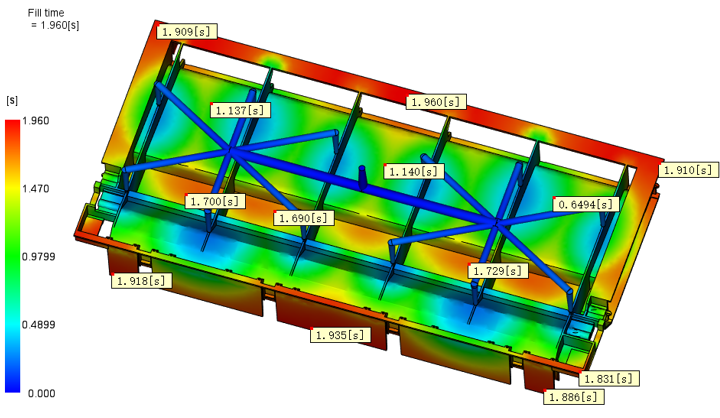
Lower pressure makes the mold more reliable. It also helps produce stable parts with a better surface finish.
Lower Cost Does Not Mean Cutting Everything
Many people believe a rapid mold is simply a simplified production mold.
This idea often causes project failure.
Some features can be simplified.
For example:
- Use a standard mold base.
- Simplify the mold structure.
- Remove unnecessary mechanisms.
- Choose suitable steel based on production volume.
These methods reduce cost without affecting quality.
But some areas should never be simplified.
Good Moldflow Analysis Comes First
For large PC/ABS parts, gate location is one of the most important factors.
A poor gate design may cause:
- Short shots
- Weld lines in critical areas
- High injection pressure
- Warpage
- Poor appearance
Before designing the mold, we perform Moldflow analysis.
We study:
- Filling
- Injection pressure
- Weld lines
- Air traps
- Warpage
Then we optimize the number and position of the gates.
The result is smoother material flow and lower injection pressure.
This also improves dimensional stability and surface quality.
Strong Steel Support is Still Necessary
Rapid tooling does not mean weak tooling.
Large flat areas and deep ribs create high molding force.
Without enough steel support, the mold may deform during injection.
This can lead to:
- Flash
- Poor dimensions
- Mold movement
- Short mold life
We add extra steel only where it is needed.
This keeps the mold strong while avoiding unnecessary cost.
The Ejection System is Also Important
Large PC/ABS parts have high ejection force.
A weak ejection system may cause:
- White marks
- Scratches
- Part deformation
- Cracks
We design enough ejector pins and support points.
We also balance the ejection force across the whole part.
This helps the part leave the mold smoothly.
Rapid Tooling Uses the Same Molding Standards
The mold is different.
The plastic part is not.
The material is the same.
The product design is the same.
So the molding process should also meet production standards.
We still control:
- Mold temperature
- Injection pressure
- Holding pressure
- Cooling
- Dimensional stability
Rapid tooling should never mean lower molding quality.
Project Results
With proper Moldflow analysis and careful mold design, we achieved:
- Injection pressure below the target limit
- Complete filling
- Good appearance
- Stable dimensions
- High first-shot success rate
- Much lower tooling cost than a production mold
The customer completed product validation and small-batch production successfully.
Conclusion
A successful rapid production mold is not built by cutting corners.
It is built by making smart engineering decisions.
At Fentor Mold, we follow several simple rules:
- Perform Moldflow analysis before mold design.
- Optimize gate locations.
- Keep injection pressure below 100 MPa whenever possible.
- Add enough steel support in critical areas.
- Design a reliable ejection system.
- Use production-level molding conditions.
This approach helps us reduce tooling cost while maintaining high part quality.
That is the real value of rapid production tooling.