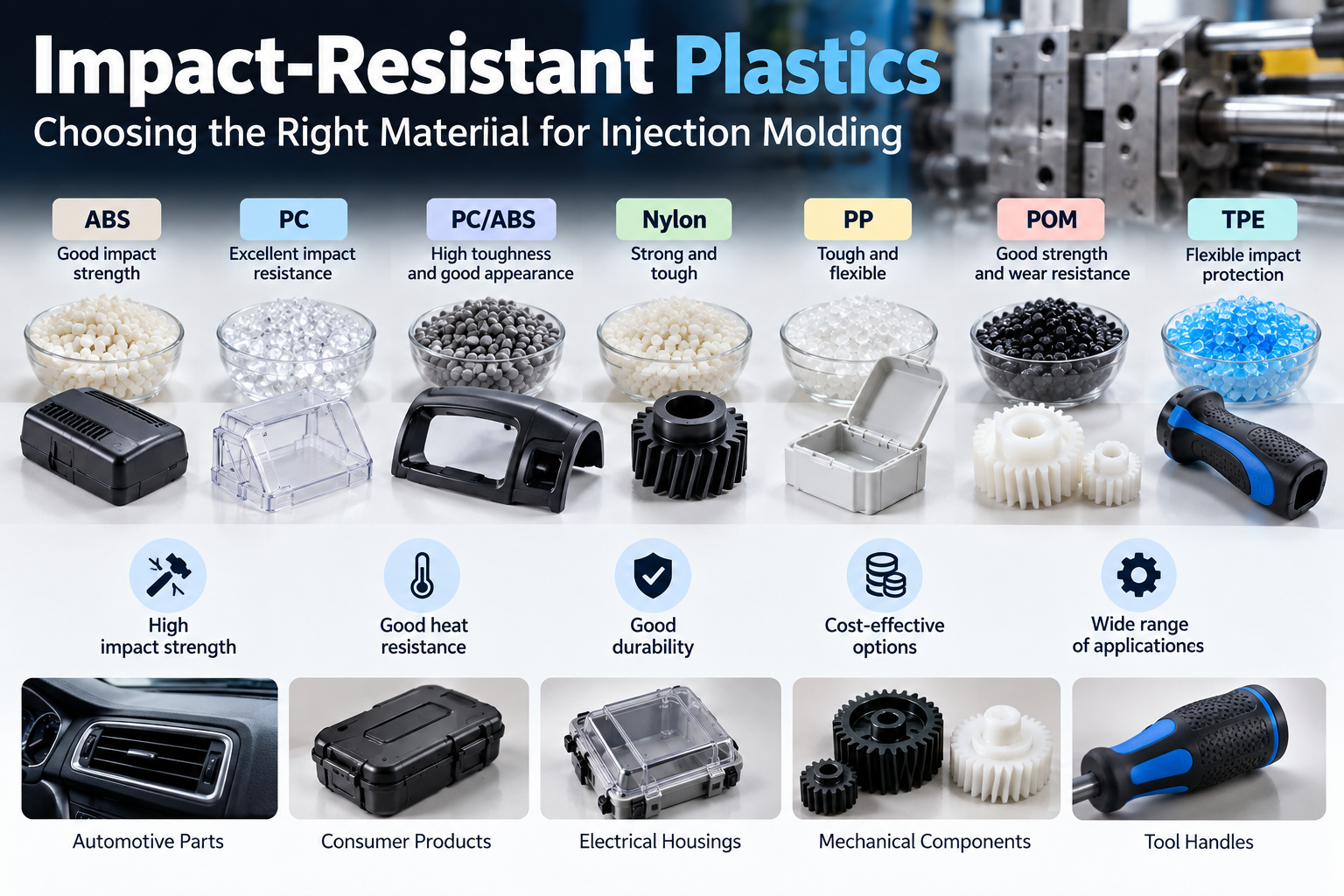
Impact-Resistant Plastics are widely used in injection molding. They are a good choice when parts must survive drops, shocks, vibration, or repeated loads.
However, not every plastic offers the same toughness. Some materials are strong but rigid. Others are softer and absorb impact better.
Therefore, material selection should start with the real use of the part. Engineers should consider impact strength, heat, wall thickness, chemicals, appearance, and cost.
At Fentor Mold, we often review material choices during DFM and mold development. Choosing the right plastic early can reduce cracking, warpage, and mold changes later.
What Are Impact-Resistant Plastics?
Impact-Resistant Plastics can absorb sudden force without breaking easily.
They are useful when a molded part may be:
- Dropped
- Hit
- Bent
- Vibrated
- Snapped together
- Used under repeated loads
- Used at low temperatures
However, high impact strength does not always mean high stiffness.
For example, one plastic may be tough but flexible. Another may be rigid but more likely to crack.
Because of this, engineers should not choose a material based on impact data alone.
Why Impact-Resistant Plastics Matter in Injection Molding
A plastic part can look strong but still fail in use.
For example, a housing may crack near a screw boss after a drop. A snap fit may break during assembly. Thin corners can also fail under repeated loads.
As a result, Impact-Resistant Plastics can improve both part life and product reliability.
They can help reduce:
- Cracking
- Brittle failure
- Broken clips
- Damaged bosses
- Corner fractures
- Assembly damage
- Drop-test failures
At the same time, material choice is only part of the solution.
Poor wall thickness, sharp corners, weak ribs, and high internal stress can still cause failure.
Common Impact-Resistant Plastics for Injection Molding
Several Impact-Resistant Plastics work well in injection molding. Still, each material has different strengths and limits.
| Material | Impact Resistance | Stiffness | Heat Resistance | Cost | Common Applications |
|---|---|---|---|---|---|
| ABS | Good | Medium | Medium | Low to Medium | Housings, covers, consumer parts |
| PC | Excellent | High | High | Medium to High | Safety covers, electrical parts |
| PC/ABS | Very Good | High | Good | Medium | Automotive interiors, housings |
| Nylon | Very Good | High | Good | Medium | Clips, gears, mechanical parts |
| PP | Good | Low to Medium | Medium | Low | Containers, covers, hinges |
| TPE | Very Good | Low | Low to Medium | Medium | Grips, seals, impact zones |
| POM | Good | High | Good | Medium | Mechanical components |
| HDPE | Good | Low | Medium | Low | Containers, industrial parts |
Therefore, the best choice depends on the full part requirement.
ABS as an Impact-Resistant Plastic
ABS is one of the most common plastics used for tough molded parts.
It gives a good balance of toughness, stiffness, surface quality, and cost. Therefore, it is widely used for:
- Electronic housings
- Equipment covers
- Consumer products
- Automotive interior parts
- Appliance components
Advantages of ABS
ABS offers:
- Good impact strength
- Good surface finish
- Easy coloring
- Stable molding
- Good dimensional control
- Reasonable cost
In addition, ABS is easier to process than many high-performance engineering plastics.
Limitations of ABS
However, ABS has lower heat resistance than PC and some engineering nylons.
Its low-temperature toughness can also vary by grade.
For outdoor use, UV resistance is another concern. Standard ABS may degrade under long-term sunlight unless it has UV protection.
Polycarbonate as an Impact-Resistant Plastic
Polycarbonate, or PC, is one of the best-known Impact-Resistant Plastics.
It has very high toughness and good heat resistance. Transparent grades are also available.
Because of this, PC is often used for:
- Safety covers
- Protective housings
- Medical equipment parts
- Electrical components
- Transparent covers
- Industrial enclosures
Advantages of Polycarbonate
PC provides:
- Very high impact resistance
- High strength
- Good heat resistance
- Good dimensional stability
- Transparent options
However, PC needs careful processing.
The resin normally needs proper drying before molding. In addition, melt temperature, mold temperature, gate design, and internal stress must be controlled.
Otherwise, cracks or stress marks may appear later.
PC/ABS for Better Balance
PC/ABS combines the toughness of PC with the easier processing of ABS.
As a result, it is common in automotive, electrical, and equipment housings.
Typical uses include:
- Automotive interior parts
- Control panels
- Instrument housings
- Electronic enclosures
- Medical equipment covers
Compared with pure PC, PC/ABS often flows more easily.
At the same time, it usually gives better heat and impact performance than standard ABS.
Therefore, PC/ABS is a good choice when appearance, toughness, and processability all matter.
Nylon as an Impact-Resistant Plastic
Nylon is widely used for mechanical and functional parts.
It offers good strength, wear resistance, and toughness. Common uses include:
- Clips
- Brackets
- Gears
- Structural parts
- Fasteners
- Mechanical housings
Glass fiber can increase nylon stiffness.
However, more glass fiber does not always mean better impact performance. A stiffer material can also become less flexible.
Therefore, engineers should balance stiffness and toughness.
Moisture is another factor. Nylon can absorb water, which may change dimensions and mechanical properties.
Polypropylene as an Impact-Resistant Plastic
Polypropylene is another common choice for tough molded parts.
It is lightweight, low cost, and resistant to many chemicals.
In addition, PP can flex more than many rigid plastics.
This makes it useful for:
- Containers
- Covers
- Hinges
- Automotive trim
- Battery parts
- Household products
Impact-modified PP grades can provide even better toughness.
Therefore, PP is useful when low weight and flexibility are important.
However, its dimensional stability is lower than PC or POM.
POM for Tough Mechanical Parts
POM, also called acetal, offers good strength, wear resistance, and dimensional stability.
It is often used in moving or mechanical parts, such as:
- Gears
- Bushings
- Levers
- Latches
- Sliding parts
- Small mechanical components
POM also has low friction.
However, it may not be the best choice for very high impact loads. Its main strength is the balance of toughness, stiffness, and wear resistance.
For precision parts, our components manufacturing service can support both prototype and production components.
TPE for Soft Impact Protection
Not every impact-resistant part needs a rigid plastic.
TPE is useful when a soft and flexible surface is needed.
For example, it can be used in:
- Handles
- Protective corners
- Soft grips
- Equipment covers
- Overmolded areas
- Shock-absorbing features
TPE is often molded over a rigid plastic.
As a result, one part can combine structure with soft impact protection.
However, the bond between TPE and the base material should be checked early.
Impact-Resistant Plastics vs Stiffness Requirements
A common mistake is to assume that the stiffest plastic is also the toughest.
That is not always true.
A rigid material may resist bending but crack under sudden shock. In contrast, a more flexible plastic may absorb impact without breaking.
Therefore, engineers should compare:
- Impact strength
- Tensile strength
- Flexural modulus
- Elongation
- Heat resistance
- Fatigue resistance
The right balance depends on the application.
For example, a structural bracket may need more stiffness. A snap-fit cover may need more flexibility.
Temperature Affects Impact-Resistant Plastics
Temperature can strongly change impact performance.
Some plastics become brittle at low temperatures. Others become soft when temperatures rise.
Therefore, operating temperature should always be part of material selection.
For example:
- ABS works well in many indoor products.
- PC handles higher temperatures better.
- Impact-modified PP can perform well at lower temperatures.
- Nylon offers good strength but can absorb moisture.
- PEEK works at much higher temperatures but costs far more.
Because of this, room-temperature impact data may not show real working performance.
Wall Thickness Affects Impact-Resistant Plastics
Wall thickness also plays an important role.
A thin wall can crack even when the material has good impact strength.
However, making the wall too thick can create:
- Sink marks
- Warpage
- Longer cooling time
- Higher material cost
Therefore, simply adding more plastic is not always the best solution.
Instead, engineers can improve the structure with:
- Ribs
- Fillets
- Rounded corners
- Balanced wall thickness
- Better load paths
As a result, the part can become stronger without adding too much weight.
Avoid Sharp Corners in High-Impact Parts
Sharp corners create stress concentration.
When a part receives an impact, cracks often start in these areas.
Therefore, suitable radii should be added where possible.
This is especially important around:
- Screw bosses
- Rib intersections
- Snap fits
- Openings
- Structural corners
In many cases, a small design change can improve durability more than changing to a costly resin.
Gate Location Affects Impact Performance
Gate location also affects part strength.
Poor gate placement can create:
- Weld lines
- Flow hesitation
- Weak areas
- Internal stress
- Uneven packing
For example, a weld line in a high-load area may reduce part strength.
Therefore, gate position should be checked during mold design.
For complex parts, Moldflow analysis can help predict flow behavior before tooling starts.
Our custom injection mold manufacturing service includes mold design and engineering review before machining.
Processing Conditions Affect Impact-Resistant Plastics
Even good Impact-Resistant Plastics can perform poorly when molding conditions are unstable.
Important process factors include:
- Melt temperature
- Mold temperature
- Injection speed
- Holding pressure
- Cooling time
- Material drying
- Back pressure
For example, poor drying can reduce the performance of PC or nylon.
Meanwhile, too much internal stress may increase the risk of cracking.
Therefore, stable process control is important for repeatable part quality.
Reinforced Plastics Are Not Always Better
Glass fiber can improve stiffness and strength.
However, reinforced plastic is not always better for impact applications.
Adding glass fiber may:
- Increase stiffness
- Reduce shrinkage
- Improve dimensional stability
- Improve heat resistance
At the same time, it may:
- Reduce flexibility
- Change impact behavior
- Reduce surface quality
- Increase tool wear
Therefore, glass-filled grades should be chosen based on actual part needs.
A rigid bracket may benefit from reinforcement. In contrast, a snap-fit part may need more flexibility.
How to Choose the Right Impact-Resistant Plastics
Choosing Impact-Resistant Plastics requires more than reading one value on a material data sheet.
Several factors should be reviewed together.
1. Define the Impact Condition
First, identify how the part will be loaded.
Ask:
- Will it be dropped?
- Will it receive direct impact?
- Will it vibrate?
- Will it bend often?
- Does it need snap-fit flexibility?
This helps define the type of toughness needed.
2. Check Operating Temperature
Next, define the lowest and highest working temperatures.
Impact performance may change greatly with temperature.
3. Review Stiffness Requirements
A flexible plastic may survive impact well but may not hold its shape under load.
Therefore, stiffness must also be checked.
4. Consider Chemical Exposure
The part may contact:
- Oils
- Cleaners
- Alcohol
- Fuel
- Detergents
- Medical chemicals
Because of this, chemical resistance should be confirmed before final material selection.
5. Compare Production Cost
High-performance resin can improve part performance. However, it can also raise cost.
Therefore, the material should match the actual need.
In many cases, a well-designed ABS or PC/ABS part can be more economical than a premium resin.
Comparison of Common Impact-Resistant Plastics
| Material | Impact Performance | Heat Resistance | Surface Quality | Dimensional Stability | Relative Cost |
|---|---|---|---|---|---|
| ABS | Good | Medium | Excellent | Good | Low |
| PC | Excellent | High | Good | Very Good | Medium-High |
| PC/ABS | Very Good | Good | Excellent | Very Good | Medium |
| Nylon | Very Good | Good | Good | Medium | Medium |
| PP | Good | Medium | Good | Medium | Low |
| POM | Good | Good | Good | Excellent | Medium |
| TPE | Very Good flexibility | Medium | Good | Low | Medium |
This table is only a general guide.
Actual results can change with grade, additives, wall thickness, geometry, and molding conditions.
When Should You Test Impact-Resistant Plastics?
Testing is useful when:
- The part has a safety function.
- Drop performance matters.
- The material is new.
- The wall is thin.
- The shape is complex.
- Low-temperature use is expected.
- The design contains many clips or bosses.
In these cases, prototypes can help confirm both material and design.
In addition, prototype injection molding is useful when the final part must be tested in the real production resin.
Fentor Mold provides prototype injection molding for projects that need molded parts before full production tooling.
From Impact-Resistant Plastics to Production
Material selection should be linked to mold design.
The resin affects:
- Shrinkage
- Flow length
- Gate design
- Cooling
- Draft
- Ejection
- Tool wear
- Cycle time
Therefore, the material should be confirmed as early as possible.
Once the design and resin are stable, the mold can be optimized for reliable production.
For larger quantities, our injection molding production service supports mold trials, process optimization, and ongoing plastic part production.
Final Thoughts
There is no single best material for every impact application.
ABS gives a good balance of cost and toughness. PC provides excellent impact and heat resistance. PC/ABS combines toughness with easier processing. Nylon works well for many mechanical parts, while PP offers flexibility and low cost.
Therefore, choosing Impact-Resistant Plastics should start with the real working conditions of the part.
Engineers should compare impact level, temperature, stiffness, chemicals, wall thickness, geometry, and cost. In addition, mold design and processing conditions should support the selected material.
With the right combination of material, part design, and molding process, injection molded parts can achieve better durability and more stable performance.