
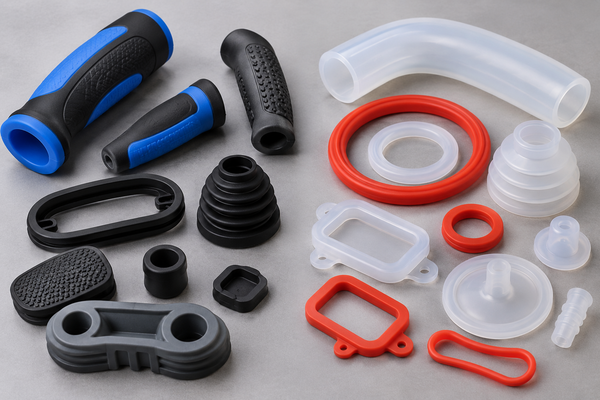
Choosing between TPE vs Silicone can directly affect the performance, cost, and production process of a molded part. Both materials are soft, flexible, and durable. However, they behave differently during molding and in actual use.
TPE is a thermoplastic elastomer. Therefore, manufacturers can process it with standard thermoplastic molding methods. Silicone, on the other hand, is an elastomer that cures during molding. It usually offers better resistance to heat, weather, and harsh environments.
So, which one should you choose? The answer depends on your application. Temperature, flexibility, chemical exposure, production volume, and cost all matter.
This guide compares TPE vs Silicone and explains how to select the right material for your molded parts.
TPE vs Silicone: What Is the Difference?
The main difference between TPE vs Silicone is their material structure and processing behavior.
TPE combines the flexibility of rubber with the processing advantages of thermoplastics. It softens when heated and becomes solid again when cooled. As a result, manufacturers can injection mold TPE using processes similar to those used for PP, ABS, and other thermoplastics.
Silicone works differently. Most molded silicone materials cure through a chemical reaction. Once cured, they do not simply melt again when heated.
Because of this difference, the two materials require different molding equipment, mold designs, and processing conditions.
| Property | TPE | Silicone |
|---|---|---|
| Material Type | Thermoplastic elastomer | Elastomer |
| Flexibility | Excellent | Excellent |
| Temperature Resistance | Good, depending on grade | Excellent |
| Chemical Resistance | Good, depending on grade | Very good |
| Weather Resistance | Good | Excellent |
| UV Resistance | Grade dependent | Excellent |
| Processing | Injection molding, extrusion | LSR molding, compression molding |
| Reprocessing | Generally possible | Generally not possible after curing |
| Overmolding | Excellent | Possible with proper material/process |
| Typical Cost | Often lower | Often higher |
Therefore, neither material is automatically better. Instead, the right choice depends on the product requirements.
What Is TPE for Molded Parts?
TPE stands for thermoplastic elastomer. It is a family of materials that combines rubber-like flexibility with thermoplastic processing.
Manufacturers commonly use TPE for soft-touch grips, seals, flexible components, protective parts, automotive components, and consumer products.
One major advantage is processing efficiency. TPE can usually be processed by conventional injection molding. Therefore, it is suitable for high-volume manufacturing.
TPE also works well for overmolding. For example, a rigid PP or ABS substrate can be combined with a soft TPE layer to improve grip, sealing, comfort, or impact protection.
At Fentor Mold, material selection is considered together with part structure and mold design. This is especially important for TPE parts because hardness, shrinkage, bonding requirements, and gate design can affect the final result.
What Is Silicone for Molded Parts?
Silicone is a flexible elastomer known for its stability across a wide temperature range.
It is widely used for seals, gaskets, medical components, kitchen products, electrical parts, and other applications that require reliable flexibility.
Unlike TPE, silicone does not behave like a normal thermoplastic. It cures during molding. Therefore, mold design and processing conditions differ from conventional plastic injection molding.
Liquid silicone rubber, or LSR, is one common option for high-volume molded silicone parts. Compression molding is another common method, depending on the material and part design.
Silicone also performs well when a product faces repeated temperature changes. In addition, many silicone grades offer strong resistance to UV exposure, ozone, and weathering.
TPE vs Silicone: Which Has Better Flexibility?
Both materials can provide excellent flexibility.
However, hardness ranges vary significantly by grade. Therefore, engineers should not select a material based only on the words “TPE” or “silicone.”
TPE is available in many Shore hardness levels. This gives designers considerable freedom when developing grips, seals, flexible covers, and soft-touch components.
Silicone also offers a broad hardness range. More importantly, it can maintain its elastic properties under demanding temperature conditions.
For normal consumer or industrial products, TPE may provide enough flexibility at a competitive cost. However, silicone may be more suitable when stable elasticity across a wider temperature range is critical.
TPE vs Silicone Temperature Resistance
Temperature is one of the most important factors when comparing TPE vs Silicone.
Many TPE grades perform well at normal operating temperatures. However, the exact temperature range depends heavily on the TPE family and grade.
Silicone generally performs better at elevated temperatures. It can also remain flexible at low temperatures.
Therefore, engineers should first define the actual operating environment.
Ask these questions:
- What is the normal operating temperature?
- What is the maximum short-term temperature?
- Will the component experience repeated heating and cooling?
- Will it contact hot liquids or surfaces?
- Does the product require sterilization?
If temperature resistance is a major design requirement, silicone often deserves closer consideration.
TPE vs Silicone Chemical Resistance
Chemical exposure can change material performance over time.
TPE resistance depends on its formulation. Some grades perform well against water, mild cleaners, and selected chemicals. Others can swell or lose properties when exposed to oils, fuels, or aggressive chemicals.
Silicone offers good resistance to many environmental conditions. However, it is not universally resistant to every chemical either.
Therefore, engineers should evaluate the exact chemical rather than relying on a general material description.
Exposure time also matters. Brief contact with a cleaning agent is different from continuous immersion.
For critical parts, material compatibility testing is a practical step before mass production.
TPE vs Silicone for Durability
Durability depends on how the molded component will be used.
For example, a soft grip experiences different loads from a gasket. A flexible cover also has different requirements from an automotive sealing component.
TPE can provide good abrasion resistance, impact performance, and flexibility. As a result, it is common in products that experience repeated handling.
Silicone performs particularly well when long-term flexibility and environmental stability are important. It also has excellent resistance to ozone and weathering.
However, designers should evaluate tear strength, tensile strength, compression set, abrasion, and aging based on the actual application.
Simply comparing material names is not enough.
TPE vs Silicone Processing Differences
Processing is another major difference between TPE vs Silicone.
TPE behaves more like a conventional thermoplastic. Manufacturers heat the material, inject it into the mold, cool the part, and eject it.
This makes TPE compatible with many standard injection molding production systems.
Silicone requires a different process. LSR, for example, uses controlled material mixing and curing. The mold is typically heated so the silicone can cure inside the cavity.
As a result, tooling requirements also differ.
Gate design, venting, temperature control, parting lines, and sealing requirements must match the selected material and molding process.
Therefore, material selection should happen before the mold design is finalized.
TPE vs Silicone for Overmolding
TPE is especially popular for overmolding.
A manufacturer can mold a rigid substrate first and then add TPE to selected areas. This approach is widely used for handles, grips, seals, buttons, protective edges, and ergonomic products.
However, adhesion must be checked carefully.
Not every TPE bonds naturally to every rigid plastic. The substrate material, TPE grade, surface condition, molding temperature, and part geometry all affect bonding strength.
Mechanical locking features can also improve the connection.
Silicone overmolding is possible as well. However, the process can be more specialized. Adhesion systems, primers, surface treatment, or mechanical retention may be required depending on the materials.
For overmolded products, early injection mold design and engineering can help identify potential bonding, venting, shutoff, and parting-line problems.
TPE vs Silicone Cost
Cost is often a key factor in material selection.
In many applications, TPE offers an economic advantage because it can use efficient thermoplastic injection molding processes. Cycle times can also be suitable for high-volume production.
In addition, runners and selected production scrap may be reusable in some TPE applications. However, this depends on the material, quality requirements, and manufacturing process.
Silicone material and processing costs can be higher. Tooling requirements may also differ.
Still, comparing only the raw material price can lead to the wrong decision.
Instead, consider the complete production cost:
- Raw material
- Mold cost
- Cycle time
- Scrap rate
- Secondary operations
- Assembly
- Expected product life
- Quality requirements
A more expensive material can sometimes reduce failures or extend service life. Therefore, total cost is more useful than material price alone.
TPE vs Silicone for Different Applications
The application usually determines which material makes more sense.
Consumer Products
TPE is widely used for soft grips, buttons, handles, protective edges, and flexible consumer components.
It is especially useful when soft-touch performance and high-volume injection molding are important.
Automotive Parts
TPE can be used for seals, interior soft-touch parts, flexible covers, and vibration-control components.
However, temperature, UV exposure, oils, and chemicals must be considered.
Silicone may be more suitable for certain under-hood or high-temperature sealing applications.
Medical Applications
Both materials can be used in medical applications when the selected grade meets the required standards.
Silicone is common where flexibility, temperature stability, or sterilization resistance matters.
However, medical material selection must always be based on the exact regulatory and application requirements.
Seals and Gaskets
Both TPE and silicone can work for sealing components.
For moderate conditions and cost-sensitive products, TPE may be suitable.
For demanding temperature or weather exposure, silicone may provide better long-term performance.
Soft-Touch Overmolded Parts
TPE is often a practical choice for soft-touch overmolding because it can integrate efficiently with thermoplastic injection molding.
Still, substrate compatibility should be confirmed before tooling begins.
When Should You Choose TPE?
TPE may be a strong option when the product requires:
- Soft-touch performance
- Flexible molded features
- Efficient injection molding
- High production volumes
- Overmolding onto rigid plastics
- Shorter molding cycles
- Reprocessing potential
- Competitive production cost
It is particularly attractive when the application does not require extreme temperature resistance.
However, the correct TPE family and grade still need careful evaluation.
When Should You Choose Silicone?
Silicone may be worth considering when the product requires:
- High-temperature resistance
- Low-temperature flexibility
- Long-term elastic performance
- Strong weather resistance
- Good UV and ozone resistance
- Specialized sealing performance
- Certain medical or food-contact applications
- Stable performance in demanding environments
Again, the exact silicone grade matters.
Food-contact, medical, and other regulated applications require suitable material certifications and compliance documentation.
How to Choose Between TPE vs Silicone
When comparing TPE vs Silicone, start with the application rather than the material price.
First, define the operating temperature. Next, identify chemical exposure and environmental conditions. Then consider hardness, flexibility, sealing requirements, and expected service life.
Production volume is also important.
For high-volume parts that can use conventional injection molding, TPE may offer processing and cost advantages. In contrast, silicone may justify its additional processing requirements when temperature stability or long-term environmental performance is critical.
The part design should also be reviewed before tooling starts. Wall thickness, ribs, undercuts, gates, parting lines, draft angles, and overmolding interfaces can all affect manufacturability.
For new products, prototype injection molding can also help verify material behavior and part performance before committing to full production tooling.
TPE vs Silicone: Final Considerations
The TPE vs Silicone decision depends on the actual requirements of the molded part.
TPE offers flexible material options, efficient thermoplastic processing, strong overmolding potential, and competitive production costs. Therefore, it works well for many consumer, automotive, industrial, and soft-touch molded components.
Silicone offers excellent temperature stability, weather resistance, and long-term flexibility. As a result, it can be a strong option for demanding seals, medical components, high-temperature parts, and products exposed to harsh environments.
Before selecting either material, evaluate temperature, chemicals, hardness, durability, production volume, molding process, and total project cost.
A material that performs well on a data sheet still needs to work with the actual part geometry and manufacturing process. For that reason, early material selection, DFM review, and mold engineering can reduce risk before tooling and production begin.