
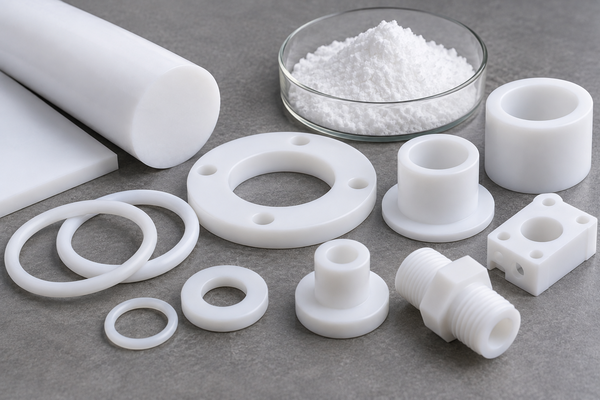
PTFE injection molding is very different from molding common plastics such as ABS, PP, PA, and PC. Most plastics melt and flow when heated. PTFE does not flow in the same way. Therefore, standard injection molding is usually not suitable for conventional PTFE.
So, how do manufacturers make PTFE parts? They often press PTFE powder into shape and then heat it through a sintering process. CNC machining is also common. In addition, materials such as PFA, FEP, and ETFE offer some similar properties and can use melt-processing methods.
This guide explains the main PTFE processing methods, their limits, and the alternatives available for molded parts.
What Is PTFE and Why Is It Difficult to Mold?
PTFE stands for polytetrafluoroethylene. It is a fluoropolymer with excellent chemical and heat resistance. It also has very low friction.
Because of these properties, manufacturers use PTFE for many demanding parts.
Common applications include:
- Seals
- Gaskets
- Bushings
- Bearings
- Valve parts
- Electrical insulation
- Chemical processing parts
- High-temperature components
However, PTFE is not easy to process like a normal thermoplastic. Its behavior at high temperatures creates a major challenge for molders.
Can PTFE Injection Molding Use Standard Equipment?
In most cases, standard equipment cannot perform conventional PTFE injection molding.
Materials such as PP, ABS, and nylon become fluid when heated. An injection molding machine can then push the molten plastic through a runner and gate into the mold cavity.
PTFE behaves differently.
Even above its melting transition, PTFE has extremely high melt viscosity. As a result, it does not flow easily through a standard injection molding system.
Increasing the barrel temperature does not solve this problem.
Instead, manufacturers normally use powder-based forming and sintering methods to make standard PTFE parts.
Therefore, engineers should confirm the production process before designing a PTFE component.
Why Is PTFE Injection Molding Difficult?
Several material properties make PTFE injection molding difficult.
PTFE Has Extremely High Melt Viscosity
This is the main problem.
Normal thermoplastics become much easier to flow after heating. Therefore, an injection molding machine can force them into a complex mold cavity.
PTFE does not develop the same free-flowing melt.
As a result, standard screws, runners, and small gates cannot process conventional PTFE in the same way.
PTFE Needs a Different Process
Normal injection molding follows a simple cycle:
Melt → Inject → Pack → Cool → Eject
PTFE normally follows a different route:
Powder → Press → Sinter → Cool → Finish
Because the processes are different, they also require different equipment.
Complex Shapes Can Be Harder to Produce
Injection molding works well for complex plastic parts. It can create ribs, bosses, clips, thin walls, and many other features in one molding cycle.
PTFE forming has more limits.
Therefore, manufacturers often use CNC machining after forming to create holes, grooves, threads, and other detailed features.
At Fentor Mold, we review the material together with the part design before tooling starts. If a design calls for PTFE but has complex molded features, another material or process may make more sense.
What Processing Methods Replace PTFE Injection Molding?
Since conventional PTFE injection molding is difficult, manufacturers use several other processes.
The best method depends on the part shape, tolerance, quantity, and application.
The most common options include compression molding, sintering, extrusion, and CNC machining.
PTFE Compression Molding and Sintering
Compression molding is a common method for making PTFE parts.
First, the manufacturer puts PTFE powder into a mold. Then, pressure compacts the powder into a basic shape.
Next, the part enters a controlled heating process called sintering. Heat allows the PTFE particles to bond together.
After cooling, the part becomes solid.
The basic process is:
PTFE powder → Pressing → Sintering → Cooling → Finishing
If the part needs tighter tolerances, CNC machining can follow.
This process is very different from conventional plastic injection mold manufacturing. Injection molding fills the mold directly with molten plastic. PTFE compression molding starts with powder.
PTFE Ram Extrusion
Ram extrusion is another common PTFE process.
The process pushes PTFE material through a die under pressure. The material then goes through a controlled heating and sintering stage.
Manufacturers often use this process for simple continuous shapes.
Examples include:
- Rods
- Tubes
- Pipes
- Profiles
These products can also become raw material for later CNC machining.
CNC Machining as an Alternative to PTFE Injection Molding
CNC machining is useful for prototypes and low-volume PTFE parts.
Manufacturers can start with PTFE rods, sheets, tubes, or molded blanks. They then machine the material into the final shape.
This method has several advantages.
First, you do not need an injection mold. Therefore, CNC machining can reduce the initial investment for small quantities.
Second, machining can create detailed features such as:
- Holes
- Grooves
- Threads
- Sealing surfaces
- Pockets
- Precision profiles
However, PTFE is relatively soft. Too much clamping force can deform the workpiece. Cutting conditions also affect dimensional accuracy.
For these reasons, the machining setup needs careful control.
Our components manufacturing services can support projects where machining offers a more practical option than injection tooling.
Paste Extrusion for PTFE
Paste extrusion is another way to process PTFE.
First, manufacturers mix fine PTFE powder with a lubricant. Next, they push the mixture through a die.
After forming, they remove the lubricant and sinter the material.
This process works well for certain tubes, wire insulation, and profiles.
Again, it is not the same as conventional injection molding.
PTFE Injection Molding vs Conventional Injection Molding
The differences become clearer when we compare PTFE with common injection molding plastics.
| Factor | PTFE | Common Thermoplastics |
|---|---|---|
| Main Process | Pressing and sintering | Injection molding |
| Melt Flow | Extremely limited | Good when heated |
| Standard Injection Machine | Usually unsuitable | Suitable |
| Complex Shapes | More difficult | Easy to produce |
| Thin Walls | Difficult | Common |
| Secondary Machining | Often needed | Often not needed |
| High-Volume Automation | More difficult | Excellent |
| Chemical Resistance | Excellent | Depends on material |
| Heat Resistance | Excellent | Depends on material |
Therefore, material choice affects both product performance and manufacturing.
What Are the Alternatives to PTFE Injection Molding?
Sometimes a product needs PTFE-like properties but also needs an efficient molding process.
In that case, engineers can consider other fluoropolymers.
PFA, FEP, and ETFE are three important options. Unlike conventional PTFE, these materials can use melt-processing methods.
However, they do not have exactly the same properties as PTFE.
Therefore, always compare the application requirements before changing materials.
PFA as a PTFE Injection Molding Alternative
PFA stands for perfluoroalkoxy alkane.
It offers excellent chemical resistance and good high-temperature performance. These properties make it useful in demanding environments.
More importantly, PFA is melt-processable.
Therefore, manufacturers can process suitable PFA grades through methods such as injection molding and extrusion.
Common applications include:
- Chemical handling parts
- Semiconductor components
- Fluid systems
- Electrical parts
- High-purity components
- High-temperature parts
However, PFA can be expensive.
For this reason, engineers should compare both performance and total production cost.
FEP as a PTFE Injection Molding Alternative
FEP stands for fluorinated ethylene propylene.
Like PTFE, it offers strong chemical resistance. It also provides useful electrical properties.
However, FEP has one major processing advantage: it is melt-processable.
Therefore, manufacturers can use molding and extrusion methods that are not practical for standard PTFE.
Still, FEP is not a direct replacement in every application.
Its temperature limits and mechanical properties differ from PTFE. As a result, engineers should check the actual service conditions first.
ETFE for Injection Molded Parts
ETFE is another melt-processable fluoropolymer.
It combines good chemical resistance with strong mechanical performance. It also offers good toughness.
Manufacturers use ETFE for applications such as:
- Electrical parts
- Chemical processing components
- Industrial products
- Wire and cable products
- Parts exposed to harsh environments
ETFE can support injection molding for suitable applications.
However, its friction, heat resistance, and mechanical behavior differ from PTFE.
Therefore, engineers should compare the material data before making a final choice.
PEEK as a Non-Fluoropolymer Alternative
Sometimes the design does not truly require PTFE.
Instead, the part may need high heat resistance, chemical resistance, strength, or wear resistance.
In this situation, PEEK may be another option.
PEEK is a high-performance thermoplastic. Suitable grades can use injection molding.
It offers:
- High strength
- High heat resistance
- Good chemical resistance
- Good wear resistance
- Strong dimensional stability
However, PEEK does not behave exactly like PTFE.
For example, it does not offer the same low-friction performance in every application. Therefore, engineers should compare the required function rather than simply replacing one material with another.
PTFE Injection Molding Alternatives Compared
The table below provides a simple early-stage comparison.
| Material | Melt Processable | Chemical Resistance | Heat Resistance | Mechanical Strength | Injection Molding |
|---|---|---|---|---|---|
| PTFE | No, in the conventional sense | Excellent | Excellent | Moderate | Generally unsuitable |
| PFA | Yes | Excellent | Excellent | Moderate | Suitable |
| FEP | Yes | Excellent | Good | Moderate | Suitable |
| ETFE | Yes | Excellent | Good | High | Suitable |
These are general comparisons only.
Each material family contains different grades. Therefore, always check the supplier’s technical data before selecting a material.
When Should You Keep PTFE?
The difficulty of PTFE injection molding does not make PTFE a poor choice.
In fact, PTFE can be ideal when its special properties are essential.
Consider PTFE when you need:
- Very low friction
- Excellent chemical resistance
- High heat resistance
- Good electrical insulation
- Non-stick properties
- Strong environmental stability
For simple parts such as seals, bushings, and rings, molded or machined PTFE may work very well.
In these cases, there may be no reason to change the material.
When Should You Choose a PTFE Injection Molding Alternative?
An alternative may make more sense when the product has complex geometry.
For example, the design may include:
- Thin walls
- Ribs
- Bosses
- Snap fits
- Complex curves
- Small molded features
Conventional injection molding can produce these features efficiently.
Production volume also matters.
Machining a few PTFE parts may be practical. However, machining thousands of complex parts can increase production time and cost.
In that case, a melt-processable material such as PFA, FEP, or ETFE may provide a better manufacturing route.
Still, the alternative must meet the required performance.
Does Part Design Change When Replacing PTFE?
Yes.
You should not replace PTFE with another material without reviewing the part design.
Different materials have different shrinkage, flow, strength, and thermal behavior.
For injection molding, engineers also need to consider:
- Wall thickness
- Draft angles
- Ribs
- Undercuts
- Gate location
- Parting lines
- Cooling
- Ejection
A part originally designed for CNC machining may not be ready for injection molding.
Therefore, a DFM review should come before mold manufacturing.
For early projects, prototype injection molding can also help test the selected material and part design before production tooling.
How to Choose the Right PTFE Processing Method
Start with the part requirements.
First, check the working temperature. Then, identify any chemicals that will contact the part.
Next, review friction, wear, electrical properties, and mechanical loads.
Part geometry comes next.
Simple rings, seals, or bushings may work well with molded or machined PTFE. In contrast, thin-wall parts with ribs and snap features may need another material.
Also consider production quantity.
CNC machining often works well for prototypes and small batches. Dedicated forming processes can make more sense as volume increases.
Finally, compare the total cost.
Do not look only at raw material price. Tooling, machining time, cycle time, scrap, and secondary operations also affect the final part cost.
PTFE Injection Molding: Final Answer
Conventional PTFE injection molding is generally not practical with standard thermoplastic injection molding equipment.
PTFE has extremely high melt viscosity. Therefore, it does not flow through a normal injection molding system like PP, ABS, PC, or nylon.
Instead, manufacturers commonly use compression molding, sintering, extrusion, and CNC machining to produce PTFE parts.
However, melt-processable fluoropolymers offer another option.
PFA, FEP, and ETFE can provide some similar properties while supporting more conventional melt-processing methods. PEEK may also work for some high-performance applications.
Therefore, start with the product requirements. Check temperature, chemicals, friction, strength, geometry, volume, and cost.
Then choose the material and manufacturing process together. This approach can reduce production risk and help avoid costly tooling changes later.