
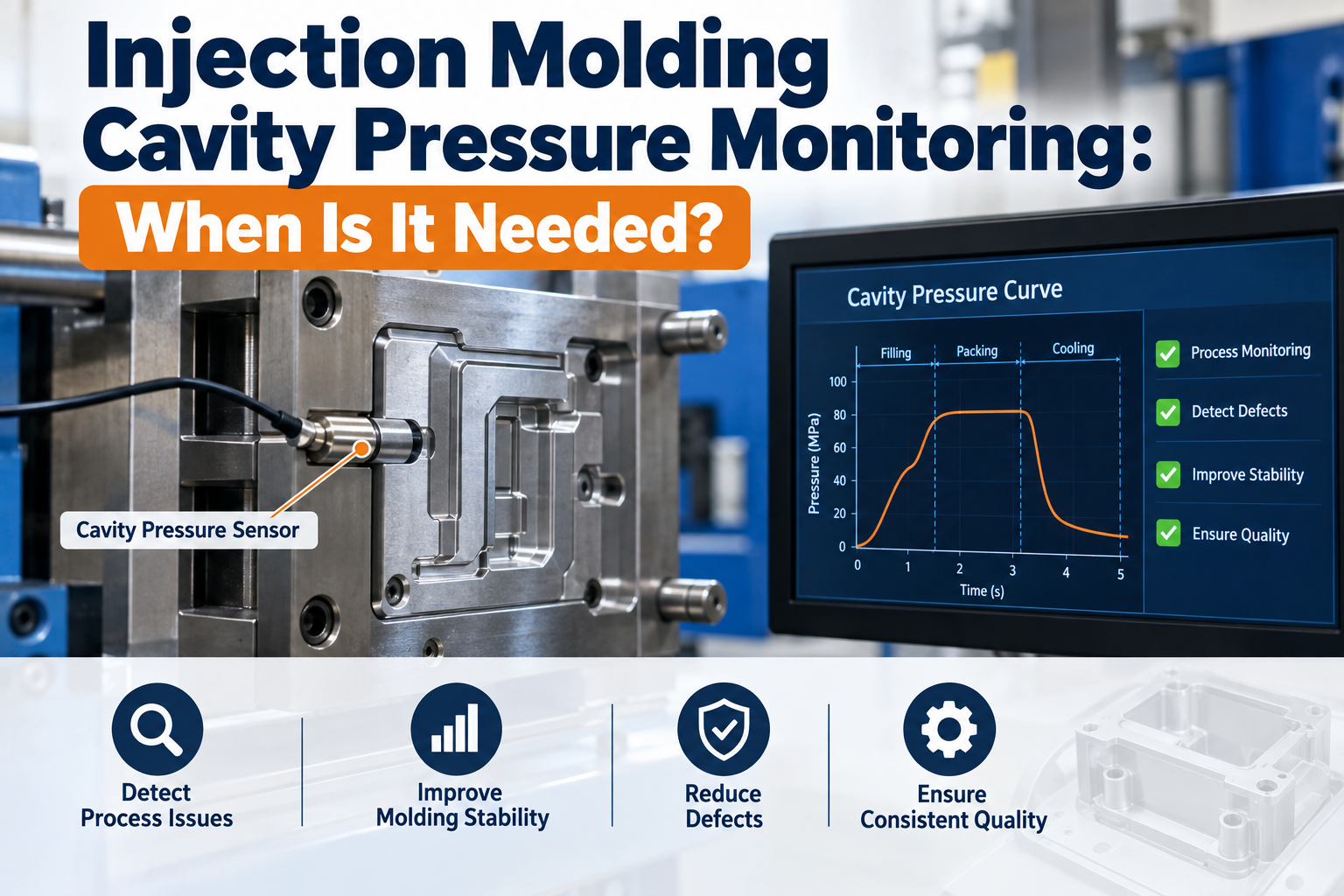
Injection molding cavity pressure monitoring helps engineers see what is happening inside the mold during filling, packing, and cooling.
Machine pressure only tells part of the story. As plastic flows through the nozzle, runner, gate, and cavity, pressure changes. Therefore, two cycles may show similar machine settings but still create different pressure inside the cavity.
For precision or high-volume parts, injection molding cavity pressure monitoring can make process changes easier to detect. However, sensors also add cost and mold complexity.
So, when is it really needed?
What Is Injection Molding Cavity Pressure Monitoring?
Injection molding cavity pressure monitoring uses sensors inside or close to the cavity to measure pressure during each molding cycle.
The system records pressure during:
- Filling
- V/P transfer
- Packing
- Holding
- Cooling
As a result, engineers can see a pressure curve for each cycle.
This curve helps show whether the molding process stays stable. In addition, it gives information that machine pressure alone cannot provide.
Unlike machine pressure, cavity pressure is measured much closer to the plastic part.
Why Machine Pressure Is Not Enough
The injection molding machine measures pressure inside the injection unit.
However, plastic loses pressure as it moves through:
- Nozzle
- Sprue
- Hot runner
- Cold runner
- Gate
- Thin sections
- Long flow paths
Therefore, machine pressure and cavity pressure are not the same.
For example, cavity pressure may change because of:
- Material viscosity
- Melt temperature
- Mold temperature
- Gate restriction
- Venting problems
- Hot runner variation
Meanwhile, the machine may still show normal values.
For this reason, injection molding cavity pressure monitoring can provide useful extra information when normal machine data is not enough.
When Is Injection Molding Cavity Pressure Monitoring Needed?
Not every injection mold needs pressure sensors.
For a simple plastic cover with wide tolerances, normal process control may be enough.
However, injection molding cavity pressure monitoring becomes more useful when small process changes can affect product quality.
Typical applications include:
- Tight-tolerance parts
- Medical components
- Multi-cavity molds
- High-volume production
- Sealing parts
- Parts with narrow molding windows
- Products with traceability requirements
At Fentor Mold, we first review the part, material, gate location, cavity layout, and mold structure. Then, we decide whether pressure monitoring adds real value.
Injection Molding Cavity Pressure Monitoring for Tight Tolerances
Tight-tolerance parts can react strongly to small changes in packing pressure.
These changes may affect:
- Diameter
- Flatness
- Part weight
- Sealing dimensions
- Assembly fit
- Shrinkage
For example, machine pressure may look stable while one key dimension slowly moves out of tolerance.
In this case, injection molding cavity pressure monitoring gives engineers another signal to compare with the final dimensions.
Therefore, it is more useful for precision parts than for simple cosmetic parts.
Injection Molding Cavity Pressure Monitoring in Multi-Cavity Molds
Multi-cavity molds are one of the best applications for injection molding cavity pressure monitoring.
For example, a 16-cavity mold may show stable machine pressure. However, individual cavities may still fill differently.
Possible causes include:
- Runner imbalance
- Different gate sizes
- Hot runner temperature variation
- Local mold temperature differences
- Venting differences
- Cavity machining differences
Pressure sensors can be installed in selected cavities.
As a result, engineers can compare how each cavity fills and packs.
If one cavity always shows lower pressure, the team can focus on that cavity instead of changing the whole molding process.
This can save a lot of troubleshooting time.
Using Injection Molding Cavity Pressure Monitoring for Short Shots
A severe short shot is easy to see.
However, a borderline filling problem can be harder to detect. The part may look complete, but some areas may not receive enough packing.
With injection molding cavity pressure monitoring, an abnormal cycle can be identified when pressure does not reach the expected range.
Possible causes include:
- Low melt temperature
- Gate blockage
- Material viscosity changes
- Incorrect V/P transfer
- Poor venting
- Insufficient filling
However, pressure data should not be used alone.
If the problem continues, engineers should also review the injection mold design, runner system, gate size, and venting.
Can Injection Molding Cavity Pressure Monitoring Help With Flash?
Yes, but it helps mainly with diagnosis.
Flash may come from:
- Excessive cavity pressure
- Low clamp force
- Worn parting surfaces
- Poor mold fitting
- Weak mold structure
- Incorrect shut-off design
If flash appears together with high cavity pressure, process settings may be part of the problem.
However, if the cavity pressure remains normal, the mold itself may need inspection.
For example, engineers should check:
- Parting lines
- Shut-offs
- Interlocks
- Wear areas
- Mold alignment
Therefore, injection molding cavity pressure monitoring can help separate process problems from mold problems.
Injection Molding Cavity Pressure Monitoring During Packing
Packing has a strong effect on final part quality.
After filling, more material enters the cavity to compensate for shrinkage.
Too little packing may cause:
- Sink marks
- Low part weight
- Voids
- Dimensional problems
On the other hand, too much packing may cause:
- Flash
- High internal stress
- Difficult ejection
- Excess part weight
Injection molding cavity pressure monitoring shows what happens inside the cavity during this stage.
As a result, engineers can better understand whether the part is under-packed or over-packed.
This is especially useful when dimensions or part weight must stay very stable.
Cavity Pressure and V/P Transfer
V/P transfer is the point where the machine changes from injection speed control to packing pressure control.
If transfer happens too early, the cavity may not fill fully.
If it happens too late, pressure may rise too quickly.
Therefore, the transfer point is very important.
Some advanced molding systems use cavity pressure to help control V/P transfer.
In these systems, injection molding cavity pressure monitoring can respond to actual cavity conditions instead of only screw position.
This can improve repeatability when material viscosity changes.
However, the machine and control system must support this function.
Where Should Pressure Sensors Be Installed?
Sensor position depends on what the engineer wants to measure.
Near the Gate
A sensor near the gate can show filling and transfer behavior.
End of Fill
A sensor near the end of the flow path helps confirm whether pressure reaches the farthest part of the cavity.
This is useful for long or thin parts.
Critical Functional Area
For sealing areas or critical dimensions, a sensor can be placed close to that feature.
Selected Cavities
In multi-cavity molds, it is not always necessary to install a sensor in every cavity.
Instead, engineers can monitor several representative cavities.
Therefore, the goal should be useful data, not simply more sensors.
Direct and Indirect Pressure Sensors
There are different ways to measure cavity pressure.
| Sensor Type | Method | Main Consideration |
|---|---|---|
| Direct sensor | Measures pressure directly from the cavity | Accurate but needs cavity space |
| Indirect sensor | Measures force through an ejector pin or another part | Easier for some mold structures |
| Selected-cavity monitoring | Monitors several representative cavities | Useful for cavity comparison |
Direct sensors give very clear cavity data.
However, indirect sensors may be easier to install in some molds.
The choice depends on mold structure, precision needs, production volume, and budget.
Injection Molding Cavity Pressure Monitoring Cannot Fix a Bad Mold
This point is important.
Injection molding cavity pressure monitoring can show a problem, but it cannot fix poor mold design.
Sensors cannot correct:
- Bad gate design
- Poor cooling
- Weak venting
- Runner imbalance
- Mold misalignment
- Poor parting-line fitting
- Unstable sliders
If the mold has a structural problem, pressure data may help find it faster. However, the mold still needs to be corrected.
Good injection molding production starts with good mold design, accurate machining, proper fitting, and a stable process.
At Fentor Mold, we treat cavity pressure data as an extra control tool, not as a replacement for good mold engineering.
What Does Injection Molding Cavity Pressure Monitoring Cost?
The cost includes more than the sensor itself.
A mold may also need:
- Sensor pockets
- Wiring channels
- Connectors
- Signal amplifiers
- Monitoring software
- Extra maintenance
Therefore, the cost should match the production risk.
For a high-volume precision part, reducing even a small number of rejects may justify the investment.
However, for a simple low-volume part, the benefit may be limited.
In that case, money may be better spent on cooling, venting, machining accuracy, or mold steel.
When Is Injection Molding Cavity Pressure Monitoring Not Necessary?
Injection molding cavity pressure monitoring may not be necessary when the project has:
- Simple part geometry
- Wide dimensional tolerances
- Low annual volume
- Stable material
- Single-cavity tooling
- Easy visual inspection
- Low reject cost
In these cases, standard machine monitoring may already be enough.
Therefore, adding pressure sensors may only increase cost without creating much value.
A simple mold does not need advanced monitoring just because the technology is available.
A Practical Example
Consider a four-cavity precision plastic housing.
During production, cavity 4 sometimes produces one dimension outside tolerance.
However, the machine pressure looks normal.
Without cavity data, engineers may adjust:
- Holding pressure
- Injection speed
- Mold temperature
- Cooling time
These changes may improve cavity 4 but also affect the other three cavities.
With injection molding cavity pressure monitoring, engineers may find that cavity 4 always reaches a lower peak pressure.
Now the investigation becomes much more focused.
They can check:
- Gate size
- Runner balance
- Local venting
- Hot runner temperature
- Mold temperature
As a result, the team can solve the real cause instead of changing the entire process.
This is where cavity pressure data becomes valuable.
Should Every Mold Use Injection Molding Cavity Pressure Monitoring?
No.
The decision should depend on the real project needs.
| Project Factor | Need for Monitoring |
|---|---|
| Simple part, wide tolerance | Low |
| Low production volume | Low |
| Tight dimensional tolerance | Medium to High |
| Multi-cavity mold | Medium to High |
| Medical or critical part | High |
| High production volume | High |
| Expensive rejected parts | High |
| Strong traceability requirement | High |
For normal commercial plastic parts, standard process control may be enough.
However, for precision or high-risk parts, injection molding cavity pressure monitoring can provide useful additional control.
Fentor Mold normally evaluates the part tolerance, material, cavity quantity, production volume, and quality risk before recommending additional monitoring.
Final Thoughts
Injection molding cavity pressure monitoring gives engineers a clearer view of what happens inside the cavity.
It can help with:
- Filling
- Packing
- V/P transfer
- Short shots
- Flash
- Cavity balance
- Dimensional variation
In addition, it can make troubleshooting faster because engineers have more direct process data.
However, the system cannot replace good gate design, cooling, venting, machining, mold fitting, or process setup.
For simple parts, pressure sensors may add unnecessary cost.
For precision, multi-cavity, medical, or high-volume parts, injection molding cavity pressure monitoring can be very useful.
The final decision should always depend on the real production risk and quality requirement.