
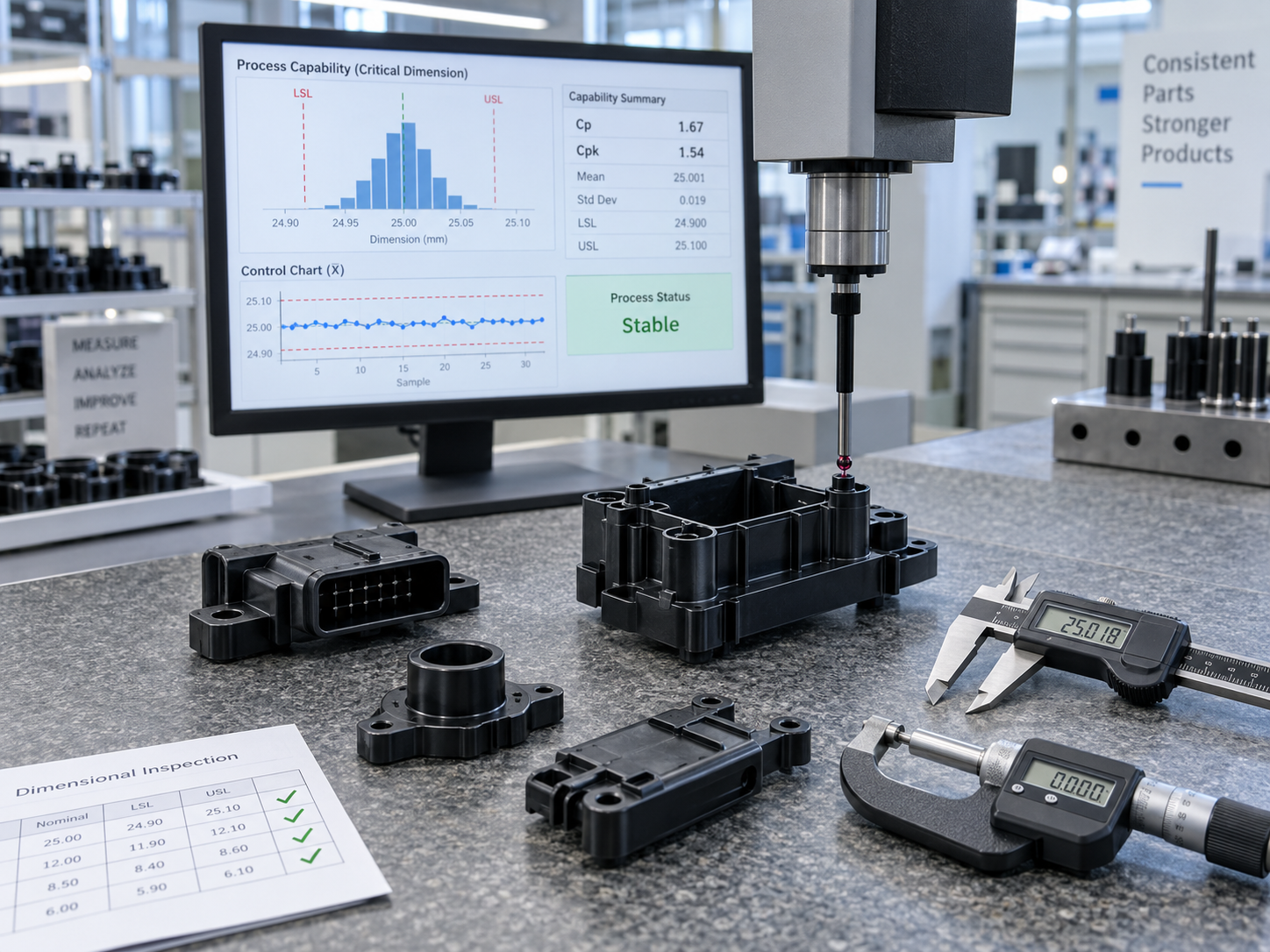
Injection Molding Cpk is a useful way to check whether a molding process can keep critical dimensions within tolerance during production.
A few good samples are not enough.
A part may pass inspection today but fail after the mold temperature changes, the material lot changes, or the machine runs for several hours.
This is why buyers should not only ask:
“Does the part meet the drawing?”
They should also ask:
“Can the process keep making good parts again and again?”
Cpk helps answer this second question.
For injection molding projects, it can show whether a key dimension is stable and well centered inside the allowed tolerance.
What Is Injection Molding Cpk?
Cpk stands for Process Capability Index.
It compares the natural variation of a production process with the drawing tolerance.
In simple terms, Injection Molding Cpk tells us two things:
- How much the dimension changes during production
- How close the average result is to the tolerance limit
A process may have low variation but still have a poor Cpk if the average is too close to one limit.
For example, imagine the drawing requires:
50.00 ±0.20 mm
The acceptable range is:
49.80–50.20 mm
If most parts measure around 50.00 mm with very little variation, the process may have a good Cpk.
However, if most parts measure around 50.17 mm, the parts may still pass.
But the process is already close to the upper limit.
A small change can create rejected parts.
This is why Cpk is more useful than checking only PASS or FAIL.
Why Injection Molding Cpk Matters
Injection molding is not a perfectly fixed process.
Many factors can change part dimensions.
These include:
- Material moisture
- Material lot
- Melt temperature
- Mold temperature
- Injection speed
- Packing pressure
- Holding time
- Cooling time
- Machine condition
- Mold wear
- Room temperature
Some changes are small.
However, tight-tolerance parts may react strongly to them.
A dimension that looks good during a short mold trial may slowly move during a long production run.
Injection Molding Cpk helps show whether the process has enough room to handle normal variation.
A Passing Dimension Can Still Have Poor Cpk
This is an important point.
Suppose the tolerance is:
30.00 ±0.10 mm
The allowed range is:
29.90–30.10 mm
Now imagine ten parts measure:
- 30.07
- 30.08
- 30.06
- 30.09
- 30.07
- 30.08
- 30.09
- 30.06
- 30.08
- 30.07
Every part passes.
At first, the result looks good.
But all the parts are close to the upper limit.
The process does not have much safety room.
If mold temperature or packing pressure changes slightly, the dimension may move above 30.10 mm.
This is why Injection Molding Cpk should be checked before a long production run for important dimensions.
Which Dimensions Need Injection Molding Cpk?
Not every dimension needs a capability study.
Doing Cpk on every dimension can waste time and money.
It is better to focus on critical features.
Typical examples include:
- Sealing dimensions
- Connector positions
- Hole locations
- Boss positions
- Flatness-related dimensions
- Bearing fits
- Insert locations
- Snap-fit features
- Critical wall thickness
- Assembly dimensions
- Functional gaps
- Overall dimensions with tight tolerance
The right question is simple:
What happens if this dimension moves?
If the part will leak, jam, fail to assemble, or stop working, the dimension may need closer process control.
Injection Molding Cpk Is Not the Same as First Article Inspection
First article inspection checks whether the first parts meet the drawing.
Cpk checks whether the process can keep meeting the drawing.
These are related, but they are not the same.
A first article report may show:
25.00 mm — PASS
That tells the buyer the measured part is acceptable.
Cpk needs many measurements.
It looks at how those results move over time.
For example:
- 24.99
- 25.01
- 25.00
- 25.02
- 24.98
- 25.01
- 25.00
This gives much more information about process stability.
You can also read our article about Injection Molding First Article Inspection to understand how first article approval and process capability work together.
How Many Parts Should Be Measured?
Cpk should not be calculated from only a few parts.
The sample must represent the real process.
The exact quantity depends on the customer, product, industry, and quality plan.
For important projects, samples should also be taken across the production run.
Do not take all parts from the same short period.
For example, samples can be taken:
- After production starts
- During the middle of the run
- After the mold reaches stable temperature
- After several hours of production
- From different cavities
This gives a better picture of the real process.
A Cpk study based on carefully selected “best parts” has little value.
Multi-Cavity Molds Need Separate Cpk Attention
Multi-cavity molds can create another problem.
Different cavities may not produce exactly the same result.
One cavity may be centered well.
Another cavity may run close to the upper limit.
A third cavity may show more variation.
This can happen because of small differences in:
- Gate size
- Runner balance
- Cooling
- Venting
- Cavity dimensions
- Mold temperature
- Steel condition
For this reason, cavity numbers should remain traceable.
When needed, Injection Molding Cpk should be reviewed by cavity.
If all parts are mixed together, the real problem may be hidden.
What Is a Good Injection Molding Cpk?
There is no single Cpk target for every project.
The required value depends on:
- Customer requirements
- Part function
- Industry
- Risk level
- Production volume
- Tolerance
A Cpk value around 1.33 or higher is often used as a common production target.
More critical dimensions may require a higher target.
However, the number alone should not control the decision.
A supplier should also review:
- Sample size
- Measurement method
- Process stability
- Cavity differences
- Data trend
- Actual product function
A high Cpk number from poor data is not useful.
Measurement Method Can Change the Cpk Result
Good data starts with good measurement.
If the measuring method is not stable, the Cpk result may be misleading.
For example, different inspectors may measure the same part in different ways.
The result can also change because of:
- Different datum points
- Different fixtures
- Different measuring tools
- Different part temperatures
- Different measuring force
- Part warpage
For critical dimensions, the buyer and supplier should agree on the measuring method.
Tools may include:
- Digital calipers
- Micrometers
- Height gauges
- CMM
- Optical measurement
- Custom inspection fixtures
At Fentor Mold, critical dimensions are reviewed based on the drawing and the real function of the part. The measurement method should match the feature being checked.
Part Cooling Time Can Affect Injection Molding Cpk
Plastic parts may keep changing after ejection.
Some materials change more than others.
This is common with:
- PA
- POM
- PP
- Glass-filled materials
- Large plastic parts
- Parts with uneven wall thickness
If one part is measured after 10 minutes and another after 24 hours, the data may not be comparable.
For this reason, measurement timing should be controlled.
For some projects, parts should rest for an agreed period before final inspection.
This gives more useful Cpk data.
Injection Molding Cpk Should Be Based on a Stable Process
Cpk should not be used to hide an unstable molding process.
Before collecting data, the process should already be under reasonable control.
Key parameters may include:
- Melt temperature
- Mold temperature
- Injection speed
- V/P transfer position
- Packing pressure
- Holding time
- Cooling time
- Cycle time
If operators keep changing these settings during the study, the data may not represent normal production.
This is why process setup matters.
Our Injection Molding Production service focuses on stable molding conditions before regular production begins.
What Causes Low Injection Molding Cpk?
Low Cpk does not always mean the same problem.
The first step is to understand why the result is low.
The Average Is Too Close to One Limit
The process may be stable, but the dimension is not centered.
Possible causes include:
- Mold size
- Shrinkage
- Packing pressure
- Mold temperature
- Material condition
In this case, the average may need to move toward the center of the tolerance.
The Variation Is Too Large
The average may be correct, but the measurements move too much.
Possible causes include:
- Unstable molding settings
- Material variation
- Cooling problems
- Machine variation
- Poor measurement
- Part warpage
The process needs to become more stable.
One Cavity Is Different
For multi-cavity molds, one cavity may reduce the overall result.
The cavity should be checked separately.
The cause may be gate size, cooling, venting, or cavity dimensions.
Should the Mold Be Modified When Cpk Is Low?
Not immediately.
This is one of the biggest mistakes.
A low Injection Molding Cpk result does not always mean the mold steel is wrong.
First check the process.
Then check the measurement method.
Also check the material and part condition.
Only modify the mold when the data shows that the mold dimension or structure is the real cause.
The correct order is:
Measure → Check Data → Find the Cause → Adjust Process → Verify → Modify Mold if Needed
This reduces unnecessary mold changes.
It also avoids creating a new problem while trying to fix the first one.
Mold Temperature Can Have a Large Effect
Mold temperature is often overlooked.
During a short trial, the mold may still be heating up.
Dimensions from the first few shots can be different from dimensions after one hour of production.
This is especially important for large molds and thick parts.
The Cpk study should therefore use parts made after the mold reaches a stable working condition.
Otherwise, early parts may make the data look worse than the real process.
Mold Wear Can Change Cpk Over Time
A good process today may not stay the same forever.
Mold wear can slowly change part dimensions.
Common areas include:
- Shut-off surfaces
- Sliders
- Lifters
- Guide components
- Inserts
- Gates
- Ejector areas
A dimension may slowly move toward one tolerance limit after many production cycles.
This is why Cpk can also be useful for long-term production monitoring.
If the value starts to fall, the supplier should investigate the reason.
Our article on Injection Mold Wear Inspection explains how mold wear can slowly affect part quality.
Do Not Improve Cpk by Selecting Good Parts
Cpk should describe the real process.
It should not describe a group of carefully selected parts.
Removing bad parts from the data can create a false result.
The same problem happens when only the best cavity is measured.
The goal is not to create a beautiful report.
The goal is to understand the true production condition.
This is especially important for buyers who will receive thousands or millions of parts.
What Should Buyers Ask Their Supplier?
Buyers do not need to become statistics experts.
A few simple questions are enough.
Ask:
- Which dimensions are critical?
- How many parts were measured?
- When were the samples taken?
- Were all cavities included?
- What measuring method was used?
- Was the molding process stable?
- Is the average close to the center of tolerance?
- Is one cavity different from the others?
- What action will be taken if Cpk is low?
These questions can quickly show whether the supplier understands process capability or is only filling out a report.
Cpk Should Support Real Product Performance
A good Cpk result is useful.
But it is not the final goal.
The final goal is a plastic part that works correctly in real production.
A dimension can have a high Cpk but still be wrong if the drawing tolerance is not suitable for the assembly.
The opposite can also happen.
A dimension may have a lower Cpk but have little effect on product function.
This is why engineering judgment still matters.
At Fentor Mold, we prefer to connect dimensional control with the actual part function, assembly, and mold condition.
The number should support the product.
The product should not serve the number.
Final Thoughts
Injection Molding Cpk helps buyers understand something that a simple inspection report cannot show.
It shows whether the production process can repeatedly hold critical dimensions inside tolerance.
A useful Cpk study should check:
- Critical dimensions
- Enough production samples
- Stable molding conditions
- Correct measurement methods
- Cavity-to-cavity differences
- Process variation over time
A part that passes today is good.
A process that keeps making good parts is better.
That is the real value of Injection Molding Cpk.