
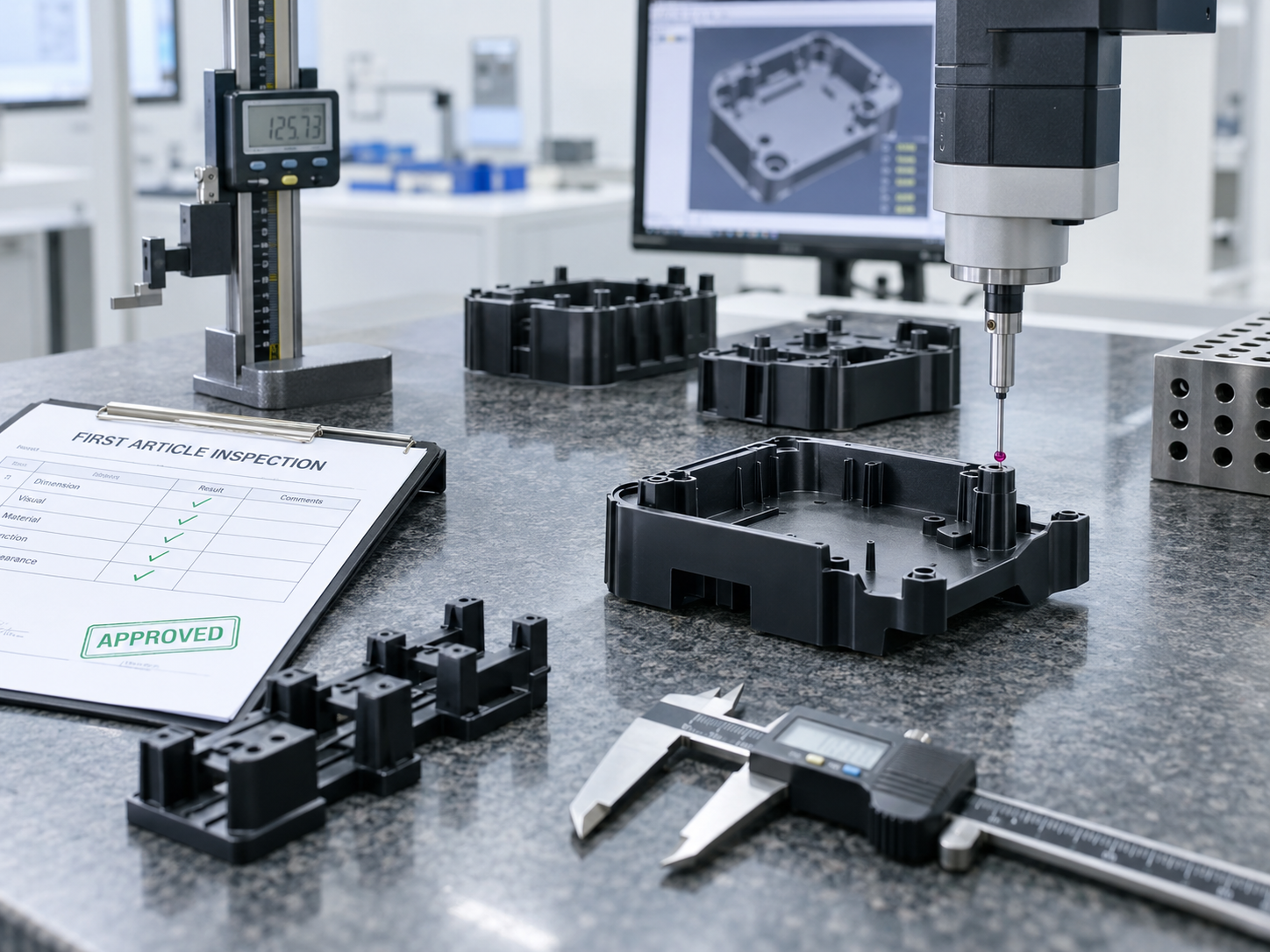
Injection Molding First Article Inspection is an important step before a new plastic part enters regular production.
A few good samples do not mean the process is ready.
Dimensions may still change. Assembly problems may not be easy to see. Small defects may also become worse after long production.
For buyers, the goal of Injection Molding First Article Inspection is simple.
Can this part be made again and again to meet the drawing and product requirements?
The inspection should not focus only on dimensions. It should also check appearance, assembly, function, material, and process stability.
What Is Injection Molding First Article Inspection?
Injection Molding First Article Inspection is a detailed check of the first production parts.
These parts may come from:
- A new mold
- A modified mold
- A new molding process
- A new production setup
The parts are checked against the project requirements.
These may include:
- 2D drawings
- Approved 3D data
- Material requirements
- Color requirements
- Surface requirements
- Assembly requirements
- Functional requirements
- Approved samples
The parts should come from a stable molding process.
This is important.
If the supplier keeps changing pressure, temperature, holding time, or cooling time just to make a few good parts, the process may not be stable.
Before regular injection molding production starts, the process should be able to make good parts again and again.
Injection Molding First Article Inspection Should Start With the Drawing
The 2D drawing should be the main guide for dimensional inspection.
However, not every dimension has the same importance.
Some dimensions have little effect on the final product.
Others can affect:
- Assembly
- Sealing
- Movement
- Position
- Product function
For this reason, the inspection should first find the critical dimensions.
These may include:
- Assembly dimensions
- Hole positions
- Boss locations
- Flatness
- Parallelism
- Perpendicularity
- Sealing surfaces
- Snap-fit dimensions
- Insert positions
- Connector locations
- Wall thickness
- Overall dimensions
For a simple housing, only a few dimensions may be critical.
For a mechanical part, many dimensions may work together.
A good Injection Molding First Article Inspection should focus more on the features that affect real product use.
Injection Molding First Article Inspection Must Look Beyond Pass or Fail
A dimension can pass the drawing and still be risky.
For example, the drawing may show:
20.00 ±0.10 mm
The allowed range is:
19.90–20.10 mm
Now suppose the part measures 20.09 mm.
It passes.
However, it is very close to the upper limit.
A small process change may push the next parts outside tolerance.
This change may come from:
- Mold temperature
- Packing pressure
- Cooling time
- Material condition
- Plastic shrinkage
This is why Injection Molding First Article Inspection should check more than PASS or FAIL.
For critical dimensions, it is better to stay near a safe target.
This gives the production process more room for normal variation.
Injection Molding First Article Inspection Should Check Multiple Parts
During Injection Molding First Article Inspection, one good part is not enough.
A supplier may measure one part and get a good result.
The next parts may be different.
For critical projects, several parts should be checked.
The exact number depends on:
- Part tolerance
- Number of cavities
- Production volume
- Customer requirements
- Product function
The main goal is to check consistency.
For example:
- 25.01 mm
- 25.00 mm
- 25.02 mm
- 25.01 mm
- 25.00 mm
These results look stable.
Now compare them with:
- 24.91 mm
- 25.08 mm
- 24.94 mm
- 25.09 mm
- 25.02 mm
These parts may all pass.
However, the variation is much larger.
A good Injection Molding First Article Inspection should check both accuracy and consistency.
Injection Molding First Article Inspection for Multi-Cavity Molds
Multi-cavity molds need extra attention.
Parts from different cavities may look the same.
However, their dimensions may be different.
Small changes can come from:
- Gate size
- Runner balance
- Venting
- Cooling
- Cavity size
- Mold fitting
- Mold temperature
For this reason, samples should stay linked to their cavity number.
Do not mix all samples before inspection.
For example, cavity 1 may be close to the target size.
Cavity 4 may be close to the tolerance limit.
If the parts are mixed together, this problem may be missed.
During long production, one bad cavity can create many rejected parts.
Injection Molding First Article Inspection Must Include Appearance
Dimensions are only one part of the inspection.
Appearance also matters.
Typical checks include:
- Flash
- Sink marks
- Weld lines
- Flow marks
- Silver streaks
- Burn marks
- Gate marks
- Ejector marks
- Scratches
- Parting line mismatch
- Texture
- Gloss
- Color
Not every product needs the same appearance standard.
A hidden internal part may allow small cosmetic defects.
A visible housing may need a much better surface.
This is why terms such as “good appearance” are too unclear.
The buyer and supplier should agree on what is acceptable.
Approved samples can then be used as the visual standard for production.
Injection Molding First Article Inspection Should Include Assembly Testing
A part can pass dimensional inspection and still fail during assembly.
This often happens because several small dimension changes add together.
One boss may pass.
One hole may also pass.
However, the full assembly may still be too tight or out of position.
During Injection Molding First Article Inspection, the real assembly should be tested when possible.
Check items such as:
- Screws
- Snap fits
- Clips
- Connectors
- Hinges
- Covers
- Seals
- Metal inserts
- Moving parts
- Mating plastic parts
Do not rely only on the dimensional report.
The real assembly may show:
- Interference
- Large gaps
- Poor alignment
- Weak snap fits
- Uneven surfaces
- Difficult assembly
These problems may not be clear from measurements alone.
Injection Molding First Article Inspection of Functional Areas
Some features are more important than others.
A sealing surface, pressure channel, connector, gear, or locating feature may need extra attention.
For example, a plastic tank may pass most dimensions.
However, a slightly warped sealing surface can still cause a leak.
A connector housing may also pass most measurements.
But if the terminal positions are wrong, the product may not work.
For this reason, Injection Molding First Article Inspection should follow how the product is used.
A long inspection report is not enough if it misses the important features.
Check Warpage After the Part Has Fully Cooled
Plastic parts can keep changing after they leave the mold.
This is common with:
- Large parts
- Glass-filled materials
- Semi-crystalline plastics
- Parts with uneven wall thickness
A part measured right after molding may have a different size several hours later.
For this reason, the buyer and supplier may need to agree on a cooling or conditioning time.
Flatness should also be checked correctly.
Do not force a warped part flat during measurement.
That can hide a real assembly problem.
Injection Molding First Article Inspection Requires a Stable Process
A good inspection report has little value if the molding process is unstable.
The molding conditions should be reasonably stable before approval.
Important settings may include:
- Melt temperature
- Mold temperature
- Injection speed
- Injection pressure
- Holding pressure
- Holding time
- Cooling time
- Screw speed
- Back pressure
- Cycle time
The goal is not to lock every setting forever.
The goal is to make sure the process has a safe working range.
The mold should not only work under one very narrow condition.
For new tooling, this usually takes several mold trials and sample checks.
You can also review our prototype injection molding process to see how mold trials and part checks are linked before regular production.
Injection Molding First Article Inspection Should Catch Problems Before They Grow
Some small problems become worse during long production.
This is why early checks are important.
Slight Flash
Small flash may look acceptable at first.
However, poor shut-off or mold fitting can make it worse after wear starts.
Trapped Air
A small burn mark or air trap may not look serious during early trials.
After long production, dirt can build up around the vents.
This can make the problem worse.
Slider or Lifter Problems
A slider or lifter may work well during a short trial.
After many cycles, wear may cause looseness, marks, or movement problems.
Difficult Ejection
A part may need high ejection force during the trial.
Later, this can cause:
- Whitening
- Deformation
- Ejector wear
- Unstable automatic production
Injection Molding First Article Inspection should help find these risks before mass production.
Should Injection Molding First Article Inspection Be Done at T1?
Not always.
T1 is often the first time real molded parts are available.
It is useful for finding major problems.
However, the mold may still need changes.
At T1:
- Dimensions may not be final
- The mold may need correction
- Process settings may still change
- Texture may not be finished
For this reason, formal Injection Molding First Article Inspection is often better after the main mold changes are complete.
The mold should also be able to make stable parts.
T1 samples are still useful.
Their main job is to find problems and guide the next mold change.
Before final approval, buyers should also check the mold itself.
Our Injection Mold Acceptance Checklist covers key checks before mold delivery.
What Should an Injection Molding First Article Inspection Report Include?
A useful report does not need to be too complex.
It should clearly show:
- Drawing number
- Drawing revision
- Part number
- Material
- Color
- Mold number
- Cavity number
- Sample date
- Measuring equipment
- Drawing dimensions
- Tolerances
- Actual results
- Pass or fail
- Inspector
- Notes
Photos can also be added for appearance problems.
For critical dimensions, the measuring method should be clear.
This helps avoid different results.
The buyer and supplier may use different datum points, fixtures, or measuring tools.
A clear method reduces this risk.
What Happens When Injection Molding First Article Inspection Fails?
A failed Injection Molding First Article Inspection does not always mean the mold must be changed.
First, find the real cause.
The problem may come from:
- Mold size
- Plastic shrinkage
- Molding settings
- Measuring method
- Part warpage
- Material condition
- Cooling
- Drawing requirements
- Tolerance build-up
For example, changing mold steel too quickly can create a new problem.
The real cause may only be an unstable molding process.
A better method is:
Measure → Analyze → Find the Cause → Correct → Sample Again → Verify
This reduces unnecessary mold changes.
If the mold is modified, the changed area should be checked again.
Injection Molding First Article Inspection Creates the Production Standard
After approval, the final records should become part of the production standard.
These may include:
- Approved dimensional report
- Approved samples
- Appearance standard
- Color standard
- Material specification
- Critical dimensions
- Assembly result
- Functional test result
- Final molding settings
These records make future production easier to control.
If a problem appears later, the supplier can compare new parts with the original approved condition.
This can help find whether the problem comes from:
- Process drift
- Material change
- Mold wear
- Measurement change
For molds that have already run for a long time, our article on injection mold wear inspection explains how part changes can show signs of mold wear.
Final Thoughts
Injection Molding First Article Inspection should not be treated as simple paperwork.
It should answer four questions:
- Does the part meet the drawing?
- Can the result be repeated?
- Does the part assemble and work correctly?
- Is the process stable enough for production?
At Fentor Mold, we prefer to find these problems before mass production.
A problem found during Injection Molding First Article Inspection may only need another trial, measurement, or mold correction.
The same problem found after thousands of parts have been made can cause much more trouble.
It may lead to sorting, rework, delays, and extra cost.
That is why early inspection matters.