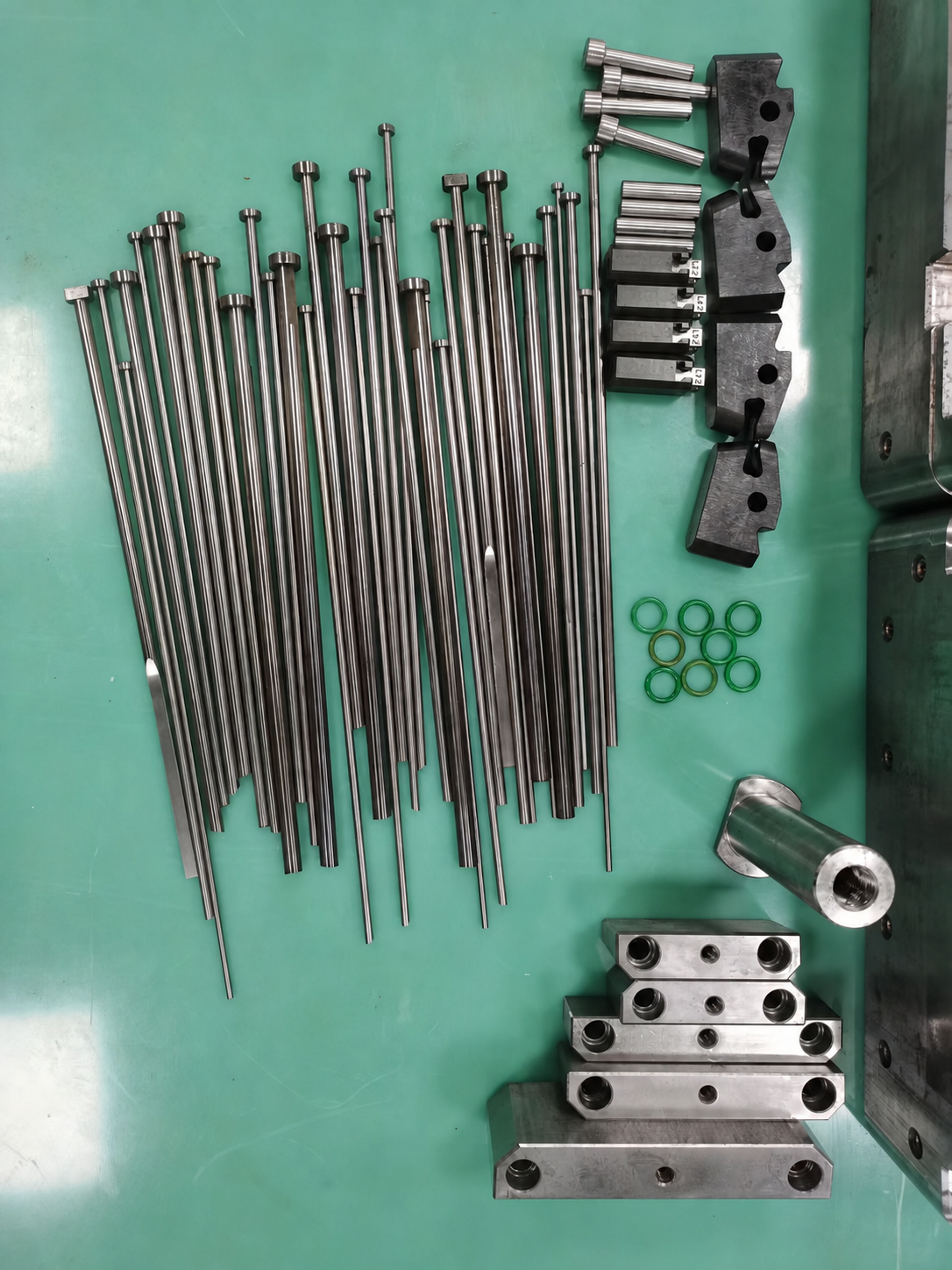
Injection mold wear parts do not all fail at the same speed. Some parts may run for years, while others can wear, bend, crack, or seize much earlier. The difference usually comes from friction, side force, heat, poor lubrication, material type, and how often the mold runs.
For buyers, the key question is not only which parts may fail. It is also which failure can stop production immediately.
At Fentor Mold, we pay close attention to these high-wear areas during mold design, trial, and long-term production.
Why Injection Mold Wear Parts Matter
A production mold is not a single block of steel.
It contains many moving and fitting parts.
Some areas move every cycle. In addition, others slide under pressure. Some parts also touch abrasive plastic materials again and again.
Because of this, wear is normal.
The real problem starts when wear changes:
- Part dimensions
- Flash
- Mold movement
- Ejection
- Part appearance
- Cooling
- Cycle time
- Production stability
Small wear can also become a much larger problem if it is not found early.
For example, a slightly worn slider may first create a small amount of flash. Later, the same area may begin to jam or damage the shut-off surface.
Injection Mold Wear Parts: Ejector Pins
Ejector pins are among the most common wear parts in a mold.
They move every cycle.
They also work under load when the molded part sticks tightly to the core.
Common ejector pin problems include:
- Bending
- Breaking
- Scratching
- Galling
- Uneven height
- Worn pin holes
- Poor return
A pin may wear faster when the part needs too much ejection force. In addition, poor alignment can create side load.
Poor lubrication can also increase friction.
If one ejector pin becomes damaged, the first sign may be an ejector mark on the plastic part.
Later, the pin may bend or break.
For molds with small-diameter pins or high ejection force, these parts deserve regular inspection.
Ejector Sleeves Can Wear Even Faster
Ejector sleeves work in a similar way to ejector pins.
However, sleeves often have a thinner wall.
This makes them more sensitive to side force and poor alignment.
Common problems include:
- Cracking
- Bending
- Inner hole wear
- Scratches
- Seizing
Sleeves around small bosses often carry high local force. As a result, if the boss sticks strongly to the core, the sleeve may receive repeated shock.
Therefore, the ejection system should move smoothly from the first mold trial.
Do not wait until production starts to solve heavy ejection.
Injection Mold Wear Parts: Sliders
Sliders are another major wear area.
A slider normally moves back and forth every mold cycle.
Its wear surfaces may include:
- Wear plates
- Guide rails
- Angle pins
- Locking blocks
- Shut-off surfaces
Poor lubrication can quickly damage these areas.
Misalignment can make the problem worse. As the wear increases, buyers may see:
- Flash near the slider
- Scratches on the product
- Noise during mold movement
- Jerky slider movement
- Metal powder
- Slider jamming
A worn slider should not simply be given more clearance.
Instead, the actual cause needs to be found first.
Our guide on Injection Mold Slide Jamming covers common slider wear, alignment, and jamming problems in more detail.
Wear Plates Are Designed to Take Wear
Wear plates protect more expensive mold components.
They are often used under sliders or other moving parts.
This is useful because replacing a wear plate is much easier than repairing a large slider or mold plate.
However, wear plates still need inspection.
Look for:
- Deep scratches
- Uneven contact
- Galling
- Low spots
- Loose screws
- Loss of thickness
If a wear plate becomes too thin, the slider position may change. As a result, the shut-off can change and flash may appear.
Therefore, a low-cost wear plate can still have a large effect on part quality.
Angle Pins Can Bend or Wear
Angle pins drive many slider systems.
They take side force each time the mold opens and closes.
If the slider is difficult to move, the angle pin may take more load than expected.
Over time, the pin may:
- Wear on one side
- Bend
- Scratch
- Crack
- Loosen
A damaged angle pin often points to another problem.
For example, the slider may have poor alignment. Also, it may not have enough clearance when hot.
Replacing the pin without solving the root cause may only give a short-term fix.
Injection Mold Wear Parts: Lifters
Lifters combine sliding and ejection movement.
Because of this, their working condition can be more difficult than a normal ejector pin.
Common lifter wear appears on:
- Guide surfaces
- Bottom seats
- Side faces
- Head areas
- Fitting surfaces
A lifter can also bend if its angle is too large or if the part holds it too tightly.
Typical warning signs include:
- Scratch marks on the plastic part
- Difficult ejection
- Uneven lifter movement
- Loose fitting
- Flash around the lifter
- Visible wear marks
Good guidance is very important. Therefore, the lifter should not depend only on a long thin steel section to control its movement.
Guide Pins and Bushings
Guide pins and bushings keep the mold halves aligned.
They may look simple, but they affect the position of the whole mold.
If lubrication is poor, the guide system can wear over time.
Common signs include:
- Scratches
- Loose fitting
- Metal powder
- Uneven mold closing
- Abnormal noise
If guide wear becomes serious, other mold areas may also start to wear. As a result, the parting line can shift.
Shut-off surfaces may no longer meet correctly.
Therefore, guide wear should not be ignored.
Shut-Off Surfaces Can Cause Bigger Problems
Shut-off surfaces are not always seen as replaceable wear parts.
However, they are critical wear areas.
These surfaces may be found around:
- Sliders
- Lifters
- Holes
- Openings
- Side cores
- Parting line details
They close under mold pressure.
If they wear, flash may begin to appear.
Once flash starts, operators sometimes increase clamping force.
However, that may only hide the problem for a short time.
The correct solution is to inspect the contact area.
Some shut-offs may need fitting, welding, or replacement of an insert.
Injection Mold Wear Parts Around the Gate
Gate areas can also wear.
This becomes more common with abrasive materials.
Glass-fiber-filled plastics are a good example.
Material enters the cavity at high speed. Therefore, over time, the gate may become larger or lose its original shape.
Possible results include:
- Larger gate vestige
- Different filling behavior
- More flash
- Part weight change
- Different pressure requirement
A worn gate can also change how the cavity fills.
So, when production conditions slowly change, the gate should be part of the inspection.
Core Pins and Small Inserts
Small core pins often fail earlier than large mold inserts.
Their size makes them more sensitive to load.
They may form:
- Small holes
- Deep bosses
- Ribs
- Connector features
- Thin internal shapes
Common failures include:
- Bending
- Breaking
- Tip wear
- Surface damage
Long thin pins are especially sensitive. For example, if plastic flow hits the pin from one side, it can create repeated side force.
Good support and correct steel selection can greatly improve life.
For critical custom parts, our Components Manufacturing service can support precision replacement inserts, pins, and other mold components.
Springs and Return Components
Springs may not look like precision parts, but they can still stop a mold.
They lose force after repeated compression.
In some cases, they can also break.
This matters in:
- Ejector return systems
- Slider systems
- Plate return systems
- Small moving inserts
If one spring becomes weaker than the others, movement may become uneven.
Therefore, springs should be replaced as a set when their condition becomes uncertain.
Hot Runner Wear Parts
Hot runner molds have another group of critical components.
Depending on the system, these may include:
- Valve pins
- Valve pin bushings
- Seals
- Heaters
- Thermocouples
- Nozzle tips
Some of these parts fail from mechanical wear. However, others fail because of heat.
A damaged heater or thermocouple may not show visible wear, but it can still stop production.
Valve pins can also wear where they contact the gate.
For this reason, the buyer should understand which hot runner parts are standard and which are custom.
Which Injection Mold Wear Parts Fail First?
There is no single order for every mold.
However, the first failures often appear in parts that have one or more of these conditions:
- High movement frequency
- High friction
- Small cross-section
- Strong side force
- Poor lubrication
- High temperature
- Abrasive plastic
- Tight fitting
- Heavy ejection load
This is why ejector pins, sleeves, sliders, lifters, wear plates, and small core pins often need more attention than large cavity blocks.
The mold design itself also matters.
A good design makes high-wear components easier to remove and replace.
In many molds, injection mold wear parts fail gradually, so early inspection is more useful than waiting for a sudden breakdown.
Glass-Filled Materials Increase Wear
Plastic material can change mold wear significantly.
Glass fiber is abrasive.
As production cycles increase, it can wear:
- Gates
- Runners
- Core pins
- Inserts
- Cavity surfaces
- Shut-offs
Therefore, molds for glass-filled PA, PBT, or similar materials need more attention to steel hardness and wear resistance.
A component that works well for normal ABS may not last as long with a high glass-fiber material.
Watch for Small Changes During Production
Wear does not always cause a sudden breakdown. Instead, the first sign is often a small change.
For example:
- Flash slowly increases
- Ejection becomes louder
- A slider moves less smoothly
- Part dimensions begin to drift
- Ejector marks become deeper
- Gate appearance changes
- More grease is needed
These signs should not be ignored.
A short inspection may prevent a much larger repair later.
Fentor Mold normally looks at both the plastic part and the mold movement because the first signs of wear often appear in the molded part.
When Should Wear Parts Be Replaced?
Do not replace a part only because it looks old.
Instead, the decision should depend on function.
A worn component should be repaired or replaced when it starts to affect:
- Mold safety
- Part quality
- Dimensions
- Smooth movement
- Production stability
Some components can be polished or fitted again. However, others should be replaced.
For example, a badly bent ejector pin should not be reused.
A severely worn wear plate should also be replaced before it changes the slider position.
Which Wear Parts Should Be Prepared in Advance?
This is where the topic connects with spare parts, but the focus is different.
Not every wear part needs to sit in stock.
Priority should go to parts that:
- Wear often
- Are custom-made
- Take a long time to produce
- Stop the mold if they fail
- Cannot be bought locally
For example, a standard spring may be easy to buy. In contrast, a custom lifter insert may not be.
So, buyers should look at both failure risk and replacement lead time.
The final mold documentation should also identify critical components and specifications.
Our Injection Mold Documentation guide explains why component lists and maintenance records matter for future repairs.
Keep the Final Component Drawings
For custom injection mold wear parts, final drawings are very important.
The mold may change several times during T1, T2, and later trials.
Therefore, the first component drawing may no longer match the final mold.
After the mold is approved, keep the final:
- 2D drawings
- 3D files
- Material grade
- Hardness
- Surface treatment
- Fitting dimensions
This becomes especially important several years later.
If the original mold maker is no longer available, the buyer can still remake the part.
For long-term production, checking injection mold wear parts during regular maintenance can reduce downtime and avoid larger mold repairs.
Injection Mold Wear Parts Inspection Checklist
| Wear Area | Common Problem | What to Check |
|---|---|---|
| Ejector pins | Bend, break, galling | Straightness and smooth movement |
| Ejector sleeves | Crack or seize | Fit and wall condition |
| Sliders | Wear or jam | Guide surfaces and clearance |
| Wear plates | Loss of thickness | Contact and surface wear |
| Angle pins | Bend or side wear | Alignment and surface marks |
| Lifters | Bend or loosen | Guidance and fitting |
| Guide pins | Wear | Alignment and lubrication |
| Shut-offs | Wear | Flash and contact condition |
| Gates | Erosion | Gate size and shape |
| Core pins | Bend or break | Tip and support |
| Springs | Lose force | Return action |
| Hot runner parts | Wear or heat failure | Pins, heaters, and sensors |
Final Thoughts
Injection mold wear parts should be judged by how they work, not only by how they look.
The parts that fail first are usually the ones that move often, carry side force, or work under high friction.
Ejector pins, sliders, lifters, wear plates, angle pins, small core pins, and some hot runner components deserve the most attention.
At Fentor Mold, we prefer to identify these areas before long-term production starts.
Therefore, the goal is simple.
Find wear while it is still small.
A worn component that costs little to replace can become an expensive mold repair if production continues for too long.