
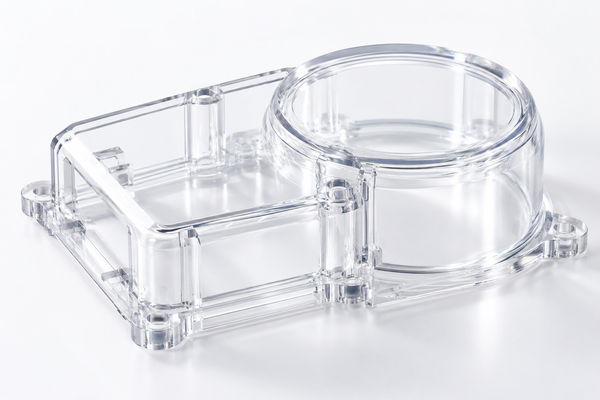
Light transmission in injection molded plastic parts is important for lenses, light covers, medical housings, display parts, sensors, and other clear products. However, using a clear resin such as PC or PMMA does not always give good transparency. Many factors can change the final result. These include material grade, wall thickness, mold polishing, drying, temperature, injection speed, and internal stress.
Therefore, manufacturers must control both the mold and the molding process.
At Fentor Mold, we normally check the resin, part design, mold structure, surface finish, and process settings together when developing clear plastic parts.
What Is Light Transmission in Injection Molded Plastic Parts?
Light transmission in injection molded plastic parts means how much visible light can pass through the finished part.
It is usually shown as a percentage.
For example, a clear resin may have high light transmission on its material datasheet. However, the final molded part may show a lower value.
This happens because molding can create defects such as:
- Haze
- Flow marks
- Weld lines
- Internal stress
- Black spots
- Surface roughness
- Bubbles
Therefore, buyers should not judge optical quality only from the resin datasheet.
Instead, the molded part should also be tested.
How Material Affects Light Transmission in Injection Molded Plastic Parts
Material choice directly affects light transmission in injection molded plastic parts.
Different clear plastics provide different levels of clarity, strength, heat resistance, and UV resistance.
| Material | Main Advantage | Typical Applications |
|---|---|---|
| PMMA | Excellent clarity | Lenses, light covers, displays |
| PC | High impact strength | Safety covers, housings, lenses |
| PETG | Good clarity and toughness | Medical parts, containers |
| MABS | Good clear appearance | Consumer housings |
| PEI | High heat resistance | Aerospace and electrical parts |
| Optical LSR | High optical performance | Lighting and optical parts |
PMMA usually provides very good clarity. However, it is more brittle than PC.
PC, on the other hand, has much better impact strength. Therefore, it is often used when both clarity and strength are important.
In addition, optical-grade resin can give better results than standard resin.
Some additives may reduce transparency. For example:
- Flame retardants
- Fillers
- Pigments
- Reinforcement fibers
Therefore, material selection should match the optical target of the final part.
Wall Thickness and Light Transmission
Wall thickness also affects light transmission in injection molded plastic parts.
As light passes through more material, some light is absorbed or scattered. As a result, a thick part may look darker than a thin part made from the same resin.
Uneven wall thickness can also create problems.
For example, sudden changes in thickness may cause:
- Uneven cooling
- Internal stress
- Sink marks
- Flow hesitation
- Optical distortion
Therefore, designers should keep wall thickness as uniform as possible.
If thickness must change, a smooth transition is better than a sharp step.
Mold Polishing Improves Light Transmission in Injection Molded Plastic Parts
The plastic surface copies the mold cavity surface.
Therefore, even a good clear resin can look cloudy if the mold surface is rough.
For this reason, transparent parts often need a highly polished mold cavity.
Common SPI finishes include:
| Finish | Method | Typical Use |
|---|---|---|
| SPI A1 | Diamond buff | High optical clarity |
| SPI A2 | Diamond buff | Clear cosmetic parts |
| SPI A3 | Diamond buff | General transparent parts |
| SPI B1 | Fine abrasive paper | Semi-gloss parts |
SPI A1 gives a very high polish. However, not every clear part needs this level.
For example, a normal transparent housing may only need SPI A2.
Therefore, the finish should match the real optical requirement.
You can learn more about our custom injection mold manufacturing process for precision plastic parts.
Mold Temperature Affects Optical Quality
Mold temperature has a strong effect on surface quality.
If the mold is too cold, the plastic can freeze too quickly near the cavity wall.
As a result, the part may show:
- Flow marks
- Poor gloss
- Surface haze
- Visible weld lines
A higher and more stable mold temperature can improve light transmission in injection molded plastic parts.
This is especially important for PC and PMMA.
However, the mold temperature should not be too high. Otherwise, cycle time will increase.
Therefore, manufacturers need to balance optical quality and production efficiency.
Melt Temperature and Light Transmission
Melt temperature also affects the final appearance.
If the melt temperature is too low, the resin becomes harder to flow.
As a result, the part may show:
- Flow marks
- Poor filling
- High stress
- Poor surface quality
However, very high melt temperature can also create problems.
For example, overheated resin may show:
- Yellowing
- Black spots
- Gas marks
- Lower transparency
These defects can reduce light transmission in injection molded plastic parts.
PC is especially sensitive to overheating.
Therefore, manufacturers should not increase melt temperature without checking the real cause of the problem.
Injection Speed Can Affect Light Transmission
Injection speed controls how the melt fills the cavity.
If the speed is too slow, the melt front may cool too early. As a result, flow marks can appear.
However, very high speed can also create defects.
These may include:
- Jetting
- Burning
- Air traps
- Excessive shear
Therefore, a stable medium-to-fast speed often works better for clear parts.
Still, the best setting depends on:
- Resin type
- Wall thickness
- Gate size
- Flow length
- Mold temperature
In some cases, multi-stage injection can improve the result.
Proper Drying Improves Light Transmission in Injection Molded Plastic Parts
Moisture is one of the most common causes of poor transparency.
Materials such as PC, PMMA, PETG, PA, and PEI can absorb moisture from the air.
During molding, this moisture can turn into vapor.
As a result, the part may show:
- Silver streaks
- Bubbles
- Splay
- Haze
Therefore, proper drying is very important for good light transmission in injection molded plastic parts.
Manufacturers should control:
- Drying temperature
- Drying time
- Dew point
- Hopper condition
- Material storage
- Exposure time after drying
In addition, dried material should not stay open in a humid workshop for too long.
Internal Stress Can Reduce Transparency
Clear parts may look good but still contain high internal stress.
This stress can cause:
- Optical distortion
- Birefringence
- Cracking
- Whitening
- Dimensional change
PC parts are especially sensitive.
For example, high injection pressure can increase stress. Low mold temperature can also make the problem worse.
In addition, excessive holding pressure may create more stress near the gate.
Therefore, reducing unnecessary stress can improve both strength and light transmission in injection molded plastic parts.
For optical parts, polarized light can help show stress inside the part.
Gate Design Affects Light Transmission in Injection Molded Plastic Parts
Gate design controls how plastic enters the cavity.
A poor gate position can create defects in important optical areas.
Common problems include:
- Weld lines
- Flow marks
- Jetting
- Gate blush
- Air traps
Therefore, the gate should stay away from critical viewing areas when possible.
In addition, the gate should be large enough to avoid high shear.
For example, some clear parts use fan gates or wider edge gates to create smoother flow.
Hot runner systems can also help with large transparent parts.
Weld Lines Can Reduce Optical Quality
A weld line appears when two melt fronts meet.
Even if the weld line is strong enough, it may still be visible.
As a result, it can reduce light transmission in injection molded plastic parts.
The weld line appearance depends on:
- Melt temperature
- Mold temperature
- Injection speed
- Gate position
- Venting
- Flow direction
Therefore, mold designers should try to move weld lines away from optical areas.
In many cases, changing gate location is more effective than changing process settings later.
Venting Is Important for Transparent Parts
Good mold venting helps air escape from the cavity.
If air becomes trapped, pressure rises quickly.
As a result, the part may show:
- Burn marks
- White haze
- Gas marks
- Short shots
- Poor surface quality
These problems can reduce light transmission in injection molded plastic parts.
Therefore, vents should be placed near the end of fill and in areas where air may collect.
However, vent depth must be controlled. Otherwise, flash may appear.
In addition, Moldflow analysis can help find possible air traps before mold manufacturing begins.
Clean Production Helps Maintain Light Transmission
Clear plastic parts show contamination very easily.
For example, one small black spot may be acceptable on a black housing. However, the same spot may cause a clear part to fail inspection.
Therefore, manufacturers need good control over:
- Raw material cleanliness
- Hopper cleanliness
- Barrel cleanliness
- Mold cavity condition
- Recycled material
- Machine purging
For high-quality optical parts, recycled material is often limited.
In addition, the machine should be cleaned before changing from dark resin to clear resin.
Good cleaning helps maintain stable light transmission in injection molded plastic parts during production.
Common Problems That Reduce Light Transmission in Injection Molded Plastic Parts
| Problem | Possible Cause | Typical Solution |
|---|---|---|
| Haze | Moisture or poor polish | Improve drying and mold polish |
| Yellowing | Too much heat | Reduce temperature or residence time |
| Silver streaks | Moisture | Improve resin drying |
| Flow marks | Cold mold or poor filling | Adjust mold temperature and speed |
| Black spots | Contamination or degradation | Clean machine and reduce overheating |
| Optical distortion | Stress or uneven thickness | Improve design and process |
| Weld lines | Poor gate position | Optimize gate position |
Several problems may appear at the same time.
Therefore, it is better to change one main parameter at a time.
This makes troubleshooting easier.
How to Improve Light Transmission in Injection Molded Plastic Parts
When light transmission in injection molded plastic parts is lower than expected, check the process step by step.
- Confirm the correct optical-grade resin.
- Check material drying.
- Inspect the mold polish.
- Review wall thickness.
- Check gate size and position.
- Confirm mold temperature.
- Check melt temperature.
- Adjust injection speed.
- Reduce excessive holding pressure.
- Check mold venting.
- Inspect internal stress.
- Check machine cleanliness.
This simple order helps reduce wasted trial time.
In addition, it makes it easier to find the real cause.
Material or Process: Which Is More Important?
Both are important.
A high-quality clear resin cannot fix a rough mold surface.
At the same time, a perfect molding process cannot make a low-clarity resin look like an optical-grade material.
Therefore, light transmission in injection molded plastic parts depends on five main areas:
Material + Part Design + Mold Design + Surface Finish + Injection Process
All five areas should work together.
Fentor Mold provides both mold manufacturing and injection molding production. Therefore, mold design and molding conditions can be checked together.
Final Thoughts
Good light transmission in injection molded plastic parts depends on more than clear resin.
Material grade, wall thickness, mold polishing, gate design, drying, mold temperature, melt temperature, injection speed, venting, cleanliness, and internal stress all matter.
For simple clear housings, small defects may be acceptable. However, lenses, lighting parts, sensors, and medical parts often need much tighter control.
Therefore, it is better to define the optical target before mold manufacturing starts.
This allows the team to choose the right material, mold finish, gate design, and molding process from the beginning.
If you are developing transparent plastic parts, Fentor Mold can support mold design, tooling, trial molding, process optimization, and production.