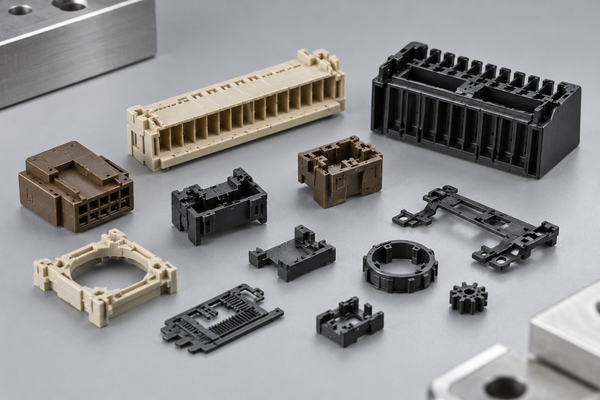
LCP injection molding is widely used for small, thin-wall, and high-precision plastic parts. LCP stands for Liquid Crystal Polymer, a high-performance engineering plastic known for excellent flow, heat resistance, dimensional stability, and low moisture absorption.
These properties make LCP especially useful for electrical connectors, sensors, automotive electronics, medical components, and other precision parts.
However, LCP is different from common plastics such as ABS, PP, or PC. Its molecular orientation strongly affects shrinkage, strength, weld lines, and warpage.
Therefore, successful LCP injection molding depends on good part design, correct gate location, balanced flow, proper venting, and stable processing conditions.
At Fentor Mold, we normally review these factors together before manufacturing molds for high-performance engineering plastics.
What Is LCP?
LCP means Liquid Crystal Polymer.
Unlike conventional thermoplastics, LCP molecules remain highly ordered even when the material is molten. Under shear, these molecules can move easily along the flow direction.
As a result, LCP has very low melt viscosity and can fill very thin sections and complex features.
Typical LCP properties include:
| Property | LCP Characteristic |
|---|---|
| Flowability | Excellent |
| Heat resistance | Very high |
| Moisture absorption | Very low |
| Dimensional stability | Excellent |
| Thin-wall molding | Excellent |
| Flame resistance | Often inherently good |
| Chemical resistance | Good |
| Electrical performance | Excellent |
| Shrinkage | Low but highly directional |
These characteristics make LCP very useful for miniaturized components.
For example, Celanese lists connectors, antennas, CPU sockets, sensors, small motors, medical devices, and surgical instruments among common LCP applications.
Why Is LCP Injection Molding Used for Thin-Wall Parts?
One of the biggest advantages of LCP injection molding is its ability to fill extremely thin sections.
Because LCP has low melt viscosity under shear, the resin can move quickly through narrow cavities.
This makes it suitable for:
- Thin connector walls
- Small electrical terminals
- Fine ribs
- Micro features
- Long flow paths
- Multi-cavity precision molds
In many cases, a part that is difficult to fill with standard engineering plastics may be easier to mold with LCP.
However, good flow does not mean mold design becomes simple.
In fact, LCP flow direction has a major effect on final part properties.
LCP Injection Molding Properties That Affect Mold Design
The most important feature of LCP is its strong molecular orientation.
During filling, the molecules and any glass fibers tend to align with the melt flow.
Therefore, the mechanical properties can be different in the flow direction and across the flow direction.
This creates several important mold-design considerations.
Flow Direction Matters
LCP often shrinks much less in the flow direction than across the flow direction.
Therefore, different areas of the same part may shrink differently.
If the flow pattern is not balanced, the result may be:
- Warpage
- Twisting
- Flatness problems
- Dimensional variation
For this reason, gate position is especially important in LCP molds.
How Gate Location Affects LCP Injection Molding
Gate location controls the direction of melt flow.
For common plastics, gate location already affects weld lines and appearance. However, for LCP, it also affects molecular orientation and shrinkage direction.
A poor gate location may cause one side of the part to shrink differently from another.
This can create severe warpage even when the cavity dimensions are correct.
Therefore, designers should consider:
- Main flow direction
- Critical dimensions
- Thin-wall areas
- Ribs
- Holes
- Connector pins
- Weld-line locations
In general, smooth and predictable flow is better than complex flow patterns.
For precision projects, injection mold design and manufacturing should consider the final dimensional requirement before the gate position is fixed.
LCP Injection Molding and Wall Thickness
LCP performs very well in thin-wall parts.
However, sudden wall-thickness changes can create flow problems.
For example, if the material flows from a thin section into a much thicker section, the melt may jet into the larger cavity.
This can trap air.
On the other hand, when material flows from thick to thin sections, one area may fill faster than another.
This can cause:
- Air traps
- Back filling
- Cold slugs
- Weld lines
- Warpage
Therefore, wall thickness should remain as uniform as possible.
Smooth transitions are better than sudden steps.
Celanese also recommends uniform filling and smooth transitions for LCP parts because uneven flow can cause trapped gas, poor weld lines and distortion.
Why Weld Lines Are a Major LCP Injection Molding Problem
Weld lines are one of the most important risks in LCP injection molding.
A weld line forms when two melt fronts meet.
For glass-filled LCP, both the polymer molecules and reinforcing fibers tend to align with the flow.
When two flow fronts meet, the reinforcement does not cross the weld line effectively.
Therefore, weld-line strength can be much lower than the strength of the surrounding material.
This is especially important for:
- Connector clips
- Snap features
- Mounting points
- Small ribs
- Load-bearing areas
Whenever possible, the gate should be positioned so weld lines stay away from high-stress areas.
If a weld line cannot be avoided, manufacturers can improve it by:
- Increasing melt temperature
- Increasing mold temperature
- Increasing injection speed
- Improving venting
- Changing gate position
- Adding an overflow area
Celanese specifically warns that weld lines can be weak points in reinforced LCP parts and recommends controlling their location through gate and flow design.
Warpage in LCP Injection Molding
LCP usually has low overall shrinkage.
However, low shrinkage does not mean zero warpage.
Because shrinkage is directional, poor flow orientation can still cause significant distortion.
Common causes of LCP warpage include:
- Unbalanced gate position
- Uneven wall thickness
- Different flow directions
- Uneven ejection
- Poor packing
- Uneven mold temperature
The most effective solution is often to improve the flow pattern instead of simply changing machine settings.
For example, moving the gate or adjusting wall thickness may improve orientation and reduce distortion.
Celanese notes that flow pattern, gate design and cross-sectional changes are major causes of LCP warpage.
LCP Injection Molding Temperature
LCP normally requires a much higher processing temperature than common plastics such as PP or ABS.
However, the exact melt temperature depends strongly on the resin grade.
Therefore, manufacturers should always follow the resin supplier’s datasheet instead of using one general LCP temperature.
A correct melt temperature helps:
- Reduce viscosity
- Improve thin-wall filling
- Improve weld lines
- Reduce short shots
However, excessive temperature or long residence time can damage the resin.
For this reason, the barrel temperature, screw speed, residence time, and shot size should be controlled together.
High-temperature plastics also place more demand on mold temperature control. You can read more in our guide to high-temperature plastic injection molding.
Injection Speed Is Important for LCP
LCP normally benefits from relatively fast filling.
Fast filling helps maintain low viscosity and allows the material to reach thin areas before the melt cools.
A slow injection speed can cause:
- Short shots
- Poor weld lines
- Flow hesitation
- Cold material
- Incomplete thin-wall features
However, excessive speed can also cause problems.
For example:
- Burn marks
- Gas traps
- Flash
- Excessive shear
Therefore, injection speed must match the gate size, flow length and venting capacity.
Venting Is Critical in LCP Injection Molding
LCP fills the cavity very quickly.
As a result, trapped air has very little time to escape.
Poor venting can cause:
- Burn marks
- Short shots
- Gas marks
- Weak weld lines
- Surface defects
- Incomplete filling
Therefore, LCP molds often need good venting at:
- End-of-fill areas
- Weld-line areas
- Deep ribs
- Inserts
- Core pins
- Parting surfaces
The runner system also needs smooth flow.
Sharp changes in runner direction can slow the melt and create cold material.
For this reason, balanced runners and smooth radii are preferred.
Does LCP Need Drying?
LCP generally absorbs much less moisture than materials such as PA or PC.
This is an advantage.
However, that does not mean drying should always be ignored.
Moisture, packaging condition, storage time and specific grade requirements still matter.
Therefore, manufacturers should follow the material supplier’s drying instructions.
This is especially important when appearance, electrical performance, or dimensional stability is critical.
Glass Fiber and LCP Mold Wear
Many commercial LCP grades contain glass fiber or mineral fillers.
These reinforcements improve:
- Strength
- Stiffness
- Heat resistance
- Dimensional stability
However, glass fiber also increases mold wear.
Critical wear areas include:
- Gates
- Core pins
- Thin inserts
- Shut-offs
- Runner transitions
- Slides
Therefore, mold steel selection becomes important for high-volume LCP production.
Wear-resistant inserts may also be useful around small gates and precision features.
This is similar to other glass-filled engineering materials such as PPS. Our article on PPS glass-fiber injection mold wear explains why reinforced high-temperature plastics require stronger mold materials and better wear control.
Common LCP Injection Molding Problems
The following table summarizes common problems.
| Problem | Typical Cause | Possible Solution |
|---|---|---|
| Short shot | Low melt temperature or slow filling | Increase melt temperature or injection speed |
| Warpage | Unbalanced flow orientation | Change gate position or improve wall thickness |
| Weak weld line | Poor melt joining | Increase temperature, speed and venting |
| Burn marks | Trapped air | Improve venting |
| Flash | Excessive pressure or worn mold | Reduce pressure or inspect shut-offs |
| Dimensional variation | Uneven flow or temperature | Improve gate and thermal balance |
| Cold slug | Poor runner flow | Improve runner layout |
| Surface marks | Poor flow or gas | Improve speed and venting |
For general troubleshooting, you can also refer to our guide on common injection molding defects.
LCP Injection Molding for Multi-Cavity Molds
LCP is often used for very small components.
Therefore, multi-cavity molds are common.
However, cavity balance is especially important.
If one cavity fills faster than another, the difference can affect:
- Part dimensions
- Weld-line position
- Packing
- Orientation
- Warpage
Therefore, runner balance and gate consistency should be checked carefully.
For high-cavity-count molds, small gate or runner differences can create noticeable quality variation.
Typical Applications of LCP Injection Molding
LCP is widely used in applications that need small size, high heat resistance and good dimensional stability.
Common products include:
| Industry | Typical Parts |
|---|---|
| Electronics | Connectors, sockets, antennas |
| Automotive | Sensors, connectors, electronic components |
| Medical | Surgical components, small device parts |
| Industrial | Precision electrical components |
| Communication | 5G antenna and RF components |
| Consumer Electronics | Camera modules and mini connectors |
LCP is particularly useful when conventional plastics become difficult to mold because the walls are too thin or the operating temperature is too high.
LCP vs Common Engineering Plastics
| Material | Flow | Heat Resistance | Moisture Absorption | Thin-Wall Capability |
|---|---|---|---|---|
| LCP | Excellent | Very High | Very Low | Excellent |
| PA66 | Good | High | High | Good |
| PBT | Good | Good | Low | Good |
| PC | Medium | Good | Low | Medium |
| PEEK | Medium | Very High | Low | More Difficult |
LCP is therefore attractive when thin-wall filling and dimensional stability are major requirements.
However, material selection should never depend on only one property.
Mechanical loads, temperature, chemical exposure, electrical performance and cost must also be considered.
What Should Buyers Check Before Starting an LCP Project?
Before ordering an LCP mold, buyers should confirm several key points.
- Exact LCP grade and filler percentage
- Required operating temperature
- Critical dimensions and tolerances
- Part flatness requirement
- Weld-line restrictions
- Wall thickness
- Gate location
- Annual production volume
- Mold life requirement
- Inspection method
These details help the mold supplier choose the correct mold structure and steel.
They also reduce the risk of expensive modifications after T0 or T1.
Fentor Mold can support both mold development and injection molding production for engineering plastic parts. This allows mold design, trial results and production conditions to be evaluated as one process.
Final Thoughts
LCP injection molding offers major advantages for thin-wall, high-temperature, and precision plastic parts.
Its high flow, low moisture absorption, heat resistance and dimensional stability make it especially useful for connectors, sensors and electronic components.
However, LCP also behaves differently from common plastics.
Strong molecular orientation can cause directional shrinkage. Poor flow balance may create warpage. Weld lines can become weak points. In addition, glass-filled grades can increase mold wear.
Therefore, successful LCP molding starts with good flow design.
The part geometry, gate location, runner system, venting, mold material and processing conditions must all work together.
For demanding LCP projects, solving these issues during DFM and mold design is usually much easier than correcting them after the mold has already been built.