Choosing between acrylic vs polycarbonate is common when designing transparent injection molded parts. Both materials can provide good clarity and attractive surfaces. However, they perform very differently in impact strength, scratch resistance, heat resistance, cost, and injection molding behavior.
Acrylic, also called PMMA, is often selected when high clarity and surface appearance are the main goals. Polycarbonate, or PC, is usually preferred when the part needs higher impact strength and better toughness.
Therefore, neither material is always better.
The right choice depends on what the plastic part must do after molding.
At Fentor Mold, we normally review the product function, wall thickness, optical requirements, assembly method, and molding risks before recommending a material for transparent plastic parts.
Acrylic vs Polycarbonate: What Is the Main Difference?
The biggest difference between acrylic vs polycarbonate is the balance between optical quality and mechanical strength.
PMMA provides excellent clarity and a high-quality glossy surface. It also has good outdoor weather resistance.
PC is much tougher. Therefore, it is better for parts that may receive impact, pressure, or repeated mechanical loads.
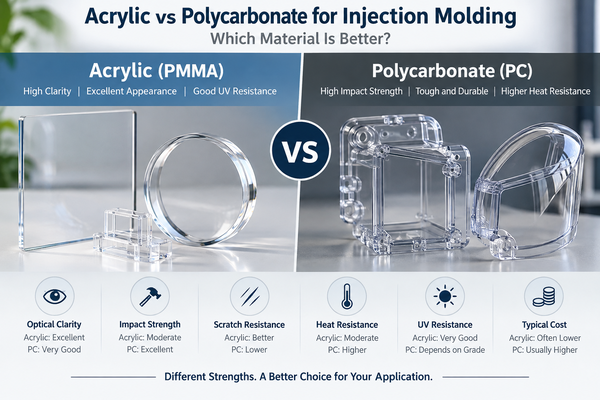
A simple comparison is shown below.
| Property | Acrylic / PMMA | Polycarbonate / PC |
|---|---|---|
| Optical clarity | Excellent | Very good |
| Impact resistance | Moderate | Excellent |
| Scratch resistance | Better | Lower |
| Heat resistance | Moderate | Higher |
| Outdoor resistance | Very good | Depends on grade / UV protection |
| Toughness | Lower | Very high |
| Molding difficulty | Moderate | Higher |
| Internal stress sensitivity | Moderate | High |
| Surface appearance | Excellent | Very good |
| Typical cost | Often lower | Usually higher |
Therefore, the first question should not be “Which material is better?”
Instead, ask:
Which material matches the part requirements better?
Why Choose Acrylic for Injection Molding?
Acrylic is widely used for transparent plastic products because it can provide very clear and glossy surfaces.
It is especially useful when appearance is more important than extreme impact strength.
Typical applications include:
- Light covers
- Display windows
- Decorative transparent panels
- Instrument covers
- Lenses
- Consumer products
- Lighting components
PMMA also provides good resistance to outdoor weathering.
Therefore, it is often used for products exposed to sunlight.
Another advantage is its surface hardness. Compared with PC, acrylic generally resists light scratching better.
However, PMMA is more brittle.
Sharp corners, high assembly stress, poor gate design, or excessive molding stress may cause cracking.
For more detail, see our guide on PMMA injection molding and how to prevent cracks and flow marks.
Why Choose Polycarbonate for Injection Molding?
Polycarbonate is selected when toughness and impact resistance are more important.
PC can withstand much more mechanical impact than PMMA.
Therefore, common applications include:
- Protective covers
- Safety components
- Automotive parts
- Electrical housings
- Medical device parts
- Industrial enclosures
- Transparent structural parts
PC also performs better at higher temperatures.
This makes it useful when the product works near heat sources or must maintain strength at elevated temperatures.
However, PC injection molding requires careful process control.
The material is sensitive to moisture. In addition, high internal stress can lead to cracking or optical distortion.
Mold temperature, material drying, gate position, packing pressure, and cooling all matter.
You can read more in our PC injection molding guide.
Acrylic vs Polycarbonate for Optical Clarity
When optical appearance is the main requirement, acrylic often has an advantage.
PMMA can produce very clear parts with excellent gloss.
Therefore, it is widely used for products where customers look directly through the plastic.
Examples include:
- Display windows
- Light guides
- Decorative lenses
- Clear covers
PC is also transparent. However, its main advantage is not maximum optical appearance.
Its main advantage is combining transparency with high toughness.
For this reason, a transparent safety cover may use PC even when PMMA could provide slightly better appearance.
The application decides which property matters more.
Acrylic vs Polycarbonate for Impact Strength
Impact strength is one of the biggest differences between the two materials.
PC is much tougher than PMMA.
Therefore, PC is normally the safer option when the part may:
- Fall
- Receive impact
- Experience vibration
- Be tightened with screws
- Carry structural loads
- Be assembled repeatedly
PMMA can crack more easily under these conditions.
This does not mean acrylic is weak.
For many covers, lenses, and decorative parts, PMMA strength is more than enough.
However, if failure could create a safety problem, impact performance should receive more attention than appearance alone.
Acrylic vs Polycarbonate for Scratch Resistance
PMMA generally offers better surface scratch resistance than standard PC.
This can be important for visible surfaces.
For example, a clear display window may be cleaned many times during its service life.
Fine scratches can quickly reduce its appearance.
PC surfaces are softer and can scratch more easily.
Therefore, some PC applications require:
- Hard coating
- Protective film
- Special surface treatment
- Careful packaging
Mold finish is also important for both materials.
Transparent parts reproduce small mold surface defects very clearly.
Therefore, highly polished cavities are often required.
Our guide to injection mold surface finish explains how material and appearance requirements affect the final mold finish.
Acrylic vs Polycarbonate for Heat Resistance
PC generally provides better heat resistance than PMMA.
Therefore, it is often preferred for:
- Electronic components
- Automotive interiors
- Lighting products
- Equipment housings
- Industrial parts
However, the actual temperature limit depends on the resin grade.
Engineers should always check the supplier’s technical datasheet before selecting a material.
In addition, temperature resistance should not be judged only by the molding temperature.
The important value is the temperature the finished product will experience during use.
Which Material Has Better UV Resistance?
PMMA naturally performs very well in outdoor environments.
It can maintain transparency and appearance for long periods when exposed to sunlight.
Standard PC may yellow or lose optical quality after long UV exposure.
However, manufacturers can use UV-stabilized PC grades or surface coatings for outdoor applications.
Therefore, material grade matters.
For an outdoor transparent cover, the choice may be:
PMMA if clarity and weather resistance are most important.
UV-stabilized PC if impact resistance is also critical.
Acrylic vs Polycarbonate Injection Molding Difficulty
Both materials require controlled processing.
However, PC is usually more demanding.
PMMA Injection Molding
Typical PMMA molding risks include:
- Flow marks
- Cracking
- Silver streaks
- Bubbles
- Poor transparency
- Weld lines
- High internal stress
Proper drying and mold temperature are important.
In addition, sharp corners should be avoided because PMMA is relatively brittle.
PC Injection Molding
Typical PC molding risks include:
- Silver streaks
- Burn marks
- High internal stress
- Cracking
- Warpage
- Flow marks
- Bubbles
PC normally requires good drying and relatively high processing temperatures.
Therefore, stable machine control is important.
How Wall Thickness Affects Acrylic vs Polycarbonate
Wall thickness affects both materials.
Very thick transparent sections can create:
- Long cooling time
- Sink marks
- Bubbles
- Internal stress
- Optical distortion
On the other hand, very thin walls increase the flow requirement.
PMMA and PC also behave differently during filling.
PC generally has higher melt viscosity than many common plastics. Therefore, long thin flow paths may need higher injection pressure.
PMMA can also develop visible flow defects if the mold temperature or filling conditions are poor.
As a result, designers should keep wall thickness as uniform as possible.
Smooth transitions are better than sudden thickness changes.
Gate Design for Acrylic and Polycarbonate Parts
Gate design can strongly affect transparent parts.
Poor gate location may create:
- Flow marks
- Weld lines
- Jetting
- Gate blush
- Internal stress
- Optical defects
Therefore, the gate should not be selected only for easy machining.
For transparent parts, engineers should also consider the viewing area.
If possible, visible weld lines and gate marks should stay away from critical optical surfaces.
The gate also needs enough size to avoid excessive shear.
For larger transparent components, Moldflow analysis can help evaluate filling before mold manufacturing begins.
Internal Stress: Why PC Needs Extra Attention
Internal stress is an important issue when comparing acrylic vs polycarbonate.
Both materials can develop molded-in stress.
However, PC is especially sensitive.
High stress may later cause:
- Stress cracking
- Optical distortion
- Assembly failure
- Chemical cracking
- Dimensional change
Common causes include:
- Low mold temperature
- High injection pressure
- Excessive packing pressure
- Small gates
- Poor part design
Therefore, solving filling problems only by increasing pressure is not always a good approach.
The better solution may involve changing the gate, wall thickness, mold temperature, or flow path.
Acrylic vs Polycarbonate for Light Transmission
Both PMMA and PC are widely used in transparent applications.
However, good raw material does not guarantee a clear molded part.
Final optical quality also depends on:
- Material drying
- Mold polishing
- Wall thickness
- Mold temperature
- Melt temperature
- Injection speed
- Gate design
- Internal stress
- Contamination
Therefore, optical quality should be treated as a complete molding system.
A transparent resin can still produce a poor-looking part if the mold or process is not correct.
Acrylic vs Polycarbonate Cost
PMMA is often less expensive than PC.
However, resin price should not be the only factor.
The total cost can also depend on:
- Part weight
- Cycle time
- Scrap rate
- Mold requirements
- Surface coating
- Assembly method
- Product life
- Quality requirements
For example, choosing cheaper PMMA for a high-impact application may reduce raw material cost.
However, cracked parts and field failures can make the total project more expensive.
Likewise, using PC for a simple decorative cover may add cost without giving the customer a useful benefit.
Therefore, material cost should always be compared with product requirements.
Acrylic vs Polycarbonate: Which Is Better for Outdoor Parts?
For outdoor products, PMMA often has an advantage because of its good weather resistance.
Typical PMMA outdoor applications include:
- Light covers
- Outdoor signs
- Transparent panels
- Decorative lenses
However, PC may still be the better choice when impact is a major concern.
For example, an outdoor safety cover may need both transparency and toughness.
In that case, UV-stabilized PC can be a better solution.
Therefore, outdoor use does not automatically mean PMMA.
The mechanical requirement still matters.
Acrylic vs Polycarbonate: Which Is Better for Lighting Parts?
Lighting applications can use both materials.
PMMA is attractive because of:
- High clarity
- Good light transmission
- Good surface appearance
- Outdoor stability
PC is attractive because of:
- High impact strength
- Better heat resistance
- Better toughness
Therefore, a decorative LED lens may favor PMMA.
A protective lighting cover near a heat source may favor PC.
Part geometry, operating temperature, impact requirements, and light transmission should all be reviewed together.
When Should You Choose Acrylic?
PMMA is usually a strong candidate when the product requires:
- Excellent clarity
- High-gloss appearance
- Better scratch resistance
- Good outdoor weather resistance
- Moderate mechanical strength
- Lower material cost
Typical products include lenses, display windows, lighting covers, and cosmetic transparent components.
When Should You Choose Polycarbonate?
PC is usually a better candidate when the product requires:
- High impact strength
- Better toughness
- Higher heat resistance
- Structural performance
- Safety protection
- Repeated assembly
Typical products include protective covers, automotive components, medical housings, electrical parts, and industrial equipment.
Acrylic vs Polycarbonate Selection Guide
| Requirement | Better Starting Choice |
|---|---|
| Highest optical clarity | Acrylic / PMMA |
| High impact resistance | Polycarbonate |
| Better scratch resistance | Acrylic / PMMA |
| Higher heat resistance | Polycarbonate |
| Outdoor weather resistance | Acrylic / PMMA |
| Structural transparent part | Polycarbonate |
| Decorative transparent part | Acrylic / PMMA |
| Safety cover | Polycarbonate |
| Optical cosmetic surface | Acrylic / PMMA |
| Tough industrial housing | Polycarbonate |
This table is only a starting point.
The final material grade should be selected according to the complete product requirements.
What Should Buyers Confirm Before Tooling?
Before starting the mold, buyers should confirm:
- Exact PMMA or PC grade
- Optical requirement
- Impact requirement
- Operating temperature
- Outdoor or indoor use
- Wall thickness
- Surface finish
- Critical dimensions
- Assembly method
- Annual production quantity
These details can affect gate design, mold polishing, cooling, steel selection, and processing conditions.
Fentor Mold provides both custom injection mold manufacturing and injection molding production. Therefore, material selection can be reviewed together with mold design and production requirements.
Final Thoughts
The acrylic vs polycarbonate decision depends on what the finished plastic part needs to achieve.
PMMA is often better when optical clarity, surface appearance, scratch resistance, and outdoor performance are the main goals.
PC is usually better when impact strength, toughness, structural performance, and heat resistance are more important.
However, neither material can produce a high-quality transparent part without the correct mold and molding process.
Wall thickness, gate design, polishing, drying, mold temperature, injection speed, cooling, and internal stress all affect the final result.
Therefore, material selection should happen early in the project.
Choosing the correct resin before mold manufacturing can reduce defects, avoid expensive mold changes, and improve production stability.