Choosing between polypropylene vs polyethylene is common when developing injection molded plastic parts. Both materials belong to the polyolefin family, and both offer low density, good chemical resistance, and low moisture absorption.
However, they do not behave the same.
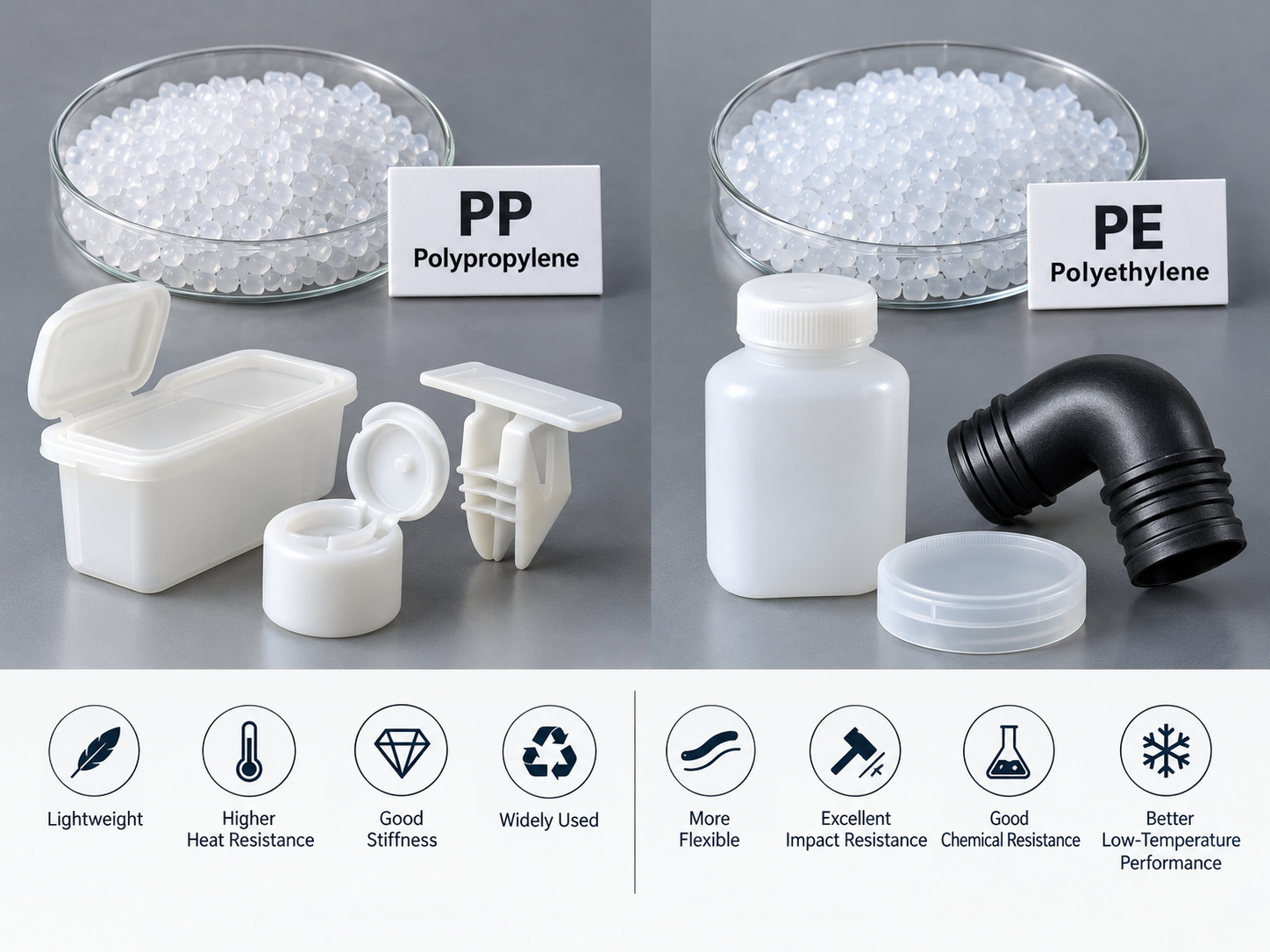
Polypropylene, or PP, is usually stiffer and more heat resistant. Polyethylene, or PE, is generally more flexible and can provide excellent toughness, especially at lower temperatures.
Therefore, the better material depends on the product.
At Fentor Mold, we normally compare mechanical requirements, wall thickness, operating temperature, shrinkage, dimensional tolerance, and production volume before confirming the final resin.
Polypropylene vs Polyethylene: What Is the Main Difference?
The biggest difference between polypropylene vs polyethylene is the balance between stiffness and flexibility.
PP is generally more rigid. It is also well suited to thin-wall parts and living hinges.
PE is softer and more flexible. Depending on the grade, it can also provide very good impact resistance.
| Property | Polypropylene / PP | Polyethylene / PE |
|---|---|---|
| Stiffness | Higher | Lower |
| Flexibility | Moderate | Higher |
| Impact resistance | Good | Very good in many grades |
| Heat resistance | Higher | Lower |
| Chemical resistance | Excellent | Excellent |
| Moisture absorption | Very low | Very low |
| Density | Very low | Low |
| Shrinkage | Moderate to high | Often higher |
| Living hinge performance | Excellent | Less common |
| Thin-wall molding | Very good | Good |
| Dimensional control | Usually easier | Can be more difficult |
Both are semi-crystalline plastics. Therefore, both normally shrink more than amorphous materials such as ABS, PC, or PMMA.
Why Choose Polypropylene for Injection Molding?
PP is one of the most widely used injection molding materials.
Its main advantages include:
- Low density
- Good stiffness
- Good chemical resistance
- Low moisture absorption
- Good fatigue resistance
- Good processability
- Relatively low material cost
One important advantage is fatigue resistance.
Because of this, PP is commonly used for products that bend repeatedly.
Typical applications include:
- Flip-top caps
- Living hinges
- Food containers
- Household products
- Automotive interior parts
- Electrical housings
- Medical components
- Thin-wall products
PP is also available in many modified grades, including impact-modified, mineral-filled, and glass-filled versions.
Therefore, designers can adjust stiffness and mechanical strength without completely changing the material family.
Why Choose Polyethylene for Injection Molding?
Polyethylene is also one of the most widely used plastics.
However, PE is not one single material.
Common types include:
- HDPE
- LDPE
- LLDPE
For injection molded rigid parts, HDPE is especially common.
PE generally provides:
- Good toughness
- High flexibility
- Excellent chemical resistance
- Low moisture absorption
- Good low-temperature performance
- Low density
Typical products include:
- Containers
- Caps
- Industrial parts
- Chemical-resistant components
- Household products
- Packaging components
PE is often a strong option when flexibility and toughness are more important than stiffness.
Polypropylene vs Polyethylene for Stiffness
PP is normally stiffer than PE.
This makes PP useful when a molded component must hold its shape under load.
Typical examples include:
- Rigid housings
- Covers
- Clips
- Thin-wall containers
- Automotive trim
PE flexes more easily.
Therefore, PE may work better when the part needs to bend slightly without cracking.
However, the exact mechanical properties depend on the resin grade.
For example, glass-filled PP can be much stiffer than standard PP.
Therefore, buyers should compare the actual material datasheet instead of choosing only by the polymer name.
Polypropylene vs Polyethylene for Impact Resistance
Impact performance is another important difference.
PE, especially HDPE, can provide excellent toughness.
It is often suitable for molded parts that may receive impact or rough handling.
PP also offers good impact resistance. However, some PP grades can become more brittle at low temperatures.
Therefore, cold-service conditions should be considered before selecting PP.
For outdoor, refrigerated, or low-temperature products, testing the actual grade is often necessary.
Polypropylene vs Polyethylene Shrinkage
Shrinkage is one of the most important molding considerations when comparing polypropylene vs polyethylene.
Both materials are semi-crystalline.
As they cool, their molecular structure becomes more ordered. As a result, they can show relatively high molding shrinkage.
PE often has a higher shrinkage tendency than PP.
However, the actual value depends on:
- Resin grade
- Part thickness
- Gate size
- Packing pressure
- Mold temperature
- Melt temperature
- Cooling rate
Therefore, engineers should not use one fixed shrinkage number for every PP or PE material.
The final resin grade should be confirmed before mold dimensions are finalized.
How Shrinkage Affects Mold Design
Higher shrinkage can create several problems:
- Warpage
- Dimensional variation
- Sink marks
- Part sticking
- Assembly mismatch
For precision components, the mold designer should consider actual material shrinkage from the beginning.
The design team should also review:
- Wall thickness
- Gate position
- Cooling layout
- Packing conditions
- Critical dimensions
A good mold design reduces the need for repeated dimensional corrections after the first mold trial.
For a wider view of mold development, see our injection mold design guide.
Polypropylene vs Polyethylene for Warpage
Warpage can happen with both PP and PE.
However, it can become more difficult to control when shrinkage is high or uneven.
Common causes include:
- Uneven wall thickness
- Unbalanced cooling
- Poor gate location
- Different flow directions
- Excessive packing
- Uneven mold temperature
For example, if one side of a flat PE part cools faster than the other, each side may shrink differently.
The result can be a visibly bent part.
Therefore, mold cooling is especially important for large, flat, or dimensionally sensitive polyolefin parts.
Polypropylene vs Polyethylene for Heat Resistance
PP generally performs better than PE at elevated temperatures.
Therefore, PP is commonly considered for:
- Automotive interiors
- Electrical products
- Appliance parts
- Hot-fill products
- Medical components
However, actual service temperature depends on the exact resin grade.
Do not confuse melt processing temperature with product operating temperature.
The material datasheet should always be checked against the real working environment.
Chemical Resistance of PP and PE
Both PP and PE provide strong resistance to many chemicals.
This is one reason both materials are commonly used for:
- Chemical containers
- Laboratory products
- Caps and closures
- Fluid-handling parts
- Industrial components
However, chemical resistance is not universal.
Performance can change according to:
- Chemical type
- Concentration
- Temperature
- Contact time
- Mechanical stress
Therefore, chemical compatibility should be checked under the actual service conditions.
Polypropylene vs Polyethylene for Moisture Absorption
Both PP and PE absorb very little moisture.
This helps reduce dimensional changes caused by environmental humidity.
It also simplifies processing compared with strongly hygroscopic materials such as PA.
However, low moisture absorption does not mean material handling can be ignored.
Contamination, storage conditions, recycled material, and surface moisture can still affect molding quality.
Polypropylene vs Polyethylene for Thin-Wall Parts
PP is especially popular for thin-wall injection molding.
It can provide a useful combination of flowability and stiffness.
Typical thin-wall PP parts include:
- Food containers
- Packaging
- Caps
- Household products
PE can also be used for thin-wall products.
However, its lower stiffness may become a limitation when the wall becomes too thin.
A thin PE part may flex more than expected.
Therefore, wall thickness should be selected according to actual rigidity requirements.
Gate Design for PP and PE
Gate design has a strong influence on PP and PE parts.
A poor gate can contribute to:
- Warpage
- Sink marks
- Flow marks
- Short shots
- Excessive shrinkage
- Dimensional instability
Because both materials can shrink significantly, the gate needs enough size to support effective packing.
If the gate freezes too early, packing pressure can no longer compensate for material shrinkage.
However, making the gate excessively large is not always the answer.
Gate location, size, part geometry, and flow length should be reviewed together.
Fentor Mold provides custom injection mold manufacturing with DFM, mold design, machining, assembly, and mold trial support.
Cooling Is Critical for PP and PE
Cooling strongly affects final part dimensions.
Uneven cooling causes uneven shrinkage.
Therefore, cooling channels should cover important areas such as:
- Thick sections
- Ribs
- Bosses
- Deep cores
- Large flat surfaces
Simply increasing cooling time may improve stability, but it also increases cycle time.
A better approach is to design the cooling system correctly from the beginning.
This becomes especially important for high-volume production.
Polypropylene vs Polyethylene for Living Hinges
PP is usually the stronger choice for living hinges.
Its fatigue resistance allows a thin molded section to bend repeatedly.
Common applications include:
- Flip-top caps
- Hinged boxes
- Small covers
- Packaging closures
PE is flexible, but flexibility alone does not make it the best material for a high-cycle living hinge.
Therefore, PP normally has a clear advantage in this application.
Polypropylene vs Polyethylene for Outdoor Parts
Both materials can be used outdoors, but standard grades may degrade under long-term UV exposure.
Outdoor products may require:
- UV-stabilized resin
- Carbon black
- Special additives
- Outdoor-grade formulations
PE is already widely used in many outdoor products.
PP can also perform well with the correct UV-stabilized grade.
Therefore, outdoor performance should be judged by the exact grade rather than simply choosing PP or PE.
Polypropylene vs Polyethylene Cost
Both PP and PE are generally economical plastics.
However, resin price alone should not decide the material.
The real molded part cost also depends on:
- Part weight
- Cycle time
- Scrap rate
- Cooling time
- Mold complexity
- Dimensional tolerance
- Annual volume
For example, a slightly cheaper resin may not save money if it creates more warpage and a higher reject rate.
Therefore, buyers should compare total manufacturing cost.
Common PP and PE Injection Molding Problems
| Problem | PP | PE |
|---|---|---|
| Shrinkage | Medium to high | Often higher |
| Warpage | Possible | Can be more difficult |
| Sink marks | Possible | Possible |
| Flash | Possible | Possible |
| Part sticking | Possible | Possible |
| Dimensional variation | Moderate | Can be higher |
| Low-temperature brittleness | More concern | Usually better |
| Thin-wall stiffness | Better | Lower |
Many of these problems are not caused by the resin alone.
Mold design, machine settings, cooling, packing, and process consistency also matter.
For this reason, stable mass production requires more than a successful T1 sample. Our article on injection molding control plans explains how key process and quality requirements can be controlled during production.
When Should You Choose Polypropylene?
PP is usually a strong starting choice when the product needs:
- Higher stiffness
- Better heat resistance
- Thin-wall performance
- Living hinges
- Low density
- Good chemical resistance
- Efficient high-volume production
It is commonly used for rigid containers, caps, clips, household products, automotive parts, and many consumer components.
When Should You Choose Polyethylene?
PE is often a better starting point when the product needs:
- Greater flexibility
- Good impact toughness
- Better low-temperature behavior
- Excellent chemical resistance
- Low moisture absorption
It is commonly used for containers, industrial products, protective components, and chemically resistant parts.
Polypropylene vs Polyethylene Selection Guide
| Requirement | Better Starting Choice |
|---|---|
| Higher stiffness | PP |
| More flexibility | PE |
| Living hinge | PP |
| Higher heat resistance | PP |
| Low-temperature toughness | PE |
| Thin-wall rigid parts | PP |
| Chemical resistance | Both |
| Lower shrinkage tendency | PP |
| Flexible molded parts | PE |
| High-volume production | Both |
This table should be used only as a starting point.
The exact material grade and product conditions must still be reviewed before tooling begins.
What Should Buyers Confirm Before Tooling?
Before choosing polypropylene vs polyethylene, confirm:
- Exact resin grade
- Required stiffness
- Impact requirement
- Operating temperature
- Wall thickness
- Critical dimensions
- Shrinkage requirement
- Chemical exposure
- Outdoor or indoor use
- Annual production volume
These factors affect gate size, shrinkage allowance, cooling design, mold dimensions, and processing conditions.
Fentor Mold also provides injection molding production after mold development, which allows mold performance and molding conditions to be considered as one complete project.
Final Thoughts
The polypropylene vs polyethylene decision depends on what the molded product must do.
PP is generally the better starting option when stiffness, heat resistance, thin-wall molding, or living hinges are important.
PE is often more suitable when flexibility, impact toughness, chemical resistance, or low-temperature performance matters more.
However, both materials can show significant molding shrinkage.
Therefore, good results still depend on wall thickness, gate design, cooling, packing, mold dimensions, and stable process control.
Choosing the correct resin before mold manufacturing can reduce warpage, improve dimensional consistency, and avoid unnecessary mold modifications later.