Choosing the right heat-resistant plastics for injection molding is important when a plastic part must work at high temperatures.
Standard plastics such as PP, ABS, and PE work well for many products. However, they may soften or lose strength when the temperature rises.
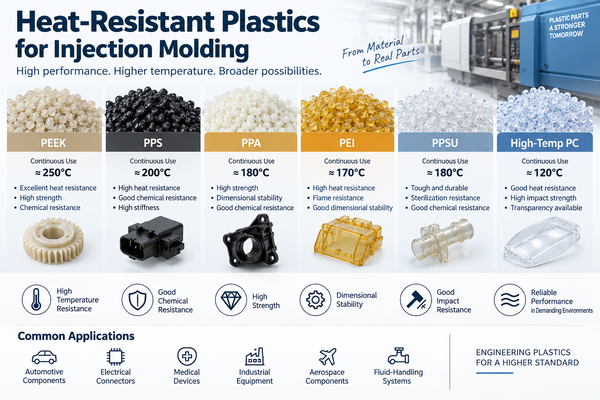
For harder jobs, engineers often use PEEK, PPS, PPA, PEI, PPSU, or high-temperature PC.
Still, the material with the highest heat rating is not always the best choice.
Cost, strength, mold design, part size, and production needs also matter.
At Fentor Mold, we review these factors before choosing heat-resistant plastics for injection molding.
What Are Heat-Resistant Plastics for Injection Molding?
Heat-resistant plastics for injection molding can keep useful strength and shape at higher temperatures.
They are often used for:
- Automotive parts
- Electrical connectors
- Medical products
- Industrial equipment
- Aerospace parts
- High-temperature housings
- Fluid-handling parts
However, “heat resistant” can mean different things.
For example, one material may survive a short heat peak. Another may perform better under long-term heat.
Therefore, engineers should check:
- Continuous service temperature
- Heat deflection temperature
- Glass transition temperature
- Melting temperature
- Strength at high temperature
In addition, the exact resin grade matters.
Which Heat-Resistant Plastics for Injection Molding Perform Best?
Several heat-resistant plastics for injection molding are common in demanding products.
| Material | Heat Resistance | Strength | Chemical Resistance | Cost | Molding Difficulty |
|---|---|---|---|---|---|
| PEEK | Excellent | Excellent | Excellent | Very high | High |
| PPS | Excellent | High | Excellent | High | High |
| PPA | Very good | High | Good | Medium-High | Medium-High |
| PEI | Very good | High | Very good | High | High |
| PPSU | Very good | High | Very good | High | Medium-High |
| High-Temp PC | Good | Good | Moderate | Medium | Medium |
Each material has a different balance.
For example, PEEK gives very high performance. However, PPS or PPA may already meet the product needs at a lower cost.
So, material selection should start with the real working conditions.
PEEK as One of the Best Heat-Resistant Plastics for Injection Molding
PEEK is one of the strongest heat-resistant plastics for injection molding.
It offers:
- High heat resistance
- High strength
- Good wear resistance
- Strong chemical resistance
- Low moisture absorption
- Good size stability
Typical uses include:
- Aerospace parts
- Medical parts
- Electrical systems
- Industrial machines
- High-temperature mechanical parts
However, PEEK is expensive.
Also, it needs very high processing temperatures.
As a result, the machine, mold, heaters, and hot runner must support these conditions.
For more details, see our guide to PEEK injection molding.
PEEK is a good choice when the product truly needs extreme performance.
PPS as a Heat-Resistant Plastic for Injection Molding
PPS is another important high-temperature material.
It offers:
- High heat resistance
- Strong chemical resistance
- Low moisture absorption
- Good stiffness
- Good electrical performance
- Stable dimensions
Because of these features, PPS is often used for:
- Electrical connectors
- Pump parts
- Automotive parts
- Sensor housings
- Industrial parts
Glass-filled PPS is especially common.
However, glass fiber can wear the mold faster.
Therefore, hardened steel or wear-resistant inserts may be needed.
For reinforced PPS, see our article on improving wear resistance for PPS injection molds.
PPA as a Heat-Resistant Plastic for Injection Molding
PPA is a high-performance polyamide.
Compared with PA6 or PA66, it usually gives better:
- Heat resistance
- Strength
- Size control
- Chemical resistance
PPA is widely used for:
- Automotive connectors
- Electrical parts
- Sensors
- Under-hood parts
- Precision parts
In addition, glass-filled PPA can provide very high stiffness.
However, PPA absorbs moisture.
So, proper drying is very important.
Poor drying may cause:
- Silver streaks
- Bubbles
- Low strength
- Poor surfaces
- Unstable dimensions
As a result, moisture control should start before molding begins.
PEI for High-Temperature Injection Molding
PEI is an amorphous engineering plastic.
It provides:
- High heat resistance
- High strength
- Good size stability
- Good flame resistance
- Good electrical properties
Typical uses include electrical, medical, and aerospace parts.
Because PEI is amorphous, shrinkage can be easier to control than with some semi-crystalline plastics.
However, PEI still needs good process control.
Poor settings may cause silver streaks, burn marks, short shots, or stress.
Therefore, stable melt and mold temperatures are important.
PPSU for Heat-Resistant Injection Molded Parts
PPSU works well when both heat resistance and toughness are important.
It is often used for:
- Medical devices
- Sterilizable parts
- Fluid-handling parts
- Healthcare products
- High-temperature housings
One key advantage is its resistance to repeated steam sterilization.
In addition, PPSU has good impact strength.
However, it is not a low-cost material.
So, scrap control is important during production.
Proper drying is also needed.
High-Temperature PC for Injection Molding
High-temperature PC is another useful option.
It can provide:
- Good heat resistance
- High impact strength
- Good toughness
- Stable dimensions
Some grades can also stay transparent.
Therefore, high-temperature PC is useful for:
- Electrical housings
- Lighting parts
- Protective covers
- Equipment parts
However, PC is sensitive to moisture.
It can also hold internal stress.
For this reason, drying, packing pressure, and mold temperature need good control.
Heat-Resistant Plastics for Injection Molding Need More Than a High Melting Point
A common mistake is to compare materials only by melting temperature.
However, this does not tell the full story.
A plastic part may soften or deform long before it melts.
Therefore, engineers should also check other values.
Heat Deflection Temperature
This shows how a material behaves under load at higher temperatures.
It is useful for structural parts.
Continuous Service Temperature
This shows how well the material can work under long-term heat.
Glass Transition Temperature
This can affect stiffness and part stability.
So, these values should be checked together.
Glass Fiber in Heat-Resistant Plastics for Injection Molding
Many heat-resistant plastics for injection molding use glass fiber.
Common examples include:
- PPS GF30
- PPA GF30
- PPA GF40
- PEEK GF30
Glass fiber can improve:
- Strength
- Stiffness
- Heat performance
- Size stability
However, it can also create problems.
For example, glass fiber may cause:
- Faster mold wear
- More warpage
- Fiber marks
- Rougher surfaces
- Weak weld lines
Therefore, reinforced materials need careful mold design.
Mold Steel for Heat-Resistant Plastics for Injection Molding
High-temperature plastics can be hard on the mold.
The mold may face:
- High melt temperature
- High mold temperature
- High injection pressure
- Abrasive glass fiber
- Corrosive gases
Because of this, mold steel selection is important.
Possible solutions include:
- Hardened cavity steel
- Wear-resistant inserts
- Corrosion-resistant steel
- Hardened gate areas
- Replaceable inserts
For high-volume projects, these choices can also reduce repair work later.
Fentor Mold provides custom injection mold manufacturing for engineering plastic parts.
Mold Temperature for Heat-Resistant Plastics for Injection Molding
Many heat-resistant plastics for injection molding need a higher mold temperature.
The mold temperature can affect:
- Filling
- Surface quality
- Weld lines
- Part strength
- Size stability
- Crystallization
If the mold is too cold, the plastic may freeze too early.
As a result, short shots or weak weld lines may appear.
Also, part dimensions may become less stable.
However, higher mold temperatures need better temperature control.
In some cases, an oil temperature controller may be needed.
Gate Design for High-Temperature Plastic Parts
Gate design is also important.
A small gate may create too much shear.
As a result, the material may burn or break down.
A small gate can also increase injection pressure.
On the other hand, a very large gate may leave a bigger gate mark.
It can also increase cooling time.
Therefore, engineers should consider:
- Material flow
- Fiber content
- Wall thickness
- Flow length
- Part appearance
- Gate position
For complex parts, Moldflow analysis can help before steel cutting.
Weld Lines in Heat-Resistant Plastics for Injection Molding
Weld lines can be a serious problem with heat-resistant plastics for injection molding.
The risk is often higher with glass-filled grades.
When two flow fronts meet, fibers may not join well.
As a result, the weld line can become weaker.
This matters for:
- Connectors
- Pressure parts
- Snap features
- Structural housings
Therefore, gate location should keep key weld lines away from high-stress areas.
In addition, good venting can improve the result.
A proper mold temperature also helps.
Drying Heat-Resistant Plastics for Injection Molding
Many heat-resistant plastics for injection molding are sensitive to moisture.
Examples include:
- PEEK
- PPA
- PEI
- PPSU
- PC
If the resin is too wet, defects may appear.
For example, common problems include:
- Silver streaks
- Bubbles
- Low strength
- Material damage
- Poor appearance
Therefore, drying should follow the resin supplier’s data sheet.
Also, drying time and temperature may vary by grade.
Common Problems With Heat-Resistant Plastics for Injection Molding
Several problems are common with heat-resistant plastics for injection molding.
| Problem | Common Cause |
|---|---|
| Short shot | Low mold temperature or poor flow |
| Burn marks | Poor venting or material damage |
| Weld lines | Poor gate position or low temperature |
| Warpage | Fiber direction or uneven cooling |
| Silver streaks | Moisture |
| Mold wear | Glass fiber |
| Size variation | Unstable temperature |
| Cracking | Internal stress or wrong material |
However, machine settings are not always the main cause.
Sometimes the mold design creates the problem.
For example, poor venting may cause burn marks even when the machine settings look correct.
Our article on high-temperature injection molding T1 failure explains this in more detail.
How to Choose Heat-Resistant Plastics for Injection Molding
Choosing heat-resistant plastics for injection molding should start with the real product needs.
| Requirement | Possible Material |
|---|---|
| Extreme heat | PEEK |
| Heat + chemical resistance | PPS |
| Automotive electrical parts | PPA |
| Heat + stable dimensions | PEI |
| Repeated sterilization | PPSU |
| Heat + impact strength | High-temp PC |
| High stiffness | GF PPS / PPA / PEEK |
However, this table is only a starting point.
For example, PEEK may give very high performance. Still, PPA may already be enough for the product.
Therefore, the best choice is the material that meets the need without adding too much cost or risk.
Cost of Heat-Resistant Plastics for Injection Molding
The cost of heat-resistant plastics for injection molding can vary a lot.
Some high-performance materials are much more expensive than standard plastics.
However, resin price is only one part of the final cost.
Other factors include:
- Cycle time
- Scrap rate
- Mold wear
- Mold temperature
- Machine needs
- Part weight
- Production volume
For example, a cheaper material may create more rejects.
As a result, the final part cost may become higher.
Therefore, buyers should compare total production cost instead of resin price alone.
What Should Buyers Confirm Before Tooling?
Before selecting heat-resistant plastics for injection molding, buyers should confirm:
- Exact resin grade
- Working temperature
- Peak temperature
- Glass fiber content
- Chemical exposure
- Part tolerance
- Wall thickness
- Annual volume
- Flame requirements
- Sterilization needs
These details can affect the mold steel, gate, cooling, venting, and machine settings.
In addition, Fentor Mold provides injection molding production. This allows mold design and production needs to be reviewed together.
Final Thoughts on Heat-Resistant Plastics for Injection Molding
There is no single best choice among heat-resistant plastics for injection molding.
PEEK offers very high overall performance. However, it also has a high cost.
PPS works well under heat and chemical exposure.
Meanwhile, PPA is common in automotive and electrical parts.
PEI gives good heat resistance and stable dimensions.
PPSU is useful for medical parts that need repeated sterilization.
High-temperature PC is useful when impact strength also matters.
Therefore, material selection should begin with the real product needs.
With the right resin, mold steel, gate design, drying, cooling, and process control, production becomes more stable and part quality improves.