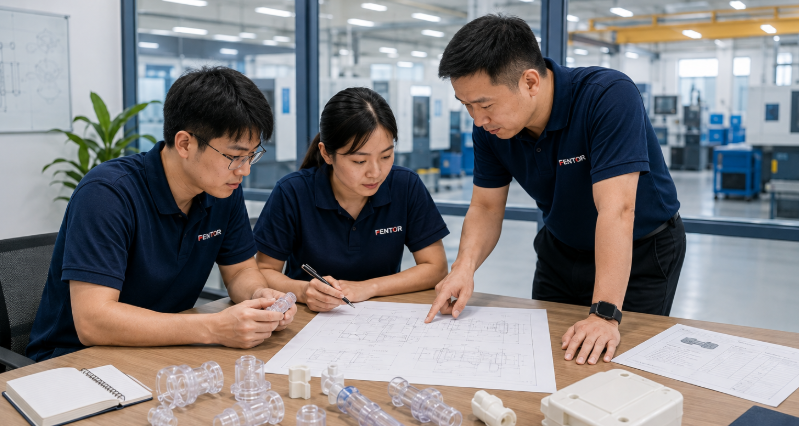
Choosing a molding supplier for a medical product is rarely just about getting the lowest mold price.
For engineering and purchasing teams, the bigger question is whether the supplier can keep the project under control from design review to mold trials and production.
Imagine that your team has finished a new medical device design. You send the same drawings to several suppliers. One gives a very low quotation. Another asks detailed questions about critical dimensions, resin, sterilization, annual volume, assembly, and validation. The second quote may not be the cheapest, but those questions often reveal something important: the supplier is already thinking about production risk.
This is one reason comparing medical injection molding companies only by quotation can lead to expensive problems later.
The right supplier should understand the mold, the molded part, the assembly, and the project schedule as one complete system.
What Should You Look for in Medical Injection Molding Companies?
A capable supplier should do more than machine a mold and send samples.
Medical projects often involve tighter dimensions, special materials, critical mating features, appearance requirements, and detailed documentation.
When evaluating suppliers, buyers should look at several areas together:
- Mold engineering capability
- Medical project experience
- Project management
- Material knowledge
- Dimensional control
- Mold trial procedures
- Quality inspection
- Communication
- Production capability
- Engineering support after T1
A supplier does not need to manufacture every type of medical device.
However, it should understand how to manage projects where small mistakes can affect assembly, sealing, product performance, or delivery.
Medical Project Experience Matters More Than a Long Customer List
Many suppliers can show a long list of industries on their websites.
Automotive.
Electronics.
Medical.
Consumer products.
Industrial equipment.
That list alone tells a buyer very little.
What matters is whether the supplier has actually handled parts with requirements similar to yours.
For example, if your project contains small medical connectors, ask whether the supplier has experience with:
- Precision mating dimensions
- Small internal diameters
- Sealing surfaces
- Fine threads
- Thin walls
- Transparent materials
- Small shutoffs
- Insert molding
- Multi-part assembly
If your product is a medical equipment housing, the relevant experience may be different.
You may care more about:
- Cosmetic surfaces
- Warpage
- Screw bosses
- Snap fits
- Texture
- Color consistency
- Assembly gaps
- Internal component alignment
Good medical project experience is therefore not just about having produced a medical part before.
It is about understanding the type of engineering problem your part creates.
Project Management Often Separates Good Suppliers From Average Ones
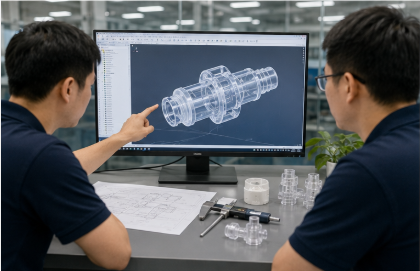
A medical mold project includes many steps.
Drawings need to be reviewed.
Questions need to be closed.
The mold design needs approval.
Steel must be ordered.
Machining must follow the schedule.
T1 samples need inspection.
Problems need corrective actions.
Revised samples need verification.
If nobody controls these steps, even a technically capable factory can create delays.
This is why project management is one of the most important factors when comparing medical injection molding companies.
At Fentor Mold, project management is treated as part of the engineering process rather than only as customer service.
For a typical project, the team follows the mold from the early quotation stage through tooling, mold trials, engineering changes, sample approval, and production preparation.
This approach gives overseas customers one clear project path instead of forcing them to coordinate with several unrelated departments.
A Good Supplier Should Ask Questions Before Cutting Steel
One warning sign is a supplier that receives the 3D file, sends a quotation, and wants to begin machining immediately.
Fast action may look efficient.
It can also mean important questions were skipped.
Before mold manufacturing begins, a supplier should understand at least:
- Part material
- Shrinkage
- Critical dimensions
- Part function
- Assembly requirements
- Expected mold life
- Annual volume
- Cosmetic requirements
- Gate restrictions
- Ejection restrictions
- Mold machine requirements
- Special testing requirements
For medical products, the supplier may also need to understand sterilization, product contact conditions, or special material requirements.
A detailed engineering discussion before tooling usually costs far less than a major mold modification after T1.
DFM Should Be Practical, Not Just a Formal Report
Many mold suppliers offer DFM reports.
The quality of those reports varies greatly.
Some reports only show draft angle, parting line, gate location, and ejector positions.
Those items are useful, but they are only the beginning.
A practical DFM review should identify where the design may create real molding or tooling risks.
Examples include:
- Thick areas that may create sink marks
- Sharp thickness transitions
- Weak shutoff areas
- Difficult steel conditions
- Long flow paths
- Air trap locations
- Weld lines near functional features
- Deformation risk
- Difficult ejection
- Critical dimensions affected by shrinkage
The best DFM discussion is not about proving the mold supplier is right.
It should help the customer make better engineering decisions before money is committed to steel.
Communication Is an Engineering Capability
For overseas buyers, communication is not simply about speaking English.
It is about how technical information moves between teams.
A useful project manager should be able to explain:
- What problem was found
- Why it happened
- What the supplier recommends
- What may happen if no change is made
- Whether the change affects cost
- Whether it affects the schedule
- What needs customer approval
This sounds simple.
In practice, poor communication causes many mold project delays.
A customer may receive a message saying:
“Part dimension is NG. Need modification.”
That does not provide enough information for an engineering decision.
A stronger update would identify the measured dimension, tolerance, likely root cause, proposed correction, and expected result.
For buyers in Europe or North America, clear written communication can save many days of back-and-forth discussion.
Look at How the Supplier Handles Problems
Every serious mold manufacturer eventually encounters difficult projects.
The question is not whether problems ever happen.
The question is how the supplier responds when they do.
A medical part may show:
- Flash
- Short shots
- Sink marks
- Warpage
- Weld lines
- Dimensional variation
- Difficult assembly
- Leakage
- Ejection marks
- Surface defects
A weak supplier may immediately change steel.
An experienced team will first investigate the cause.
The problem may come from:
- Tooling
- Part design
- Resin behavior
- Mold temperature
- Packing pressure
- Cooling
- Venting
- Gate design
- Measurement method
Changing the mold without understanding the root cause can make the situation worse.
When selecting a supplier, ask how it normally handles T1 problems and corrective actions.
The answer can reveal a lot about the company’s engineering culture.
Check Whether Mold Making and Injection Molding Work Together
Some companies only build molds.
Others only run production.
This can work for simple projects, but it may create extra coordination when molded parts need repeated engineering changes.
For a new medical product, it is often useful when mold engineering and injection molding teams work closely together.
During trials, processing data can help engineers understand whether a problem comes from the mold or the molding conditions.
If the same supplier manages tooling and production, the transition from T1 to approved production can also be more controlled.
Fentor Mold supports customers through both injection mold manufacturing and injection molding project development, which helps keep tooling decisions connected to actual production requirements.
Do Not Ignore the Mold Trial Process
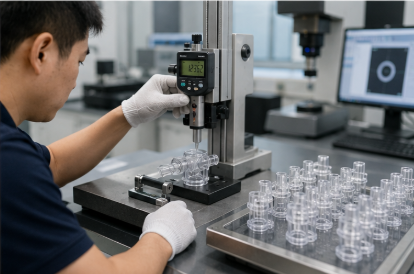
T1 is not simply a milestone where the supplier sends photos of the first parts.
It is an engineering test.
Before the first trial, the supplier should prepare the mold properly and define suitable process conditions.
After T1, buyers should expect clear feedback on:
- Filling condition
- Part appearance
- Critical dimensions
- Warpage
- Flash
- Ejection
- Gate condition
- Cycle behavior
- Assembly issues
- Required corrections
For important medical components, dimensional inspection should focus on critical-to-function features rather than measuring random dimensions only.
If a connector needs to mate with another component, that mating condition deserves more attention than a non-functional surface dimension.
Dimensional Control Starts Before Inspection
Some buyers believe dimensional control belongs mainly to the quality department.
It actually begins during product and mold design.
Suppose a medical part has a very tight internal diameter.
The final dimension may be affected by:
- Steel machining
- Material shrinkage
- Packing
- Cooling
- Mold temperature
- Part geometry
- Measurement conditions
The supplier should understand these relationships before the mold is completed.
For certain dimensions, leaving steel safe may be a better strategy than machining directly to the final theoretical value.
After T1 measurements, the supplier can then make a controlled correction.
This is especially important for medical connectors, fittings, and small functional components.
Material Knowledge Can Prevent Expensive Mistakes
Medical products may use materials such as:
- PP
- PC
- ABS
- PC/ABS
- POM
- TPE
- PPSU
- PEEK
- Other engineering plastics
Each material behaves differently.
PC requires proper drying.
POM needs careful processing and venting.
High-temperature plastics create different tooling requirements.
Transparent materials make cosmetic defects easier to see.
Soft materials can create difficult ejection conditions.
A supplier should understand these differences before recommending gate sizes, mold temperatures, surface finishes, or processing conditions.
For projects where the final material has not yet been confirmed, prototype tooling can also help engineers evaluate the design before investing in a full production mold. Fentor Mold’s prototype injection molding service can support this early validation stage.
Ask Who Will Manage Your Project
This is a simple question that buyers sometimes forget.
Before placing an order, ask:
Who will manage the project after the purchase order?
Will you communicate with a salesperson only?
Will an engineer join technical discussions?
Who sends weekly updates?
Who manages design changes?
Who follows T1 corrective actions?
Who controls the final approval list?
A clear project owner reduces confusion.
It also makes it easier to track open issues.
For overseas medical projects, this becomes especially valuable when different teams are working across time zones.
Weekly Updates Should Contain Useful Information
A project update should tell the customer what changed.
It should not simply say:
“Mold is in progress.”
A useful update can include:
- Current mold stage
- Completed work
- Work in progress
- Next step
- Open technical questions
- Schedule status
- Risks
- Photos where useful
For complicated molds, buyers may also want updates on major machining milestones.
Consistent project reporting creates transparency.
More importantly, it gives the customer enough time to react if a decision is needed.
Engineering Changes Must Be Controlled
Medical device designs often change during development.
A customer may update:
- A connector size
- Wall thickness
- Snap geometry
- Assembly clearance
- Logo
- Surface finish
- Internal structure
Changes are normal.
Uncontrolled changes are dangerous.
The supplier should clearly record:
- What changed
- Which mold area is affected
- Whether steel has already been cut
- Additional cost, if any
- Schedule impact
- Revision level
This prevents an old CAD file from being used accidentally.
It also creates a clearer history when the project reaches validation.
Low Mold Price Does Not Always Mean Low Project Cost
Suppose Supplier A quotes $20,000.
Supplier B quotes $23,000.
At first, Supplier A appears cheaper.
But if the cheaper mold requires several unexpected modifications, repeated shipping of samples, additional engineering time, and a six-week delay, the total project cost may become much higher.
For medical products, buyers should evaluate cost in a wider way.
Consider:
- Tool price
- Engineering time
- Modification risk
- Trial efficiency
- Sample lead time
- Part quality
- Communication cost
- Production stability
- Delivery reliability
The lowest initial quotation and the lowest total project cost are not always the same thing.
Should You Visit the Factory?
For large or long-term programs, a factory visit can be useful.
It allows buyers to see:
- Mold manufacturing equipment
- Injection molding machines
- Tool assembly areas
- Inspection equipment
- Project management process
- Mold storage
- Production organization
If an on-site visit is not practical, video meetings and detailed factory presentations can still provide useful information.
Ask to see actual tooling and manufacturing areas rather than only polished marketing slides.
Questions to Ask Before Choosing a Supplier
When comparing medical injection molding suppliers, these questions can help reveal how the company works:
1. Have you built molds for similar parts?
The part does not need to be identical, but similar engineering experience matters.
2. Who reviews the DFM?
Find out whether experienced mold engineers are involved.
3. How do you manage critical dimensions?
Look for an engineering answer, not only “we can meet the tolerance.”
4. How often will I receive project updates?
Clear reporting is important for overseas projects.
5. How do you handle T1 problems?
The supplier should explain its root-cause process.
6. Can you support mold modifications?
Medical designs often evolve during development.
7. Can you support both tooling and production?
This may simplify the transition to mass production.
8. How do you control drawing revisions?
This matters when engineering changes occur.
9. What information do you need before tooling starts?
Good suppliers usually ask many questions.
10. Who will be responsible for my project?
You should know who owns the schedule and technical follow-up.
What Fentor Mold Brings to Medical Projects
For an overseas customer, a mold supplier is often thousands of kilometers away.
That makes visibility and project control especially important.
Fentor Mold has handled multiple medical molding projects and has built its project approach around close communication between customers, project managers, mold engineers, molding technicians, and quality teams.
The goal is not simply to finish a mold.
The goal is to keep technical decisions clear throughout the project.
This includes reviewing part requirements before tooling, following mold manufacturing progress, organizing mold trials, checking dimensional results, managing corrections, and supporting the project toward production.
For medical projects with precision connectors, housings, transparent components, or other functional molded parts, this structured approach can reduce avoidable changes and make the development process easier for overseas engineering teams.
The Best Medical Injection Molding Company Is Not Always the Biggest
Large suppliers can offer impressive facilities.
Small and medium-sized suppliers can sometimes offer more direct engineering support.
Company size alone does not tell you whether a supplier is right for your project.
Instead, look at how the company works.
Does the supplier understand your drawing?
Does it ask useful questions?
Does it identify risks early?
Can engineers explain problems clearly?
Does someone take ownership of the project?
Can the company support changes after T1?
These factors often matter more than the size of the factory.
Final Thoughts
Choosing among medical injection molding companies is an engineering decision as much as a purchasing decision.
A low tooling price may look attractive at the beginning, but a medical project depends on much more than mold cost.
Experience, project management, DFM quality, dimensional control, mold trial procedures, communication, and corrective-action capability all influence the final result.
The best supplier should help your team identify problems before they become expensive.
It should also give you clear information when a problem does occur.
For overseas medical device companies, that combination of engineering capability and transparent project management can make the difference between simply buying a mold and building a stable production program.