
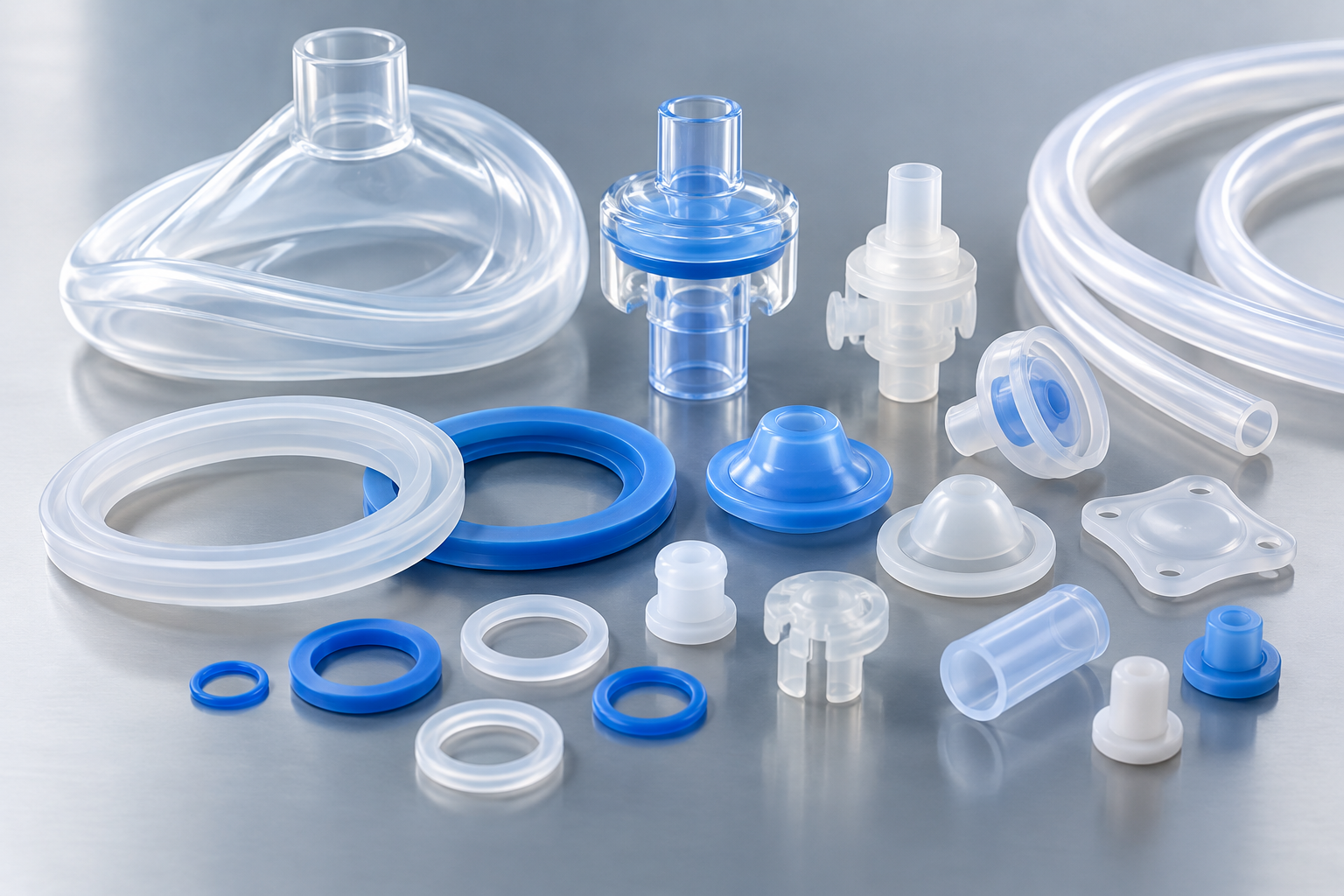
Medical silicone molding is an important process for making flexible and reliable parts used in healthcare products. However, poor material selection or mold design can lead to defects, safety risks, and high production costs.
For example, excess flash can affect a silicone seal. Air bubbles may reduce part strength, while poor curing can cause unstable dimensions. These problems can delay production and increase inspection costs.
At Fentor Mold, we understand how tooling design and process control affect molded part quality. In this guide, we explain how to choose silicone materials, improve mold design, prevent common defects, and meet medical product requirements.
What Is Medical Silicone Molding?
Medical silicone molding is a process used to produce silicone rubber parts for medical devices and healthcare equipment.
Silicone is popular because it is flexible, durable, and resistant to many chemicals. In addition, some silicone grades can meet the biological safety needs of specific medical applications.
Common medical silicone parts include:
- Silicone seals and gaskets
- Medical valves
- Respiratory equipment components
- Flexible silicone connectors
- Medical tubing components
- Silicone membranes
- Protective covers for medical devices
However, not all silicone materials are suitable for medical use. Therefore, manufacturers must select the correct grade for each application.
What Materials Are Used in Medical Silicone Molding?
Two common materials used in medical silicone molding are liquid silicone rubber (LSR) and high consistency rubber (HCR).
Both materials offer good flexibility. However, their processing methods and molding requirements are different.
Liquid Silicone Rubber (LSR)
LSR is a two-part silicone material commonly used for precision injection molding.
Manufacturers mix the two components before injecting them into a heated mold. The material then cures and forms the finished part.
LSR offers several advantages:
- Good flexibility and elastic recovery
- High precision for small parts
- Suitable for complex shapes
- Stable properties under controlled processing
- Options for transparent silicone parts
- Availability of medical application grades
As a result, LSR is often suitable for seals, valves, and other small medical components.
High Consistency Rubber (HCR)
HCR is a thicker silicone material. Unlike LSR, it has a gum-like form before processing.
Manufacturers often use compression molding, transfer molding, or specialized injection molding to produce HCR parts.
HCR is commonly used for:
- Larger silicone seals
- Thick rubber parts
- Flexible medical components
- Custom silicone gaskets
However, HCR may require more handling and different production equipment than LSR.
LSR vs HCR: Which Is Better?
| Feature | LSR | HCR |
|---|---|---|
| Material form | Liquid | Gum-like |
| Common process | Injection molding | Compression, transfer or injection molding |
| Small complex parts | Often suitable | Depends on design |
| Automation | Well suited | Depends on process |
| Production consistency | Good with process control | Good with process control |
| Typical applications | Valves, seals, membranes | Seals, gaskets, larger parts |
For small and complex components, LSR is often a practical option. However, manufacturers should compare part design, material requirements, and production volume before making a final decision.
How to Choose Medical Grade Silicone
Choosing the correct material is one of the most important steps in medical silicone molding.
Medical grade silicone usually refers to silicone materials supported by specific biological testing or documentation.
However, the term does not guarantee that every finished product will meet medical device requirements.
Before selecting a material, check the following properties.
Hardness and Flexibility
Silicone hardness is commonly measured using Shore A.
Softer silicone can work well for flexible seals and membranes. Meanwhile, harder grades may offer better support for certain structural features.
Therefore, hardness should match the function of the finished part.
Heat and Chemical Resistance
Some medical parts need to withstand cleaning, disinfection, or sterilization.
For this reason, manufacturers should check the material’s resistance to heat and chemicals.
However, not every silicone grade performs the same way.
Biocompatibility
Biocompatibility matters when medical components contact the human body.
For example, patient-contact products may need biological evaluation based on the nature and duration of contact.
Therefore, buyers should request suitable material documentation and determine what finished-device testing is required.
Material Traceability
Reliable material records are also important.
Manufacturers should keep the material grade, supplier information, and batch numbers when the project requires traceability.
As a result, quality teams can identify material sources if problems occur later.
How Does Mold Design Affect Medical Silicone Molding?
Good mold design helps manufacturers produce consistent silicone parts with fewer defects.
Poor tooling may cause flash, air bubbles, unstable dimensions, or damaged parts.
Therefore, engineers should review the design before mold manufacturing begins.
Parting Line Design
The parting line is where the mold halves meet.
If the parting surfaces do not fit correctly, silicone may escape and create flash.
This problem is especially important for medical seals.
To reduce flash, engineers should:
- Improve parting surface accuracy
- Check mold alignment
- Avoid parting lines on critical sealing areas where possible
- Select suitable clamping conditions
- Inspect mold wear regularly
In addition, part drawings should clearly define acceptable flash limits.
Gate and Vent Design
Good gate design helps silicone flow into the mold cavity.
Meanwhile, proper venting allows trapped air to escape.
Without enough venting, parts may develop bubbles or incomplete filling.
However, excessive vent gaps can also lead to flash.
Therefore, engineers must balance filling performance and flash control.
Shrinkage and Dimensional Control
Silicone parts may change size during curing, cooling, and post-curing.
As a result, mold designers must consider the selected material’s shrinkage behavior.
Critical factors include:
- Mold temperature
- Material grade
- Curing time
- Part thickness
- Post-curing conditions
- Final measurement method
For precision silicone components, engineers should identify important dimensions before making the mold.
Easy Part Removal
Soft silicone parts may stretch or tear during demolding.
Therefore, designers should avoid sharp edges and unnecessary undercuts.
In addition, smooth mold surfaces and suitable part removal methods can reduce damage.
For precision tooling development, our custom injection mold manufacturing services support mold design, machining, and engineering review.
What Are Common Medical Silicone Molding Defects?
Medical silicone molding defects can affect the function and appearance of finished parts.
However, many defects can be reduced through better tooling and stable process control.
| Defect | Common Cause | Solution |
|---|---|---|
| Flash | Poor mold fit or excessive pressure | Improve mold accuracy and process settings |
| Air bubbles | Trapped air | Improve venting and material handling |
| Short shots | Incomplete filling | Optimize gates and injection conditions |
| Dimensional variation | Uneven curing or shrinkage | Stabilize curing and temperature |
| Tearing | Poor part removal | Improve mold design |
| Surface contamination | Poor handling or dirty equipment | Improve cleaning and handling controls |
| Incomplete curing | Incorrect curing conditions | Verify temperature, time, and mixing |
How to Reduce Flash
Flash is a common problem in silicone molding.
Because silicone can flow into small gaps, mold accuracy is very important.
Therefore, manufacturers should check mold alignment, parting surfaces, and injection pressure.
Regular mold maintenance also helps prevent flash during long production runs.
How to Prevent Air Bubbles
Air bubbles may reduce part strength and create surface defects.
To prevent bubbles, manufacturers should improve venting and material preparation.
In addition, stable injection conditions help reduce trapped air.
How to Improve Dimensional Accuracy
Soft silicone parts can be difficult to measure.
For this reason, manufacturers should use suitable measuring equipment and consistent inspection methods.
Furthermore, stable curing conditions help reduce dimensional variation.
How to Improve Medical Silicone Molding Quality
Quality control should begin before production starts.
A good quality plan covers raw materials, mold inspection, process settings, and finished parts.
Check Raw Materials
Before production, verify that the silicone matches the approved material specification.
Important checks include:
- Material grade
- Supplier information
- Batch number
- Shelf life
- Storage conditions
- Required material certificates
In addition, manufacturers should follow material handling instructions from the supplier.
Control Molding Parameters
Stable process settings help improve medical silicone molding quality.
Important parameters include:
- Injection pressure
- Injection speed
- Mold temperature
- Curing time
- Material mixing ratio
- Demolding conditions
For example, an incorrect curing temperature may affect part strength or dimensions.
Therefore, manufacturers should verify the production settings and keep them stable.
Inspect Finished Parts
Visual and dimensional inspection helps identify defects before shipment.
Common inspection items include:
- Flash
- Air bubbles
- Surface damage
- Dimensional accuracy
- Color variation
- Contamination
- Sealing surfaces
However, visual inspection alone may not be enough for functional medical components.
Test Part Performance
Depending on the application, manufacturers may need additional testing.
Common tests include:
- Shore A hardness
- Tensile strength
- Tear strength
- Elongation
- Compression set
- Leakage performance
- Repeated compression testing
For example, a silicone seal may need compression-set and leakage tests.
Meanwhile, a flexible membrane may require repeated bending tests.
Therefore, the product’s function should determine the testing plan.
What Safety Standards Apply to Medical Silicone Parts?
Medical silicone parts may need to meet specific quality and safety requirements.
However, the required standards depend on the product’s intended use and market.
Two important standards are ISO 10993 and ISO 13485.
ISO 10993: Biological Safety
ISO 10993 covers the biological evaluation of medical devices.
Its requirements help manufacturers and device developers assess possible biological risks.
For example, the evaluation considers how the finished device contacts the body and how long that contact lasts.
However, material testing alone does not prove the safety of every finished product.
The final device may also require evaluation of manufacturing processes, chemical residues, and sterilization effects.
ISO 13485: Quality Management
ISO 13485 is a quality management standard for medical device organizations.
It supports consistent manufacturing, traceability, and controlled processes.
Important quality management activities may include:
- Document control
- Supplier management
- Production records
- Product traceability
- Risk management
- Corrective actions
However, ISO 13485 certification does not automatically mean that a finished medical device has received regulatory approval.
Therefore, buyers should confirm the supplier’s actual certification status and the requirements of the specific project.
How to Prevent Contamination in Medical Silicone Molding
Contamination can affect the appearance, performance, and safety of silicone parts.
For this reason, manufacturers should control cleanliness during material handling, molding, inspection, and packaging.
Keep Materials and Equipment Clean
Silicone materials should be stored in suitable conditions.
In addition, manufacturers should clean mold surfaces and production equipment regularly.
Dirty equipment may introduce particles or other unwanted substances.
Improve Part Handling
Operators should follow suitable handling procedures.
For example, gloves and clean work surfaces can help reduce contamination.
However, the required controls depend on the product’s cleanliness requirements.
Use Cleanroom Production When Needed
Not every medical silicone part requires cleanroom molding.
However, some products may need controlled production environments.
Therefore, manufacturers should confirm the required cleanliness level before production.
Can Medical Silicone Parts Be Sterilized?
Many silicone materials can withstand certain sterilization processes.
However, compatibility depends on the specific silicone grade and finished product.
Common sterilization methods include:
- Steam sterilization
- Ethylene oxide sterilization
- Gamma radiation
- Electron beam sterilization
Each method has different effects on silicone materials.
For example, repeated steam sterilization may change the properties of some silicone grades.
Therefore, manufacturers should confirm material compatibility and evaluate finished-part performance after the intended sterilization process.
Important checks may include hardness, dimensions, flexibility, and sealing performance.
How to Move from Prototype to Medical Silicone Production
Moving from prototype samples to mass production requires careful planning.
A clear development process helps reduce tooling changes and quality problems.
Step 1: Review the Product Design
Start with the 3D model and technical drawings.
Then, check the product’s dimensions, material requirements, and functional features.
In addition, identify critical sealing areas and possible manufacturing risks.
Step 2: Review the Mold Design
Next, evaluate the parting line, gate location, venting, and demolding method.
Good DFM analysis can help identify design problems before tooling production.
As a result, manufacturers may reduce unnecessary mold modifications.
Step 3: Make Prototype Samples
Prototype samples help engineers check the product design.
For example, samples can be used to evaluate dimensions, flexibility, and assembly.
However, sample approval should not replace required medical testing or process validation.
Step 4: Test and Improve the Parts
After the first samples are available, engineers should inspect and test them.
If problems appear, the team can adjust the tooling or molding process.
Then, the updated samples should be checked again.
Step 5: Prepare for Production
Before full production, manufacturers should confirm:
- Approved material
- Final drawings
- Mold condition
- Production settings
- Inspection methods
- Quality records
- Required validation activities
For suitable plastic component development, Fentor Mold also provides prototype injection molding services.
Silicone-specific prototypes, however, require a molding process suited to the selected silicone material.
How to Choose a Medical Silicone Molding Supplier
Choosing the right supplier is important for product quality and production reliability.
A reliable manufacturing partner should understand material selection, mold design, process control, and inspection needs.
Before choosing a medical silicone molding supplier, consider these questions.
Does the Supplier Understand Silicone Materials?
The supplier should understand the differences between LSR and HCR.
In addition, the engineering team should know how material properties affect molding and part performance.
Can the Supplier Design Precision Molds?
Good mold design reduces defects and improves consistency.
Therefore, look for tooling experience, engineering support, and suitable manufacturing equipment.
Can the Supplier Control Quality?
A supplier should have clear inspection procedures and suitable testing methods.
Furthermore, ask whether the team can provide the required material and production records.
Can the Supplier Support Your Project?
Good communication is also important.
For example, early DFM feedback can help prevent design problems and reduce tooling costs.
Fentor Mold has experience in precision mold development and components manufacturing.
For medical-related projects, we recommend reviewing the drawings, materials, quality requirements, and specific manufacturing capabilities before confirming the production approach.
Learn more about our custom mold and plastic parts manufacturing capabilities.
Frequently Asked Questions About Medical Silicone Molding
What Is Medical Silicone Molding Used For?
Medical silicone molding is used to make flexible parts such as seals, valves, membranes, and connectors for healthcare products.
What Is the Best Material for Medical Silicone Molding?
LSR is often suitable for small, precise silicone components. However, the best material depends on the product design, required properties, and intended use.
What Is the Difference Between LSR and HCR?
LSR is a liquid material commonly used for injection molding. HCR is thicker and can be processed through compression, transfer, or specialized injection molding.
How Can Manufacturers Reduce Silicone Molding Defects?
Manufacturers can improve mold design, optimize processing conditions, maintain equipment, and inspect finished parts.
Does Medical Grade Silicone Need ISO 10993 Testing?
The required biological evaluation depends on the intended use and risk assessment of the finished device. Material-level evidence may help, but it does not automatically replace finished-device evaluation.
Does Medical Silicone Molding Require a Cleanroom?
Not always. Cleanroom production depends on the product’s cleanliness requirements, intended use, and applicable regulations.
Conclusion
Medical silicone molding requires the right materials, precise molds, stable production settings, and careful quality control.
Good mold design helps prevent flash, bubbles, and dimensional problems. In addition, proper material selection improves flexibility and product performance.
For medical applications, manufacturers must also consider biological safety, traceability, cleanliness, and validation needs.
By planning these requirements early, buyers can reduce production risks and improve part quality.
If you need support with precision tooling or custom component development, contact Fentor Mold to discuss your project.