
Introduction
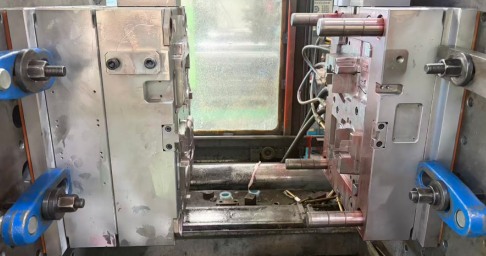
Mold temperature controller connected with injection mold + cooling water lines
Injection mold temperature control system for stable plastic part production
Mold temperature control is one of the key factors that decides injection molding quality. Many molding problems, such as warpage, sink marks, surface defects, and dimensional changes, are caused by unstable mold temperature.
Engineers often adjust injection pressure or holding time first when defects appear. However, if the mold temperature is not stable, changing these parameters may only hide the problem temporarily.
The mold temperature affects plastic flow, cooling speed, shrinkage, and internal stress. For precision parts and high-volume production, controlling heat inside the mold is essential to achieve stable quality.
Why Does Incorrect Mold Temperature Cause Injection Molding Defects?
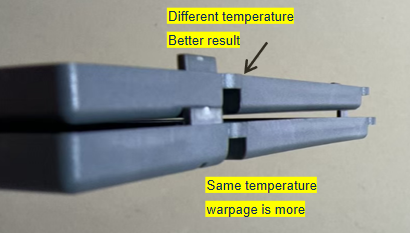
Comparison image showing good part vs warped part, Using different mold temperature to improve the uneven of part shringing
Mold temperature directly affects how plastic fills and cools inside the cavity. When molten plastic enters the mold, it starts losing heat immediately. The cooling speed determines the final structure and dimensions of the part.
If the mold temperature is too low, the plastic may freeze too quickly before filling the cavity completely. This can create short shots, weld line weakness, poor surface finish, and higher internal stress.
If the mold temperature is too high, the cooling time becomes longer. The part may shrink more after ejection and create dimensional problems.
For example, a customer developed an automotive plastic housing with tight assembly requirements. During T1 trial, the part passed visual inspection but failed dimensional testing after cooling. The main reason was uneven mold temperature between the core and cavity side. After improving the cooling balance, the part dimension became stable during mass production.
A well-designed injection mold manufacturing process must consider cooling performance during mold design, not only after production problems appear.
How Does Mold Temperature Affect Plastic Flow and Injection Pressure?
Mold temperature changes the viscosity of molten plastic. A colder mold surface creates a thicker frozen layer during filling, which makes plastic flow more difficult.
When flow resistance increases, the injection machine needs higher pressure to fill the cavity. Higher pressure may create additional stress, flash problems, or part deformation.
For engineering plastics such as PA, PC, PPS, and LCP, temperature control is even more important because these materials have specific processing windows.
The correct mold temperature allows the plastic to flow smoothly with lower stress and improves the final mechanical performance.
How Does Uneven Cooling Create Internal Stress and Warpage?
Cooling is not only about removing heat. It must remove heat evenly from all areas of the mold.
When one area cools faster than another area, different sections of the part shrink at different speeds. This creates internal stress inside the plastic part.
After ejection, these stresses can release and cause bending, twisting, or dimensional changes.
For complex parts with ribs, bosses, thick walls, or inserts, cooling imbalance becomes a common reason for production instability.
Using DFM and Mold flow analysis before tooling helps engineers identify possible cooling and shrinkage risks before mold production starts.
Why Does Mold Cooling Design Decide Long-Term Production Stability?
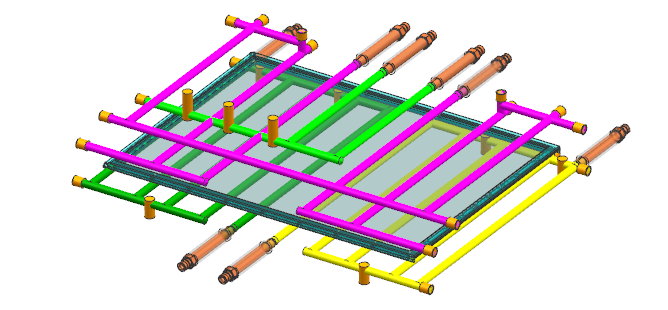
Injection mold cooling channel design for thermal balance
The cooling system is one of the most important systems inside an injection mold. A mold with poor cooling design may produce acceptable samples but fail during continuous production.
During mass production, the mold receives heat every cycle. If this heat cannot be removed evenly, some areas become hotter than others.
Common causes include:
- Cooling channels too far from the cavity
- Different cooling efficiency between core and cavity
- Poor water flow inside channels
- Hot spots around thick sections
These problems increase cycle variation and make part quality unstable.
A professional mold design should balance cooling layout, steel thickness, and part geometry to achieve consistent heat transfer.
How Does Cooling Channel Layout Influence Mold Temperature?
Cooling channel distance and position directly affect heat removal.
Channels close to the cavity surface can remove heat faster. However, they must maintain enough steel thickness to avoid reducing mold strength.
For areas with thick walls or complex structures, additional cooling circuits may be required.
A balanced cooling design reduces temperature differences and improves dimensional repeatability.
This is why experienced suppliers combine mold design, machining capability, and process knowledge when producing injection molded parts, see our injection molding production line how to control the mold temperature.
How Does Cooling Flow Rate Affect Temperature Stability?
The cooling water flow rate determines how quickly heat leaves the mold.
Low flow rate reduces cooling efficiency and creates temperature differences inside the mold. This can increase cycle time and cause inconsistent part dimensions.
Stable water flow helps maintain the same mold condition from the first shot to thousands of production cycles.
For high-volume projects, monitoring cooling performance is necessary to avoid unexpected production variation.
How Can Engineers Improve Mold Temperature Control During Production?
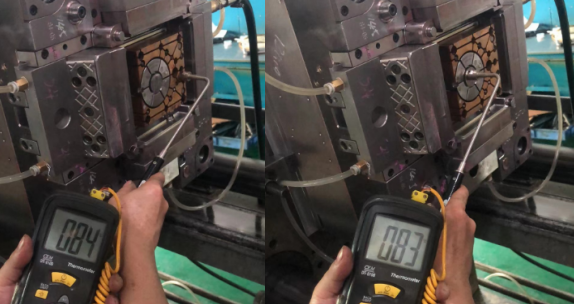
Engineer checking injection mold temperature with measurement equipment
Many production teams only check the temperature setting on the mold temperature controller. However, the displayed temperature does not always represent the real cavity surface condition.
Actual mold temperature is affected by:
- Cooling channel design
- Water flow condition
- Production speed
- Mold material
- Workshop temperature
A stable molding process requires measurement, testing, and continuous monitoring.
During mold validation, engineers should check:
- Mold temperature difference between areas
- Cooling water inlet and outlet temperature
- Part dimensions after cooling
- Cycle stability
Combining process monitoring with helps ensure reliable production performance.
Engineering Conclusion
Mold temperature control is not simply a machine setting. It is a complete thermal management system involving mold design, material behavior, cooling performance, and production control.
When temperature is unstable, adjusting injection parameters alone cannot fully solve quality problems.
A stable injection molding process starts with balanced heat transfer, proper cooling design, and accurate process validation. For precision plastic parts, controlling mold temperature is one of the most important steps to achieve consistent quality from prototype trials to mass production.