Nylon injection molding is widely used for mechanical parts, automotive components, electrical housings, gears, clips, and industrial products. Nylon offers good strength, wear resistance, and heat performance. However, different nylon grades can behave very differently during molding and in final use.
PA6, PA66, glass-filled nylon, and other modified grades each offer different benefits. Moisture absorption, temperature, stiffness, impact strength, and dimensional stability can all affect part performance.
Therefore, choosing the right nylon grade is just as important as choosing the right mold design.
At Fentor Mold, we review part structure, load, environment, tolerance, and production needs before selecting a suitable molding solution.
What Is Nylon Injection Molding?
Nylon is a common engineering thermoplastic from the polyamide family.
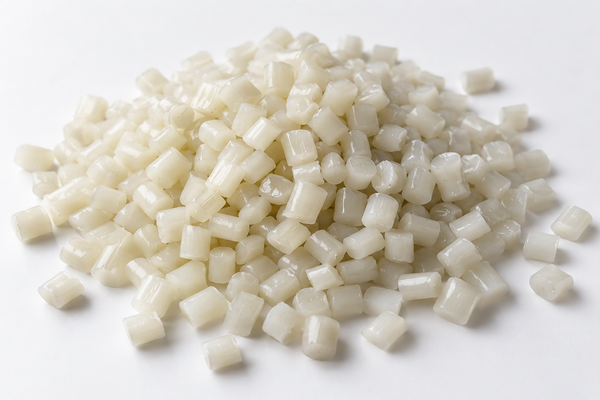
In injection molding, manufacturers heat nylon pellets until they melt. The machine then injects the material into a mold cavity. After cooling, the part becomes solid and keeps the required shape.
Nylon offers several useful properties:
- good mechanical strength;
- good wear resistance;
- low friction;
- good fatigue resistance;
- good heat resistance;
- good chemical resistance;
- suitable for glass fiber reinforcement.
Because of these properties, nylon often replaces metal in lightweight mechanical applications.
However, nylon also absorbs moisture. This can change its dimensions and mechanical properties.
For this reason, material selection should consider both molding conditions and the final working environment.
Common Nylon Grades for Injection Molding
Several nylon grades are widely used in injection molding.
The most common include PA6 and PA66.
| Nylon Grade | Main Advantage | Typical Use |
|---|---|---|
| PA6 | Good toughness and easier processing | Housings, clips, general parts |
| PA66 | Higher stiffness and heat resistance | Mechanical and automotive parts |
| PA6 GF30 | Higher stiffness and strength | Structural components |
| PA66 GF30 | High heat and mechanical performance | Automotive and industrial parts |
| Flame-retardant PA | Improved electrical safety | Electrical components |
| Impact-modified PA | Better toughness | Clips and impact-loaded parts |
Each grade has a different balance of strength, stiffness, moisture resistance, and processing behavior.
PA6 vs PA66 in Nylon Injection Molding
PA6 and PA66 are two of the most common nylon materials.
They look similar, but their performance is different.
PA6
PA6 usually offers:
- good toughness;
- good impact resistance;
- easier flow;
- slightly lower processing temperature;
- good surface quality.
Because PA6 flows well, it can fill complex cavities more easily.
However, it generally absorbs more moisture than some other nylon grades.
PA66
PA66 usually offers:
- higher stiffness;
- better heat resistance;
- good wear resistance;
- better performance under mechanical load.
Therefore, PA66 is often used for automotive and industrial components.
However, it normally requires higher molding temperatures and careful moisture control.
Nylon Injection Molding and Moisture Absorption
Moisture is one of the most important issues in nylon injection molding.
Nylon is hygroscopic. In simple terms, it absorbs water from the surrounding air.
This can happen before molding and after molding.
Moisture Before Molding
If nylon pellets contain too much moisture before processing, several molding problems may appear.
These include:
- silver streaks;
- bubbles;
- poor surface quality;
- reduced strength;
- material degradation;
- unstable dimensions.
Therefore, nylon should normally be dried before injection molding.
Drying conditions depend on the exact grade and supplier recommendation.
Moisture After Molding
Finished nylon parts can also absorb moisture during use.
As moisture increases, the part may become slightly larger and more flexible.
At the same time, stiffness may decrease.
This matters when the product has:
- tight tolerances;
- precision assembly;
- gears;
- bearings;
- snap fits;
- sealing surfaces.
For these applications, designers should consider the final moisture condition rather than checking only the dry molded part.
How Nylon Grade Affects Part Strength
Nylon is known for good mechanical strength.
However, strength depends heavily on the material grade.
Unfilled nylon offers a useful balance of toughness and flexibility.
Glass-filled nylon provides much higher stiffness.
For example, adding glass fiber can improve:
- tensile strength;
- stiffness;
- heat resistance;
- dimensional stability;
- creep resistance.
However, glass fiber also changes molding behavior.
The material becomes less flexible and may become more sensitive to flow direction.
Therefore, stronger material does not always mean a better part.
The correct choice depends on how the part will be loaded.
Glass-Filled Nylon Injection Molding
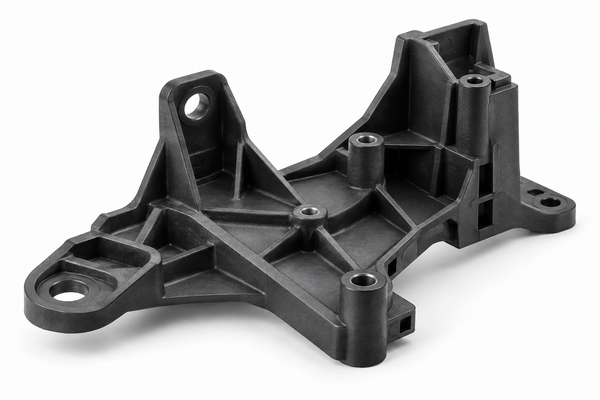
Glass-filled nylon is widely used for structural plastic parts.
Common grades include:
- PA6 GF15;
- PA6 GF30;
- PA66 GF30;
- PA66 GF40;
- higher glass fiber grades for special applications.
GF30 means the material contains about 30% glass fiber by weight.
Benefits of Glass-Filled Nylon
Glass fiber can improve:
- rigidity;
- load capacity;
- thermal stability;
- dimensional stability;
- resistance to creep.
As a result, glass-filled nylon is often used for brackets, housings, mechanical supports, and under-hood automotive parts.
Challenges With Glass-Filled Nylon
However, glass fiber also creates new challenges.
These can include:
- higher mold wear;
- stronger fiber orientation;
- warpage;
- rougher surface appearance;
- visible flow marks;
- more difficult welding lines.
Therefore, gate location and part geometry become especially important.
Our custom injection mold manufacturing service includes DFM and mold structure review before machining starts.
Nylon Injection Molding and Heat Resistance
Heat resistance is another reason manufacturers choose nylon.
PA66 normally performs better at higher temperatures than PA6.
Glass fiber can improve heat performance further.
However, temperature resistance depends on more than the base resin.
It can also depend on:
- glass fiber content;
- stabilizers;
- part thickness;
- load;
- exposure time;
- moisture level.
For this reason, material selection should use actual working conditions.
A part that briefly sees high temperature may need a different grade from a part that remains hot for many hours.
Dimensional Stability in Nylon Injection Molding
Dimensional stability can be challenging with nylon.
Several factors can change final part size:
- mold shrinkage;
- moisture absorption;
- fiber orientation;
- cooling rate;
- part thickness;
- molding pressure;
- mold temperature.
Unfilled nylon can show more dimensional change after moisture absorption.
Glass-filled grades normally improve stability.
However, glass fiber can also create different shrinkage in different directions.
This may cause warpage.
Therefore, designers should consider both moisture and fiber orientation when setting tight tolerances.
Gate Design for Nylon Injection Molding
Gate design affects filling, weld lines, fiber direction, and warpage.
For simple parts, several common gate types may work well.
These include:
- edge gates;
- sub gates;
- pin gates;
- direct gates;
- hot runner gates.
However, the best gate location depends on the part shape.
For glass-filled nylon, gate position is especially important because fibers follow the melt flow.
Poor gate placement can create strong orientation in one area and weak weld lines in another.
Therefore, engineers should review the flow path before finalizing the mold.
Wall Thickness for Nylon Parts
Consistent wall thickness helps improve molding quality.
Very large thickness changes can cause:
- sink marks;
- voids;
- long cooling time;
- uneven shrinkage;
- warpage.
Instead, designers should keep the wall thickness as uniform as possible.
Gradual transitions are better than sudden changes.
Ribs can also add strength without making the main wall too thick.
This is especially useful for nylon because many nylon parts need high mechanical strength.
Ribs and Bosses in Nylon Injection Molding
Ribs and bosses are common in nylon parts.
They can support screw holes, mounting areas, and structural sections.
However, oversized features may cause sink marks and stress.
For better results:
- avoid overly thick ribs;
- add suitable radii;
- support tall bosses;
- avoid sharp corners;
- keep transitions smooth.
Glass-filled nylon can be more sensitive to sharp corners because the material is stiffer.
Therefore, good radius design can help reduce stress concentration.
Nylon Injection Molding and Mold Temperature
Mold temperature affects both surface quality and internal part structure.
A higher mold temperature can improve:
- surface finish;
- material flow;
- crystallinity;
- part strength in some applications.
However, it may also increase cycle time.
A lower mold temperature may shorten production time, but it can sometimes reduce surface quality or increase internal stress.
Therefore, mold temperature should match the material grade and part requirement.
Our injection molding production service includes trial molding and process adjustment to improve production stability.
Common Nylon Injection Molding Defects
Nylon can produce several common molding defects if material or process conditions are not stable.
| Problem | Common Cause |
|---|---|
| Silver streaks | Moisture in resin |
| Short shot | Low melt temperature or poor flow |
| Flash | High pressure or poor mold fit |
| Warpage | Uneven cooling or fiber orientation |
| Sink marks | Thick areas |
| Burn marks | Poor venting |
| Weld lines | Flow fronts meet around holes |
| Brittle parts | Material degradation or incorrect conditioning |
Many of these problems can be reduced before production through good part design and mold design.
When Should You Choose PA6?
PA6 can be a good choice when the project needs:
- good toughness;
- good flow;
- easier molding;
- good surface appearance;
- moderate heat resistance;
- lower material cost in some applications.
It is often suitable for housings, clips, covers, and general mechanical parts.
However, moisture absorption should still be considered.
When Should You Choose PA66?
PA66 may be a better choice when the part needs:
- higher stiffness;
- better heat resistance;
- stronger mechanical performance;
- better wear resistance;
- higher structural strength.
Therefore, PA66 is common in automotive, industrial, and electrical applications.
However, the process window can be more demanding.
When Should You Choose Glass-Filled Nylon?
Glass-filled nylon is often suitable when the part needs:
- high stiffness;
- low deformation under load;
- improved heat performance;
- better dimensional stability;
- higher structural strength.
Typical applications include:
- automotive brackets;
- motor housings;
- gear components;
- machine parts;
- electrical structural parts.
However, the mold should also handle abrasive material.
That means cavity steel, gate area, and other wear zones may need stronger materials or surface treatment.
Nylon Injection Molding vs Other Plastics
Nylon is not always the best plastic.
The right choice depends on the application.
| Material | Main Advantage | Main Limitation |
|---|---|---|
| Nylon | Strength and wear resistance | Moisture absorption |
| POM | Low friction and good stability | Lower heat range in some uses |
| PC | High impact strength | Higher cost and stress sensitivity |
| ABS | Easy molding and good appearance | Lower heat resistance |
| PP | Low cost and chemical resistance | Lower stiffness |
| PBT | Good electrical and dimensional stability | Different impact performance |
Therefore, nylon should be selected because its properties match the part requirement, not simply because it is a strong material.
How to Choose the Right Nylon Grade
Before selecting a nylon grade, review these questions:
- What load will the part carry?
- What temperature will it see?
- Will it contact water or humid air?
- How tight are the tolerances?
- Does the part need high stiffness?
- Is impact strength important?
- Will the part rub against another surface?
- Does it need flame resistance?
- Will glass fiber affect appearance?
- What production volume is expected?
Once these points are clear, material selection becomes much easier.
For complex parts, Fentor Mold Components Manufacturing can also support secondary machining and component manufacturing when needed.
Final Thoughts
Nylon injection molding offers a strong combination of mechanical performance, wear resistance, heat resistance, and design flexibility.
However, not all nylon grades perform the same way.
PA6 offers good toughness and molding performance. PA66 provides higher stiffness and heat resistance. Glass-filled nylon can improve structural strength and dimensional stability, but it also increases mold wear and warpage risk.
Therefore, the best nylon grade should match the real working environment, load, temperature, moisture level, tolerance, and part design.
By choosing the right nylon material before mold manufacturing begins, manufacturers can improve part quality, reduce molding problems, and achieve more stable long-term performance.