
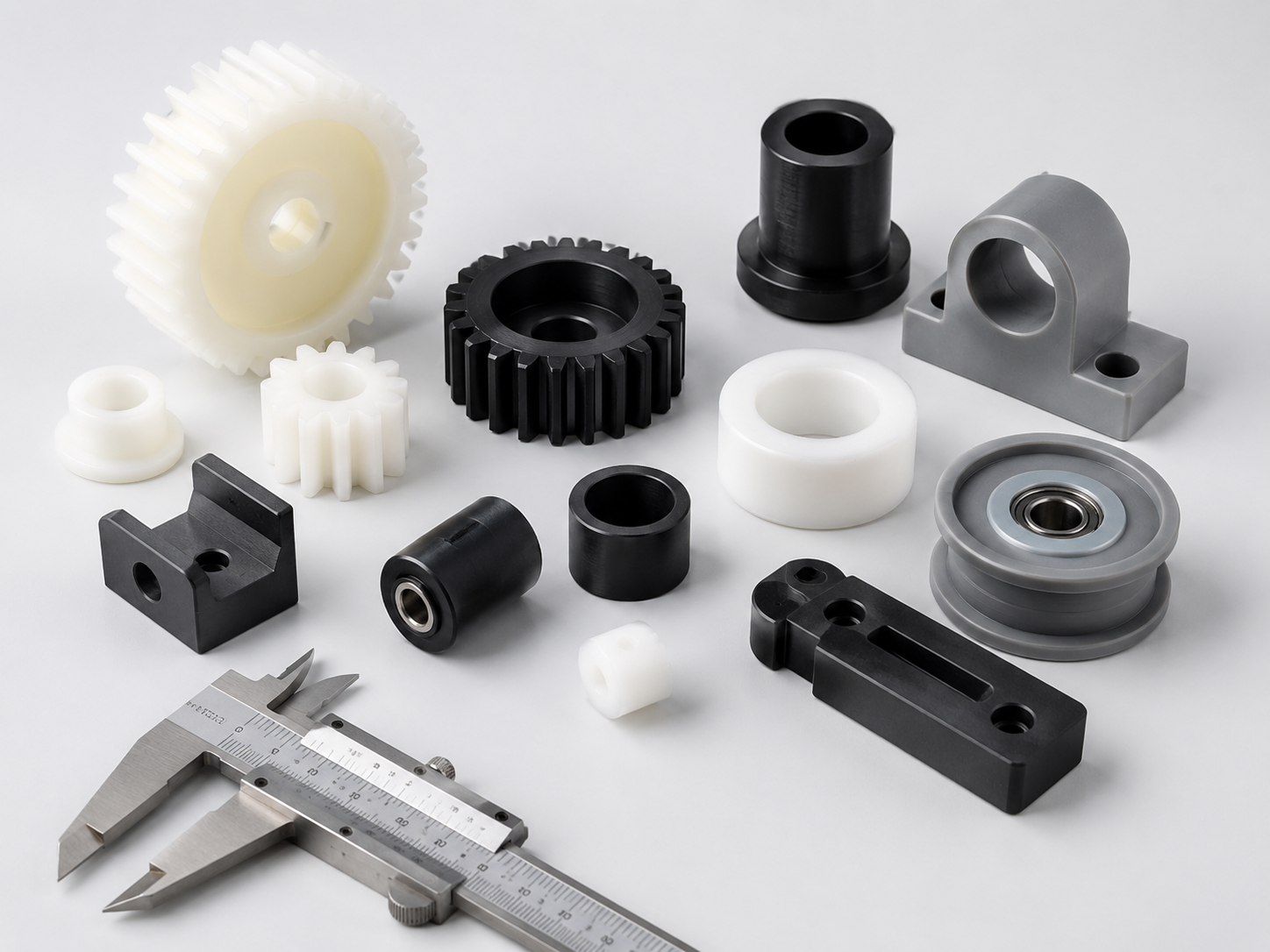
Plastic mechanical parts often look simple, but they can be much harder to manufacture than ordinary plastic housings.
A gear may need to rotate smoothly. A bushing must maintain its inner diameter. A guide may slide thousands of times without excessive wear. A small locating component may need to fit another part with very little clearance.
For these plastic mechanical parts, appearance is usually secondary. What matters is whether the part continues to work after repeated assembly, movement, loading and long-term use.
Tolerance, material, friction, wear, shrinkage and manufacturing method therefore need to be considered together from the beginning.
What Are Plastic Mechanical Parts?
Plastic mechanical parts are functional components designed to transmit force, guide movement, locate other components or maintain a mechanical connection.
Common examples include:
- Gears
- Bushings
- Rollers
- Guides
- Bearings
- Spacers
- Pulleys
- Clips
- Levers
- Sliding blocks
- Valve components
- Precision connectors
- Small structural components
Unlike decorative plastic parts, these components are normally judged by function.
A small dimensional change that would be invisible on a housing can create serious problems in a mechanical assembly.
For example, an oversized bore may create excessive movement, while an undersized bore may increase friction or make assembly impossible.
That is why dimensional requirements should be reviewed before starting injection mold manufacturing, rather than waiting until the first samples are produced.
Tolerance Is Not Just a Drawing Requirement
One of the most common mistakes with plastic mechanical parts is applying metal machining tolerances directly to molded plastic components.
Plastic behaves differently.
After the cavity is filled, the material cools and shrinks. Final dimensions can be affected by:
- Resin shrinkage
- Fiber orientation
- Wall thickness
- Gate position
- Holding pressure
- Mold temperature
- Cooling balance
- Part geometry
- Moisture absorption
- Measurement conditions
A drawing may specify ±0.05 mm, but that does not automatically mean the dimension can be maintained economically in mass production.
The first question should be:
Does this dimension really need such a tight tolerance?
Critical mating, sealing, positioning and movement dimensions may require close control.
Non-functional dimensions normally do not.
Reducing unnecessary tight tolerances can simplify tooling, reduce mold corrections and make production more stable.
For a deeper explanation, see our guide to injection molding tolerances.
Pay Attention to Tolerance Stack-Up
A single dimension can be within specification while the complete assembly still fails.
Consider a plastic gear mounted between two plastic supports.
The final working clearance may depend on:
- Gear thickness
- Shaft diameter
- Hole diameter
- Support position
- Housing dimension
Small variations in each feature can accumulate.
For mechanical components, checking tolerance stack-up is often more useful than simply tightening every individual dimension.
Material Selection Directly Affects Wear and Accuracy
Choosing material according to appearance or resin price alone is risky for mechanical applications.
Different plastics behave very differently under friction, load and temperature.
POM
POM, also called acetal, is one of the most common materials for plastic mechanical parts.
Typical applications include gears, bushings, rollers and guides.
Its advantages include:
- Low friction
- Good wear resistance
- Good stiffness
- Good dimensional stability
- Smooth movement
For components involving repeated sliding or rotation, POM is often one of the first materials worth evaluating.
Our POM injection molding guide explains its molding behavior and common manufacturing issues in more detail.
PA / Nylon
Nylon is useful where higher strength and wear resistance are required.
Glass-filled nylon can provide significantly greater stiffness, making it suitable for structural mechanical parts.
However, moisture absorption requires attention.
A nylon component that meets dimensions immediately after molding may change slightly after absorbing moisture from the environment.
For very tight assemblies, this needs to be considered during both design and inspection.
PBT
PBT provides good dimensional stability, electrical properties and chemical resistance.
It is commonly considered for mechanical and electrical components where dimensional consistency is important.
Glass-filled grades can further increase stiffness.
PC and ABS
PC and ABS can also be used for functional components, but they are normally selected for a different balance of impact strength, appearance and processing characteristics.
They are not automatically the best choices for continuous sliding surfaces.
The material should always match the actual operating condition rather than simply following previous projects.
Wear Resistance Depends on More Than the Plastic
Selecting a wear-resistant resin does not guarantee a long-lasting component.
Wear depends on the complete working system.
Important factors include:
- Contact pressure
- Sliding speed
- Operating temperature
- Surface roughness
- Lubrication
- Mating material
- Alignment
- Load direction
- Operating cycle
- Dust or contamination
For example, a POM slider may perform very well under moderate load but wear quickly if it is misaligned and only one edge carries the load.
In that case, changing to a more expensive material may not solve the real problem.
Avoid Excessive Local Contact
Mechanical parts should distribute load over a reasonable contact area.
Sharp contact points and very narrow sliding surfaces increase local pressure.
Whenever possible:
- Increase the contact area
- Avoid unnecessary sharp corners
- Improve alignment
- Provide suitable radii
- Reduce side loading
- Keep mating surfaces stable
These small design changes can improve service life without significantly increasing manufacturing cost.
Mold Design Has a Major Effect on Plastic Mechanical Parts
Good material and a correct drawing are not enough.
The injection mold must reproduce the geometry consistently over many production cycles.
Gate Location
Gate position affects how plastic fills and shrinks.
For precision components, an unsuitable gate can cause:
- Uneven shrinkage
- Warpage
- Weld lines
- Dimensional variation
- Internal stress
The gate should therefore be selected according to both filling behavior and critical dimensions.
Cooling
Uneven cooling is another common reason for dimensional instability.
If one side of a mechanical component cools faster than the other, the part may bend or shrink unevenly.
This becomes particularly important for:
- Long parts
- Flat parts
- Components with different wall thicknesses
- Precision gears
- Parts with large bosses
Ejection
Mechanical parts often have holes, teeth, ribs or narrow functional surfaces.
Ejection force should not deform these areas.
A component can measure correctly inside the mold but become distorted during ejection.
This is why DFM should review not only filling but also cooling and ejection before tooling begins.
Control the Dimensions That Actually Affect Function
Not every dimension deserves the same level of control.
For plastic mechanical parts, we normally separate dimensions into different functional groups.
Critical Dimensions
These directly affect operation.
Examples:
- Bearing diameter
- Shaft hole
- Gear center distance
- Sliding clearance
- Sealing surface
- Locating feature
- Assembly interface
These dimensions may require additional mold adjustment and measurement.
Important Dimensions
These affect assembly but have slightly more tolerance flexibility.
General Dimensions
These have little impact on function and can usually follow standard molded tolerances.
This approach makes the drawing easier to manufacture and helps the supplier focus inspection resources on the features that matter.
Injection Molding or CNC Machining?
Not every plastic mechanical component should immediately be injection molded.
The manufacturing method depends heavily on quantity and design maturity.
CNC Machining
Plastic CNC machining can be useful for:
- Prototype quantities
- Engineering validation
- Low-volume production
- Very thick components
- Parts requiring frequent design changes
It avoids injection mold investment and allows dimensions to be changed relatively quickly.
However, the unit price remains relatively high.
Injection Molding
Injection molding becomes more attractive when quantities increase.
Once a stable mold and process are established, it offers:
- Lower unit cost
- Faster production
- Good repeatability
- Complex geometry
- Integrated ribs and bosses
- Consistent mass production
For projects moving toward continuous production, our injection molding production service covers the process from tooling validation through production.
Use Both When Necessary
Some projects use CNC machining during early development and injection molding after the design has been confirmed.
This reduces the risk of building production tooling too early.
It is often a practical approach for precision mechanical products where mating dimensions must first be validated.
Prototype Testing Should Focus on Function
A mechanical component should not be approved simply because the first samples match the drawing.
Functional testing is equally important.
Depending on the application, testing may include:
- Repeated assembly
- Sliding tests
- Rotation tests
- Load tests
- Wear tests
- Temperature testing
- Dimensional inspection
- Long-cycle testing
A gear that rotates smoothly for ten cycles may behave differently after tens of thousands of cycles.
Likewise, a clip that works during the first assembly may gradually lose holding force.
For components with moving or loaded features, prototype and trial testing should simulate the actual working condition as closely as possible.
Mass Production Can Reveal Problems That T1 Samples Do Not
This is especially important with plastic mechanical parts.
A mold may produce excellent T1 samples, but problems can become visible after longer production.
Typical examples include:
- Gate wear
- Insert wear
- Dimensional drift
- Ejector wear
- Flash around moving areas
- Changes in sliding clearance
- Process variation
- Material batch differences
Glass-filled materials can also increase wear on mold surfaces and gates.
Therefore, mold condition should be considered when planning long-term production.
Dimensional stability needs to be monitored over production runs rather than checked only during the first mold trial.
How to Improve Plastic Mechanical Parts Before Production
The most effective improvements normally happen before mold steel is cut.
Before production, review:
- Actual working conditions
Define load, movement, temperature and expected life. - Material selection
Select resin based on mechanical requirements rather than price alone. - Critical dimensions
Identify which dimensions really affect function. - Tolerance stack-up
Check the entire assembly instead of evaluating dimensions separately. - Contact surfaces
Review sliding, rotating and load-bearing areas. - Gate and cooling design
Consider how molding will affect shrinkage and warpage. - Wear points
Identify both product wear and potential mold wear. - Testing requirements
Decide how the component will be validated before mass production.
Doing this early normally costs far less than repeatedly modifying the mold after T1.
Choosing a Manufacturer for Plastic Mechanical Parts
When sourcing precision mechanical components, manufacturing capability should be evaluated around the actual product requirements.
A supplier should be able to discuss:
- Material behavior
- Functional tolerances
- DFM
- Mold structure
- Shrinkage
- Warpage
- Critical dimensions
- Inspection method
- Trial results
- Long-term production stability
The goal is not simply to produce a plastic shape that matches the CAD file.
The finished component needs to assemble correctly, move correctly and continue performing throughout its intended service life.
At Fentormold, we support custom plastic projects from mold development through injection molding and precision component manufacturing. For mechanical parts, we focus particularly on functional dimensions, material behavior and production repeatability before moving into stable production.
Final Thoughts
Good plastic mechanical parts are the result of several decisions working together.
Tolerance alone cannot guarantee performance. A highly accurate component can still fail if the material wears quickly. A wear-resistant material can still fail if the working clearance is wrong. A well-designed component can still become unstable if the mold cooling or production process is poorly controlled.
For this reason, tolerance, material, wear, mold design and manufacturing method should be reviewed as one system.
When these factors are considered early, it becomes much easier to achieve stable dimensions, longer service life and reliable mechanical performance without adding unnecessary manufacturing cost.