
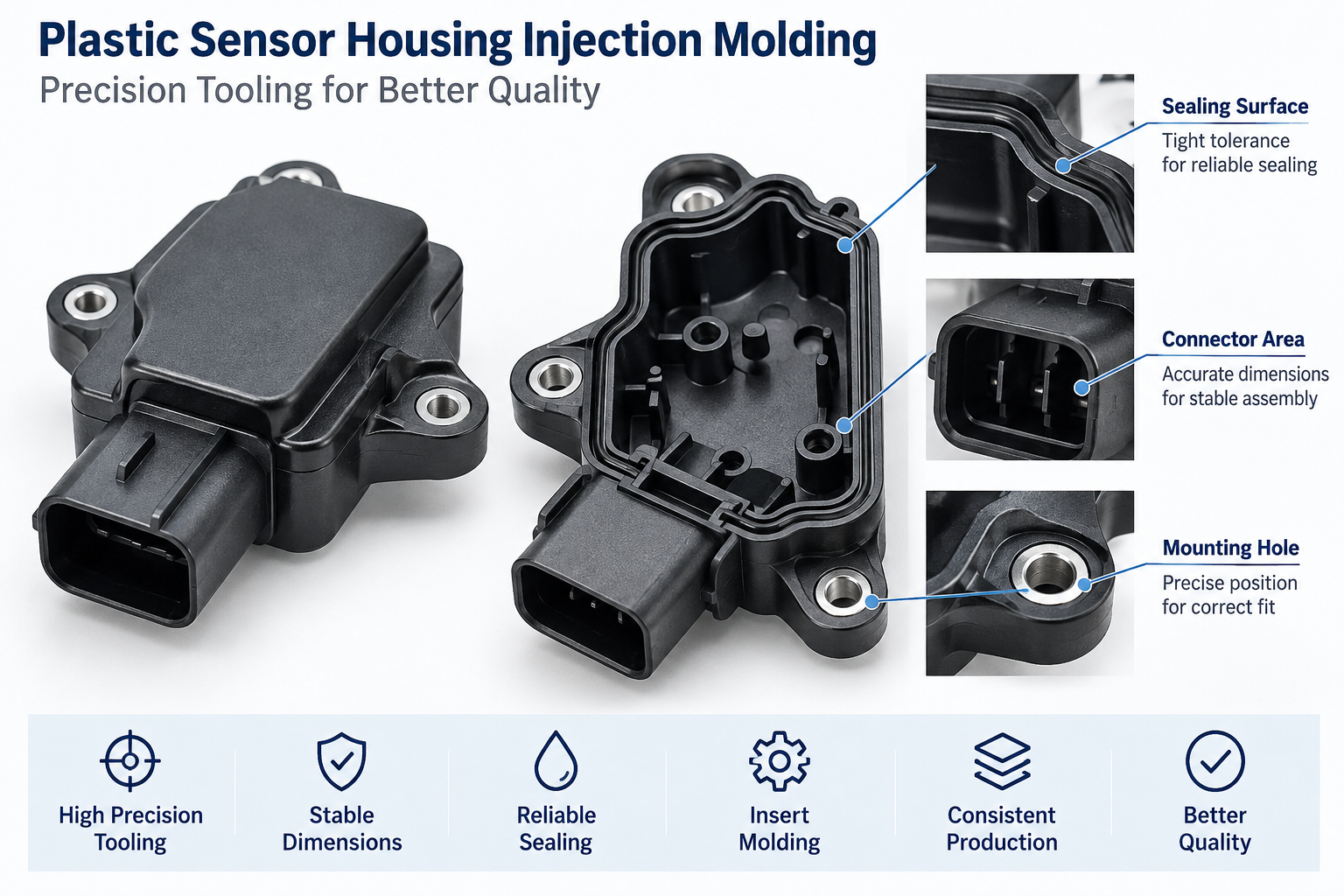
Plastic Sensor Housing Injection Molding requires good control of mold accuracy, part dimensions, sealing areas, and long-term production stability.
Sensor housings are often small. However, their function can be very sensitive to small errors.
A hole may shift. A sealing surface may warp. A connector opening may become too tight. In addition, a thin wall may not fill completely.
These problems can affect assembly, sealing, positioning, and sensor performance.
Therefore, good quality starts with precision tooling.
The mold must form the critical features correctly. At the same time, the molding process must repeat the result during production.
Why Plastic Sensor Housing Injection Molding Needs Precision
A sensor housing may contain many functional details.
Typical features include:
- Connector openings
- Mounting holes
- Sealing surfaces
- O-ring grooves
- Snap fits
- Thin ribs
- Small bosses
- Metal inserts
- Pressure ports
- Internal locating features
These areas often work together.
For example, a mounting hole may pass its own tolerance.
However, if the hole position moves slightly, the complete sensor may not fit the final assembly.
Therefore, Plastic Sensor Housing Injection Molding should focus on function rather than appearance alone.
Plastic Sensor Housing Injection Molding Starts With DFM
Before mold manufacturing begins, the part design should be reviewed.
Important DFM points include:
- Wall thickness
- Draft angle
- Rib thickness
- Boss design
- Sealing areas
- Gate location
- Parting line
- Ejection
- Undercuts
- Insert positions
- Cooling layout
For example, a thick boss beside a thin wall can create sink marks.
Meanwhile, a deep rib with too little draft can make ejection difficult.
Poor gate location can also create weld lines near a sealing or pressure area.
Therefore, these risks should be found before steel cutting begins.
At Fentor Mold, our Injection Mold service includes DFM review, mold design, machining, mold trial, and modification for custom plastic parts.
Critical Dimensions Need More Attention
Not every dimension needs the same tolerance.
For sensor housings, the most important areas are usually linked to assembly or function.
These may include:
- Sensor element position
- Connector position
- Mounting holes
- Sealing diameter
- O-ring groove
- Pressure port
- Insert position
- Housing height
- Mating surfaces
For this reason, the drawing should clearly mark critical dimensions.
Otherwise, time may be spent controlling features that do not affect function.
Meanwhile, truly important dimensions may not receive enough attention.
Plastic Sensor Housing Injection Molding Depends on Mold Insert Accuracy
Sensor housing molds often use several small inserts.
These inserts may form:
- Connector slots
- Small holes
- Pressure channels
- Sealing areas
- Internal ribs
- Locating features
Small mold components must be accurate.
A small machining error can directly change the plastic part.
For this reason, CNC, EDM, wire cutting, and grinding may all be used.
In addition, the insert should be easy to check and replace when needed.
For long-term production, this can reduce mold repair time.
Small Core Pins Must Be Strong Enough
Small holes and channels often require thin core pins.
However, thin pins can create production risks.
They may:
- Bend
- Break
- Wear
- Move under pressure
- Create unstable hole size
Therefore, the core pin design should not only match the product drawing.
It must also be strong enough for production.
In some cases, the product feature should be changed slightly.
In other cases, a separate insert or stronger steel may be better.
Good tooling design must balance part accuracy and mold life.
Plastic Sensor Housing Injection Molding Needs Stable Sealing Surfaces
Many sensor housings need sealing.
This may involve:
- O-rings
- Gaskets
- Ultrasonic welding
- Adhesive sealing
- Press-fit covers
- Overmolded seals
A sealing surface may look simple.
However, small warpage or mismatch can cause leakage.
Therefore, sealing areas should be treated as critical features.
Important checks include:
- Flatness
- Surface condition
- Parting line position
- Flash
- Sink marks
- Warpage
- Groove dimensions
A small amount of flash in an unimportant area may be acceptable.
However, the same flash on a sealing surface can cause failure.
Gate Location Can Affect Sensor Housing Quality
Gate position affects much more than filling.
It can also affect:
- Warpage
- Weld lines
- Internal stress
- Part dimensions
- Surface marks
- Packing balance
For example, a poor gate location may push the part unevenly during filling.
As a result, the housing may warp after cooling.
Also, weld lines may form around mounting holes or sealing areas.
Therefore, the gate should be selected based on both filling and function.
For more complex parts, Moldflow can help compare different gate positions before mold manufacturing.
Venting Is Important for Deep and Small Features
Sensor housings often include deep ribs and narrow channels.
Air can become trapped in these areas.
Poor venting may cause:
- Burn marks
- Short shots
- Weak weld lines
- Incomplete ribs
- Poor surface quality
Therefore, vents should be placed near the end of the flow path.
Small inserts can also be used to help release trapped air.
However, vent depth must be controlled.
If the vent is too deep, flash can appear.
If it is too shallow, air cannot escape.
Cooling Has a Direct Effect on Dimensional Accuracy
Cooling is one of the main factors behind warpage and shrinkage.
If one side of the housing cools faster, the part may bend.
If a local area stays hot, dimensions may also change.
This is common near:
- Thick bosses
- Deep cores
- Inserts
- Connector areas
- Mounting features
Therefore, cooling channels should be placed as evenly as possible.
In addition, small critical inserts may need special cooling.
Stable mold temperature helps Plastic Sensor Housing Injection Molding produce more consistent parts.
Material Selection Affects Precision and Stability
Sensor housings can use different plastics.
Common materials include:
- ABS
- PC
- PC+ABS
- PA6
- PA66
- PBT
- PPS
- Glass-filled grades
- Flame-retardant grades
The correct material depends on the application.
Important factors include:
- Heat resistance
- Strength
- Chemical resistance
- Moisture absorption
- Dimensional stability
- Flame rating
- Electrical properties
- Cost
For example, PA offers good strength.
However, it can absorb moisture.
As a result, dimensions may change after molding.
PBT often provides good electrical performance and dimensional stability.
Still, drying and molding conditions need good control.
Plastic Sensor Housing Injection Molding Must Control Shrinkage
Plastic shrinkage is normal.
However, uneven shrinkage can cause problems.
Different materials have different shrinkage rates.
Glass-filled materials may also shrink differently along and across the flow direction.
Therefore, the mold cannot simply use one standard shrinkage value for every feature.
Critical dimensions should be checked after the mold reaches stable production conditions.
In addition, the real production material should be used during mold trials whenever possible.
Metal Inserts Need Accurate Positioning
Some sensor housings contain metal inserts.
These may include:
- Threaded inserts
- Bushings
- Pins
- Electrical terminals
- Mounting inserts
The insert must stay in position during injection.
Otherwise, it may move under plastic pressure.
Possible causes include:
- Weak mold positioning
- Loose inserts
- High injection pressure
- Insert size variation
- Loading errors
Therefore, the mold should locate the insert firmly.
The loading method should also be easy to repeat.
For larger production volumes, automation may help improve consistency.
Flash Can Create Functional Problems
A small amount of flash may look harmless.
However, sensor housings often have small functional areas.
Flash can affect:
- Sealing
- Connector assembly
- Snap fits
- Mounting
- Sensor positioning
Therefore, critical shut-off areas need good fitting.
The mold also needs enough support.
If the mold opens slightly under injection pressure, flash can appear even when the parting line looks correct during mold fitting.
Ejection Must Protect Critical Features
Sensor housings may have thin walls, deep ribs, and small internal features.
As a result, ejection may be difficult.
Poor ejection can cause:
- Warpage
- Whitening
- Cracks
- Ejector marks
- Broken ribs
Therefore, ejector pins should be placed in strong areas.
The part should also have enough draft.
In addition, the ejection force should be spread as evenly as possible.
A good ejection system protects both appearance and dimensions.
Plastic Sensor Housing Injection Molding Needs Process Stability
A precise mold is only part of the solution.
The molding process must also remain stable.
Important settings include:
- Melt temperature
- Mold temperature
- Injection speed
- Injection pressure
- V/P transfer
- Holding pressure
- Holding time
- Cooling time
- Cycle time
Frequent adjustment can cause dimensional drift.
Therefore, a stable process window should be established before full production.
At Fentor Mold, our Injection Molding Production service focuses on repeatable molding conditions and stable part quality during regular production.
Multi-Cavity Sensor Housing Molds Need Cavity Tracking
Multi-cavity molds can reduce part cost.
However, they also require better control.
Different cavities may have small differences in:
- Gate size
- Cooling
- Venting
- Insert dimensions
- Mold temperature
As a result, one cavity may produce parts that are closer to the tolerance limit.
Therefore, parts should remain traceable by cavity.
Critical dimensions should also be checked by cavity.
Our article on Multi-Cavity Injection Molding explains why cavity tracking helps find production problems faster.
Sensor Housing Assembly Should Be Tested
Dimensional inspection alone is not enough.
The real sensor assembly should be checked whenever possible.
Typical tests may include:
- Connector fitting
- Screw assembly
- Insert position
- Snap-fit assembly
- Seal fitting
- Cover assembly
- Mounting fit
A part can pass individual dimensions and still fail during assembly.
This can happen when several small tolerance changes add together.
Therefore, assembly testing should be part of final approval.
Injection Molding Cpk Can Help Check Critical Dimensions
For important dimensions, a few good samples may not be enough.
Cpk can help show whether the molding process can keep the dimension inside tolerance over time.
For example, a sealing diameter may pass inspection.
However, if the result is already close to one tolerance limit, long production may create rejects.
Therefore, capability data can be useful for high-risk dimensions.
Our article on Injection Molding Cpk explains how process capability can help check production stability.
Common Problems in Plastic Sensor Housing Injection Molding
Typical problems include:
Sealing Surface Warpage
Possible causes:
- Uneven cooling
- Poor gate location
- Uneven wall thickness
- High internal stress
Connector Position Shift
Possible causes:
- Mold insert error
- Core movement
- Shrinkage
- Warpage
Flash Around Functional Areas
Possible causes:
- Shut-off wear
- Poor fitting
- High pressure
- Weak mold support
Short Shot in Thin Areas
Possible causes:
- Poor venting
- Small gate
- Low material temperature
- Long flow path
Insert Movement
Possible causes:
- Weak positioning
- High injection pressure
- Insert size variation
- Loading error
The correct solution depends on the real cause.
Therefore, mold changes should not be made before the process and measurement results are checked.
Better Quality Comes From Tooling and Process Control Together
Plastic Sensor Housing Injection Molding is not only about mold accuracy.
It also depends on production control.
Good results come from:
- Correct DFM
- Accurate mold inserts
- Strong core pins
- Good gate design
- Effective venting
- Balanced cooling
- Stable material control
- Stable molding parameters
- Reliable inspection
- Real assembly testing
If one area is weak, production problems may appear later.
Therefore, tooling and process control should be treated as one system.
Final Thoughts
Plastic Sensor Housing Injection Molding needs precision because many small features directly affect the final product.
The main points are:
- Control critical dimensions
- Keep sealing areas stable
- Use accurate mold inserts
- Protect small core pins
- Balance gate and cooling design
- Prevent flash in functional areas
- Control material shrinkage
- Keep production conditions stable
- Test real assembly
At Fentor Mold, we focus on both mold accuracy and production stability.
A sensor housing should not only look correct during the first mold trial.
Instead, it should keep the same dimensions, fit, sealing performance, and assembly quality during long production.
That is where precision tooling creates better quality.