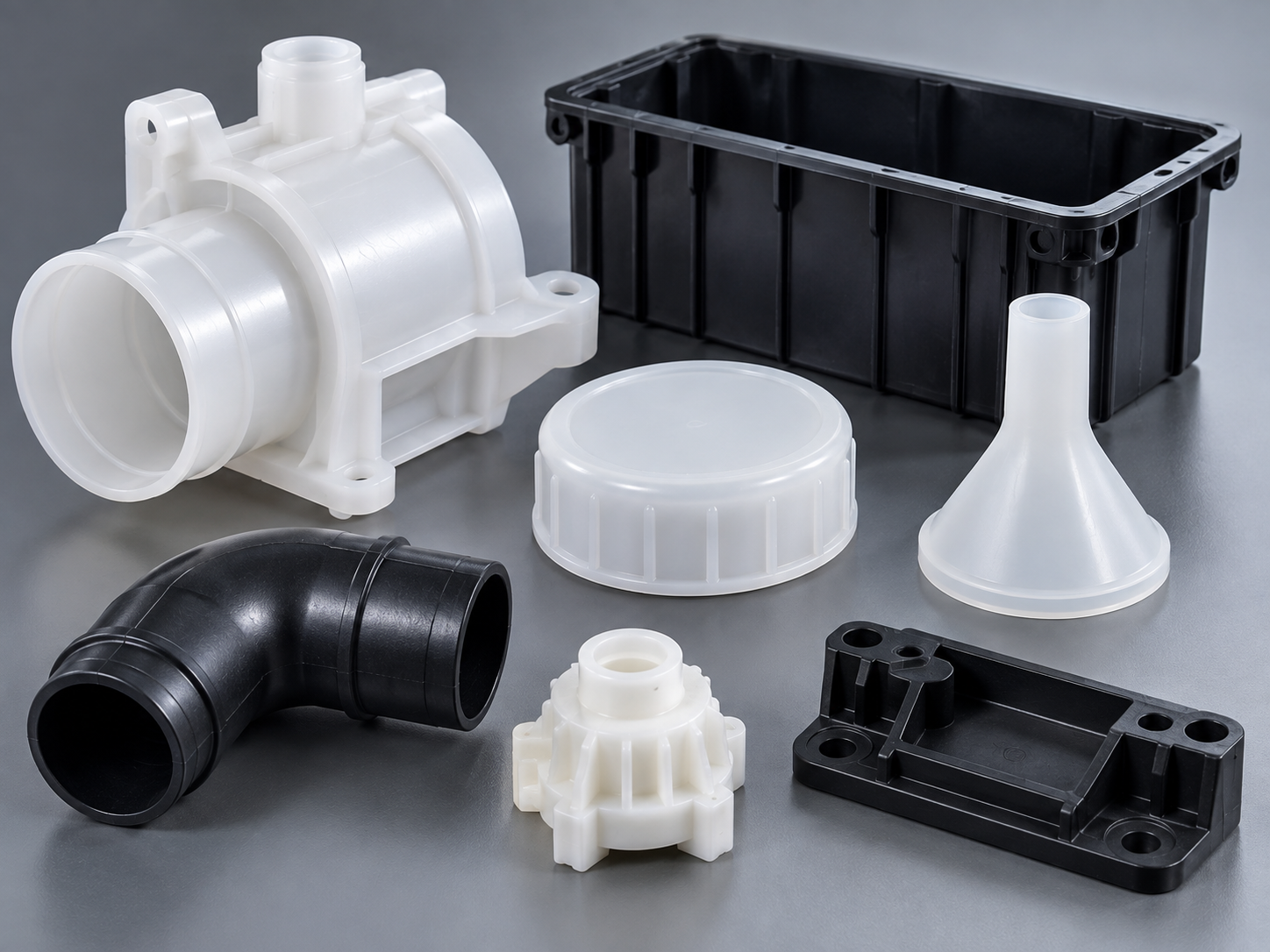
Polyethylene injection molding is widely used because polyethylene offers good chemical resistance, low cost, toughness, and stable processing. However, good results still depend on correct material selection, mold design, cooling, packing, and process control.
Although PE is easier to mold than many engineering plastics, problems can still appear. For example, parts may warp, shrink too much, show sink marks, or vary in size.
Therefore, a stable polyethylene molding process should control both the mold and the machine settings.
What Is Polyethylene Injection Molding?
Polyethylene injection molding is a process in which PE resin is melted, injected into a mold cavity, cooled, and then ejected as a finished plastic part.
Several PE grades are used in molding.
| Material | Main Characteristics | Typical Applications |
|---|---|---|
| HDPE | Stiff, strong, good chemical resistance | Containers, housings, industrial parts |
| LDPE | Soft and flexible | Caps and flexible components |
| LLDPE | Tough and flexible | Flexible molded products |
| UHMWPE | Very high wear resistance | Usually not used in standard injection molding |
Among these, HDPE is one of the most common materials.
However, different PE grades have different flow behavior, shrinkage, stiffness, and cooling needs.
Therefore, material selection should come before mold design.
Why Polyethylene Injection Molding Can Be Difficult
Polyethylene generally flows well. However, its high shrinkage can create several problems.
Common issues include:
- Warpage
- Sink marks
- Flash
- Dimensional variation
- Weak weld lines
- Uneven surface appearance
- Long cooling time
In addition, PE continues to shrink after molding.
Therefore, cooling balance and packing control are very important.
1. Choose the Right Material for Polyethylene Injection Molding
The first step is choosing the correct PE grade.
Important factors include:
- Part stiffness
- Impact resistance
- Chemical resistance
- Wall thickness
- Melt flow index
- Surface requirements
- Working temperature
- Production volume
For example, a higher-flow grade can fill thin walls more easily.
However, a lower-flow grade may provide better strength for thicker parts.
Therefore, the resin should match the product requirement rather than only the target price.
2. Control Melt Temperature Carefully
Melt temperature directly affects filling.
If the melt temperature is too low, the material may not flow well.
As a result, the part may show:
- Short shots
- Strong weld lines
- Poor surface finish
- High injection pressure
- Incomplete filling
However, an excessively high temperature is also not ideal.
It may increase cooling time and cause unstable processing.
Therefore, the resin supplier’s data sheet should be used as the starting point.
Also, do not use one fixed temperature for every PE grade.
3. Mold Temperature Matters in Polyethylene Injection Molding
Mold temperature affects surface quality, shrinkage, and dimensional stability.
If the mold is too cold, the part may cool too quickly.
As a result, you may see:
- Uneven gloss
- Higher internal stress
- Poor weld lines
- Unstable shrinkage
On the other hand, a mold that is too hot may increase cycle time.
Therefore, the main goal is not simply a high or low mold temperature.
Instead, the temperature should be stable and balanced.
Fentor Mold pays close attention to cooling layout during mold design, especially for large or deformation-sensitive PE parts.
You can learn more about our injection mold manufacturing process.
4. Control Shrinkage in Polyethylene Injection Molding
Shrinkage is one of the biggest challenges in polyethylene injection molding.
It can affect:
- Final dimensions
- Flatness
- Hole position
- Assembly
- Part symmetry
Several factors influence shrinkage.
| Factor | Effect |
|---|---|
| Wall thickness | Thick areas usually shrink more |
| Packing pressure | Higher packing can reduce shrinkage |
| Mold temperature | Changes cooling and crystallization |
| Cooling time | Short cooling can increase variation |
| Gate position | Affects packing efficiency |
| Material grade | Different PE grades shrink differently |
Therefore, mold size should not be based on one general shrinkage value.
The actual resin and part geometry should both be considered.
5. Use Proper Packing Pressure
Packing pressure helps compensate for material shrinkage.
If packing is too low, the part may develop:
- Sink marks
- Voids
- Excessive shrinkage
- Poor dimensional control
However, too much packing can also cause problems.
For example:
- Flash
- Difficult ejection
- High part weight
- Gate stress
Therefore, packing pressure should be optimized together with gate freeze time.
Also, increasing pressure alone may not solve the problem.
If the gate freezes too early, extra pressure cannot reach the cavity effectively.
6. Gate Design for Polyethylene Injection Molding
Gate size and gate location strongly affect filling and packing.
A poor gate design can cause:
- Uneven shrinkage
- Weld lines
- Warpage
- Long flow paths
- Sink marks
For large parts, the gate must allow stable filling without excessive pressure.
For thick parts, the gate should also stay open long enough for packing.
Common gate types include:
- Edge gate
- Fan gate
- Submarine gate
- Direct sprue gate
- Hot runner gate
Therefore, the gate type should match the part shape, appearance needs, and production volume.
7. Improve Cooling to Reduce Warpage
Warpage is common in polyethylene parts.
The main reason is uneven shrinkage.
Typical causes include:
- Uneven wall thickness
- Poor cooling channel layout
- Early ejection
- Poor gate position
- Uneven packing
Large and flat parts are especially sensitive.
To reduce warpage:
- Keep wall thickness consistent
- Improve cooling balance
- Avoid local hot spots
- Optimize gate location
- Increase cooling time when needed
- Maintain stable packing
In addition, cooling design should be reviewed before steel cutting.
Machine settings cannot fully correct a poor cooling system.
8. Keep Wall Thickness More Uniform
Uniform walls improve both filling and cooling.
Sudden thickness changes can cause:
- Sink marks
- Warpage
- Uneven shrinkage
- Longer cooling time
Therefore, thick sections should be avoided when possible.
If a thick section is necessary, it is often better to core it out.
Ribs can also add strength without using too much material.
However, ribs should not be too thick.
Otherwise, sink marks may appear on the opposite surface.
9. Improve Weld Lines in Polyethylene Injection Molding
Weld lines appear when two melt fronts meet.
They often form around:
- Holes
- Ribs
- Inserts
- Multiple gates
- Complex geometry
Although PE flows well, weak weld lines can still reduce strength.
To improve them:
- Increase melt temperature when appropriate
- Keep mold temperature stable
- Improve venting
- Adjust injection speed
- Optimize gate location
In addition, weld line position should be reviewed during DFM.
That is especially important for load-bearing parts.
10. Improve Mold Venting
Air trapped inside the cavity can stop stable filling.
Poor venting may cause:
- Burn marks
- Short shots
- Poor weld lines
- High injection pressure
- Surface defects
Therefore, vents should be placed near end-of-fill areas.
However, vent depth must also be controlled.
If vents are too deep, flash may occur.
So, good venting requires both correct position and correct depth.
11. Ejection in Polyethylene Injection Molding
PE parts can shrink tightly around the mold core.
As a result, ejection force may become too high.
Poor ejection can cause:
- Deformation
- Ejector marks
- Stress whitening
- Drag marks
To improve ejection:
- Add enough draft
- Use enough ejector pins
- Avoid concentrating ejector force
- Polish core surfaces properly
- Reduce unnecessary undercuts
In addition, large soft PE parts may deform easily after ejection.
Therefore, both mold design and cooling time are important.
12. Cooling Time Affects Part Stability
Cooling time has a major effect on part stability.
If a part is ejected too early, it may still be soft.
As a result, it can deform after leaving the mold.
Typical problems include:
- Warpage
- Size change
- Shape distortion
- Difficult handling
Therefore, cycle time should not be reduced too aggressively.
For large or thick parts, cooling may become the longest part of the cycle.
In many cases, better cooling channels can reduce cycle time more safely than lowering mold temperature.
Common Polyethylene Injection Molding Defects
| Defect | Possible Cause | Recommended Action |
|---|---|---|
| Warpage | Uneven cooling | Improve cooling balance |
| Sink marks | Low packing or thick walls | Adjust packing and wall thickness |
| Flash | High pressure or mold gap | Reduce pressure and inspect mold |
| Short shot | Low melt temperature | Increase melt temperature or speed |
| Weld line | Poor flow balance | Improve gate position |
| Ejector marks | High ejection force | Improve draft and ejection |
| Dimensional variation | Unstable cooling | Improve process stability |
| Voids | Thick areas or low packing | Improve design and packing |
HDPE Injection Molding Needs Good Shrinkage Control
HDPE is widely used because it offers strength, chemical resistance, and low cost.
However, HDPE can shrink significantly.
Therefore, HDPE parts need careful control of:
- Gate size
- Packing pressure
- Cooling balance
- Mold shrinkage
- Wall thickness
- Ejection timing
For large parts, Moldflow analysis can also help predict filling and deformation risks.
As a result, potential problems can be corrected before mold manufacturing begins.
Polyethylene Injection Molding Depends on Mold Design Too
Many molding problems cannot be solved by adjusting machine settings alone.
For example, poor cooling, a small gate, weak venting, or incorrect shrinkage allowance can limit process stability.
Therefore, polyethylene injection molding should be considered during mold development, not only after the mold is completed.
At Fentor Mold, we review part structure, gate location, cooling, ejection, and expected production conditions during DFM and mold design.
For projects that require both tooling and molding, you can also review our injection molding production service.
Final Thoughts
Polyethylene injection molding is a reliable and cost-effective process. However, stable quality still depends on correct material selection, shrinkage control, cooling, packing, gate design, and wall thickness.
In particular, shrinkage and cooling have a strong effect on warpage and dimensional stability.
Therefore, buyers should not judge a mold only by whether it can fill the cavity.
A good mold should also produce stable dimensions, consistent appearance, controlled cycle time, and reliable long-term production.
Fentor Mold supports polyethylene mold design, mold manufacturing, mold trials, process adjustment, and plastic part production for custom projects.