
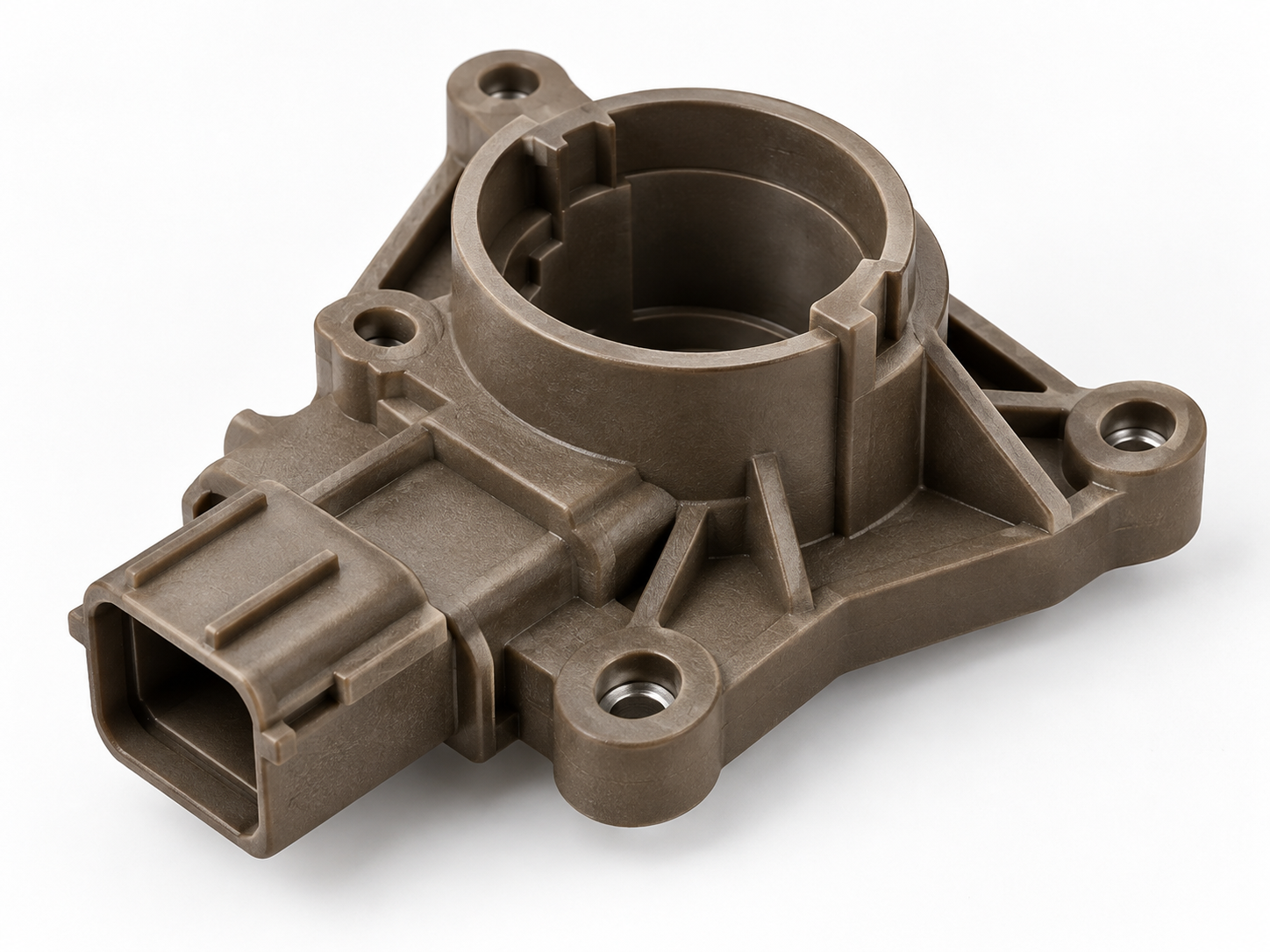
PPA injection molding is widely used for plastic parts that must maintain strength, stiffness, and dimensional stability at higher temperatures. Typical applications include automotive connectors, electrical housings, sensor components, pump parts, and other technical products exposed to heat.
However, PPA is more difficult to process than many common engineering plastics.
The material often requires high melt temperature, high mold temperature, strict drying, strong tooling, and careful process control. In addition, many PPA grades contain glass fiber, which can increase mold wear and warpage risk.
Therefore, successful PPA molding depends on much more than simply increasing barrel temperature.
At Fentor Mold, we usually review material grade, wall thickness, gate position, cooling, mold steel, and dimensional requirements before tooling because high-temperature materials leave less room for process error.
What Is PPA Injection Molding?
PPA, or polyphthalamide, is a high-performance polyamide used when standard nylon does not provide enough heat resistance or dimensional stability.
Compared with common PA6 or PA66 materials, PPA can offer better performance in demanding environments.
Depending on the grade, PPA may be used for:
- Automotive connectors
- Electrical components
- Under-hood parts
- Sensor housings
- Pump components
- Industrial fittings
- High-temperature clips
- Structural plastic parts
Many commercial PPA grades are reinforced with glass fiber.
As a result, PPA injection molding often combines the processing challenges of high-temperature resin and reinforced engineering plastic.
Why Is PPA Injection Molding Difficult?
PPA parts can be difficult to mold because several process requirements must be controlled at the same time.
Common challenges include:
- High processing temperature
- High mold temperature
- Moisture sensitivity
- Fast freezing in thin sections
- Glass-fiber orientation
- Warpage
- Mold wear
- Tight dimensional requirements
- Difficult gate design
- Narrow processing window
A small mistake in one area may affect several others.
For example, reducing mold temperature may shorten the cycle. However, it can also reduce flow, increase internal stress, and create poor surface quality.
Therefore, the entire molding system must be evaluated together.
PPA Injection Molding Requires Proper Drying
Like other polyamide materials, PPA can absorb moisture.
Therefore, drying is one of the first process controls to confirm before molding.
If the material contains too much moisture, possible problems include:
- Surface defects
- Silver streaks
- Material degradation
- Reduced mechanical performance
- Unstable viscosity
- Dimensional variation
The exact drying temperature and time depend on the material grade.
Therefore, processors should follow the resin supplier’s recommendations rather than use one general drying condition for every PPA.
After drying, the resin should also be protected from moisture pickup before entering the machine.
For long production runs, a closed material handling system can improve consistency.
High Melt Temperature Increases Processing Difficulty
PPA normally requires a higher melt temperature than standard commodity plastics.
This creates several practical challenges.
First, the machine must be capable of maintaining stable temperature control.
Second, long residence time can increase the risk of material degradation.
In addition, any dead zones inside the barrel or hot runner system can become more important when processing high-temperature resin.
Therefore, the molding setup should avoid unnecessary residence time.
The process should also be stable from shot to shot.
For small parts, machine size becomes especially important because an oversized barrel may keep the resin hot for too long.
Mold Temperature Is Critical for PPA Parts
Mold temperature has a major effect on flow, surface quality, crystallization, shrinkage, and dimensional stability.
If mold temperature is too low, the melt may freeze too quickly.
As a result, the part can show:
- Short shots
- Poor weld lines
- High internal stress
- Incomplete features
- Rough surface appearance
However, high mold temperature creates another challenge.
The cycle time becomes longer, and the mold structure must handle continuous thermal loading.
Therefore, cooling design should not simply focus on making the mold cold.
The real goal is to maintain a stable and balanced mold temperature.
Thin Walls Can Freeze Before Filling Is Complete
Many high-temperature PPA parts are small, technical components with thin walls and fine features.
Examples include:
- Connector walls
- Terminal supports
- Small ribs
- Narrow slots
- Thin clips
- Fine sealing features
These areas lose heat quickly.
Therefore, the material may freeze before the cavity fills completely.
To reduce this risk, engineers should review:
- Gate size
- Gate location
- Flow length
- Mold temperature
- Injection speed
- Venting
- Material viscosity
A good injection mold design should address these factors before steel cutting begins.
PPA Injection Molding and Glass-Fiber Orientation
Many PPA grades contain glass fiber to improve stiffness, strength, and heat resistance.
However, glass fiber can increase warpage risk.
During filling, fibers tend to align with the melt flow.
As a result, the part may shrink differently in different directions.
This is especially important for:
- Long thin parts
- Flat housings
- Connectors
- Structural frames
- Parts with uneven gate positions
For example, a long PPA GF30 component gated from one end may develop strong fiber orientation along the flow direction.
After cooling, the part may bend or twist because shrinkage is not uniform.
Therefore, gate design has a strong effect on final part shape.
Gate Location Can Affect Warpage and Weld Lines
Gate position is one of the most important decisions in PPA injection molding.
A poor gate location can create:
- Long flow length
- Unbalanced filling
- Strong fiber orientation
- Weld lines
- Air traps
- High pressure
- Uneven packing
- Warpage
For technical parts, gate location should not be selected only for easy machining.
Instead, engineers should consider how the melt flows through the complete part.
For complex geometries, simulation can help identify possible filling and fiber-orientation problems before mold manufacturing.
PPA Injection Molding Needs Good Venting
High-temperature engineering plastics can require significant injection pressure, especially in thin sections.
Therefore, trapped air can become a serious problem.
Poor venting may cause:
- Short shots
- Burn marks
- High filling pressure
- Weak weld lines
- Incomplete details
However, vents must also be controlled carefully.
If the vent is too deep, flash can occur.
For this reason, vent depth and vent position should match the material and part geometry.
Areas near the end of fill should receive special attention.
Glass-Filled PPA Can Increase Mold Wear
Glass fiber improves part performance, but it also makes the material more abrasive.
Over time, glass-filled PPA can wear:
- Gates
- Runners
- Core pins
- Inserts
- Slides
- Shut-off surfaces
Therefore, mold steel selection becomes more important.
For high-volume production, wear-resistant steel or hardened inserts may be needed in critical areas.
The gate area deserves special attention because resin speed and fiber concentration can create strong local wear.
In some cases, replaceable gate inserts can make future maintenance easier.
Cooling Balance Affects Dimensional Stability
Cooling is another major factor in PPA molding.
Even when the mold operates at a high temperature, both sides of the part should cool as evenly as possible.
Uneven cooling can create:
- Warpage
- Dimensional drift
- Different shrinkage
- Long cycle time
- Local stress
Deep cores, thick bosses, and difficult inserts may retain more heat.
Therefore, the cooling circuit should be reviewed during mold design rather than after T0.
For precision parts, balanced cooling can be just as important as accurate machining.
Thick and Thin Sections Should Be Controlled
Large wall-thickness changes can create problems in PPA parts.
Thick sections cool slowly, while thin sections freeze quickly.
As a result, the part may develop:
- Sink marks
- Internal stress
- Uneven shrinkage
- Warpage
- Dimensional variation
Whenever possible, wall thickness should remain reasonably uniform.
Thick bosses can often be cored out.
Ribs should also be designed carefully to provide strength without creating unnecessary material concentration.
PPA Injection Molding Requires Stable Packing
Packing pressure helps compensate for shrinkage after filling.
If packing is too low, the part may show:
- Sink marks
- Low density
- Dimensional variation
- Excess shrinkage
However, too much packing can create:
- Flash
- High internal stress
- Difficult ejection
- Distortion
Therefore, the goal is not maximum packing pressure.
Instead, the process should create a stable pressure window.
Gate freeze time should also be checked because holding pressure has little effect after the gate has frozen.
Tight Tolerances Need Trial Validation
Many PPA components are used in technical assemblies.
Therefore, dimensions can be critical.
Typical CTQ features may include:
- Connector pitch
- Hole position
- Snap dimensions
- Flatness
- Sealing surfaces
- Insert positions
- Assembly dimensions
These features should be identified before mold manufacturing begins.
After T0, parts should be measured under controlled conditions.
If necessary, the mold can then be adjusted based on actual shrinkage.
For precision engineering parts, a supplier’s components manufacturing capability is also important because machining accuracy, dimensional inspection, and repeatability can directly affect final assembly performance.
Insert Molding With PPA Requires Extra Attention
PPA is often used around metal terminals, pins, or inserts.
This creates additional risks.
The mold designer should consider:
- Insert position
- Insert heating
- Resin flow around the metal
- Weld lines
- Air traps
- Flash around the insert
- Differential shrinkage
If the insert blocks the melt flow, filling can become difficult.
In addition, the plastic and metal may shrink differently after molding.
Therefore, insert position and gate direction should be reviewed early.
Common PPA Injection Molding Problems
| Problem | Possible Cause | First Check |
|---|---|---|
| Short shot | Melt freezes too early | Mold temperature and gate |
| Warpage | Fiber orientation or cooling imbalance | Gate and cooling |
| Burn marks | Trapped air | Venting |
| Flash | High pressure or weak shut-off | Parting line and process |
| Surface defects | Moisture or low mold temperature | Drying and temperature |
| Dimension drift | Cooling or shrinkage variation | Mold temperature and packing |
| Gate wear | Glass-filled resin abrasion | Gate steel and insert design |
| Weld-line weakn |