
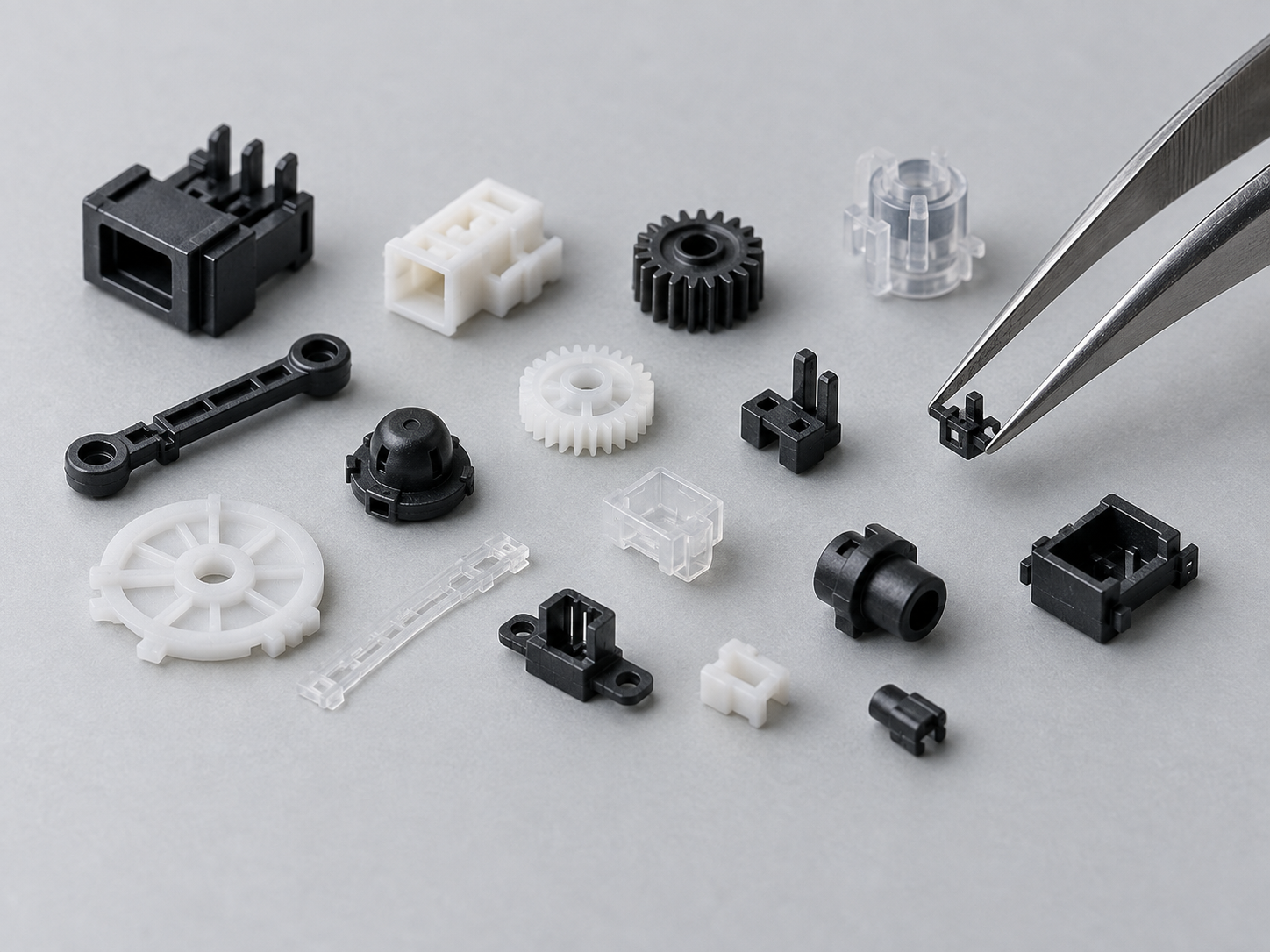
Micro injection molding is used to produce very small plastic parts with fine details, thin walls, and tight tolerances. However, making a small part is not simply the same as making a normal injection molded part at a smaller scale.
As part size decreases, many molding problems become more difficult to control.
Small variations in gate size, venting, mold temperature, shot volume, ejection, or material condition can have a much larger effect on the final part.
Therefore, successful micro injection molding requires accurate mold design, stable process control, and precise inspection.
At Fentor Mold, small plastic parts are reviewed carefully during DFM because many problems that are easy to manage on larger parts become much more sensitive at micro scale.
What Is Micro Injection Molding?
Micro injection molding is a process used to manufacture very small plastic parts or parts with extremely small features.
Typical applications may include:
- Small electronic components
- Medical device parts
- Micro connectors
- Small gears
- Precision clips
- Sensor components
- Small housings
- Tiny mechanical parts
The molded part may be only a few millimeters in size, or the part may contain micro features such as very thin ribs, small holes, narrow channels, or fine details.
Although the basic molding process is similar to standard injection molding, the process window is usually much smaller.
Why Is Micro Injection Molding Difficult?
The main challenge is that very small parts allow little room for variation.
For example, a small change in material volume may have almost no effect on a large molded housing.
However, the same change may cause:
- Short shots
- Flash
- Dimensional variation
- Overpacking
- Incomplete features
in a micro part.
The same principle applies to mold temperature, gate size, cooling, and ejection.
As a result, micro injection molding depends heavily on repeatability.
Micro Injection Molding: Small Shot Size
One of the first challenges is shot size.
Very small plastic parts require only a small amount of resin.
If the machine is too large, the actual shot may represent only a very small percentage of the barrel capacity.
This can create problems such as:
- Poor shot repeatability
- Long material residence time
- Material degradation
- Unstable pressure
- Poor metering accuracy
Therefore, the injection molding machine should match the part and runner volume.
A machine that is suitable for a large plastic part may not be suitable for a micro molding project.
Small Gates Make Filling More Difficult
Gate design is especially important in micro injection molding.
A small gate may freeze very quickly.
If it freezes too early, packing becomes difficult and the cavity may not fill correctly.
However, if the gate is made too large, it can create other problems.
These may include:
- Large gate marks
- Difficult gate removal
- Part deformation
- Excessive stress around the gate
The gate must therefore balance filling performance with part size and appearance requirements.
During injection mold design, gate position should also be reviewed together with flow length and part geometry.
Micro Injection Molding Needs Good Venting
Air has less room to escape in a very small cavity.
Therefore, poor venting can quickly cause problems.
Typical defects include:
- Short shots
- Burn marks
- Incomplete details
- High filling pressure
- Weld-line problems
The vent must be deep enough to allow air to escape.
However, it cannot be too deep because this may create flash.
This makes vent design more sensitive than in many standard molds.
For parts with very small ribs or thin flow paths, proper venting can make the difference between stable filling and repeated short shots.
Thin Walls and Micro Features Freeze Quickly
Small parts often contain very thin sections.
These areas lose heat quickly when the molten plastic touches the mold surface.
As a result, the material may freeze before the cavity is completely filled.
This can cause:
- Missing details
- Short shots
- Weak weld lines
- High injection pressure
- Poor surface finish
Therefore, mold temperature and injection speed must be carefully controlled.
In some cases, a higher mold temperature may help the melt reach small features before freezing.
However, higher temperature can also increase cycle time.
The process must therefore balance filling and cooling.
Mold Machining Accuracy Becomes More Important
In standard injection molds, a small machining error may still remain within part tolerance.
In micro injection molding, the same machining error can become a large percentage of the feature size.
For example, an error of 0.02 mm may be minor on a large plastic housing.
However, on a very small slot or rib, it may completely change the function of the feature.
Important machining areas include:
- Micro cores
- Small inserts
- Tiny holes
- Narrow shut-offs
- Fine ribs
- Small gate features
Therefore, CNC, EDM, grinding, and polishing accuracy become very important.
For micro parts, reliable injection mold manufacturing is especially important because even a small machining deviation can affect tiny ribs, holes, slots, and other functional features.
Micro Injection Mold Inserts Need Careful Design
Very small mold features are often made as separate inserts.
This makes manufacturing and replacement easier.
However, small inserts may also be fragile.
Engineers should consider:
- Insert strength
- Steel type
- Heat treatment
- Support
- Cooling
- Assembly accuracy
- Replacement method
A weak micro insert can break during molding or maintenance.
Therefore, the mold structure should protect small features as much as possible.
Ejection Is More Difficult for Small Plastic Parts
Small parts are often lightweight and flexible.
This can make ejection difficult.
Common problems include:
- Part sticking
- Ejector marks
- Part deformation
- Parts remaining on the mold
- Parts flying unpredictably after ejection
The ejection force must be strong enough to release the part.
However, the force must also be distributed carefully.
A large ejector pin may not fit on a small component.
Therefore, micro molds may require:
- Small ejector pins
- Sleeves
- Air ejection
- Stripper systems
- Special pickup systems
The correct method depends on the part structure.
Handling Tiny Parts After Ejection Can Be Difficult
Ejection is only one part of the problem.
After the part leaves the mold, it still needs to be collected and handled.
Very small parts can:
- Stick to the mold
- Stick together
- Fall into the machine
- Become mixed with runners
- Be difficult to count
- Be damaged during handling
Therefore, automation may be useful for high-volume production.
For example, a robot or vacuum system can collect parts immediately after ejection.
This can improve both part protection and production efficiency.
Micro Injection Molding Requires Tight Dimensional Control
Many micro plastic parts are used in precision assemblies.
Therefore, tolerance is often one of the main project requirements.
Small dimensional changes may affect:
- Assembly
- Snap fit
- Sealing
- Gear engagement
- Connector position
- Sensor function
The mold maker should identify critical dimensions before steel cutting begins.
These CTQ dimensions should be checked during each trial.
For precision projects, core and cavity machining accuracy directly affects the final result.
Shrinkage Is Harder to Predict on Micro Parts
Plastic shrinkage affects every injection molded part.
However, micro features may react differently from large simple areas.
Shrinkage can be influenced by:
- Material type
- Wall thickness
- Gate location
- Packing
- Mold temperature
- Fiber orientation
- Cooling rate
Therefore, using one general shrinkage value may not be enough.
For tight-tolerance parts, the first mold trial should be followed by dimensional measurement.
Then the mold can be adjusted based on actual molded results.
Material Handling Matters More Than Expected
Small shot size makes material condition very important.
Moisture, contamination, or degraded resin can affect a large percentage of the final shot.
For engineering plastics, drying conditions should follow the resin supplier’s recommendation.
Material handling should also reduce:
- Moisture pickup
- Dust
- Contamination
- Long residence time
This is especially important when molding PA, PBT, PC, PEEK, and other engineering materials.
Micro Injection Molding and Glass-Filled Materials
Glass-filled materials can provide higher strength and stiffness.
However, they can also create additional challenges for micro parts.
Possible issues include:
- Higher tool wear
- Difficult filling
- Fiber orientation
- Surface roughness
- Small feature damage
Very small gates and thin sections can also make fiber-filled materials harder to process.
Therefore, material selection should be confirmed before mold design is finalized.
In some cases, a lower-viscosity material may provide better filling for micro features.
Multi-Cavity Micro Molds Need Good Balance
A multi-cavity mold can increase production output.
However, all cavities must fill consistently.
In micro molding, even a small runner imbalance may create noticeable differences between cavities.
Possible results include:
- One cavity short shot
- Another cavity flash
- Different part weights
- Different dimensions
- Uneven packing
Therefore, runner and gate balance should be checked carefully.
For very small parts, hot runner design may also require special attention because nozzle size and temperature control become more critical.
For projects that continue into mass production, stable injection molding production is also important because small parts require consistent shot volume, cavity balance, part handling, and dimensional repeatability.
Micro Injection Molding: Common Problems and Solutions
| Problem | Possible Cause | First Check |
|---|---|---|
| Short shot | Early freezing or poor venting | Gate, venting, mold temperature |
| Flash | Excess pressure or poor shut-off | Parting line and pressure |
| Missing micro feature | Melt freezes too early | Injection speed and mold temperature |
| Dimension out of tolerance | Tooling or shrinkage variation | Mold dimensions and process |
| Part sticks to mold | Poor draft or ejection | Draft and ejector design |
| Part deformation | Uneven ejection | Ejector position |
| Cavity variation | Runner imbalance | Runner and gate balance |
| Burn marks | Trapped air | Venting |
| Gate damage | Gate too large or poor position | Gate design |
This table is only a starting point.
The final cause should be confirmed during mold trial.
Inspection Is a Major Challenge
Measuring very small parts is not always easy.
Traditional calipers may not be accurate enough for certain features.
Depending on the project, inspection may require:
- Tool microscope
- Vision measurement
- CMM
- Optical system
- Special gauges
- Functional fixtures
The measurement method should be agreed before final acceptance.
Otherwise, the customer and supplier may measure the same feature differently.
Define CTQ Dimensions Before Mold Manufacturing
A common mistake is waiting until T0 to decide which dimensions are important.
Instead, the buyer and mold supplier should define critical dimensions early.
These may include:
- Snap dimensions
- Hole positions
- Wall thickness
- Slot width
- Flatness
- Connector position
- Assembly dimensions
This allows the mold maker to focus machining and inspection on the most important features.
It also reduces unnecessary mold modifications after T0.
Micro Injection Molding Checklist
Before starting a micro molding project, review the following items:
| Check Item | Status |
|---|---|
| Part dimensions reviewed | ☐ |
| Minimum wall thickness checked | ☐ |
| Micro features identified | ☐ |
| Material flow reviewed | ☐ |
| Gate size confirmed | ☐ |
| Gate position reviewed | ☐ |
| Venting reviewed | ☐ |
| Machine shot size suitable | ☐ |
| Mold machining capability confirmed | ☐ |
| Ejection method confirmed | ☐ |
| Part handling method confirmed | ☐ |
| CTQ dimensions defined | ☐ |
| Inspection method confirmed | ☐ |
| Multi-cavity balance reviewed | ☐ |
A simple checklist like this can prevent many problems before steel cutting begins.
Conclusion
Micro injection molding is challenging because very small parts leave little room for variation.
The main difficulties include:
- Small shot size
- Fast material freezing
- Tiny gates
- Limited venting
- High mold machining accuracy
- Difficult ejection
- Tight tolerances
- Small-part handling
- Precision inspection
Most importantly, micro molding should not be treated as normal injection molding at a smaller scale.
The machine, mold, gate, venting, material, ejection, and inspection method must all match the size of the part.
At Fentor Mold, we review small plastic parts during DFM and mold design to identify risks before tooling begins. For precision small-part projects, controlling mold accuracy, filling, ejection, and measurement early can reduce mold modifications and improve production stability.