
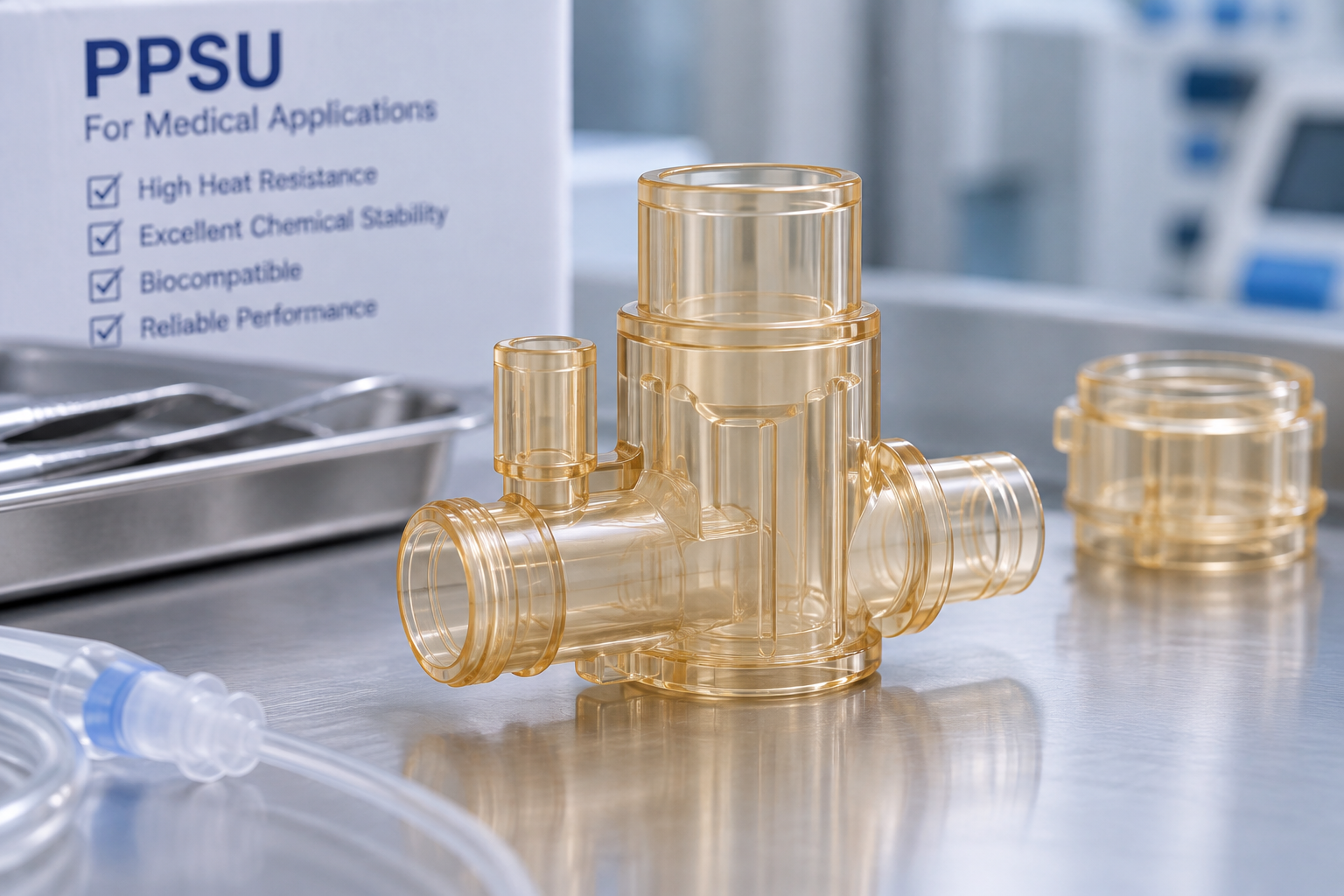
PPSU injection molding is widely used for medical parts that need high heat resistance, toughness, and repeated sterilization. However, PPSU is not an easy material to mold. Its high processing temperature and sensitivity to moisture can quickly cause surface defects, dimensional problems, or unstable mechanical performance.
For medical products, these problems can be especially serious. A small molding defect may affect assembly, sealing, appearance, or long-term reliability.
Therefore, good medical part quality depends on more than selecting medical-grade PPSU. The mold design, material drying, processing temperature, venting, and molding parameters must work together.
At Fentor Mold, we consider these factors from the mold development stage instead of trying to correct every problem during production.
What Is PPSU Injection Molding?
PPSU, or polyphenylsulfone, is a high-performance thermoplastic. Compared with many common engineering plastics, it provides excellent heat resistance and impact strength.
More importantly, PPSU can withstand repeated steam sterilization. Therefore, manufacturers often use it for medical and healthcare products such as:
- Surgical instrument components
- Medical device housings
- Sterilization trays
- Fluid-handling components
- Dental instrument parts
- Reusable medical components
- Connectors and functional components
However, PPSU requires much higher processing temperatures than ABS, PP, or PC. As a result, both the mold and injection molding process need careful control.
For projects that require complete tooling development, our custom injection mold manufacturing service covers DFM analysis, mold design, machining, assembly, trial molding, and validation.
Why Is PPSU Injection Molding Difficult?
The main challenge is its narrow processing window combined with high melt temperature.
Typical PPSU molding problems include:
| Problem | Possible Cause | Effect on Medical Parts |
|---|---|---|
| Silver streaks | Moisture in resin | Poor appearance and possible material degradation |
| Black spots | Excessive heat or material residence time | Cosmetic rejection and contamination concerns |
| Short shots | Low melt temperature or poor venting | Incomplete functional features |
| Burn marks | Trapped air | Poor appearance and damaged material |
| Sink marks | Thick sections or insufficient packing | Dimensional and cosmetic problems |
| Warpage | Uneven cooling or packing | Assembly and sealing problems |
| Stress cracking | High residual stress | Reduced long-term reliability |
| Flash | Poor mold fitting or excessive pressure | Additional finishing and quality risks |
Therefore, stable PPSU injection molding starts before the material enters the injection machine.
PPSU Injection Molding Requires Proper Material Drying
Moisture control is one of the first steps toward stable quality.
PPSU can absorb moisture from the environment. If the resin contains too much moisture during processing, the high melt temperature may cause visible defects or material degradation.
Common symptoms include:
- Silver streaks
- Surface splay
- Bubbles
- Poor surface quality
- Reduced mechanical performance
For this reason, the material should be dried according to the resin supplier’s technical data before molding. In addition, the material should remain protected from moisture after drying.
Simply increasing the barrel temperature usually does not solve moisture-related defects. In fact, excessive heat may make degradation worse.
Practical rule: always check drying conditions before making major changes to the molding parameters.
Control Melt Temperature Carefully
PPSU needs a high melt temperature to flow correctly. However, unnecessarily high temperature can also damage the material.
If the temperature is too low, the part may show:
- Short shots
- Poor weld lines
- High injection pressure
- Poor surface replication
On the other hand, excessive temperature or long residence time can cause:
- Yellowing or discoloration
- Black spots
- Burned material
- Material degradation
Therefore, processors should avoid using temperature alone to solve filling problems.
Instead, evaluate the complete system, including the gate, runner, venting, injection speed, mold temperature, and part geometry.
This is especially important when producing medical components through controlled injection molding production.
Mold Temperature Affects PPSU Medical Part Quality
Mold temperature has a major effect on surface quality and dimensional stability.
If the mold is too cold, the melt can freeze too quickly. This may create visible flow marks, poor weld lines, or excessive internal stress.
A stable mold temperature helps the material fill thin sections and detailed features more consistently.
However, temperature uniformity is just as important as the temperature itself.
For example, one side of a medical housing may cool faster than the other. As a result, uneven shrinkage can cause warpage.
Therefore, the cooling circuit should follow the geometry of the part as closely as practical.
Improve PPSU Injection Molding With Better Venting
Poor venting is a common cause of defects in high-temperature materials.
As PPSU fills the cavity, the melt pushes air toward the end of fill. If that air cannot escape quickly enough, pressure and temperature rise sharply.
This can cause:
- Burn marks
- Short shots
- Diesel effect
- Poor weld lines
- Unstable filling
For PPSU injection molding, vents should be positioned at likely air-trap locations, especially near the end of fill, ribs, bosses, and weld-line areas.
However, vent dimensions must also be controlled carefully. Excessively deep vents may create flash.
This is why venting should be considered during mold design rather than added only after molding defects appear.
Gate Design Is Critical for PPSU Medical Parts
The gate controls how molten PPSU enters the cavity. Therefore, its size and position directly affect filling pressure, weld lines, packing, and appearance.
A gate that is too small can create excessive shear and pressure. Meanwhile, a poor gate position may create weld lines in critical areas.
During DFM and mold design, engineers should evaluate:
| Design Factor | Main Concern |
|---|---|
| Gate position | Filling balance and weld-line location |
| Gate size | Shear and pressure loss |
| Runner size | Material residence and pressure |
| Flow length | Filling capability |
| Wall thickness | Flow balance |
| End-of-fill area | Air trapping and venting |
For complex medical parts, Moldflow analysis can also help predict filling behavior before steel cutting.
At Fentor Mold, we use DFM and, when required, Moldflow analysis to review potential filling and tooling risks before mold manufacturing.
Keep Wall Thickness as Uniform as Possible
Large wall-thickness changes make molding more difficult.
For example, a thick section beside a thin wall may cool much more slowly. This difference can lead to sink marks, shrinkage variation, and warpage.
Therefore, designers should keep wall thickness reasonably uniform whenever the product allows it.
When extra strength is required, adding properly designed ribs is often better than simply increasing the entire wall thickness.
However, ribs should not be excessively thick. Otherwise, sink marks may appear on the opposite cosmetic surface.
Reduce Residual Stress in PPSU Medical Parts
Residual stress can become a hidden quality problem.
A PPSU component may look acceptable immediately after molding but later develop cracking or dimensional changes during assembly, sterilization, or long-term use.
Several factors can increase molded-in stress:
- Low mold temperature
- Excessive injection pressure
- Poor gate design
- Sharp corners
- Large wall-thickness changes
- Unbalanced packing
- Difficult ejection
Therefore, part geometry and processing conditions should be reviewed together.
Adding suitable radii to sharp internal corners can also reduce local stress concentration.
Avoid Excessive Shear and Material Degradation
High shear can increase the melt temperature locally even when the barrel temperature appears normal.
Common sources of excessive shear include:
- Gates that are too small
- Restricted runners
- Very high injection speed
- Poorly sized machine nozzles
- Excessive screw speed
Because PPSU already requires high processing temperatures, additional shear heating can increase the risk of discoloration or degradation.
Therefore, the runner and gate system should provide enough flow area without unnecessarily increasing material volume.
Ejection Design Also Affects Medical Part Quality
Not every PPSU defect occurs during filling.
Poor ejection design can cause deformation, whitening, scratches, or local stress after the cavity has already filled successfully.
Deep ribs, tall bosses, textured surfaces, and insufficient draft can increase ejection resistance.
Therefore, engineers should provide enough draft and distribute ejector force properly.
Ejector pins should also avoid critical cosmetic or sealing surfaces whenever possible.
For early-stage medical products, prototype injection molding can help verify part geometry, assembly, and molding behavior before higher-volume tooling decisions are finalized.
Control Critical Dimensions From the Mold Design Stage
Medical parts often contain features that must work together precisely, such as:
- Connector interfaces
- Sealing surfaces
- Snap-fit features
- Screw bosses
- Tubing connections
- Assembly holes
Simply applying the same tolerance to every dimension can make the mold unnecessarily difficult and expensive.
Instead, identify critical-to-function dimensions first.
Then, mold design, steel-safe dimensions, cooling, and measurement plans can focus on the features that actually affect product performance.
Where practical, leaving critical dimensions steel-safe during the first mold trial also gives engineers more room for controlled adjustment.
Use Mold Trials to Build a Stable Processing Window
A successful T0 or T1 sample does not automatically mean the mold is ready for medical part production.
The process should also be stable.
During mold trials, engineers should review:
| Check | Purpose |
|---|---|
| Filling behavior | Identify hesitation and air traps |
| Part weight | Check process consistency |
| Critical dimensions | Verify shrinkage and tolerance |
| Surface quality | Find flow, burn, or gate defects |
| Warpage | Check cooling and packing balance |
| Ejection | Identify sticking or deformation |
| Process window | Confirm production stability |
Instead of chasing one perfect sample, the goal should be a repeatable molding condition.
This approach reduces the risk of quality changing when production runs for longer periods.
PPSU Injection Molding Quality Checklist
Before approving a PPSU medical part for production, check the following areas:
| Area | Key Check |
|---|---|
| Material | Correct PPSU grade |
| Drying | Supplier-recommended drying condition followed |
| Melt | Stable temperature without degradation |
| Mold | Uniform and controlled temperature |
| Gate | Suitable size and position |
| Venting | Adequate at air-trap areas |
| Cooling | Balanced across critical geometry |
| Ejection | No excessive deformation or stress |
| Dimensions | Critical features measured |
| Appearance | No burns, black spots, splay, or unacceptable flow marks |
| Process | Stable production window established |
A checklist does not replace engineering analysis. However, it helps prevent basic processing problems from being overlooked.
Final Thoughts
Successful PPSU injection molding requires control from product design through mold manufacturing and final production.
Material drying is important, but it is only one part of the process. Gate design, venting, mold temperature, cooling balance, ejection, and dimensional control all influence final medical part quality.
For complex medical components, correcting these issues during the mold design stage is usually more effective than trying to solve them only by changing molding parameters.
Fentor Mold supports custom injection mold development and plastic part production from DFM and mold design through machining, mold trials, dimensional inspection, and injection molding. For PPSU projects, early engineering review can help identify potential quality risks before they become expensive mold modifications or production problems.