
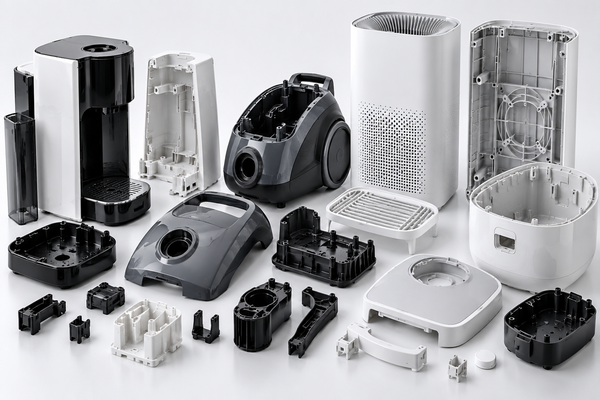
Rapid tooling helps home appliance manufacturers develop and test plastic parts before mass production. It offers a practical way to produce injection molded housings, covers, brackets, and other components without immediately investing in full-scale production tooling.
For example, a coffee machine manufacturer may need molded housings for assembly testing. A vacuum cleaner manufacturer may need plastic parts to check strength, fit, and appearance. In both cases, rapid tooling can support product development and early production.
However, faster mold manufacturing does not mean lower quality requirements. Mold design, material selection, and part dimensions still need careful control.
At Fentor Mold, we provide custom injection mold manufacturing and plastic injection molding services. Our team focuses on DFM analysis, mold design, and production quality to support customer projects.
This guide explains how rapid tooling works for home appliance plastic parts, which materials to choose, and how to control tooling costs and production quality.
What Is Rapid Tooling for Home Appliances?
Rapid tooling is a method of manufacturing injection molds with a focus on shorter tooling lead times.
Compared with traditional high-volume production molds, rapid molds may use simpler structures, fewer cavities, or materials that are easier to machine.
Common options include aluminum molds and pre-hardened steel molds.
However, the best choice depends on part size, design complexity, plastic material, and expected production quantity.
Home appliance manufacturers often use rapid tooling for:
- Functional prototypes
- Plastic housing samples
- Assembly testing
- Design verification
- Small-batch injection molding
- Pilot production
- Product development testing
For example, a manufacturer developing a new air purifier may need 300 plastic housings for testing. Instead of immediately building an expensive multi-cavity production mold, the company may first use a simpler mold.
This allows engineers to evaluate real injection molded parts before making a larger tooling investment.
Common Home Appliance Plastic Parts Made with Rapid Tooling
Many home appliances contain plastic parts that are suitable for rapid tooling.
These components may have cosmetic, structural, or functional requirements.
1. Rapid Tooling for Coffee Machine Housings
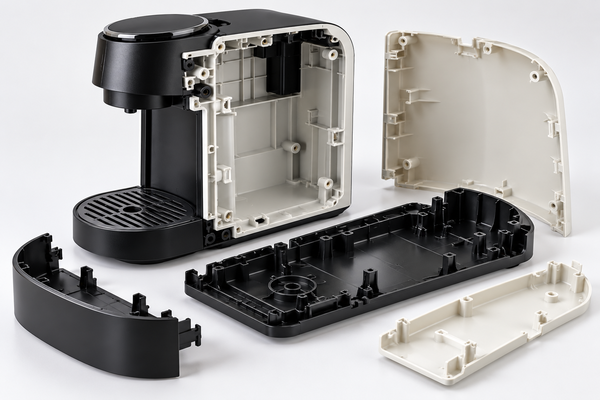
Coffee machines contain several injection molded plastic components.
Common examples include:
- Exterior housings
- Control panels
- Internal mounting brackets
- Plastic covers
- Switch supports
- Decorative panels
These parts often require good surface appearance and accurate assembly dimensions.
Rapid tooling allows engineers to check housing fit, screw boss positions, and snap-fit connections.
However, parts near heating elements may require heat-resistant materials.
Therefore, material selection should follow the actual operating temperature and product requirements.
2. Rapid Tooling for Vacuum Cleaner Plastic Parts
Vacuum cleaners use many plastic components, including motor housings, handles, dust container parts, and internal supports.
Some parts must withstand vibration, impact, and repeated handling.
For example, a vacuum cleaner handle may experience repeated mechanical loads during use.
A plastic locking feature may also need to survive many assembly cycles.
Rapid tooling helps manufacturers produce functional samples for testing these requirements.
In addition, engineers can evaluate part deformation, assembly clearances, and surface quality before mass production.
3. Rapid Tooling for Air Purifier Housings
Air purifiers often contain relatively large plastic housings.
These parts may have thin walls, ventilation openings, internal ribs, and mounting features.
As a result, they can be difficult to mold.
Common problems include:
- Warpage
- Sink marks
- Weld lines
- Short shots
- Uneven shrinkage
- Surface defects
Rapid tooling can support design verification before manufacturers invest in full production molds.
For example, engineers may use molded samples to check the assembly between the front cover, rear housing, and internal filter frame.
4. Rapid Tooling for Kitchen Appliance Components
Kitchen appliances such as blenders, mixers, and food processors contain different types of plastic parts.
Examples include exterior covers, handles, protective guards, and internal supports.
Some parts require impact strength, while others need heat resistance or chemical resistance.
For components that contact food, manufacturers must also check applicable food-contact requirements.
Rapid tooling allows engineers to test the molded components before larger production runs.
5. Smart Home Appliance Plastic Enclosures
Smart home products often use compact plastic housings with complex internal structures.
For example, a smart thermostat enclosure may contain:
- PCB mounting bosses
- Snap-fit clips
- Screw holes
- Cable openings
- Internal support ribs
These features require accurate dimensions.
Even a small dimensional error may affect assembly.
Therefore, rapid tooling can be useful for checking part fit and functional performance.
Benefits of Rapid Tooling for Home Appliance Manufacturers
Rapid tooling can offer several benefits during home appliance development.
However, its value depends on the project requirements.
Faster Product Development
Product development often requires several rounds of testing.
A plastic housing may look correct in a CAD model but develop warpage after molding.
Rapid tooling allows manufacturers to produce actual injection molded parts.
As a result, engineers can identify design problems earlier and make changes before mass production.
Lower Initial Tooling Investment
Rapid molds may cost less than complex production molds for suitable applications.
For example, a single-cavity mold may require less initial investment than a multi-cavity production mold.
However, this is not always the case.
Large housings and complex parts may still require expensive mold structures.
Therefore, tooling cost must be evaluated based on the actual design.
Functional Testing with Molded Parts
3D printing is useful for early product development.
However, printed samples may not have the same mechanical properties or dimensional behavior as injection molded parts.
Rapid tooling allows manufacturers to evaluate components produced through the intended molding process.
This is important for snap-fit connections, screw bosses, plastic brackets, and mating housings.
Support for Pilot Production
Before launching a new home appliance, manufacturers may need a limited quantity of products.
For example, they may require several hundred or several thousand plastic components for product testing or market evaluation.
Rapid tooling can support these early production requirements.
However, the mold must be designed for the expected production volume and part quality.
Material Selection for Rapid Tooling Plastic Parts
Material selection is important for rapid tooling because different plastics have different molding and performance requirements.
Home appliance components may need impact resistance, heat resistance, chemical resistance, or good surface appearance.
The following table compares common injection molding materials.
| Material | Main Properties | Typical Applications |
|---|---|---|
| ABS | Good impact strength and surface appearance | Appliance housings, control panels |
| PC | High impact resistance and good heat resistance | Protective covers, selected structural parts |
| PC/ABS | Balanced toughness and thermal performance | Premium appliance housings |
| PP | Lightweight, chemical resistance, and flexibility | Containers, covers, internal parts |
| PA6/PA66 | Good mechanical strength and wear resistance | Brackets, clips, functional parts |
| POM | Low friction and good wear resistance | Gears, sliding parts, moving mechanisms |
The final material grade should match the actual service conditions.
ABS for Home Appliance Housings
ABS is commonly used for home appliance plastic housings.
It offers good impact resistance and surface appearance.
In addition, ABS can produce attractive molded finishes when the mold surface and processing conditions are properly controlled.
However, standard ABS may not be suitable for high-temperature environments.
Engineers should check the required heat resistance before selecting the material.
PC/ABS for Stronger Plastic Components
PC/ABS combines useful properties of polycarbonate and ABS.
Selected grades offer good impact resistance and improved thermal performance.
Therefore, PC/ABS can be suitable for some demanding appliance housings.
However, material cost and molding requirements must also be considered.
PP for Lightweight Plastic Parts
PP is lightweight and offers good chemical resistance.
It is often suitable for containers, covers, and selected internal components.
However, PP has relatively high molding shrinkage.
As a result, large flat parts may require careful wall thickness and cooling design to reduce warpage.
Engineering Plastics for Functional Parts
PA66 and POM are common engineering plastics for mechanical components.
PA66 can provide good strength for selected brackets and supports.
Meanwhile, POM offers low friction and good wear resistance for moving mechanisms.
However, the final choice should consider temperature, mechanical loads, and long-term durability.
Key Design Rules for Rapid Tooling Plastic Parts
Good plastic part design can reduce mold manufacturing time and improve molding quality.
This is particularly important when rapid tooling is used for home appliance housings with large cosmetic surfaces and complex internal features.
1. Maintain Uniform Wall Thickness
Uneven wall thickness can cause sink marks, warpage, and internal stress.
For example, thick areas behind the visible surface of a coffee machine housing may create sink marks.
Therefore, designers should maintain consistent wall thickness where possible.
When thickness changes are necessary, use gradual transitions.
2. Optimize Ribs and Screw Bosses
Plastic ribs increase stiffness without greatly increasing the main wall thickness.
However, thick ribs may create sink marks on the opposite surface.
Screw bosses also require careful design.
Important factors include:
- Boss diameter
- Boss wall thickness
- Support rib design
- Screw type
- Distance from nearby walls
- Assembly load
Proper design helps reduce cracking and assembly problems.
3. Add Proper Draft Angles
Draft angles allow plastic parts to release from the mold.
Without enough draft, parts may stick to the core or cavity.
This can cause scratches, deformation, or difficult ejection.
The required draft depends on material, surface finish, part depth, and mold design.
Textured surfaces may require more draft than smooth surfaces.
4. Improve Snap-Fit Design
Many home appliance housings use snap-fit connections.
These features can reduce the need for additional screws and simplify assembly.
However, poorly designed snap-fit arms may crack during installation.
Important design factors include arm length, thickness, root radius, and required deflection.
Therefore, engineers should test snap-fit performance using actual molded samples.
5. Control Cosmetic Surface Quality
Home appliance housings often have visible surfaces.
Customers expect consistent colors, smooth finishes, and minimal molding defects.
Therefore, mold gate locations, parting lines, and ejector positions require careful planning.
For example, gate marks should be placed away from important cosmetic surfaces when possible.
Rapid Tooling Mold Design for Home Appliances
Rapid tooling requires careful mold design even when the project schedule is short.
The mold must produce parts with acceptable dimensions, surface quality, and mechanical performance.
Aluminum vs Steel Rapid Tooling
Aluminum molds can be easier to machine for certain applications.
As a result, they may reduce tooling lead times for suitable parts.
However, aluminum generally has lower wear resistance than common mold steels.
Pre-hardened steel molds may provide longer service life.
| Factor | Aluminum Rapid Mold | Steel Rapid Mold |
|---|---|---|
| Machining | Often faster for suitable designs | Depends on steel grade and complexity |
| Wear Resistance | Generally lower | Generally higher |
| Initial Cost | Can be lower | Depends on mold design |
| Mold Life | Depends on material and process | Can support longer production runs |
| Applications | Selected prototype and short-run projects | Prototypes and pilot production |
A steel mold can also be manufactured using a rapid tooling approach.
Therefore, rapid tooling should not be confused with aluminum tooling alone.
Simplify the Rapid Tooling Mold Structure
Complex mold mechanisms increase machining and assembly requirements.
For example, an undercut may require a slider or lifter.
However, some undercuts can be removed through small product design changes.
Therefore, DFM analysis should identify opportunities to simplify the mold.
A simpler mold can reduce tooling cost and manufacturing time.
Optimize Gate Location
Gate position affects plastic flow, weld lines, and surface appearance.
This is particularly important for large appliance housings.
For example, a poorly positioned gate may create flow marks on a visible cover.
It may also create weak weld lines near mounting features.
Therefore, engineers should review gate position before mold manufacturing.
Design Reliable Cooling and Ejection
Cooling affects both cycle time and dimensional stability.
Uneven cooling can cause warpage, particularly in large flat plastic parts.
Meanwhile, ejector pins must release components without damaging visible surfaces.
Therefore, even a rapid mold requires proper cooling and ejection design.
Rapid Tooling Process: From CAD to Production
A clear rapid tooling process helps manufacturers control quality and reduce unnecessary delays.
The following steps explain how a typical home appliance tooling project moves from design to molded parts.
Step 1: Review CAD Files
The project begins with reviewing 3D CAD files and technical requirements.
Important information includes:
- Part dimensions
- Plastic material
- Required production quantity
- Critical tolerances
- Surface finish
- Expected delivery schedule
This information helps the supplier evaluate mold complexity and manufacturing requirements.
Step 2: Perform DFM Analysis
DFM analysis identifies potential molding problems.
Engineers review wall thickness, draft angles, undercuts, ribs, bosses, and gate positions.
For large appliance housings, warpage and cosmetic requirements are especially important.
Early design review can reduce mold modifications later.
Step 3: Confirm Rapid Tooling Design
After DFM approval, the moldmaker prepares the tooling design.
The mold structure depends on part complexity, material, and expected quantity.
For example, a simple plastic cover may use a single-cavity mold.
A complex housing may require additional mold mechanisms.
The customer and supplier should confirm the mold design before machining begins.
Step 4: Manufacture the Mold
Rapid tooling manufacturing may involve CNC machining, EDM, fitting, and mold assembly.
Critical mold features require accurate machining.
Although the project focuses on shorter lead times, dimensional accuracy remains important.
Step 5: Conduct Mold Trials
After mold assembly, the supplier performs a mold trial.
The first molded samples help identify problems such as:
- Short shots
- Sink marks
- Warpage
- Flash
- Weld lines
- Dimensional errors
- Ejection problems
Engineers then determine whether processing adjustments or mold modifications are necessary.
Step 6: Approve Samples and Start Production
After the customer approves the molded samples, the project can move to the agreed production stage.
This may involve a small batch or pilot production.
However, the supplier should confirm that the mold can support the expected quantity and quality requirements.
Rapid Tooling Cost for Home Appliance Parts
Rapid tooling costs depend on part design, mold material, and production requirements.
A small internal bracket may require a simple mold.
However, a large air purifier housing may require more machining, a larger mold base, and additional mold mechanisms.
The following factors affect the cost of rapid tooling.
Part Size and Complexity
Larger parts generally require larger molds and more machining.
Complex undercuts, deep ribs, and difficult ejection features may also increase cost.
Therefore, part geometry should be reviewed before quotation.
Mold Material
Aluminum and steel have different material and machining costs.
The correct choice depends on the expected production quantity and mold requirements.
Number of Cavities
A single-cavity mold may reduce initial investment.
Meanwhile, multi-cavity molds can increase output per cycle.
However, they usually require a higher tooling investment.
Surface Finish
High-gloss surfaces, polishing, and mold textures can increase manufacturing work.
For home appliance housings, cosmetic requirements can have a major effect on tooling cost.
Expected Production Quantity
Production quantity affects mold design and part cost.
For example, a project requiring 300 samples may need a different mold solution from one requiring 20,000 parts.
Therefore, customers should provide estimated quantities when requesting a rapid tooling quotation.
Rapid Tooling vs Production Tooling
Rapid tooling and production tooling serve different project requirements.
Home appliance manufacturers should choose based on product development stage, expected demand, and budget.
| Factor | Rapid Tooling | Production Tooling |
|---|---|---|
| Main Purpose | Design verification and early production | Long-term mass production |
| Initial Investment | Often lower for suitable designs | Often higher |
| Mold Structure | May use simpler structures | Optimized for production requirements |
| Cavities | Often one or a few | Based on production capacity |
| Design Changes | May be easier with a flexible tooling approach | Can become more costly |
| Production Volume | Prototype and agreed short-run quantities | Sustained production volumes |
For example, a manufacturer may first use rapid tooling to produce 500 coffee machine housings for product testing.
After the design is approved and market demand is confirmed, the company may invest in a high-volume production mold.
However, some steel rapid molds may also support continued production within their validated limits.
How to Choose a Rapid Tooling Supplier
Choosing the right rapid tooling supplier is important for both product quality and project schedules.
Before placing an order, home appliance manufacturers should review the supplier’s engineering and manufacturing capabilities.
DFM and Engineering Support
A supplier should identify molding risks before manufacturing begins.
For example, large appliance housings may require careful wall thickness, rib, and cooling design.
A useful DFM report should explain the problems and suggest practical improvements.
Mold Manufacturing Capability
The supplier should have suitable machining equipment and moldmaking experience.
Ask about mold materials, CNC machining, EDM, and quality control methods.
Mold Trials and Inspection
Mold trials help confirm that the tooling can produce acceptable parts.
For critical features, dimensional inspection reports may also be necessary.
Injection Molding Production
If the project requires pilot production, confirm that the supplier can support the expected quantity.
In addition, ask about process control, inspection, and sample approval procedures.
Clear Quotation and Lead Time
A reliable supplier should clearly confirm tooling specifications, quoted costs, delivery schedule, and production requirements.
Customers should provide complete CAD files and project information to improve quotation accuracy.
Why Choose Fentor Mold for Rapid Tooling?
Home appliance plastic parts often combine cosmetic surfaces, internal mounting features, and assembly requirements.
Therefore, successful rapid tooling requires both engineering knowledge and manufacturing experience.
At Fentor Mold, we support custom injection mold manufacturing and plastic injection molding projects.
Our services include:
- DFM Analysis: Reviewing part geometry and identifying molding risks.
- Injection Mold Manufacturing: Developing custom molds based on project requirements.
- Material Evaluation: Reviewing suitable plastic materials for different applications.
- Mold Trials: Producing molded samples for inspection and evaluation.
- Injection Molding: Supporting plastic part production according to agreed requirements.
For home appliance projects, early mold design decisions can affect part quality, tooling cost, and production efficiency.
Our goal is to help customers select practical tooling solutions for their plastic components.
Frequently Asked Questions About Rapid Tooling
What Is Rapid Tooling Used for in Home Appliances?
Rapid tooling is commonly used to produce molded samples, functional prototypes, and parts for pilot production.
Typical applications include coffee machine housings, vacuum cleaner parts, air purifier covers, and internal brackets.
Is Rapid Tooling Cheaper Than Production Tooling?
Rapid tooling can reduce initial tooling costs for suitable projects.
However, actual cost depends on part size, complexity, mold material, and production requirements.
Can Rapid Tooling Produce Functional Plastic Parts?
Yes. Rapid tooling can produce injection molded parts using suitable engineering plastics.
These parts can be evaluated for assembly, strength, dimensional accuracy, and surface quality.
Which Materials Can Be Used with Rapid Tooling?
Common materials include ABS, PC, PC/ABS, PP, PA66, and POM.
However, the selected material must match the part design and tooling requirements.
How Long Does Rapid Tooling Take?
Lead time varies based on mold size, complexity, material, and surface finish requirements.
Simple molds may require less manufacturing time than large molds with complex mechanisms.
Therefore, the supplier should confirm delivery after reviewing the CAD files.
Can Rapid Tooling Support Small-Batch Production?
Yes. Rapid tooling can support small-batch production when the mold is designed for the required quantity.
However, mold life and production efficiency should be evaluated before manufacturing begins.
Conclusion
Rapid tooling offers home appliance manufacturers a practical solution for product development, functional testing, and early production.
It allows companies to evaluate injection molded plastic housings, covers, brackets, and other components before investing in long-term production tooling.
However, successful rapid tooling requires careful material selection, part design, mold manufacturing, and quality inspection.
For home appliance projects, early DFM analysis can reduce development risks and improve production stability.
Need Rapid Tooling for Your Home Appliance Plastic Parts?
At Fentor Mold, we provide custom injection mold manufacturing and plastic injection molding services for customer projects.
Send us your 3D CAD files, material requirements, expected production quantities, and target delivery schedule for a tooling evaluation and quotation.