
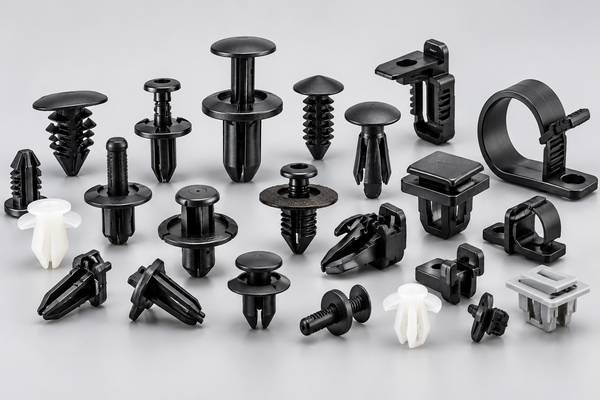
Automotive plastic fasteners are widely used to connect and secure parts inside vehicles. They hold door panels, bumpers, interior trim, wire harnesses, and protective covers in place.
Although these parts are small, they play an important role in vehicle assembly. A poorly designed fastener can break during installation, become loose, or cause unwanted noise.
Therefore, engineers must consider material selection, fastening strength, part geometry, and injection molding requirements.
At Fentor Mold, we understand how plastic part design and mold quality affect automotive component performance. A well-designed fastener must be easy to install, strong enough to hold parts securely, and suitable for stable mass production.
This guide explains the common types of automotive plastic fasteners, their materials, and the key design rules for reliable performance.
What Are Automotive Plastic Fasteners?
Automotive plastic fasteners are molded components that connect, position, or secure vehicle parts.
Unlike metal screws and bolts, many plastic fasteners use flexible arms, locking tabs, or push-in features to hold components together.
As a result, they can reduce assembly time and eliminate the need for additional metal hardware in suitable applications.
Common applications include:
- Interior door panels
- Dashboard assemblies
- Bumper covers
- Wheel arch liners
- Engine compartment covers
- Wire harness mounting
- Underbody protection panels
- Automotive trim and molding
However, not every plastic fastener works in the same way. Different applications require different locking structures, materials, and holding forces.
Common Types of Automotive Plastic Fasteners
Automotive plastic fasteners come in several designs. Each type serves a specific purpose.
1. Plastic Push Rivets
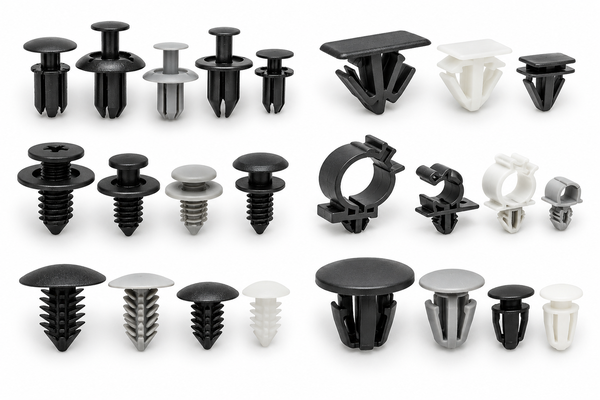
Plastic push rivets are common in automotive assembly.
They usually include a body and a locking pin. When the pin moves into the body, it expands the retaining section and secures the connected parts.
Manufacturers often use them for:
- Bumper covers
- Wheel arch liners
- Underbody panels
- Engine covers
- Interior trim
Design tip: Check the mounting hole diameter, panel thickness, and required insertion force. An incorrect hole size may cause loose assembly or difficult installation.
2. Automotive Trim Clips
Trim clips attach decorative and functional panels to the vehicle body.
They often have flexible locking arms that bend during installation and return to their original position after engaging the mounting hole.
Common applications include door panels, pillar trim, and interior covers.
However, thin locking arms can break if the material is too stiff or the design creates excessive stress.
For more details, read our Automotive Plastic Clips: How to Improve Strength and Durability.
3. Plastic Snap-Fit Fasteners
Snap-fit fasteners use flexible hooks or tabs to connect two components.
During assembly, the locking arm bends and then returns toward its original position to secure the connection.
Their main benefits include:
- Fast assembly
- Fewer additional components
- Lower assembly complexity
- Compact fastening structures
However, poor snap-fit geometry may cause cracking or weak retention.
A good design must balance flexibility and holding force.
You can learn more in our Snap-Fit Design for Injection Molding guide.
4. Plastic Cable Clips and Clamps
Cable clips hold electrical wires, tubes, and wire harnesses in position.
They prevent cables from moving into unwanted areas and help reduce wear caused by vibration.
These fasteners are widely used in modern vehicles because automotive electrical systems contain many cables and connectors.
Therefore, their design must provide enough holding force without damaging the cable insulation.
5. Plastic Screw Clips and Nuts
Plastic screw clips and nuts provide fastening points for screws.
They are often used in interior panels, lightweight brackets, and other non-structural assemblies.
Some designs include flexible features that fit into a metal or plastic mounting hole.
Others use molded threads or screw-receiving holes.
For these parts, engineers must control hole dimensions, material strength, and tightening torque.
Excessive torque may crack the plastic or damage the threads.
Common Materials for Automotive Plastic Fasteners
Material selection directly affects the strength, flexibility, and durability of automotive plastic fasteners.
Different plastics perform differently under heat, vibration, moisture, and long-term loading.
The table below compares common material options.
| Material | Main Advantages | Typical Applications |
|---|---|---|
| PA6 | Good toughness and mechanical strength | Trim clips, retainers |
| PA66 | Good strength and thermal performance | Clips in more demanding environments |
| POM | Low friction and good dimensional stability | Precision clips, locking mechanisms |
| PP | Low weight, chemical resistance, and flexibility | Interior clips, push rivets |
| PBT | Dimensional stability and electrical properties | Selected electrical fastening parts |
The final choice depends on the material grade, operating conditions, and part design.
PA6 and PA66
PA6 and PA66 are common engineering plastics for automotive fasteners.
They offer a useful balance of strength and toughness. In addition, selected grades can perform well in demanding vehicle environments.
However, both materials absorb moisture.
Moisture can affect dimensions, stiffness, and mechanical performance. Therefore, engineers should evaluate the material under expected service conditions.
POM
POM offers low friction, good stiffness, and relatively stable dimensions.
It can work well in fastening mechanisms that require smooth movement or precise engagement.
However, the material grade and part geometry must provide enough flexibility for the intended locking action.
PP
PP is lightweight and often economical for high-volume production.
It also offers good chemical resistance and flexibility.
For this reason, manufacturers may use PP in selected push rivets and interior fastening parts.
However, long-term loading and elevated temperatures can increase the risk of creep.
How to Choose the Right Material
Before selecting a plastic, consider:
- Required insertion and retention forces
- Operating temperature
- Vibration and impact loads
- Exposure to chemicals and moisture
- Expected service life
- Required assembly and removal cycles
- Material and production cost
A stronger plastic is not always the best choice. For example, excessive stiffness may increase installation force and cause a flexible locking arm to break.
Therefore, the material must match the fastener geometry and its intended function.
Key Design Rules for Automotive Plastic Fasteners
Good design is essential for reliable fastening performance.
The following rules help engineers reduce part failures and improve production quality.
1. Balance Insertion Force and Retention Force
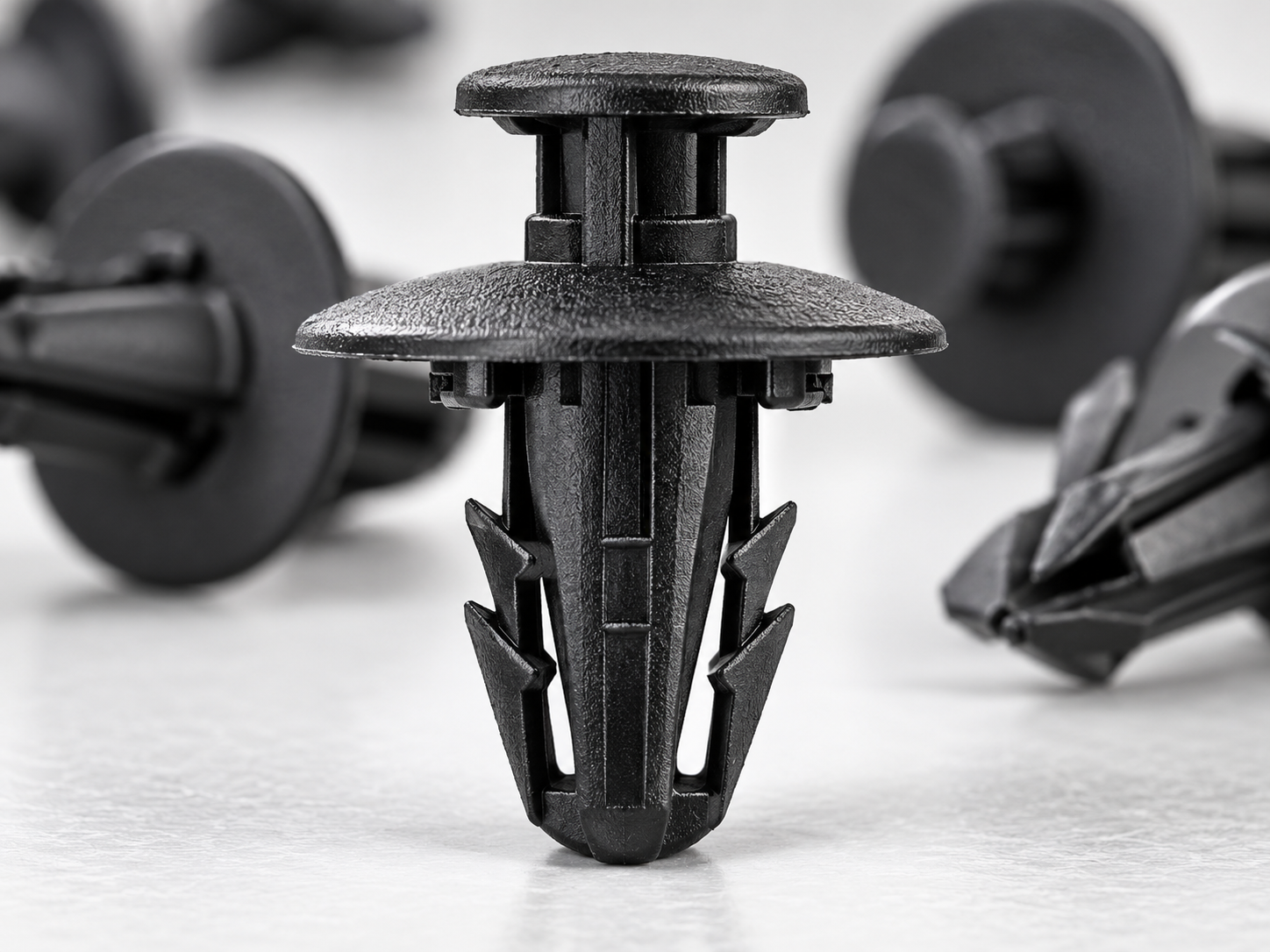
Automotive plastic fasteners must be easy to install while providing enough holding force.
Insertion force is the force needed to install the fastener.
Retention force is the force required to pull it out or disengage it.
If insertion force is too high, assembly workers or automated equipment may damage the fastener.
However, low retention force can allow panels to become loose during vehicle operation.
Therefore, engineers should define both requirements early in the design stage.
2. Avoid Sharp Corners
Sharp corners create stress concentration.
This problem is especially important near the base of flexible locking arms.
When an arm bends during assembly, stress increases around its root.
Adding a smooth radius helps spread the load and reduces the risk of cracking.
However, the radius must also fit the available space and mold design.
3. Control Wall Thickness
Uniform wall thickness helps improve injection molding quality.
Large thickness changes can cause uneven cooling, sink marks, and internal stress.
Meanwhile, extremely thin sections may lead to short shots or weak parts.
Therefore, designers should:
- Use consistent wall thickness where possible.
- Avoid sudden thickness changes.
- Add smooth transitions between sections.
- Check thin locking arms for sufficient strength.
- Reduce unnecessary thick areas.
There is no single wall thickness suitable for all fasteners.
The correct value depends on the material, part size, molding process, and mechanical requirements.
4. Design Flexible Locking Arms Carefully
Many automotive plastic fasteners use flexible arms to create a locking connection.
These arms must bend during installation without exceeding the material’s allowable strain.
Important design factors include:
- Arm length
- Arm thickness
- Root radius
- Hook height
- Required deflection
- Material stiffness
- Available clearance
For example, a longer flexible arm may reduce bending strain during installation. However, it also needs enough space to move.
Therefore, engineers must balance flexibility, strength, and available assembly space.
5. Consider Mounting Hole Tolerances
Even a well-designed fastener may fail if the mounting hole is incorrect.
The hole size and shape affect both insertion and retention.
Important dimensions include:
- Mounting hole diameter or profile
- Panel thickness
- Fastener stem dimensions
- Locking feature size
- Engagement depth
- Position tolerance
Engineers should evaluate these dimensions together.
In addition, tolerance stack-up must be considered. A fastener should work throughout the approved dimensional limits, not only at nominal dimensions.
6. Add Proper Draft Angles
Draft angles help plastic parts release from the injection mold.
Without enough draft, parts may stick to the mold cavity or core.
This can cause scratches, deformation, and difficult ejection.
However, draft angles may also change the fit of the locking features.
Therefore, mold designers must consider draft early rather than adding it after the part design is complete.
7. Consider Heat, Vibration, and Long-Term Loading
Automotive fasteners face different operating conditions depending on their location.
For example, an interior trim clip may experience different temperatures and loads from a fastener near the engine compartment.
Designers should consider:
- Temperature changes
- Continuous vibration
- Moisture exposure
- Chemical contact
- Repeated assembly
- Material creep
- Long-term aging
A fastener that works during initial assembly may still fail after extended use.
Therefore, durability testing is important before mass production.
Injection Mold Design for Automotive Plastic Fasteners
Reliable automotive plastic fasteners require accurate injection molds.
These components often contain thin arms, small hooks, narrow slots, and complex locking features.
As a result, mold design directly affects dimensional accuracy and production stability.
Mold Parting Line and Undercut Design
Many fasteners contain hooks or locking tabs that create undercuts.
Depending on the design, the mold may require sliders, lifters, or other mechanisms.
However, some flexible parts can be designed for controlled stripping from the mold when the material and geometry allow it.
Engineers should evaluate these options during DFM analysis.
A simpler mold structure may reduce tooling cost and improve production efficiency.
Gate Location and Material Flow
Gate location affects how molten plastic fills the cavity.
Poor gate placement may create weld lines near critical locking features.
These areas can become weak points during assembly.
Therefore, designers should study the material flow before finalizing the mold.
For small fasteners, gate size and location must also support clean separation and stable production.
Cooling System Design
Uneven cooling may cause shrinkage differences and part deformation.
Although automotive plastic fasteners are relatively small, dimensional changes can affect their locking performance.
Therefore, mold cooling should support consistent part dimensions across production cycles.
Ejection System Design
Thin hooks and flexible arms may become damaged during mold ejection.
If ejector pins push directly against weak sections, the part may bend or crack.
Therefore, ejector locations should support stronger areas of the fastener.
The mold must also provide enough draft and release clearance.
At Fentor Mold, DFM analysis helps identify these problems before tooling begins. Early review can improve mold structure, part quality, and manufacturing efficiency.
Common Automotive Plastic Fastener Defects
Even a good design can fail when molding conditions are not stable.
The table below shows common problems and possible solutions.
| Problem | Possible Cause | Recommended Solution |
|---|---|---|
| Broken locking arms | High assembly strain or sharp corners | Adjust arm geometry and add smooth radii |
| Loose fasteners | Incorrect engagement or dimensional variation | Check hole size and retention features |
| Short shots | Poor filling of thin sections | Improve gate design and filling conditions |
| Warpage | Uneven cooling or shrinkage | Improve cooling and wall thickness |
| Weak weld lines | Flow fronts meet near stressed areas | Review gate position and filling pattern |
| Flash | Poor mold fit or excessive cavity pressure | Check mold condition and process settings |
| Difficult ejection | Insufficient draft or undercuts | Improve release geometry and ejection design |
However, defects may have several causes.
For example, broken locking arms can result from poor geometry, material selection, molding conditions, or assembly problems.
Therefore, engineers should identify the root cause before changing the mold or processing parameters.
How to Test Automotive Plastic Fasteners
Automotive fasteners should be tested before mass production.
Testing helps confirm that the parts meet assembly and performance requirements.
Insertion Force Test
This test measures the force needed to install the fastener.
The result helps determine whether the part is suitable for manual or automated assembly.
Retention Force Test
This test measures how strongly the fastener holds the connected components.
Engineers should test it using representative mounting holes and panel materials.
Vibration Test
Vehicle vibration can cause fasteners to loosen over time.
Vibration testing helps evaluate whether the connection remains secure under defined operating conditions.
Temperature and Aging Tests
Plastic properties can change after exposure to heat, cold, moisture, or chemicals.
Therefore, engineers should evaluate fastener performance after suitable environmental conditioning.
Assembly and Removal Cycle Test
Some fasteners must be removed during vehicle maintenance.
For these designs, repeated installation and removal tests can help identify damage or loss of holding force.
The test method and acceptance limits should follow the vehicle manufacturer’s requirements.
How to Reduce Automotive Plastic Fastener Production Costs
Automotive plastic fasteners are often produced in large quantities.
Therefore, even small improvements can affect total production costs.
Several methods can help.
Simplify the Part Design
Avoid unnecessary undercuts and complex locking structures.
A simpler design may reduce mold complexity and maintenance requirements.
Use Multi-Cavity Injection Molds
For high-volume production, multi-cavity molds can increase output per cycle.
However, cavity filling, cooling, and dimensional consistency must be carefully controlled.
Select Materials Based on Performance
Avoid choosing expensive engineering plastics when a lower-cost material can meet the requirements.
At the same time, material cost should not come at the expense of product reliability.
Improve Mold Life and Production Stability
A durable mold helps maintain consistent quality during long production runs.
Proper mold steel selection, accurate machining, and regular maintenance can reduce downtime and repair costs.
Why Choose Fentor Mold for Automotive Plastic Fasteners?
Automotive plastic fasteners require more than accurate part dimensions.
They must also provide reliable assembly, consistent retention force, and stable quality during mass production.
At Fentor Mold, we focus on injection mold manufacturing and plastic injection molding for automotive applications.
Our engineering approach includes:
- DFM analysis: Review part geometry, wall thickness, undercuts, and molding risks.
- Injection mold manufacturing: Develop tooling based on part design and production requirements.
- Material evaluation: Review material options according to the application.
- Mold trials: Check molded parts and identify necessary adjustments.
- Injection molding production: Support consistent part quality for customer projects.
For fasteners integrated into larger mounting components, our Automotive Plastic Brackets: How to Improve Strength and Design article also explains important structural design considerations.
By reviewing part design and mold requirements early, manufacturers can reduce engineering changes and improve production reliability.
Frequently Asked Questions About Automotive Plastic Fasteners
What Are the Most Common Automotive Plastic Fasteners?
Common types include push rivets, trim clips, snap-fit fasteners, cable clamps, and plastic screw clips.
Each type provides a different fastening method for vehicle assembly.
Which Plastic Is Best for Automotive Fasteners?
PA6, PA66, POM, and PP are common options.
However, the best material depends on temperature, flexibility, strength, chemical exposure, and retention requirements.
Why Do Automotive Plastic Fasteners Break?
Common causes include excessive assembly force, sharp corners, poor material selection, incorrect tolerances, and weak molded sections.
Proper design and testing can reduce these failures.
Can Automotive Plastic Fasteners Be Injection Molded?
Yes. Injection molding is widely used for plastic fasteners because it can produce complex shapes with consistent dimensions.
For high-volume projects, multi-cavity molds can also improve manufacturing efficiency.
What Makes a Good Automotive Plastic Fastener Design?
A good design combines reliable holding force, easy installation, suitable material selection, and stable molding quality.
It should also meet the required service life and environmental conditions.
Conclusion
Automotive plastic fasteners are small components, but their design has a major effect on vehicle assembly and long-term reliability.
The right fastener must match the mounting structure, material requirements, and operating environment.
In addition, good injection mold design helps maintain accurate dimensions and consistent part quality.
For manufacturers developing custom automotive plastic fasteners, early DFM analysis and proper tooling design can reduce production risks and improve overall performance.
Looking for a reliable supplier for automotive injection molds or plastic parts?
Contact Fentor Mold to discuss your project requirements, mold design, and injection molding production needs.