
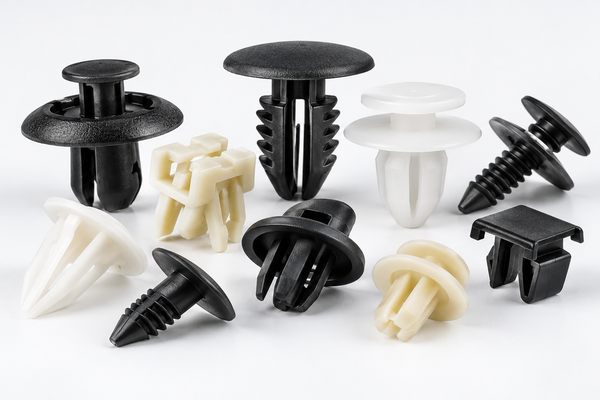
Automotive plastic clips are small but important car parts. They hold door panels, bumpers, trim, and wires in place. These clips must stay strong during daily use. However, some clips break during assembly or become loose over time.
Good design can prevent many of these problems. The right plastic, a flexible locking arm, and a well-made mold all help improve clip life.
In this guide, you will learn how to make automotive plastic clips stronger, prevent damage, and improve their service life.
Why Do Automotive Plastic Clips Break?
Automotive plastic clips often break when their locking arms bend too far.
During assembly, the arms bend inward to enter a hole. Once in place, they move back and lock the part.
If the arms bend too much, they may crack. Sharp corners and poor materials can make this problem worse.
Other common causes include:
- Weak or unsuitable plastic
- Short and thick locking arms
- Sharp corners near the arm base
- Hooks that are too large
- Weak weld lines
- High stress from molding
- Poor part dimensions
- Heat and material aging
Heat can also make some clips lose their holding force.
As a result, clip strength depends on both material choice and part design.
Best Materials for Automotive Plastic Clips
The right material helps a clip bend without breaking. It also helps the clip keep its shape and hold parts firmly.
Common materials include PA6, PA66, POM, and PP. Each plastic has its own benefits and limits.
PA6 and PA66 Automotive Plastic Clips
PA6 and PA66 are types of nylon. Many car clips use these materials because they offer good strength and toughness.
PA6 is often a good choice for flexible clips. It can bend and handle impact well. For example, PA6 works well for many door trim clips.
PA66 offers good heat resistance and strength. As a result, it may suit clips used in warmer areas of a vehicle.
Main benefits:
- Good strength
- Strong but flexible
- Good wear resistance
- Suitable for many car parts
- Heat-resistant grades available
However, nylon absorbs water from the air. This can change its size, strength, and flexibility.
For this reason, engineers should test both dry and moisture-conditioned clips.
POM for Automotive Plastic Clips
POM is another common engineering plastic. It has low friction and keeps its shape well.
These features make it useful for clips that need a close fit.
POM also absorbs very little water. As a result, its size stays more stable in changing weather.
However, POM is not the best choice for every clip. A short arm with a large hook may still break during assembly.
The clip design must allow safe bending.
PP for Automotive Plastic Clips
PP is light, flexible, and low in cost. It also resists many chemicals.
For these reasons, PP can work well for some interior clips.
Common uses include:
- Interior trim clips
- Light panel fasteners
- Flexible retaining parts
- Low-load clips
However, PP may slowly change shape when it holds a load for a long time. Heat can make this worse.
Therefore, PP is not always the best choice for clips that need high holding force.
Is Glass-Filled Nylon Better?
Glass fibers can make nylon stronger and stiffer. They also help improve heat resistance.
However, a stiffer plastic does not always make a better clip.
Flexible arms need to bend during assembly. Glass-filled nylon may break if the arm bends too far.
For this reason, unfilled or impact-modified nylon may work better for flexible clips.
Glass-filled grades may suit clips that need strength but only bend a little.
Automotive Plastic Clips Material Comparison
| Material | Main Benefit | Main Limit | Common Use |
|---|---|---|---|
| PA6 | Tough and flexible | Absorbs moisture | Door trim clips |
| PA66 | Strong and heat resistant | Moisture changes properties | Heat-resistant clips |
| POM | Stable size and low friction | Needs safe bending design | Precision clips |
| PP | Light and low cost | May lose holding force | Interior clips |
| Glass-filled PA | Stiff and strong | Less flexible | Rigid clips |
The strongest plastic is not always the best choice.
Instead, choose a material that offers the right balance of strength, flexibility, and heat resistance.
How to Improve Automotive Plastic Clips Strength
Better design can make automotive plastic clips stronger and easier to install.
Small changes to the locking arm, hook, or wall thickness can help prevent cracks.
1. Make the Locking Arm Longer
Longer arms can bend more easily than short arms.
As a result, they often handle the same movement with less stress.
Short, thick arms may need too much force during installation. This can cause cracks near the base.
When space allows, use a longer arm to reduce bending stress.
2. Choose the Right Wall Thickness
A thick locking arm is not always stronger.
In fact, thick arms can be too stiff. They may break when pushed into a mounting hole.
Thin arms bend more easily. However, they may not provide enough holding force.
Therefore, the wall must be thick enough to hold the part but thin enough to bend safely.
3. Add Smooth Corners
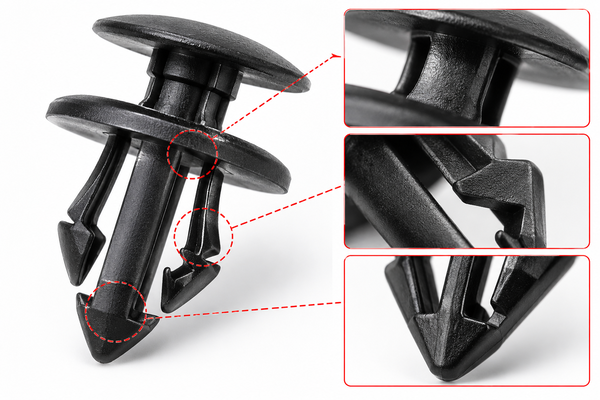
Sharp corners create high stress.
This is a common problem near the base of a locking arm.
Adding a smooth radius helps spread the force over a larger area.
As a result, the arm is less likely to crack during assembly.
4. Improve the Hook Design
The hook keeps the clip locked in place.
A large hook may offer good holding force. However, it can also make the clip harder to install.
If the arm must bend too far, it may break.
A smooth lead-in angle can make installation easier.
Meanwhile, the hook must be large enough to stop the clip from coming loose.
Good hook design balances easy installation with strong holding force.
5. Control Clip Dimensions
Small size changes can affect how a clip works.
For example, an oversized clip may be hard to install. A clip that is too small may not hold firmly.
Key dimensions include:
- Clip stem size
- Hook height
- Arm thickness
- Mounting hole size
- Panel thickness
- Locking depth
Check these sizes together before making the mold.
For more advice, read our Snap-Fit Design for Injection Molding guide.
How Mold Design Affects Automotive Plastic Clips
A good injection mold helps make strong clips with stable dimensions.
Poor mold design can cause weak areas, warping, or damage during part removal.
At Fentor Mold, we check the part shape, material, and mold structure during the DFM stage.
This helps find possible problems before mold production begins.
Gate Location and Clip Strength
The gate controls where melted plastic enters the mold.
If two flow paths meet near a locking arm, they can form a weld line.
This area may be weaker than the rest of the clip.
As a result, a clip may crack when it bends during assembly.
Good gate placement helps keep weak weld lines away from areas that carry high loads.
Moldflow analysis can help engineers find better gate locations.
Cooling and Part Size
Plastic shrinks as it cools.
If one area cools faster than another, the clip may bend or change shape.
Even a small size change can affect the locking force.
Therefore, the mold needs good cooling to help each part keep a stable shape.
For molds with many cavities, balanced cooling is also important.
Ejection Design for Flexible Clips
Many clips have hooks or barbs that make them hard to remove from the mold.
Some clips need sliders or lifters. Others can bend enough to leave the mold without moving cores.
However, too much force during ejection can damage a thin arm.
For this reason, ejector pins should push on stronger areas of the part.
The mold must also allow hooks to release safely.
Multi-Cavity Mold Design
Automotive plastic clips are often made in large numbers.
A multi-cavity mold can make several clips in one cycle. This helps improve output and lower the cost per part.
However, all cavities must fill and cool in a similar way.
If one cavity fills differently, its clips may have different sizes or strength.
Good mold balance helps keep part quality stable.
You can also read our Automotive Injection Mold Design Guide for more information.
Common Automotive Plastic Clips Problems
Even well-designed clips can fail if the molding process is not stable.
The table below shows common problems and ways to solve them.
| Problem | Main Cause | Possible Solution |
|---|---|---|
| Clip breaks | Too much bending | Improve arm shape and material |
| Clip becomes loose | Poor fit or plastic creep | Improve hook design |
| Thin arm does not fill | Poor plastic flow | Improve gate and venting |
| Flash appears | Poor mold sealing | Improve mold fitting |
| Clip bends out of shape | Uneven cooling | Improve cooling |
| Parts vary between cavities | Unbalanced mold | Balance filling and cooling |
A change in molding settings cannot fix every problem.
For example, higher injection pressure will not fix a locking arm that is too short.
Therefore, find the real cause before changing the mold or process.
How to Make Automotive Plastic Clips Last Longer
Good strength helps during installation. However, long service life needs more than initial strength.
Clips must also handle heat, moisture, vibration, and repeated use.
Reduce Stress After Installation
Some clips remain bent after installation.
Over time, this constant stress can make the plastic slowly change shape. It may also reduce the holding force.
To prevent this, avoid designs that keep the locking arm bent more than needed.
A good clip should lock firmly without carrying too much stress.
Check Heat and Moisture Resistance
Different car parts face different temperatures.
For example, clips inside a door may face heat from the sun. Clips near the engine may face even higher temperatures.
Nylon clips also absorb moisture, which changes how they bend.
Therefore, test the selected plastic under the conditions it will face in the vehicle.
Improve Resistance to Repeated Bending
Some clips need to be removed and installed more than once.
Each time, the locking arm bends.
Repeated bending can slowly weaken the plastic.
To improve clip life:
- Use smooth corners
- Avoid large arm movement
- Select a tough material
- Reduce insertion force
- Check the hook shape
- Test repeated installation
The required number of tests depends on how the clip will be used.
How to Test Automotive Plastic Clips
Testing helps confirm that a clip can hold parts safely and last as expected.
Different clips may need different tests.
| Test | What It Checks |
|---|---|
| Insertion force | How hard the clip is to install |
| Holding force | How firmly the clip stays in place |
| Removal force | How hard the clip is to remove |
| Repeated assembly | Strength after many uses |
| Heat and cold cycling | Effect of temperature changes |
| Vibration | Ability to stay locked |
| Size inspection | Fit with the mounting hole |
| Aging test | Changes after long-term exposure |
Always use the correct mounting hole and panel thickness during testing.
For nylon clips, test both dry and moisture-conditioned parts when needed.
This helps show how the clip may perform in real use.
How to Reduce Automotive Plastic Clips Production Cost
A well-designed clip can lower both part cost and assembly cost.
Broken clips create waste. Poor fitting clips also slow down assembly.
Better part and mold design can help reduce these problems.
Choose suitable materials. Avoid expensive plastics when a lower-cost grade can meet the needs.
Keep the mold simple. Reduce complex hooks and undercuts when possible.
Use the right cavity count. More cavities can improve output, but only if the mold stays balanced.
Control part dimensions. Stable sizes help reduce rejects and assembly problems.
Maintain the mold. Regular checks help prevent flash and mold wear.
Fentor Mold offers custom injection mold manufacturing for automotive and industrial plastic parts.
In addition, our injection molding production services can support customers who need both molds and finished clips.
Conclusion
Strong automotive plastic clips need the right material, simple part design, and reliable injection molds.
PA6, PA66, POM, and PP can all work well for different clip types. However, material choice should match the required strength, bending movement, and working temperature.
Longer locking arms, smooth corners, and better hook shapes can reduce the risk of cracks.
Good mold design also helps prevent weak weld lines, warping, and damage during ejection.
With proper design and testing, manufacturers can make automotive plastic clips that are easier to install, hold firmly, and last longer.