
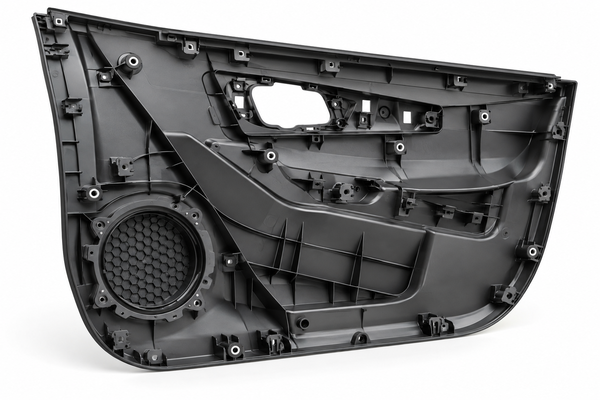
Automotive door panel mold design plays a key role in the quality of car interior parts. Door panels are often large, thin, and full of ribs, clips, and mounting features. As a result, they can bend or twist during injection molding.
Warpage can cause poor assembly, uneven gaps, and surface defects. In some cases, the panel may not fit the metal door structure correctly. Therefore, engineers must control warpage before mass production begins.
At Fentor Mold, we support custom automotive injection mold projects. This guide explains how better part design, gate location, cooling, and mold trials can reduce door panel warpage.
Why Is Automotive Door Panel Mold Design Difficult?
Automotive door panels have a large surface area and many functional features. Unlike small plastic parts, their shape can change across a long distance.
A typical molded door panel may include:
- Large decorative surfaces
- Thin walls and deep ribs
- Speaker openings
- Mounting clips and bosses
- Window switch mounting areas
- Side pockets and reinforcement structures
- Complex curves and undercuts
However, not every door panel uses the same molding process. Many door trim assemblies combine an injection molded carrier with separate decorative parts, soft materials, and other components.
Therefore, the mold design must match the actual part structure.
How Warpage Affects Door Panel Quality
Warpage is the unwanted bending or twisting of a molded part.
For example, one corner of a large door panel may bend inward after cooling. As a result, its mounting clips may no longer match the required positions.
Common problems include:
- Uneven gaps between the panel and door frame
- Poor alignment of mounting holes
- Difficult assembly
- Changes in surface shape
- Unwanted stress around clips
- Noise caused by poor assembly fit
Therefore, controlling the overall shape is just as important as checking individual dimensions.
Common Causes of Warpage in Automotive Door Panel Mold Design
Warpage mainly comes from uneven shrinkage. However, several design and process factors can create this problem.
| Cause | Effect on Door Panels | Possible Solution |
|---|---|---|
| Uneven wall thickness | Different cooling and shrinkage rates | Improve wall thickness |
| Poor gate location | Unbalanced flow and packing | Optimize gate positions |
| Uneven cooling | Temperature differences across the part | Improve cooling layout |
| Material shrinkage | Uneven part contraction | Select and evaluate the material |
| Fiber orientation | Different shrinkage by direction | Review flow and fiber orientation |
| Early ejection | Part bends while still hot | Improve cooling and ejection |
| Poor rib design | Local stress and uneven shrinkage | Adjust rib size and layout |
1. Uneven Wall Thickness
Large door panels often contain thick mounting areas and thin decorative walls.
These areas cool at different speeds. As a result, they may shrink by different amounts.
Therefore, engineers should avoid unnecessary thick sections.
They should also review areas where ribs and bosses meet the main wall.
2. Unbalanced Material Flow
Poor flow balance can create different packing conditions across the panel.
For example, areas near the gate may receive more effective packing than distant areas.
Consequently, the final shrinkage may not be uniform.
A suitable gate design can help reduce this difference.
3. Uneven Mold Cooling
Some parts of the mold may remain hotter than others.
This problem is common near deep ribs, thick bosses, and complex core areas.
As a result, the plastic may cool and shrink unevenly.
Therefore, the cooling system must reach critical areas wherever practical.
How to Improve Automotive Door Panel Mold Design
The best way to control warpage is to identify risks before cutting mold steel.
Good DFM analysis can reduce later changes and costly mold trials.
1. Keep Wall Thickness as Uniform as Possible
Uniform walls help the part cool more evenly.
However, automotive door panels also need enough strength to support clips, switches, and other components.
Therefore, engineers must balance strength and wall thickness.
Useful design practices include:
- Avoid sudden wall thickness changes.
- Use smooth transitions between thick and thin areas.
- Reduce unnecessary material around bosses.
- Use suitable radii at wall connections.
- Check long, thin sections for filling risks.
In addition, engineers should review the complete part rather than each feature alone.
2. Optimize Ribs and Mounting Bosses
Ribs can improve stiffness without making the whole panel thicker.
However, thick ribs may cause sink marks and uneven shrinkage.
For this reason, rib thickness should remain suitable for the selected material and surface requirements.
Engineers should also pay attention to rib direction.
Long ribs can make a panel stiffer in one direction. Yet they may also affect shrinkage and bending behavior.
Therefore, rib geometry should be reviewed together with the gate and cooling design.
3. Control Clip and Mounting Positions
Mounting points are critical to door panel assembly.
Even if the visible surface looks acceptable, the part may fail assembly checks when the clips are out of position.
Therefore, engineers should identify critical mounting locations during DFM.
They should also consider how the panel will rest in the inspection fixture.
Furthermore, the mold and process must be capable of keeping those features within the required tolerances.
Gate Location in Automotive Door Panel Mold Design
Gate location is one of the most important factors in large plastic part molding.
It affects melt flow, packing pressure, weld lines, and shrinkage.
For large automotive door panels, a single gate may not provide the required filling performance.
Therefore, engineers often evaluate multiple gate locations or suitable hot runner systems.
How to Choose Gate Locations
A good gate layout should support balanced filling.
Engineers should consider:
- Flow length
- Wall thickness
- Weld line locations
- Packing performance
- Visible surface requirements
- Critical mounting features
- Expected material orientation
In addition, gate marks should be kept away from important appearance and assembly surfaces whenever possible.
Sequential Valve Gate Systems for Large Door Panels
Some large automotive molds use sequential valve gate hot runner systems.
This technology allows engineers to control when individual gates open.
As a result, they can influence the flow front and reduce certain weld line problems.
However, valve gate timing must match the part geometry and molding conditions.
Poor timing can create new flow marks, uneven packing, or other defects.
Therefore, Moldflow analysis and mold trials should guide the final valve gate settings.
Read our detailed article on sequential valve gate molding to learn more about this technology.
Cooling System Design to Prevent Door Panel Warpage
A balanced cooling system is essential for large automotive molds.
If one area cools faster than another, the part may bend after ejection.
Therefore, engineers should evaluate the cooling layout during mold design.
Improve Cooling Around Deep Ribs and Bosses
Deep ribs and thick mounting features can create local hot spots.
These areas may require extra cooling attention.
Depending on the mold structure, engineers may use:
- Additional cooling channels
- Baffles or bubblers
- Suitable cooling inserts
- Separate cooling circuits
- Improved cooling channel placement
However, cooling efficiency is not only about using more water channels.
The system must also provide stable flow and suitable temperature control.
Balance Core and Cavity Temperatures
The core and cavity sides of a large mold may have different temperatures.
If the difference causes uneven shrinkage, the door panel may bend.
Therefore, engineers should check both sides during cooling analysis.
In some cases, controlled temperature differences may help balance the final part shape.
However, the correct settings depend on the material and actual warpage direction.
Avoid Early Ejection
Large thin-wall parts may still be flexible when they leave the mold.
If ejection occurs too early, the part may bend under its own weight or ejection force.
Therefore, the cooling time must allow safe release.
In addition, ejector positions and the removal method should support the part properly.
Moldflow Analysis for Automotive Door Panel Mold Design
Moldflow analysis helps engineers identify possible problems before mold manufacturing.
For large automotive door panels, it is especially useful for gate selection, filling balance, cooling, and warpage prediction.
Check Filling and Pressure
First, engineers should review the filling pattern.
They should check whether the melt reaches all areas without excessive pressure.
In addition, the analysis can help identify air traps and weld lines.
Predict Shrinkage and Warpage
Next, engineers can review shrinkage and predicted deformation.
For example, the analysis may show that one corner is likely to move more than the others.
The team can then compare different gate locations, cooling layouts, or wall designs.
However, Moldflow results are predictions rather than guaranteed production values.
Therefore, mold trials must confirm the actual part behavior.
Review Fiber Orientation
Some automotive door panel carriers use glass-filled PP or other reinforced materials.
During filling, glass fibers tend to align with the material flow.
As a result, shrinkage may differ by direction.
Therefore, fiber orientation should be part of the warpage study when using reinforced materials.
How to Control Warpage During T0 and T1 Mold Trials
Good mold design reduces risk, but trials remain necessary.
During T0 and T1, engineers should measure the actual parts and compare them with the approved drawings.
Check the First Molded Samples
During T0, focus on:
- Filling completeness
- Visible surface quality
- Overall warpage
- Critical mounting positions
- Ejection performance
- Weld lines and gate marks
In addition, record the process settings for each sample group.
This makes later comparisons easier.
Measure Parts Under Defined Conditions
Large plastic parts can continue to change shape after ejection.
Therefore, inspection should follow an agreed cooling and conditioning period.
Engineers should also use a suitable checking fixture.
The part must rest on defined datums, with agreed support and clamping conditions.
Otherwise, different inspection methods may produce different results.
Adjust the Process Before Changing Steel
If the panel shows warpage, engineers should review the cause first.
Possible process adjustments include:
- Mold temperature
- Melt temperature
- Injection speed
- Packing pressure
- Packing time
- Cooling time
- Valve gate timing
However, changing too many parameters at once makes the results difficult to understand.
Therefore, a controlled trial plan is the better approach.
If process changes cannot solve the problem, engineers may need to modify the gate, cooling system, or part geometry.
Can Mold Compensation Reduce Door Panel Warpage?
Sometimes, engineers use mold compensation to correct predictable deformation.
For example, they may adjust the cavity shape so the part moves closer to its target geometry after cooling.
However, this method should not be the first solution.
Before changing the steel, engineers should confirm:
- The material grade is correct.
- The molding process is stable.
- Cooling and packing are suitable.
- The warpage direction is repeatable.
- Measurement results are reliable.
Otherwise, mold compensation may create new problems.
For complex large parts, controlled compensation can help improve final shape accuracy once the process is stable.
Quality Control for Automotive Door Panels
Warpage control should continue after sample approval.
A stable production process helps maintain assembly quality.
Critical Dimensions to Inspect
Important features may include:
- Overall panel shape
- Mounting clip positions
- Hole locations
- Door handle mounting areas
- Speaker opening positions
- Edge profiles
- Assembly gap requirements
However, the actual inspection plan must follow the customer drawing.
Maintain Stable Molding Conditions
During production, the team should monitor key process parameters.
In addition, operators should check part appearance and critical dimensions at defined intervals.
For larger parts, a checking fixture can help detect shape changes.
Furthermore, production teams should follow an approved method for part cooling, handling, and storage.
How Fentor Mold Supports Automotive Door Panel Mold Design
Automotive door panel mold design requires experience in large mold structures, cooling, and precision machining.
At Fentor Mold, we provide custom injection mold manufacturing for automotive plastic parts.
Our injection mold manufacturing services include DFM review, Moldflow evaluation, mold design, precision machining, mold assembly, and trial support.
For large automotive parts, our engineering review can focus on gate location, cooling, mold strength, sliders, lifters, and part warpage.
In addition, customers can learn more about our approach to large plastic injection molding.
We aim to identify mold design risks early and reduce unnecessary changes during development.
Conclusion
Automotive door panel mold design has a major effect on part quality and assembly performance.
Large size, thin walls, deep ribs, and complex mounting features can make warpage difficult to control.
However, good part design, balanced cooling, suitable gate locations, and Moldflow analysis can reduce these risks.
In addition, careful T0 and T1 trials help engineers confirm the actual part shape.
If you are developing a custom automotive door panel injection mold, Fentor Mold can review your drawings and provide engineering recommendations and a tooling quotation.
Frequently Asked Questions
What Causes Warpage in Automotive Door Panel Mold Design?
Uneven shrinkage is the main cause. Wall thickness, gate location, cooling, packing, and material orientation can all affect it.
What Materials Are Used for Automotive Door Panels?
PP-based materials, including selected filled or reinforced grades, are common choices for door panel carriers. Other materials may be used for decorative and functional parts. The final selection depends on project requirements.
Can Moldflow Predict Door Panel Warpage?
Yes. Moldflow can estimate warpage and show possible causes. However, the final results must be checked through real mold trials.
How Can Cooling Reduce Door Panel Warpage?
Balanced cooling helps reduce temperature differences across the part. This can improve shrinkage consistency and reduce deformation after ejection.
Can Sequential Valve Gates Improve Door Panel Quality?
Yes, when the part and mold design support them. Proper valve gate timing can improve flow control and help manage weld lines. However, it does not automatically remove all warpage.
When Should Engineers Modify the Mold to Correct Warpage?
Engineers should first confirm the material, process settings, and inspection method. If warpage remains stable and repeatable, a mold or product design change may be needed.