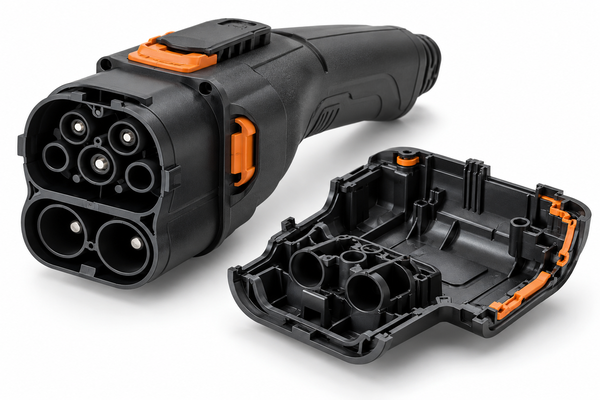
EV charging connector injection molding plays a key role in making safe and reliable plastic parts for electric vehicle charging systems. These parts must resist heat, provide electrical insulation, and keep their shape during use.
However, poor material choice or mold design can cause cracks, warpage, flash, and poor assembly fit. In some cases, these problems may affect the safety of the complete connector.
At Fentor Mold, we support custom injection mold projects for precision plastic components. This guide explains how to improve EV charging connector quality through better materials, mold design, and process control.
What Is EV Charging Connector Injection Molding?
EV charging connector injection molding is a process used to make plastic parts for electric vehicle charging plugs, sockets, and related connector systems.
The plastic parts protect internal components, support electrical insulation, and help maintain a secure fit.
Common molded parts include:
- Connector housings: Protect internal electrical parts.
- Insulation bodies: Separate and support electrical contacts.
- Contact holders: Keep metal contacts in the correct position.
- Locking components: Help secure the connector during use.
- Cable support parts: Support cable entry and strain relief.
- Sealing supports: Help position seals and gaskets.
Each part has different design needs. Therefore, engineers must choose materials and mold structures based on the part’s function.
Best Materials for EV Charging Connector Injection Molding
Material choice is one of the most important steps in EV charging connector injection molding.
Unlike many decorative plastic parts, charging connector components may face electrical, thermal, and mechanical stress.
Therefore, materials must meet the required product standards and operating conditions.
| Material | Main Advantages | Main Limitations | Possible Uses |
|---|---|---|---|
| PA66 | Good strength and wear resistance | Moisture affects dimensions and properties | Contact holders and structural parts |
| PBT | Good electrical properties and dimensional stability | Grade-dependent impact and heat performance | Insulating housings and supports |
| PC | Good impact strength and appearance | Chemical and stress-cracking risks | Selected outer housings |
| PC/ABS | Balanced impact strength and moldability | Grade-dependent heat and flame performance | Selected outer shells |
| PPA | High heat performance and strength | Higher cost and processing demands | High-temperature connector components |
| PPS | High heat and chemical resistance | Higher cost and possible brittleness | Selected demanding insulation parts |
These are material families, not approved grades. A suitable grade must meet the exact electrical, heat, flame, and mechanical requirements.
PA66 for EV Charging Connector Injection Molding
PA66 is a common engineering plastic for electrical and automotive parts.
It offers useful strength and wear resistance. In addition, selected flame-retardant grades can meet demanding connector requirements.
However, PA66 absorbs moisture. This can change part size and mechanical properties.
Therefore, engineers should consider both dry and conditioned material properties.
For parts with tight tolerances, moisture control is especially important.
PBT for EV Charging Connector Injection Molding
PBT is another material option for connector housings and contact supports.
It offers good electrical properties and often provides more stable moisture-related dimensions than PA66.
In addition, selected PBT grades offer flame-retardant performance.
However, not every PBT grade is suitable for EV charging applications. Engineers must check heat resistance, impact strength, and electrical performance.
PPA and PPS for High-Temperature Parts
Some connector components need higher heat resistance.
In these cases, PPA or PPS may be suitable.
PPA offers high strength and good heat performance. Meanwhile, PPS provides strong heat and chemical resistance.
However, these materials cost more than many standard engineering plastics.
They also need careful mold and process control.
Therefore, choose them only when the operating conditions justify their use.
Key Quality Requirements for EV Charging Connector Injection Molding
EV charging connector injection molding must meet more than appearance requirements.
The finished plastic parts should provide reliable insulation, stable dimensions, and suitable mechanical performance.
1. Electrical Insulation
Electrical insulation helps reduce the risk of unwanted current flow.
Therefore, material selection must consider dielectric strength, insulation resistance, and tracking resistance where relevant.
Engineers should also check the complete connector design.
For example, the spacing between metal contacts may affect electrical safety.
A flame-retardant material alone does not guarantee electrical insulation safety.
The finished connector must pass the tests required by its intended standard and application.
2. Heat Resistance
EV charging connectors may become warm during operation.
Therefore, plastic parts must keep their strength and shape under the expected temperature conditions.
Engineers should review:
- Continuous operating temperature
- Short-term thermal exposure
- Heat deflection temperature
- Thermal aging behavior
- Strength at elevated temperatures
However, a high melting point does not always mean good long-term heat performance.
Material grade and test conditions matter.
3. Flame Resistance
Flame resistance is important for many electrical connector parts.
For example, some projects specify a UL 94 V-0 material rating at a defined thickness.
However, the required rating depends on the product design and applicable standard.
Therefore, engineers should confirm the exact material grade, test thickness, and certification information.
To learn more, read our guide on flame-retardant plastics for injection molding.
4. Dimensional Accuracy
Charging connector parts often have small holes, clips, and contact positions.
Even a small dimensional change may cause assembly problems.
For this reason, engineers should identify critical dimensions before tooling starts.
These may include:
- Contact hole positions
- Terminal spacing
- Mating surfaces
- Locking features
- Seal grooves
- Housing assembly points
Furthermore, tolerance requirements should reflect the function of each feature.
Mold Design Tips for EV Charging Connector Injection Molding
Good mold design can prevent many quality problems before production begins.
For EV charging connector injection molding, engineers should pay close attention to wall thickness, gate position, cooling, and ejection.
Keep Wall Thickness Consistent
Uneven wall thickness can create sink marks and warpage.
For example, a thick area around a terminal support may cool more slowly than a thin outer wall.
As a result, the finished part may lose dimensional accuracy.
To reduce this risk:
- Keep main walls as even as possible.
- Avoid sudden thickness changes.
- Use ribs where suitable.
- Add smooth transitions between sections.
- Review thick areas near critical dimensions.
However, electrical insulation and mechanical strength must take priority over making walls thinner.
Choose the Right Gate Location
Gate location affects filling pressure, weld lines, and part strength.
For connector housings, poor gate placement may create weak weld lines near mounting features.
Therefore, engineers should review how plastic flows around holes, metal inserts, and thin sections.
Moldflow analysis can help locate potential filling problems.
In addition, gate marks should not interfere with sealing or mating surfaces.
Improve Mold Venting
Poor venting can trap air inside the cavity.
This may cause burn marks, short shots, or weak weld lines.
Therefore, engineers should place vents near likely air traps.
However, vent depth must suit the material and mold design. Deep vents may cause flash.
Good venting can improve filling and reduce defects.
Balance Mold Cooling
Uneven cooling can cause warpage and dimensional variation.
As a result, contact holes and mating features may move outside their required tolerances.
To improve cooling, engineers should review water channel layout and local hot spots.
In addition, they should check part temperatures during mold trials.
Protect Small Features During Ejection
Connector parts often include thin clips, small cores, and narrow walls.
These features may break if ejection force is too high.
Therefore, the mold should provide suitable draft and balanced ejection.
Ejector pins should also avoid weak areas and critical surfaces.
For complex parts, inserts, sliders, or lifters may be needed.
Our custom injection mold manufacturing services cover DFM analysis, precision machining, mold assembly, and trial support.
Common Defects in EV Charging Connector Injection Molding
Even with good tooling, poor process settings can create defects.
Therefore, production teams should monitor both the molding process and part quality.
| Defect | Common Causes | Possible Solutions |
|---|---|---|
| Warpage | Uneven cooling or shrinkage | Improve cooling and packing |
| Short shot | Poor flow or trapped air | Improve filling and venting |
| Flash | High pressure or poor mold fit | Review shut-off surfaces and settings |
| Sink marks | Thick walls or poor packing | Improve wall design and packing |
| Burn marks | Trapped air or excessive shear | Improve venting and process settings |
| Weld lines | Melt fronts meeting around features | Review gate location and melt flow |
| Cracks | Stress, poor design, or handling | Reduce stress and improve part design |
How to Prevent Warpage
Warpage can affect contact alignment and housing assembly.
First, review wall thickness and gate location.
Next, improve cooling balance and packing conditions.
Also, allow parts to reach defined inspection conditions before measuring them.
Finally, confirm the results during repeated mold trials.
How to Reduce Flash and Short Shots
Flash may interfere with mating surfaces or locking features.
Meanwhile, a short shot may leave an important section incomplete.
Therefore, engineers should not simply increase injection pressure to solve every filling problem.
Instead, check the gate, runner, venting, material condition, and mold fit.
How to Prevent Cracks
Cracks can reduce the strength of connector components.
Common causes include sharp corners, high internal stress, poor ejection, and unsuitable materials.
To prevent them, improve corner radii and avoid sudden wall changes.
In addition, adjust process settings to reduce excessive molded-in stress.
How to Improve EV Charging Connector Injection Molding Accuracy
Precision is especially important for contact holders and mating features.
However, accurate mold machining alone does not guarantee accurate molded parts.
Material shrinkage and production conditions also affect dimensions.
Control Material Moisture
Some engineering plastics absorb moisture.
For example, PA66 and PPA need suitable drying before molding.
Poor drying may cause surface defects or material damage.
Furthermore, moisture absorbed after molding may change dimensions.
Therefore, the production and inspection plans should account for the material’s moisture behavior.
Control Shrinkage
Different plastics have different shrinkage behavior.
Glass-filled materials may also shrink differently along and across the flow direction.
As a result, complex connector parts may warp.
Therefore, engineers should consider material grade, fiber orientation, gate location, and packing conditions during mold design.
Measure Critical Dimensions
Not every dimension needs the same inspection method.
For example, terminal holes and mating surfaces may need closer control than non-functional outer surfaces.
Engineers can use CMM, optical measurement, gauges, or special fixtures based on the feature.
In addition, inspection results should link to the approved drawing and measurement conditions.
For more details, see our article on GD&T for injection molded parts.
Quality Control for EV Charging Connector Injection Molding
Quality control should begin during product development.
A good plan helps detect problems before mass production starts.
DFM Review
Before making the mold, engineers should check:
- Material grade
- Wall thickness
- Gate position
- Draft angles
- Cooling design
- Mold release
- Critical tolerances
- Assembly features
This early review helps reduce costly mold changes.
T0 and T1 Mold Trials
T0 trials help check the first molded samples.
Engineers should inspect filling, dimensions, appearance, and ejection.
Next, the team should record any defects and plan corrective actions.
Later trials can confirm whether these changes improved part quality.
However, sample approval should follow the customer’s defined requirements.
Electrical and Mechanical Testing
A molded connector housing may look perfect but still fail its function.
Therefore, the final connector assembly may require:
- Insulation resistance testing
- Dielectric strength testing
- Temperature rise testing
- Mechanical strength testing
- Mating and unmating cycle testing
- Environmental exposure testing
- Seal and ingress protection testing
The exact tests depend on the applicable product standard and connector design.
These are system-level or assembly-level requirements where applicable. They cannot all be confirmed by plastic part inspection alone.
Mass Production Control
After approval, the production team should maintain stable molding conditions.
Important parameters include melt temperature, mold temperature, injection speed, packing pressure, and cooling time.
Also, material drying and handling should remain consistent.
Regular checks help detect process changes before they cause large batches of defects.
How Fentor Mold Supports EV Charging Connector Injection Molding
EV charging connector injection molding requires careful planning from material selection to mold trials.
At Fentor Mold, we provide custom mold design and manufacturing for precision plastic parts.
Our engineering team can review drawings, part structures, material requirements, and critical dimensions before tooling starts.
In addition, our injection molding production services support customers who need plastic parts after mold development.
For connector projects, we can help assess gate location, mold cooling, ejection, dimensional stability, and manufacturing risks.
However, final electrical certification and connector system approval must follow the customer’s applicable standards and qualified testing process.
Conclusion
EV charging connector injection molding needs more than good surface quality.
The plastic components must provide suitable insulation, heat resistance, strength, and dimensional accuracy.
Therefore, material choice, mold design, and process control should work together.
Good DFM analysis can reduce tooling risks. In addition, stable molding conditions and careful inspection help improve part consistency.
If you are developing a custom EV charging connector housing or precision electrical plastic part, Fentor Mold can review your drawings and provide mold manufacturing recommendations and a quotation.
Frequently Asked Questions
What Materials Are Best for EV Charging Connector Injection Molding?
PA66, PBT, PPA, PPS, and selected PC-based grades are possible choices. However, the best material depends on heat, insulation, flame, strength, and cost requirements.
Why Is Flame Resistance Important in EV Charging Connectors?
Flame resistance helps reduce fire-related risks. However, the required rating depends on the connector design and applicable standards. Engineers must verify the selected grade and required test results.
How Can EV Charging Connector Injection Molding Defects Be Reduced?
Start with good part design and material choice. Next, improve gate location, venting, cooling, and ejection. Finally, use mold trials and inspection to confirm quality.
What Causes Dimensional Problems in EV Connector Housings?
Common causes include material shrinkage, uneven cooling, moisture changes, and unstable molding settings. Therefore, engineers should check both mold design and production conditions.
Can Injection Molding Produce High-Voltage Connector Housings?
Yes. Injection molding can make plastic housings and insulating parts for high-voltage connectors. However, material approval, electrical safety, and final assembly testing must meet the project’s requirements.