
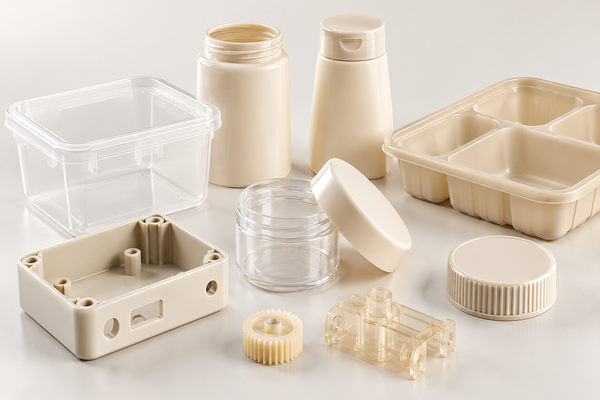
PLA injection molding is a manufacturing process used to make plastic containers, packaging, housings, and consumer products. PLA is a bio-based plastic made from renewable raw materials, such as corn or sugarcane.
Yes, PLA can be injection molded using conventional injection molding machines. However, it needs careful process control. PLA is sensitive to moisture and high temperatures. Also, standard PLA can be brittle and has limited heat resistance.
As a result, manufacturers may face problems such as cracks, warpage, short shots, and poor surface quality.
At Fentor Mold, we understand how material properties affect mold design and product quality. In this guide, we explain the PLA injection molding process, recommended processing conditions, common defects, and practical solutions.
What Is PLA Plastic?
PLA stands for polylactic acid. It is a thermoplastic polymer mainly produced from renewable plant-based materials.
Unlike most traditional plastics, PLA comes from biological raw materials rather than fossil fuels.
PLA can also be industrially compostable under suitable conditions. However, this does not mean every PLA product will break down naturally in soil or seawater.
The environmental performance of PLA depends on its material grade, additives, product design, and disposal conditions.
Key Properties of PLA
| Property | Typical Value or Characteristic |
|---|---|
| Material name | Polylactic Acid (PLA) |
| Material type | Bio-based thermoplastic |
| Density | Approximately 1.24 g/cm³ |
| Glass transition temperature | 55–65°C |
| Melting temperature | Around 150–180°C for crystalline grades |
| Stiffness | Relatively high |
| Impact resistance | Limited for standard PLA |
| Heat resistance | Low for standard amorphous PLA |
| Injection moldability | Good with proper processing |
| Common applications | Packaging, containers, and consumer products |
These values are general references. Actual properties depend on the PLA grade and its formulation.
PLA offers good stiffness and can provide an attractive surface finish. However, standard PLA may not be suitable for products exposed to high heat or repeated impacts.
How Does PLA Injection Molding Work?
PLA injection molding uses a process similar to conventional plastic injection molding.
Most standard injection molding machines can process PLA grades designed for this method.
The process includes five main steps.
Step 1: Material Drying
Before production, PLA pellets must be dried according to the material supplier’s instructions.
Moisture can damage PLA during melting. Therefore, correct drying is essential.
Step 2: Melting
The machine heats the pellets until they melt.
However, the barrel temperature must remain within the recommended range. Excessive heat may cause material degradation.
Step 3: Injection
The screw pushes molten PLA into the mold cavity.
Injection speed and pressure must be controlled to achieve complete filling.
Step 4: Cooling
The molten material cools and forms the required shape.
Cooling time depends on wall thickness, mold temperature, and the selected PLA grade.
Step 5: Ejection
Finally, the mold opens, and the finished part is removed.
Proper draft angles and ejector positions help prevent scratches, cracks, and deformation.
Although the process is straightforward, each step can affect the final product quality.
PLA Injection Molding Processing Parameters
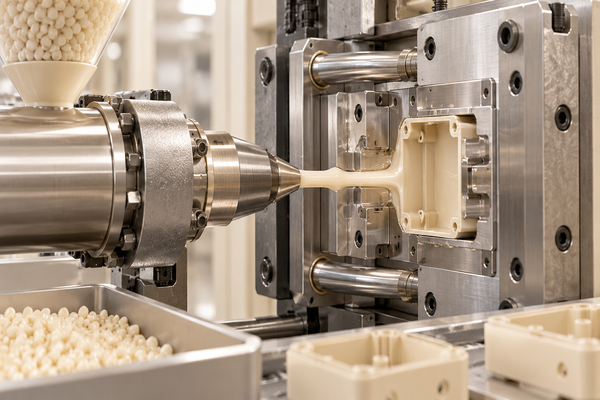
Correct processing conditions are important for stable production and good part quality.
The table below provides general starting points for many standard PLA grades.
| Processing Parameter | Typical Starting Range |
|---|---|
| Melt temperature | 170–210°C |
| Mold temperature | 20–40°C for selected standard amorphous grades |
| Material drying | Follow the PLA grade manufacturer’s instructions |
| Target moisture content | Below 250 ppm, or as specified by the supplier |
| Injection speed | Moderate, depending on part geometry |
| Holding pressure | Adjust to control packing and shrinkage |
| Cooling time | Depends on part thickness and material |
| Screw speed | Low to moderate |
Important: These values are only general references. The correct settings depend on the specific PLA grade.
For example, high-heat PLA compounds may need higher mold temperatures to develop crystallinity.
Always check the material supplier’s technical data sheet before production.
1. Dry PLA Before Injection Molding
Moisture is one of the biggest challenges in PLA injection molding.
If wet pellets enter the barrel, water can damage the polymer chains during melting. This process is called hydrolysis.
As a result, molded parts may become weaker and more brittle.
To reduce moisture-related problems:
- Dry PLA according to the supplier’s instructions.
- Use suitable drying equipment.
- Keep dried pellets protected from moisture.
- Avoid leaving material exposed to humid air.
- Check material moisture when necessary.
Some amorphous PLA grades require relatively low drying temperatures. Higher temperatures may cause the pellets to soften or stick together.
Therefore, drying conditions should always match the material grade.
2. Control the PLA Melt Temperature
PLA needs enough heat to flow through the mold.
If the temperature is too low, poor flow may cause short shots or flow marks.
However, excessive heat may degrade the material.
Common signs of degradation include:
- Yellow or brown discoloration
- Unusual odor
- Black spots
- Reduced mechanical strength
- Unstable molding performance
For better results, use the lowest practical melt temperature that allows complete filling.
Also, avoid keeping PLA inside a hot barrel for too long.
3. Choose the Correct Mold Temperature
Mold temperature affects cooling, shrinkage, and dimensional stability.
For some standard PLA products, a relatively cool mold can provide acceptable cycle times.
However, certain heat-resistant PLA grades need warmer molds.
Higher mold temperatures can help suitable PLA compounds develop crystallinity. This may improve their heat resistance.
On the other hand, warmer molds can increase production cycle time.
Therefore, the correct mold temperature depends on the material grade and required product performance.
4. Adjust Injection Speed and Pressure
Injection speed affects how molten PLA fills the cavity.
If the speed is too low, the material may cool before reaching the end of the flow path.
As a result, short shots or poor surface quality may occur.
However, excessive injection speed can increase shear heating and create flash or other defects.
Start with a moderate speed. Then adjust the settings based on the filling pattern and part quality.
Holding pressure is also important. Proper packing can reduce sink marks and improve dimensional accuracy.
Common PLA Injection Molding Defects and Solutions
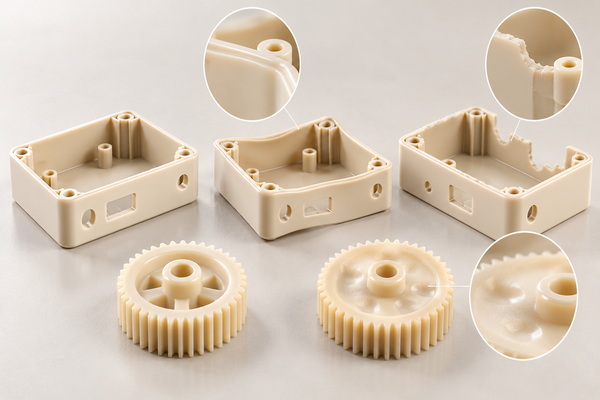
PLA injection molding can produce good-quality parts. However, several material properties make processing more sensitive.
The following problems are among the most common.
1. PLA Material Degradation
PLA is sensitive to moisture and excessive heat.
If the pellets contain too much moisture, hydrolysis may occur during melting.
Also, excessive barrel temperatures or long residence times can damage the material.
Common signs:
- Discoloration
- Reduced strength
- Brittle parts
- Poor surface appearance
- Unstable molding quality
Solutions:
- Dry the material properly.
- Control melt temperature.
- Reduce barrel residence time.
- Avoid long production interruptions.
- Follow the supplier’s purging instructions.
Good material preparation helps maintain stable molding quality.
2. Brittleness and Cracking
Standard PLA has good stiffness but limited impact resistance.
Therefore, thin clips, snap-fit features, and flexible sections may crack during assembly.
Sharp corners and uneven wall thickness can increase this risk.
Solutions:
- Choose impact-modified PLA when necessary.
- Avoid sharp internal corners.
- Add suitable radii to stressed areas.
- Improve wall thickness transitions.
- Test assembly features before mass production.
If a product requires repeated bending or high impact resistance, another plastic may be more suitable.
3. Low Heat Resistance
Standard amorphous PLA has a glass transition temperature of approximately 55–65°C.
As a result, parts may soften or deform when exposed to elevated temperatures.
This limits the use of standard PLA in some industrial and automotive applications.
Solutions:
- Choose heat-resistant PLA grades.
- Use suitable crystallizing PLA compounds.
- Optimize mold temperature.
- Consider annealing when appropriate.
- Test the product under actual service conditions.
Improved crystallinity can increase heat resistance in suitable PLA formulations.
However, it may also affect shrinkage, dimensional stability, and cycle time.
4. Warpage and Dimensional Changes
Warpage is another common problem in PLA injection molding.
Uneven cooling, poor packing, or internal stress can cause parts to bend after ejection.
Changes in crystallinity may also affect part dimensions.
Solutions:
- Keep wall thickness uniform.
- Improve mold cooling.
- Use balanced gate locations.
- Adjust holding pressure.
- Allow sufficient cooling time.
- Consider shrinkage during mold design.
For products that require annealing, dimensional changes after heat treatment must also be considered.
5. Short Shots and Poor Filling
Short shots happen when molten PLA does not completely fill the mold cavity.
This problem is more common in thin-wall parts and products with long flow paths.
Low melt temperatures, insufficient pressure, and poor venting may contribute to the problem.
Solutions:
- Check the recommended melt temperature.
- Adjust injection speed and pressure.
- Improve gate and runner design.
- Add proper mold venting.
- Reduce unnecessary flow restrictions.
For complex products, mold flow analysis can help identify filling problems before tooling production.
6. Difficult Demolding
Some PLA products may stick to the mold during ejection.
This can happen when the part has insufficient draft angles, deep ribs, or poor surface conditions.
Also, parts may deform if they are ejected before they become stiff enough.
Solutions:
- Add suitable draft angles.
- Avoid unnecessary undercuts.
- Improve mold surface finish.
- Use balanced ejector positions.
- Optimize cooling time.
- Reduce stress during ejection.
Good mold design helps reduce part damage and production interruptions.
PLA Injection Mold Design Tips
A well-designed mold can prevent many PLA processing problems.
During mold development, engineers should consider material flow, cooling, shrinkage, and ejection.
At Fentor Mold, we focus on practical mold design solutions for stable injection molding and consistent plastic part quality.
Keep Wall Thickness Uniform
Uneven wall thickness can create different cooling rates.
Thick sections usually cool more slowly than thin areas. As a result, sink marks, internal stress, or warpage may develop.
Keep wall thickness consistent whenever possible.
Also, use smooth transitions between thick and thin sections.
Optimize Gate and Runner Design
Gate and runner design control how molten PLA enters the cavity.
Poor gate locations may cause weld lines, short shots, or uneven packing.
For better results:
- Choose gate locations that support balanced filling.
- Avoid unnecessarily long flow paths.
- Reduce sharp restrictions.
- Consider weld line locations.
- Select suitable gate sizes.
For complex parts, mold flow simulation can support gate selection and filling analysis.
Improve Mold Cooling
Cooling affects both part quality and cycle time.
Uneven mold temperatures may cause different shrinkage rates across the product.
Therefore, a balanced cooling system is important.
However, cooling requirements depend on the selected PLA grade.
Standard amorphous PLA and high-heat crystallizing PLA may require different mold temperatures.
Add Suitable Draft Angles
Draft angles help molded parts release from the cavity and core.
Without enough draft, parts may stick to the mold and become damaged during ejection.
For some simple molded surfaces, around 1–2° can be a useful starting point.
However, deep ribs, textured surfaces, and complex features may require more draft.
The final angle should depend on part geometry and material behavior.
Applications of PLA Injection Molded Parts
PLA injection molding is suitable for many consumer products and selected industrial applications.
However, material selection should consider operating temperature, mechanical strength, and expected product life.
Consumer Products
PLA is used in selected household and personal care products.
Examples include:
- Cosmetic packaging
- Rigid containers
- Decorative accessories
- Personal care product housings
- Small household items
These applications can benefit from PLA’s stiffness and bio-based raw materials.
However, high-temperature or high-impact products may require modified PLA.
Packaging and Containers
PLA injection molding can produce certain rigid packaging components.
Examples include packaging lids, small containers, and product covers.
However, food-contact products require suitable material grades and compliance with relevant regulations.
In addition, packaging exposed to hot filling or high storage temperatures needs extra testing.
Disposable Products
PLA can be used in selected single-use products.
However, not every PLA product is certified compostable.
Therefore, manufacturers should confirm the compostability of the finished product before making environmental claims.
Industrial and Technical Parts
Modified PLA compounds may be suitable for some low-load technical components.
Possible applications include covers, housings, and non-critical plastic parts.
However, standard PLA is generally not suitable for products exposed to high temperatures, heavy loads, or repeated mechanical stress.
For demanding applications, other engineering plastics may offer better performance.
PLA vs ABS vs PP for Injection Molding
PLA, ABS, and PP are common materials for injection molded products.
However, each has different advantages.
| Property | PLA | ABS | PP |
|---|---|---|---|
| Raw material source | Mainly bio-based | Mainly fossil-based | Mainly fossil-based |
| Stiffness | High | Good | Moderate |
| Impact resistance | Limited for standard PLA | Good | Grade-dependent |
| Heat resistance | Limited for standard PLA | Generally better | Grade-dependent |
| Moisture drying | Usually required | Usually required | Usually not required |
| Chemical resistance | Application-dependent | Moderate | Generally good |
| Injection moldability | Good with proper control | Good | Good |
| Common applications | Packaging and consumer products | Housings and consumer products | Containers and household products |
When Should You Choose PLA?
PLA may be suitable when:
- The product requires a bio-based material.
- High stiffness is important.
- Operating temperatures are relatively low.
- Impact requirements are limited.
- The selected grade meets product requirements.
When Are ABS or PP Better Options?
ABS is often a better choice for plastic housings that require higher toughness and impact resistance.
Meanwhile, PP offers good chemical resistance and flexibility for many consumer products.
For example, PP is commonly used for living hinges and flexible packaging components.
Material selection should always consider the actual operating conditions.
For more information, read our guide to ABS Chemical Resistance.
You can also learn how processing conditions affect ABS parts in our article about ABS Injection Molding Temperature.
How to Improve PLA Injection Molding Quality
Manufacturers can improve PLA injection molding quality by following a structured development process.
Step 1: Choose the Correct PLA Grade
Review the product requirements before material selection.
Consider stiffness, impact resistance, heat resistance, appearance, and service life.
If standard PLA cannot meet these requirements, consider a modified PLA grade.
Step 2: Review the Product Design
Check wall thickness, ribs, corners, and draft angles.
A good design can prevent many defects before mold manufacturing begins.
Also, avoid unnecessary stress concentrations.
Step 3: Optimize the Injection Mold
Review gate locations, runners, cooling channels, and ejector positions.
For complex products, mold flow analysis can help identify possible problems.
Step 4: Control Material Moisture
Dry the PLA according to the supplier’s instructions.
Also, protect dried pellets from moisture before processing.
Step 5: Establish Stable Processing Conditions
Adjust melt temperature, mold temperature, injection speed, holding pressure, and cooling time.
Once the process becomes stable, avoid unnecessary changes.
Step 6: Inspect and Test the Parts
Check product dimensions and surface quality.
Also, test mechanical performance and heat resistance when required.
If the parts require annealing, inspect their dimensions again after heat treatment.
Is PLA Injection Molding Suitable for Mass Production?
Yes. PLA injection molding can support mass production when the correct material and processing conditions are used.
However, manufacturers must consider several factors before large production runs.
These include:
- Material cost
- Production cycle time
- Product strength
- Dimensional stability
- Scrap rate
- Heat resistance
- Quality consistency
For example, standard PLA may provide efficient molding cycles for certain consumer products.
However, high-heat PLA compounds may require longer cycles to develop crystallinity.
This can increase production costs.
Therefore, the mold and processing conditions should be validated during sampling.
At Fentor Mold, we provide custom injection mold manufacturing and plastic injection molding services. Our engineering team can review product drawings, material requirements, and mold designs for new projects.
For PLA products, we recommend confirming the material grade before finalizing the mold design.
Frequently Asked Questions About PLA Injection Molding
Can PLA Be Injection Molded?
Yes. PLA can be processed using conventional injection molding machines. However, proper drying, temperature control, and mold design are important.
What Is the Recommended PLA Injection Molding Temperature?
Many standard PLA grades use melt temperatures around 170–210°C. However, the actual temperature depends on the material grade and supplier recommendations.
Does PLA Need Drying Before Injection Molding?
Yes. PLA is sensitive to moisture during melting. Proper drying helps prevent material degradation and improves part quality.
Why Do PLA Injection Molded Parts Crack?
Standard PLA can be brittle. Sharp corners, internal stress, poor material drying, and unsuitable product design may increase cracking risks.
How Can You Reduce PLA Injection Molding Warpage?
Use uniform wall thickness, balanced cooling, suitable gate locations, and stable holding pressure.
Also, consider shrinkage and crystallization during mold design.
Can PLA Replace ABS in Injection Molding?
PLA can replace ABS in selected low-temperature and low-impact applications.
However, ABS usually provides better toughness and heat resistance than standard PLA.
Is PLA Injection Molding More Expensive Than PP?
It can be. PLA resin often costs more than standard commodity PP.
In addition, drying, cycle time, and scrap rates may affect the final production cost.
Conclusion
PLA injection molding is a practical manufacturing option for consumer products, packaging components, and selected technical parts.
However, PLA requires careful processing. Moisture, excessive heat, brittleness, and limited heat resistance can cause molding problems.
To achieve better results, manufacturers should select the correct PLA grade, optimize mold design, and maintain stable processing conditions.
Good product design and early testing can also reduce production risks.
Looking for a reliable injection mold manufacturer?
Fentor Mold provides custom injection mold manufacturing and plastic injection molding services. Contact our team to discuss your product design, material requirements, and production needs.