
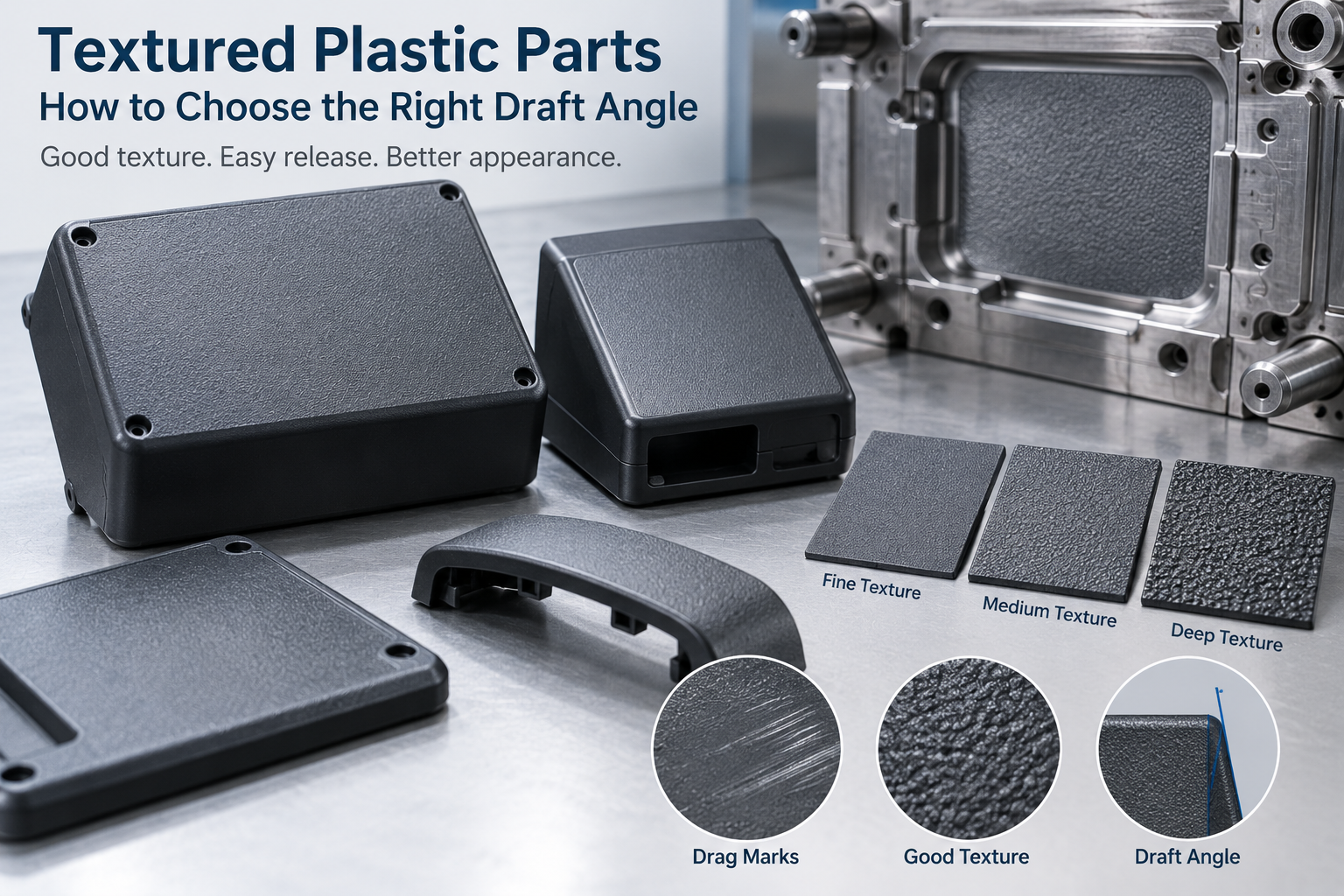
Textured plastic parts usually need more draft than smooth molded parts.
The reason is simple. A textured cavity surface creates more friction during ejection. If the draft angle is too small, the part may drag against the mold surface. As a result, scratches, drag marks, gloss changes, or even sticking can appear.
Therefore, draft angle should be reviewed together with texture depth, texture direction, part geometry, and ejection method.
At Fentor Mold, we normally check these points during DFM because texture-related problems are easier to prevent before steel cutting than to repair later.
Why Textured Plastic Parts Need More Draft
A smooth plastic surface can often release with a relatively small draft angle.
However, a textured surface behaves differently.
The texture creates peaks and valleys on the mold surface. During ejection, these small details increase resistance between the plastic and the steel.
If the side wall is almost vertical, the molded part may rub heavily against the texture.
This can cause:
- Drag marks
- Scratches
- Uneven gloss
- White stress marks
- Surface damage
- Difficult ejection
- Part deformation
Therefore, textured plastic parts usually require more draft than polished or smooth parts.
Texture Depth Affects the Required Draft Angle
Not all textures are the same.
A light matte texture needs less draft than a deep grain pattern.
In general, deeper texture creates more resistance during ejection.
This means the draft angle should increase as texture depth increases.
Important factors include:
- Texture depth
- Texture pattern
- Surface roughness
- Mold release direction
- Plastic material
- Part wall height
- Product shape
For example, a shallow fine texture on a short wall may release easily.
However, a deep grain on a tall side wall may need much more draft.
Therefore, the texture specification should be confirmed before the mold design is finalized.
Textured Plastic Parts Can Show Drag Marks Easily
Drag marks are one of the most common problems on textured surfaces.
They usually appear when the plastic rubs against the mold during ejection.
Typical causes include:
- Too little draft
- Deep texture
- Long vertical walls
- Poor ejection balance
- Local undercut
- Incorrect mold release direction
The damage may appear as shiny lines or flattened texture.
Sometimes the part still ejects successfully, but the surface quality is no longer acceptable.
This is especially important for visible products such as:
- Electronic housings
- Automotive interior parts
- Appliance covers
- Control panels
- Consumer plastic products
For these parts, appearance can be just as important as function.
Draft Angle Should Match the Texture Direction
Texture direction also matters.
If the texture runs against the mold release direction, ejection becomes more difficult.
In this case, even a reasonable draft angle may not be enough.
Therefore, the mold designer should check:
- Mold opening direction
- Slider direction
- Lifters
- Parting line
- Texture direction
- Local shut-off areas
This is especially important when the product has several textured surfaces facing different directions.
A single draft value may not work for every wall.
Tall Walls Need More Attention
Wall height affects how much rubbing happens during ejection.
A short textured wall may release with little trouble.
However, a tall wall remains in contact with the mold for a longer distance.
As a result, the risk of drag marks increases.
For tall textured plastic parts, the designer should check whether the draft angle is sufficient over the full wall height.
Sometimes a small increase in draft can make a large difference in mold release.
Material Also Affects Mold Release
Different plastics behave differently during ejection.
Some materials shrink more tightly around the core.
Others may have higher friction or lower stiffness.
Therefore, draft angle should not be selected only by texture depth.
Material also matters.
Common materials for textured parts include:
- ABS
- PC+ABS
- PP
- PC
- PA
- TPE
For example, a rigid ABS housing and a flexible TPE part may need different release strategies.
In addition, glass-filled materials can behave differently from standard resin grades.
So, material choice should be part of the draft review.
Avoid Texturing Critical Shut-Off Areas
Texture should not be applied blindly to every visible surface.
Some areas are more sensitive.
These include:
- Shut-off surfaces
- Slider contact areas
- Sealing surfaces
- Assembly fits
- Snap-fit regions
- Thin edges
Texture in the wrong location can create wear or make mold fitting difficult.
Therefore, the texture map should clearly define where texture starts and stops.
For complex projects, Fentor Mold usually reviews the texture boundary together with the parting line and moving mold components.
This reduces the risk of later rework.
Textured Plastic Parts Need Good Ejection Design
Draft angle alone cannot solve every release problem.
Ejection design also matters.
If ejector force is uneven, the part may tilt during release.
As a result, one side may drag against the mold even when the nominal draft is acceptable.
Useful design considerations include:
- Balanced ejector layout
- Enough ejector area
- Stable core support
- Proper lifter design
- Controlled slider movement
- Enough cooling before ejection
If the part is still too hot, it may deform more easily during ejection.
Therefore, cooling and ejection timing should also be checked.
Appearance Defects May Appear Only After Texturing
A smooth mold trial may look fine.
However, after texture is applied, new problems can appear.
For example:
- Drag marks
- Uneven gloss
- Texture whitening
- Local sticking
- Texture damage
- Visible flow differences
This is why textured products should not be judged only from a polished T1 sample.
The final texture can change the release condition.
Therefore, the mold should be tested again after texturing if the appearance is critical.
How to Choose the Right Draft Angle for Textured Plastic Parts
There is no single draft angle that works for every texture.
The correct value depends on the full product design.
Buyers and engineers should consider:
- Texture depth
- Wall height
- Plastic material
- Mold release direction
- Visible surface requirement
- Slider and lifter direction
- Ejection method
- Part geometry
The texture supplier may also provide recommended draft values for a specific texture code.
These recommendations are useful, but they should still be checked against the real part geometry.
A deep texture on a short wall is different from the same texture on a long side wall.
Therefore, draft should be reviewed locally, not only as one general number for the whole part.
What Buyers Should Confirm Before Mold Texturing
Before texture is applied, buyers should confirm several points.
Check:
- Final texture code
- Texture area
- Texture boundary
- Approved texture sample
- Draft angle
- Main appearance surface
- Mold release direction
- Slider and lifter areas
- Areas that should remain polished
This step is important because texture removal or rework can be difficult.
If the wrong area is textured, the mold may need polishing, welding, machining, or another texture process.
Therefore, approval before texturing can save both time and cost.
How Fentor Mold Reviews Textured Plastic Parts
For textured plastic parts, Fentor Mold normally checks the relationship between texture, draft, ejection, and appearance.
The review usually focuses on:
- Whether the draft is enough
- Whether deep texture is used on tall walls
- Whether the texture crosses a moving mold area
- Whether the part may drag during ejection
- Whether texture boundaries are clear
- Whether sliders or lifters need extra clearance
The goal is not simply to make the mold open.
The part should release cleanly and keep the intended surface appearance.
Final Thoughts
Good textured plastic parts depend on more than choosing a texture pattern.
Draft angle is one of the most important factors.
If the draft is too small, the part may drag against the mold and damage the surface. If the texture is deep, the risk becomes even higher.
Therefore, texture depth, wall height, material, mold direction, and ejection should be reviewed together.
For appearance-critical parts, this review should happen before mold manufacturing and before final texturing.
A small change in draft angle can prevent drag marks, surface damage, and difficult ejection later.
If your project includes textured housings, covers, automotive interior parts, or other appearance-sensitive molded components, Fentor Mold can review the draft and texture areas during DFM before tooling starts.