Choosing between thermoset vs thermoplastic is an important decision when developing an injection molded plastic part. The two material families behave differently during molding and in the finished product. The right choice depends on temperature, mechanical loads, chemical exposure, dimensional requirements, production volume, and cost.
For many everyday plastic parts, thermoplastics are the practical choice because they offer a wide material range and efficient processing. Thermosets become more attractive when the part must maintain its properties under high heat, chemical exposure, or demanding electrical conditions.
So, which is better for injection molding? There is no universal winner. The better material is the one that matches the actual working conditions of the part.
Thermoset vs Thermoplastic: What Is the Main Difference?
The biggest difference between thermoset vs thermoplastic materials is how they respond to heat after molding.
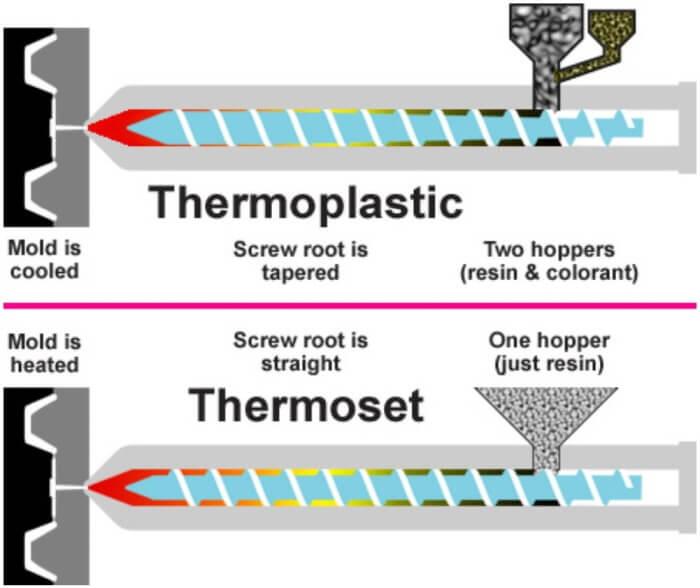
Thermoplastics soften or melt when heated and solidify again when cooled. This behavior makes them suitable for conventional injection molding and allows many thermoplastic materials to be reprocessed.
Thermosets undergo an irreversible curing or cross-linking reaction during processing. Once cured, they do not simply melt again when reheated. This permanent molecular structure is one reason thermosets can provide strong resistance to heat, chemicals, and dimensional change.
| Factor | Thermoset | Thermoplastic |
|---|---|---|
| Behavior after heating | Permanently cured | Can soften or melt again |
| Reprocessing | Generally not possible | Possible for many materials |
| Heat resistance | Usually excellent | Depends strongly on resin |
| Chemical resistance | Often excellent | Depends on resin |
| Impact resistance | Material dependent | Often very good |
| Dimensional stability | Often excellent | Material dependent |
| Production flexibility | More specialized | Very broad |
| Common applications | Electrical, industrial, high-temperature parts | Automotive, electronics, appliances, consumer products |
The table is a starting point rather than a final material-selection rule. Individual grades can behave very differently within either material family.
How Thermoplastic Injection Molding Works
Thermoplastic injection molding is the more familiar process for most plastic manufacturers.
Plastic pellets are heated until they become molten or sufficiently softened. The material is then injected into the mold cavity, where it cools and solidifies into the required shape.
After cooling, the mold opens and the part is ejected.
This process is well suited to high-volume production because the material can be processed repeatedly and injection molding cycles can be relatively short depending on the material, part geometry, and mold design.
Common thermoplastics include:
- PP
- ABS
- PC
- PA
- POM
- HDPE
- PVC
- PEEK
- PPS
- TPE
The material should not be selected simply because it is commonly used. The actual application requirements should determine the resin grade.
For a broader look at material choices, see our article 10 Best Injection Molding Materials for High Quality Parts.
How Thermoset Injection Molding Works
Thermoset molding is different because the material must cure inside the mold.
The material is heated and injected or otherwise introduced into the mold cavity. Heat and pressure promote the curing or cross-linking reaction. Once the material has cured, the finished part maintains its permanent shape and cannot simply be melted and reshaped.
This difference affects the mold design, processing conditions, equipment, cycle time, and production controls.
Common thermoset materials include phenolic compounds, epoxy systems, certain polyester compounds, and silicone-based materials. The exact processing method depends on the specific resin and compound.
This is important when selecting a supplier. A manufacturer experienced in standard thermoplastic injection molding does not automatically have the equipment and process experience needed for every thermoset application.
Thermoset vs Thermoplastic: Heat Resistance
Heat resistance is one of the strongest reasons to consider a thermoset.
Because thermosets form a permanent cross-linked structure during curing, they can maintain dimensional and mechanical stability under demanding thermal conditions. They are therefore commonly considered for applications where long-term heat exposure is important.
Thermoplastics vary considerably in this area.
A commodity thermoplastic may soften or deform at temperatures that would not be a problem for a high-performance engineering resin. On the other hand, materials such as PPS or PEEK can provide very high temperature performance.
Therefore, it would be incorrect to assume that thermoset always means better heat resistance.
A better approach is to compare the actual grades against the required continuous operating temperature, short-term temperature exposure, mechanical load, and expected service life.
Thermoset vs Thermoplastic: Mechanical Performance
Mechanical performance is another area where the answer depends on the application.
Thermosets can provide high stiffness, hardness, dimensional stability, and resistance to deformation. However, some thermoset materials can be more brittle and less impact-resistant than suitable thermoplastics.
Thermoplastics cover a much wider range of mechanical behavior.
For example:
- PP can provide flexibility and good chemical resistance.
- ABS offers a useful combination of toughness and processability.
- PC is known for high impact resistance.
- PA can provide strength and wear resistance.
- POM offers stiffness, low friction, and good dimensional behavior.
This means that a product requiring repeated impact, snap-fit assembly, or flexibility may favor a thermoplastic.
A high-temperature electrical component with strict dimensional requirements may point toward a thermoset.
Thermoset vs Thermoplastic: Chemical Resistance
Chemical exposure should be considered before selecting the material.
Thermosets often provide strong chemical resistance because of their cross-linked structure. This can make them useful in demanding industrial environments.
However, thermoplastic chemical resistance varies significantly by resin.
For example, one thermoplastic may perform well against a particular chemical while another may suffer stress cracking or degradation.
Therefore, do not select material based only on the general label “thermoset” or “thermoplastic.” Check the specific resin’s chemical compatibility with:
- Oils
- Fuels
- Cleaning agents
- Acids
- Alkalis
- Solvents
- Coolants
- Outdoor chemicals
The operating temperature should also be considered because chemical resistance can change with temperature.
Thermoset vs Thermoplastic: Dimensional Stability
Dimensional stability can become critical when a plastic component has tight tolerances or must remain stable for years of service.
Thermosets can perform well in applications where low deformation and stable dimensions under heat are important. Their cross-linked structure helps prevent the material from simply softening and flowing when heated.
Thermoplastics can also provide excellent dimensional stability, but the result depends on the resin, reinforcement, part design, processing conditions, and environment.
For example, glass-fiber-reinforced thermoplastics can provide significantly different dimensional behavior from an unfilled resin.
Therefore, mold design and processing remain important even after the material has been selected.
Thermoset vs Thermoplastic: Cost and Production
Cost is often where purchasing teams want a simple answer, but there is no fixed rule that thermosets are cheaper or more expensive.
Material price is only one part of the calculation.
Consider:
- Resin cost
- Cycle time
- Mold cost
- Machine requirements
- Scrap
- Post-processing
- Tool maintenance
- Production volume
- Quality inspection
- Material handling
Thermoplastics are often attractive for high-volume production because of their broad material availability and efficient molding processes.
Thermosets can make economic sense when their performance eliminates the need for additional components, insulation, heat protection, or other design measures.
In other words, compare total part cost, not simply the price per kilogram of resin.
Which Applications Use Thermoset Materials?
Thermosets are particularly useful where the finished component must withstand demanding environments.
Electrical Components
Thermosets can provide strong electrical insulation and resistance to heat, making them useful for certain electrical and electronic components.
Automotive Components
Thermoset materials can be considered for components exposed to high temperatures, chemicals, or demanding mechanical conditions.
Industrial Components
Industrial equipment may require materials that maintain their dimensions and properties under heat and chemical exposure.
High-Temperature Components
When a part operates continuously at elevated temperatures, a thermoset may be worth considering if conventional thermoplastics cannot meet the required performance.
For more background, see our article What Is Thermoset Plastic? Properties and Applications.
Which Applications Use Thermoplastic Materials?
Thermoplastics are used across a much broader range of injection molded products.
Typical examples include:
- Automotive interior and exterior parts
- Consumer electronics housings
- Home appliance components
- Medical products
- Packaging
- Industrial components
- Toys
- Household products
Their wide material selection makes it possible to balance impact resistance, stiffness, transparency, chemical resistance, heat resistance, appearance, and cost.
For companies producing complex plastic parts, thermoplastic injection molding also provides many options for insert molding, overmolding, two-shot molding, and other processes.
Thermoset vs Thermoplastic: Which Is Better for Injection Molding?
The answer depends on what the part needs to do.
Choose Thermoplastic When:
- High-volume production is expected.
- Good impact resistance is important.
- The part requires flexibility or snap-fit features.
- Reprocessing or recycling is important.
- A wide range of colors and surface finishes is required.
- The operating temperature is within the selected resin’s capability.
- Standard injection molding production is preferred.
Consider Thermoset When:
- High-temperature stability is critical.
- The part must resist permanent deformation under heat.
- Electrical insulation is a major requirement.
- Chemical resistance is important.
- Long-term dimensional stability is required.
- The application justifies specialized thermoset processing.
There are also applications where both material families could technically work. In these cases, engineering should compare the complete performance and cost requirements rather than choosing based on material category alone.
What Should Buyers Tell the Mold Manufacturer?
When requesting a quotation, provide more than just the part drawing.
For thermoset vs thermoplastic material selection, the supplier should understand:
- Material or required material properties
- Expected annual quantity
- Part weight
- Operating temperature
- Chemical exposure
- Dimensional tolerance
- Surface requirements
- Expected mold life
- Production location
- Required certification
If the material has not been finalized, provide the required performance instead.
For example, instead of saying:
“Please recommend a plastic.”
it is much more useful to say:
“The part will operate continuously at 150°C, must provide electrical insulation, and requires dimensional stability after long-term heat exposure.”
That information allows the mold manufacturer and material supplier to make a much more meaningful recommendation.
Does Material Choice Affect Mold Design?
Yes.
The material decision should be made early because different plastics can require different processing conditions and mold design considerations.
Material selection can influence:
- Mold temperature
- Cooling or heating requirements
- Gate design
- Runner design
- Venting
- Shrinkage
- Ejection
- Mold steel
- Surface finish
- Cycle time
Thermoset molding can also require a different mold temperature strategy because curing takes place inside the mold, while thermoplastic molding relies primarily on cooling the molten material after filling.
This is why material selection should happen before the mold design is finalized.
For projects that require complete tooling and production support, Fentormold provides custom injection mold manufacturing and Injection Molding Production services.
A Practical Way to Choose Between Thermoset and Thermoplastic
If you are still unsure which material family to use, start with the application rather than the material name.
Ask these questions:
1. What Temperature Will the Part See?
If continuous high-temperature performance is critical, investigate thermosets as well as high-performance thermoplastics.
2. Does the Part Need to Flex or Absorb Impact?
If yes, a suitable thermoplastic may provide an advantage.
3. Does the Part Need Electrical Insulation?
If electrical performance is critical, thermoset materials may deserve closer consideration.
4. Is Chemical Exposure Severe?
Compare actual chemical-resistance data for the candidate grades rather than relying on general material categories.
5. What Is the Production Volume?
For high-volume production, cycle time and manufacturing efficiency can have a major effect on total cost.
6. Can the Material Be Reprocessed?
If recyclability or regrinding is an important project requirement, thermoplastics generally offer more options than cured thermosets.
Final Takeaway
There is no simple winner in the thermoset vs thermoplastic comparison.
Thermoplastics are usually the more flexible choice for general injection molding because they offer a broad material range, efficient production, good impact performance in many grades, and the ability to be reheated and reprocessed.
Thermosets become more attractive when the part needs strong resistance to heat, chemicals, electrical stress, or long-term dimensional change.
The best material is therefore not the one with the most impressive datasheet. It is the one that can meet the actual operating conditions, production requirements, and target cost of the finished part.
For buyers planning a new injection molding project, material selection should be discussed before mold construction begins. A small decision at the material-selection stage can affect mold design, processing conditions, cycle time, quality, and the final cost of the entire project.