Plastic molding is used to manufacture products in almost every major industry, from automotive components and electronic housings to medical devices, packaging, and industrial parts. However, different products require different manufacturing processes.
The main types of plastic molding include injection molding, blow molding, compression molding, extrusion, rotational molding, thermoforming, vacuum forming, insert molding, and overmolding. Each process has different advantages, limitations, tooling requirements, and production costs.
For example, injection molding is generally suitable for complex three-dimensional plastic parts with ribs, bosses, snap fits, and tight dimensional requirements. Blow molding is better suited to hollow products such as bottles and tanks, while extrusion is designed for continuous profiles.
Therefore, selecting a plastic molding process should start with the part geometry, material, production volume, and functional requirements, rather than simply choosing the lowest tooling price.
In this guide, we explain the major plastic molding processes, their common applications, advantages, limitations, and the factors buyers should consider before requesting a quotation.
What Are the Main Types of Plastic Molding?
The most common types of plastic molding include:
- Injection molding
- Blow molding
- Compression molding
- Extrusion molding
- Rotational molding
- Thermoforming
- Vacuum forming
- Insert molding
- Overmolding
Although these processes all shape plastic into useful products, their manufacturing principles are very different.
| Process | Best For | Typical Products |
|---|---|---|
| Injection molding | Complex 3D parts | Housings, automotive parts, connectors |
| Blow molding | Hollow products | Bottles, tanks, containers |
| Compression molding | Thermosets and composites | Automotive and electrical components |
| Extrusion molding | Continuous profiles | Tubes, sheets, seals, profiles |
| Rotational molding | Large hollow parts | Tanks, containers, outdoor products |
| Thermoforming | Thin-wall sheet parts | Trays, covers, packaging |
| Vacuum forming | Large shallow shells | Panels, packaging, covers |
| Insert molding | Plastic and metal assemblies | Connectors, threaded components |
| Overmolding | Multi-material parts | Handles, grips, seals |
The right process depends on product geometry, material, production volume, tolerance, surface requirements, and total manufacturing cost.
1. Injection Molding
Injection molding is one of the most widely used plastic manufacturing processes for high-volume production.
During the process, plastic pellets are heated until they melt and are then injected under pressure into a closed mold cavity. After the material cools and solidifies, the mold opens and the finished part is ejected.
Injection molding is particularly effective for complex three-dimensional parts containing:
- Ribs
- Bosses
- Snap fits
- Clips
- Threads
- Living hinges
- Mounting features
- Cosmetic surfaces
Common applications include automotive components, electronic housings, medical parts, appliance components, industrial products, and consumer goods.
For companies looking for reliable custom injection molding, evaluating the material, annual volume, cavity requirement, and part geometry early can help determine whether injection molding is the right production method.
Why Choose Injection Molding?
The main advantages of injection molding include:
- Excellent repeatability
- High production efficiency
- Complex part geometries
- Good dimensional control
- Wide material selection
- Automation potential
- Competitive unit cost at high production volumes
However, injection molding requires an initial tooling investment. Therefore, it becomes particularly attractive when production quantities justify the mold cost.
The mold itself also has a major influence on part quality. Cooling layout, gate location, venting, ejection, shrinkage, and mold steel selection all need to be considered during development.
For projects requiring production tooling, an experienced injection mold supplier can help reduce risks related to mold design, manufacturing, and long-term maintenance.
2. Blow Molding
2. Blow Molding
blow molding process for hollow plastic products
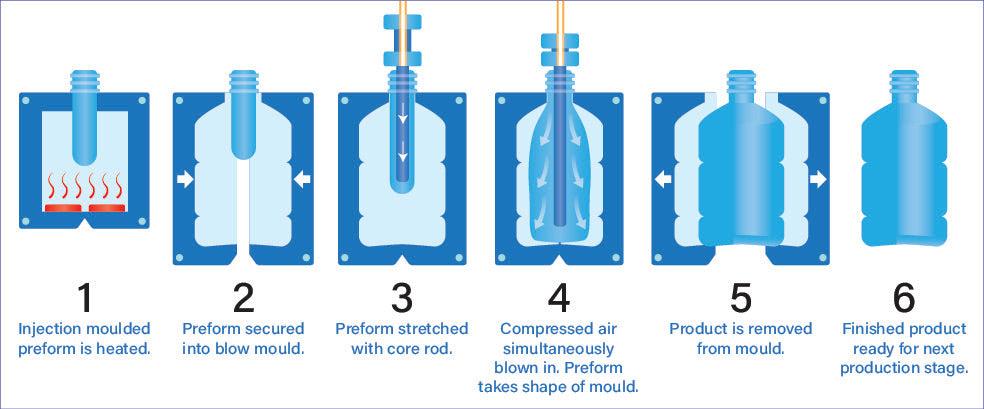
Blow molding uses internal air pressure to form heated plastic against the mold cavity and is primarily used to manufacture hollow plastic products.
The process forms a heated plastic tube or preform and then uses internal air pressure to expand the material against the mold cavity.
Typical products include:
- Plastic bottles
- Fuel tanks
- Water tanks
- Chemical containers
- Air ducts
- Hollow industrial containers
Blow molding is an excellent choice when the internal hollow volume is an essential part of the product design.
However, it is not normally the first choice for products requiring many detailed three-dimensional features such as deep ribs, complex bosses, or precision mounting surfaces.
Injection Molding vs. Blow Molding
The simplest way to distinguish these two processes is:
Injection molding → complex three-dimensional components
Blow molding → primarily hollow products
For example, a bottle cap may be injection molded while the bottle itself is produced using blow molding.
3. Compression Molding
Compression molding forms plastic or composite material by placing a measured charge into a heated mold and applying pressure.
It is commonly used for thermoset materials, rubber-like materials, and certain composite applications.
Typical products include:
- Automotive components
- Electrical components
- Composite parts
- Industrial components
- Heat-resistant components
One advantage of compression molding is that it can be suitable for relatively large parts and materials that are difficult to process using conventional injection molding.
However, cycle times and detailed feature replication can be less favorable than injection molding for certain high-volume precision components.
4. Extrusion Molding
Extrusion is different from most other plastic molding processes because it produces a continuous profile rather than individual molded parts.
Plastic is melted and pushed through a specially shaped die. The die determines the cross-sectional profile.
Common extrusion products include:
- Plastic tubes
- Pipes
- Sheets
- Films
- Seals
- Channels
- Window profiles
- Plastic rods
Extrusion is a strong choice when the cross-section remains relatively constant along the length of the product.
For example, a long plastic seal can be extruded continuously and then cut to the required length.
However, extrusion is not suitable when a component requires complex three-dimensional features such as integrated bosses, snap fits, or enclosed cavities.
5. Rotational Molding
Rotational molding, often called rotomolding, is commonly used for large hollow plastic products.
During the process, plastic material is placed inside a mold. The mold is then heated and rotated so that the material gradually coats the inside surface.
Typical products include:
- Large storage tanks
- Water tanks
- Waste containers
- Outdoor equipment
- Industrial containers
- Playground components
One major advantage of rotational molding is that it can produce large hollow structures with relatively low internal stresses.
The process can also be economical for certain large products because the tooling can be simpler than a large, complex injection mold.
However, rotational molding generally does not provide the same level of dimensional precision or cycle speed as injection molding.
6. Thermoforming
Thermoforming uses heated plastic sheets rather than plastic pellets injected directly into a mold cavity.
The sheet is heated until it becomes soft and then formed over or into a mold.
Typical applications include:
- Packaging trays
- Appliance liners
- Automotive interior panels
- Protective covers
- Medical trays
- Large plastic panels
Thermoforming can be attractive for large, thin-wall components because the tooling can be less expensive than a complex injection mold.
However, deep-draw areas may experience wall thinning, and additional trimming may be required after forming.
Therefore, thermoforming is usually more suitable for relatively thin shell-like products than precision components containing numerous bosses and ribs.
7. Vacuum Forming
Vacuum forming is a type of thermoforming that uses vacuum pressure to pull a heated plastic sheet against the mold surface.
It is commonly used for:
- Packaging
- Equipment covers
- Display products
- Interior panels
- Protective shells
- Large shallow components
Vacuum forming can be useful when a product has relatively simple geometry and production requirements do not justify a high-cost injection mold.
However, the process has limitations when the product requires very tight tolerances, deep features, or complex three-dimensional details.
8. Insert Molding
Insert molding combines plastic with another component, often a metal insert, during the molding process.
A metal component is positioned inside the mold before plastic is injected around it.
Common applications include:
- Electrical connectors
- Threaded components
- Metal bushings
- Automotive components
- Electronic assemblies
Insert molding can reduce secondary assembly operations and create a strong connection between plastic and metal components.
For example, a brass threaded insert can be molded directly into a plastic housing instead of being installed afterward.
This approach can improve assembly efficiency while reducing the number of separate components.
9. Overmolding
Overmolding is another important process when a product requires multiple materials or a combination of rigid and flexible materials.
A typical example is a rigid plastic substrate combined with a softer elastomer surface.
Common applications include:
- Tool handles
- Medical device grips
- Consumer products
- Automotive controls
- Electrical connectors
- Sealing components
For projects requiring two different materials or colors, comparing Two-Shot Molding vs Overmolding can help engineers choose the right process for their application.
For example, a rigid structural material can provide strength while a softer material provides grip, sealing, or improved ergonomics.
Which Types of Plastic Molding Are Best for Precision Parts?
precision injection mold core and cavity for plastic molding
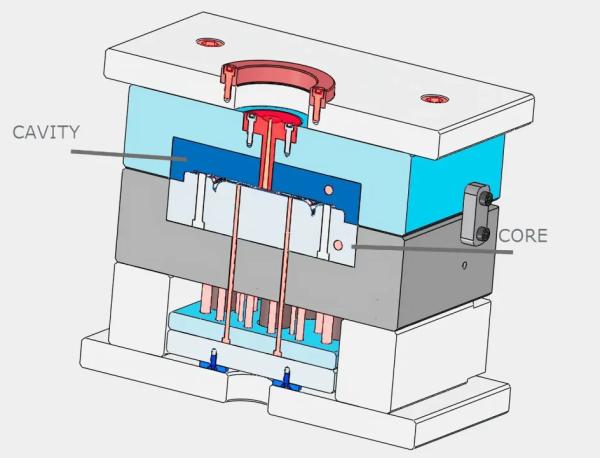
Precision injection mold core and cavity used to form complex three-dimensional plastic parts.
For complex precision plastic components, injection molding is usually the first process to evaluate.
It is particularly suitable when the product requires:
- Tight dimensional control
- Complex 3D geometry
- Multiple ribs and bosses
- Snap-fit features
- Threaded features
- Consistent cosmetic surfaces
- High production volumes
However, precision does not come from the injection molding machine alone.
The mold design has a major influence on the final result.
Important considerations include:
- Mold steel
- Cavity and core design
- Gate location
- Cooling layout
- Venting
- Ejection system
- Shrinkage compensation
- Parting line
- Mold tolerances
This is also why precision mold components are important for stable mold performance.
For projects involving guide pins, bushings, ejector components, mold inserts, or other precision tooling parts, Components Manufacturing plays an important role in maintaining mold alignment, repeatability, and long-term production stability.
How to Choose Between Different Types of Plastic Molding
Selecting among different types of plastic molding should be based on several factors rather than tooling price alone.
1. Part Geometry
Geometry should be the first consideration.
Ask:
- Is the part hollow?
- Is it a continuous profile?
- Does it have complex 3D features?
- Does it require deep drawing?
- Does it contain ribs and bosses?
- Does it require metal inserts?
For example:
Hollow container → Blow molding or rotational molding
Continuous profile → Extrusion
Thin shell → Thermoforming
Complex 3D component → Injection molding
Plastic + metal → Insert molding
Rigid + soft material → Overmolding
2. Production Volume
Annual production volume strongly influences tooling economics.
Injection molding may require a higher initial investment, but the unit cost can become very competitive when the same mold is used to produce hundreds of thousands or millions of parts.
For low-volume projects, prototype tooling or other manufacturing methods may sometimes be more economical.
3. Material Selection
The plastic material must be compatible with the selected process.
Common engineering plastics used for injection molding include:
- ABS
- PP
- PC
- PA
- POM
- PBT
- PE
- TPE
Material shrinkage, flow behavior, temperature resistance, mechanical strength, and chemical resistance should all be considered before tooling begins.
4. Tolerance Requirements
Not every plastic molding process can achieve the same dimensional control.
If a component must fit tightly with another mechanical component, injection molding may be preferable to thermoforming or rotational molding.
However, even injection molding cannot eliminate material shrinkage and process variation. Mold design and process control remain essential.
5. Surface Finish
Cosmetic requirements can also influence process selection.
Visible automotive and consumer products may require:
- High-gloss surfaces
- Textured surfaces
- Mold polishing
- Grain patterns
- Consistent appearance
The mold surface and processing conditions must be designed around these requirements.
6. Total Production Cost
A low tooling price does not always mean a low manufacturing cost.
A better comparison includes:
Tooling + Material + Cycle Time + Labor + Secondary Operations + Scrap + Maintenance + Quality Costs
For high-volume production, even a small difference in cycle time can significantly affect the final part cost.
Plastic Molding Process Comparison
| Process | Best Application | Main Advantage | Main Limitation |
|---|---|---|---|
| Injection molding | Complex 3D parts | Precision and repeatability | Higher tooling investment |
| Blow molding | Hollow products | Efficient hollow-part production | Limited complex features |
| Compression molding | Thermosets and composites | Suitable for certain large parts | Longer cycles |
| Extrusion molding | Continuous profiles | Continuous production | Limited 3D geometry |
| Rotational molding | Large hollow parts | Large parts with relatively simple tooling | Lower precision |
| Thermoforming | Thin shells and trays | Lower tooling cost | Wall thinning and trimming |
| Vacuum forming | Large shallow shells | Simple and economical | Limited detail |
| Insert molding | Plastic + metal | Reduces assembly | Insert loading required |
| Overmolding | Multi-material parts | Combines material functions | More complex tooling |
Common Applications of Different Plastic Molding Processes
The different plastic molding processes are used across almost every major manufacturing sector.
Automotive
Common applications include:
- Dashboards
- Door panels
- Interior trim
- Grilles
- Brackets
- Electrical housings
- Air ducts
Electronics
Typical products include:
- Device housings
- Connectors
- Switches
- Battery housings
- Cable components
- Protective covers
Medical
Plastic molding processes are commonly used for:
- Medical housings
- Laboratory components
- Disposable devices
- Syringe components
- Surgical instrument components
Consumer Products
Applications include:
- Storage containers
- Bottle caps
- Appliance components
- Handles
- Packaging
- Toys
Industrial Products
Common industrial applications include:
- Gears
- Bushings
- Equipment housings
- Industrial containers
- Pipe fittings
- Protective covers
This wide range of applications explains why selecting the correct molding process is an important engineering and purchasing decision.
Common Mistakes When Choosing a Plastic Molding Process
A supplier or buyer can create unnecessary cost and production risk by selecting a process too early.
Choosing the Process Based Only on Tooling Price
A cheaper mold may produce higher scrap, slower cycle times, or unstable dimensions.
The initial mold quotation should therefore be compared with the expected production cost over the life of the project.
Ignoring Annual Production Volume
A process that looks inexpensive for 1,000 parts may not be the best option for one million parts.
Production volume should be considered before deciding how much tooling investment makes sense.
Selecting Material After Tool Design
Material shrinkage and flow behavior can affect mold dimensions, gate design, cooling, and processing conditions.
The material should be confirmed before final mold design whenever possible.
Ignoring Secondary Operations
Trimming, drilling, assembly, insert installation, and surface finishing can significantly increase the actual part cost.
The complete manufacturing route should therefore be considered when comparing processes.
Focusing Only on the Machine
The machine is only one part of the manufacturing system.
Mold design, material, process parameters, cooling, ejection, and quality control all influence the final result.
FAQ About Types of Plastic Molding
What are the main types of plastic molding?
The main types include injection molding, blow molding, compression molding, extrusion molding, rotational molding, thermoforming, vacuum forming, insert molding, and overmolding.
Which plastic molding process is best for complex parts?
Injection molding is generally the best choice for complex three-dimensional plastic parts with ribs, bosses, snap fits, and other detailed features.
Which molding process is best for hollow plastic products?
Blow molding and rotational molding are commonly used for hollow plastic products. The best option depends on product size, geometry, production volume, and dimensional requirements.
Is injection molding suitable for low-volume production?
It can be, but the tooling investment should be evaluated against the expected production volume. Prototype tooling or other manufacturing methods may be more economical for very low quantities.
What factors affect plastic molding cost?
Major factors include material, part size, geometry, annual volume, mold complexity, number of cavities, cycle time, tolerances, surface finish, and secondary operations.
Can one product use multiple molding processes?
Yes. A finished assembly may combine injection molded components with extruded seals, thermoformed trays, blow molded containers, or overmolded components.
Final Thoughts
The different types of plastic molding are designed for different manufacturing requirements.
Injection molding is usually the strongest choice for complex, high-volume 3D components. Blow molding is better for hollow products, extrusion works well for continuous profiles, and thermoforming can be effective for large thin-wall parts. Rotational molding, compression molding, insert molding, and overmolding each provide advantages for specific applications.
The best process should therefore be selected based on part geometry, material, tolerance, production volume, surface requirements, tooling investment, and total production cost.
For manufacturers and purchasing teams, making this decision before tooling begins can prevent expensive design changes and production problems later.
If you are developing a new plastic component, providing the 3D model, material requirement, annual volume, critical tolerances, and surface finish requirements allows a molding supplier to evaluate the most appropriate manufacturing process before the mold is built.
For complex or high-volume plastic components, Fentormold can support the project from mold design and mold manufacturing through injection molding production, helping customers evaluate tooling and production requirements before committing to a manufacturing route.
Contact Fentormold for help evaluating the right plastic molding process for your project.