
CNC Machining for Mold Components: What You Need to Know
- CNC machining is one of the most important manufacturing processes for producing precision injection mold components with tight tolerances and stable quality.
- CNC machining is widely used for mold plates, inserts, cores, cavities, sliders, and other structural components that require high dimensional accuracy.
- Machining accuracy depends on several factors, including material selection, machine capability, cutting parameters, tooling quality, and engineering experience.
- Combining CNC machining with EDM, grinding, and precision inspection helps manufacturers achieve complex mold requirements.
- Choosing an experienced CNC machining supplier can reduce manufacturing risks and improve injection mold performance.
What Is CNC Machining for Mold Components?
CNC machining for mold components is a precision manufacturing process that uses computer-controlled machines to remove material from metal blocks and create accurate mold parts.
Unlike manual machining methods, CNC machines follow programmed instructions from CAD/CAM data to control cutting movements, speed, and machining paths. This allows manufacturers to produce complex components with consistent dimensions and repeatable quality.
In injection mold manufacturing, CNC machining is commonly used for components that require:
- Tight dimensional tolerances
- Complex geometries
- High surface accuracy
- Stable production performance
Typical materials processed by CNC machining include:
- P20 tool steel
- H13 hardened steel
- S136 stainless steel
- NAK80 mold steel
- Aluminum alloys
- Copper alloys
For precision mold production, Injection Mold Manufacturers rely on advanced CNC machining capabilities to create accurate components before final assembly and testing.
Why CNC Machining Improves Mold Component Accuracy
Accuracy is one of the most important factors affecting injection mold quality. A small dimensional error in mold components can lead to:
- Parting line mismatch
- Flash defects
- Poor part fit
- Shorter mold life
- Increased maintenance costs
Professional CNC machining helps control these risks through precise programming, stable cutting processes, and advanced inspection methods.
1. Tight Tolerance Control for Precision Mold Parts
Injection mold components often require extremely accurate dimensions because multiple parts must work together during production.
Common CNC machining tolerances for mold components can reach approximately:
- ±0.01mm for general precision machining
- ±0.005mm or tighter for high-precision applications
The final accuracy depends on:
- Machine rigidity
- Cutting tools
- Material hardness
- Machining strategy
- Operator experience
Components such as mold inserts, cores, and cavity plates require excellent tolerance control to ensure proper mold assembly. For reliable Injection mold components manufacturing, working with an experienced manufacturer helps maintain accuracy and consistency throughout the production process.
2. Complex Geometry Machining Capability
Modern injection molds often contain complicated features that cannot be produced through simple machining methods.
CNC machining can create:
- Deep pockets
- Precision slots
- Cooling channels
- Mounting holes
- Complex structural features
With advanced multi-axis machining centers, manufacturers can reduce setups and improve machining consistency.
This is especially important for molds used in automotive, electronics, and industrial applications where part requirements are becoming more complex.
3. Better Repeatability for Mass Production
Injection molds are expected to produce thousands or even millions of plastic parts.
Consistent mold component quality is essential for maintaining stable production.
CNC machining provides:
- Repeatable machining results
- Stable component dimensions
- Reduced manual adjustment
- Improved assembly efficiency
This helps manufacturers reduce mold trial problems and shorten production preparation time.
Common Mold Components Made by CNC Machining
CNC machining is widely used for many injection mold components.
Mold inserts require high precision because they directly form plastic part features. CNC machining is commonly used for injection mold inserts to create:
- Insert pockets
- Structural features
- Cooling holes
- Mounting areas
For complex cavity details requiring sharp corners or fine textures, CNC machining is often combined with EDM.
Mold Cores and Cavities
Cores and cavities are the most critical components in injection molds.
CNC machining is usually used for:
- Rough machining
- Shape preparation
- Large material removal
After CNC machining, additional processes such as EDM, polishing, and surface treatment may be required to achieve final specifications.
Mold Plates and Structural Components
Many mold structures depend on accurately machined plates and support components.
CNC machining is used for:
- Mold bases
- Clamp plates
- Support plates
- Ejector plates
- Guide systems
These components require reliable flatness, alignment, and dimensional accuracy.
Sliders and Lifters
Slider and lifter systems require precise mechanical movement.
CNC machining helps manufacture:
- Slider bodies
- Wear plates
- Guide surfaces
- Mechanical interfaces
Accurate machining improves mold movement stability and reduces wear during production.
CNC Machining Process for Injection Mold Components
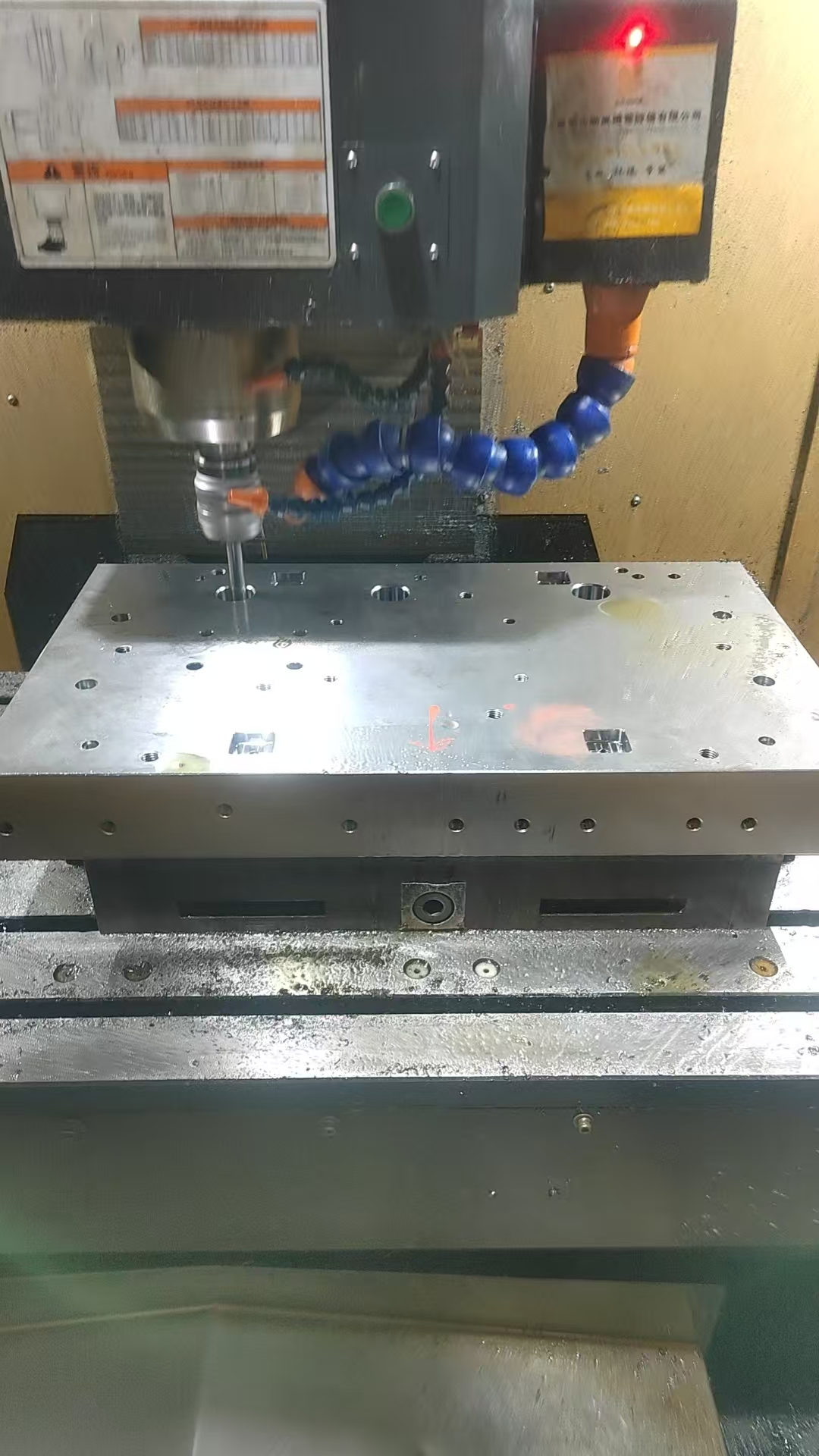
A professional CNC machining process usually includes several important stages.
1. Design Review and CAM Programming
Before machining begins, engineers review 3D models and manufacturing requirements.
Important considerations include:
- Material selection
- Component tolerance
- Machining sequence
- Tool selection
A proper DFM review can identify potential machining issues before production starts.
2. Material Preparation
The selected mold steel is prepared according to project requirements.
Material preparation includes:
- Cutting raw material
- Checking material specifications
- Stress relief when required
Proper material preparation helps reduce deformation during machining.
3. Rough CNC Machining
The first machining stage focuses on removing large amounts of material quickly.
The goal is:
- Creating the basic component shape
- Reducing machining time
- Preparing for finishing operations
4. Finish CNC Machining
Finish machining focuses on achieving final dimensions and surface requirements.
Engineers optimize:
- Cutting speed
- Feed rate
- Tool selection
- Machining path
This stage directly affects component accuracy and surface quality.
5. Inspection and Quality Control
After machining, components should be inspected using precision measurement equipment.
Common inspection methods include:
- Coordinate Measuring Machine (CMM)
- Height gauges
- Optical measurement systems
Inspection ensures CNC machined components meet drawing requirements before mold assembly.
CNC Machining vs EDM Machining for Mold Components
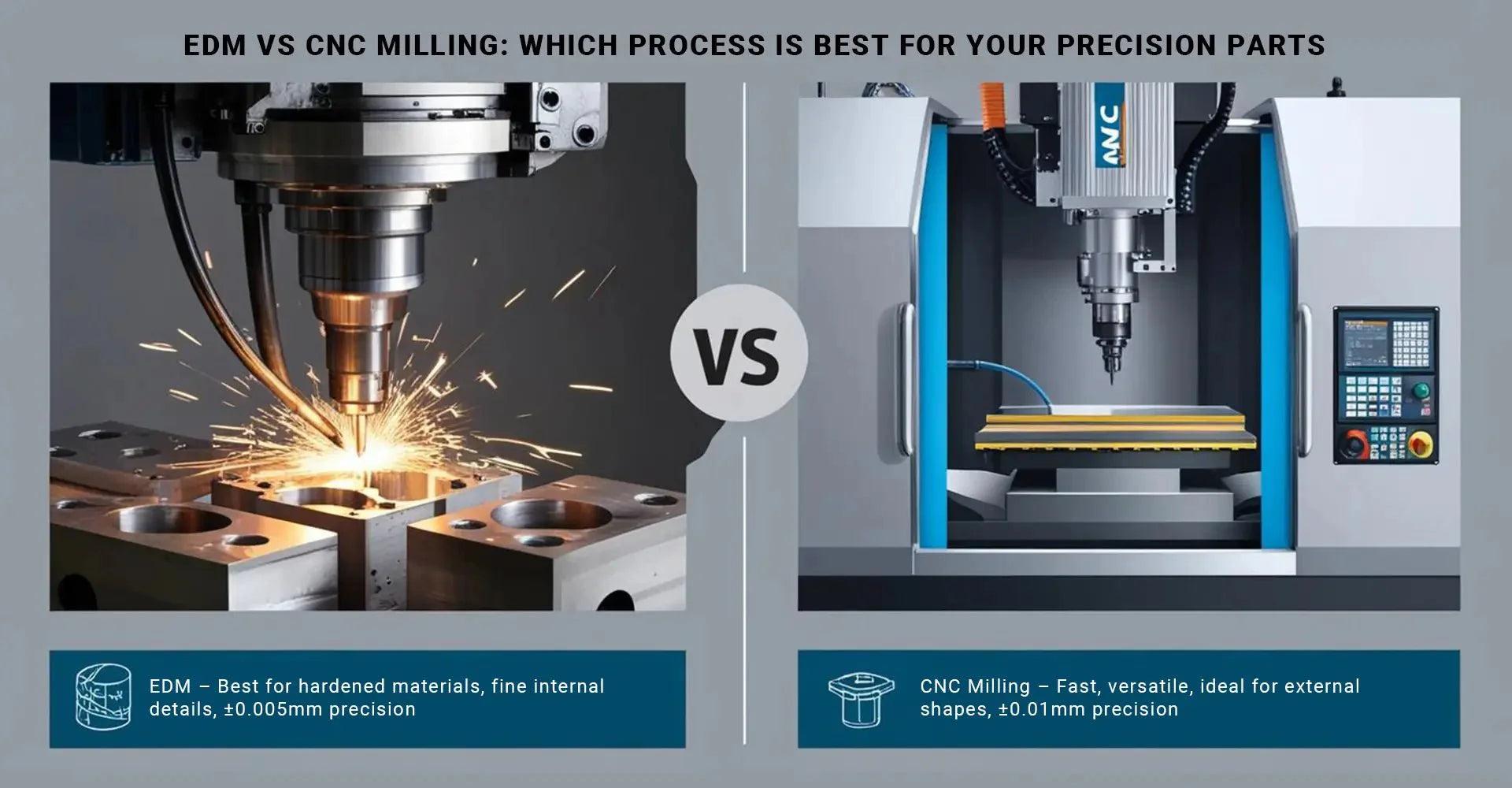
CNC and EDM are both important technologies in injection mold manufacturing, but they are suitable for different applications.
| Factor | CNC Machining | EDM Machining |
|---|---|---|
| Material removal speed | Faster | Slower |
| Hardened steel machining | Limited | Excellent |
| Complex cavities | Good | Excellent |
| Sharp internal corners | Limited | Excellent |
| Surface finish | Good | Excellent |
| Main application | Structural machining | Precision details |
In actual mold production, CNC and EDM are often used together rather than replacing each other.
CNC machining is usually selected for efficient material removal and structural components, while EDM is used for complex features requiring high precision.
Factors Affecting CNC Machining Accuracy
Several factors influence the final quality of CNC machined mold components.
Machine Capability
High-quality CNC machines provide:
- Better positioning accuracy
- Higher stability
- Improved repeatability
Advanced equipment is especially important for complex mold components with tight tolerances.
Cutting Tools and Machining Parameters
Tool selection directly affects:
- Surface finish
- Dimensional accuracy
- Machining efficiency
Incorrect cutting parameters may cause:
- Tool vibration
- Surface defects
- Dimensional errors
Material Properties
Different mold steels have different machining characteristics.
For example:
- P20 is easier to machine and commonly used for production molds.
- S136 provides excellent corrosion resistance and polishing performance.
- H13 offers high heat resistance for demanding applications.
Proper material selection helps balance machining cost and mold performance.
Engineering Experience
CNC machining quality depends not only on equipment but also on engineering knowledge.
Experienced engineers understand how to optimize:
- Machining sequence
- Tool paths
- Tolerance requirements
- Deformation control
This experience helps prevent costly machining problems.
CNC Machining Cost Factors for Mold Components
The cost of CNC machining depends on several factors:
| Cost Factor | Impact |
|---|---|
| Material type | Harder materials require more machining time |
| Component complexity | Complex geometry increases programming and machining time |
| Tolerance requirement | Higher accuracy requires more processes |
| Surface finish | Additional finishing increases cost |
| Quantity | Higher volume reduces unit cost |
For injection mold components, investing in precision machining can reduce future repair costs and improve mold reliability.
How to Choose a CNC Machining Supplier for Mold Components
Selecting the right CNC machining supplier for injection mold components is critical for successful injection mold projects.
Consider these factors:
Injection Mold Experience
A supplier should understand mold manufacturing, not only CNC machining.
Experience with injection molds helps engineers make better decisions regarding:
- Component design
- Tolerance requirements
- Assembly accuracy
Complete Manufacturing Capability
A supplier with CNC machining, EDM, grinding, mold assembly, and inspection capabilities can provide better project control.
This reduces communication issues and improves delivery reliability.
Quality Control System
Professional suppliers should provide:
- Inspection reports
- Dimensional verification
- Quality records
Reliable quality control ensures components meet production requirements.
Frequently Asked Questions About CNC Machining for Mold Components
What mold components can be made by CNC machining?
CNC machining can produce mold inserts, cores, cavities, plates, sliders, lifters, and many structural mold components.
How accurate is CNC machining for mold components?
High-quality CNC machining can typically achieve tolerances around ±0.005mm depending on material, machine capability, and design requirements.
Is CNC machining better than EDM for mold components?
Neither process completely replaces the other. CNC machining is better for fast material removal and structural parts, while EDM is better for complex cavities and hardened steel features.
What materials are commonly used for CNC machined mold components?
Common materials include P20, H13, S136, NAK80, aluminum, and copper alloys.
How can CNC machining improve injection mold quality?
Accurate CNC machining improves component fit, reduces assembly problems, and helps produce more stable injection molding results.
Conclusion
CNC machining for mold components is a fundamental process in modern injection mold manufacturing. Its ability to achieve tight tolerances, complex geometries, and repeatable results makes it essential for producing reliable molds.
For companies searching for a precision machining partner, choosing an experienced CNC machining and injection mold manufacturer with advanced equipment, engineering expertise, and complete quality control can help reduce risks and improve mold performance.
Need help selecting the right machining process for your mold project? Our engineering team can provide DFM feedback, material recommendations, and manufacturing solutions based on your production requirements. Learn more about our injection mold manufacturing services and how we support global customers with custom tooling solutions.