
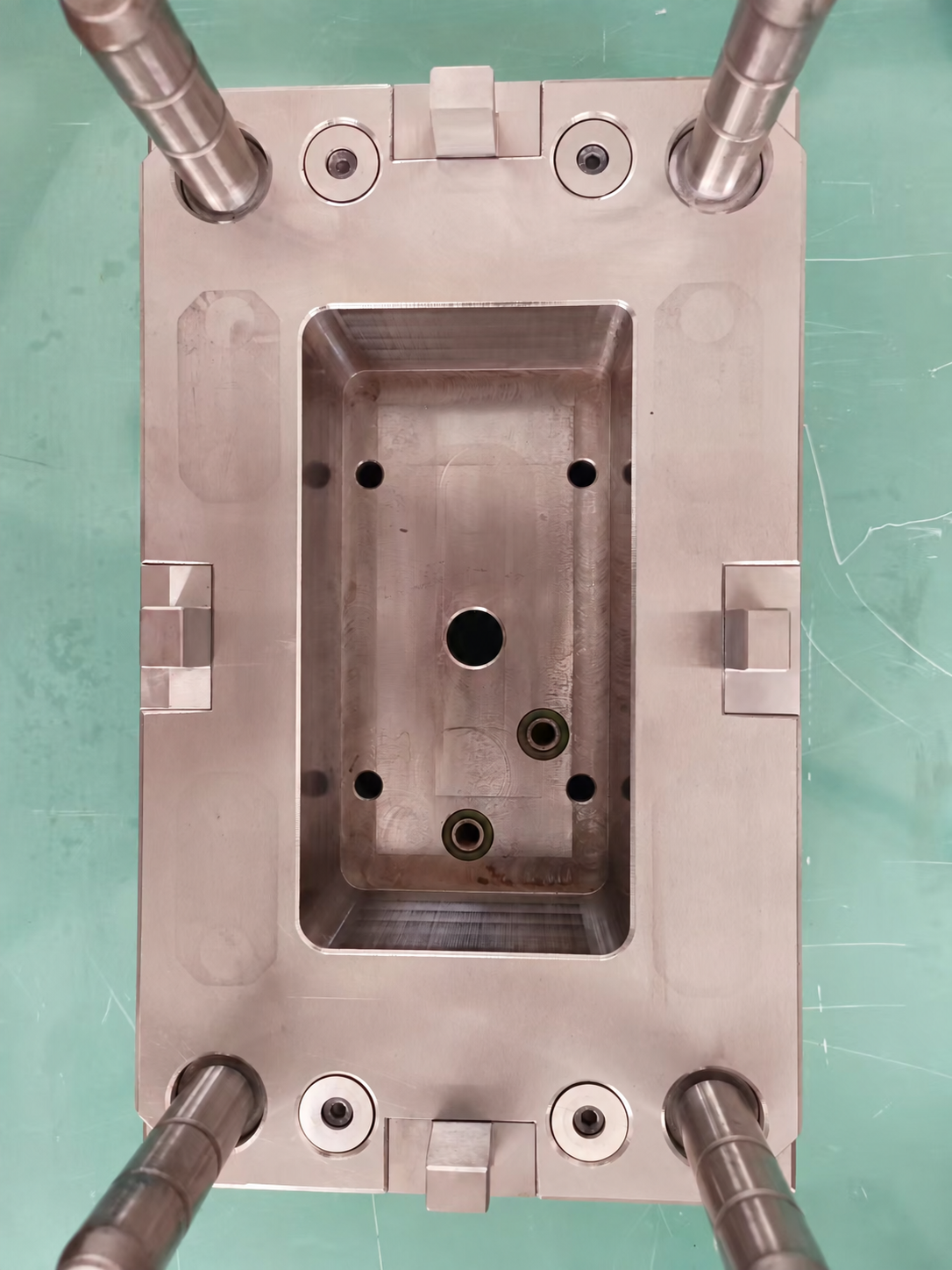
Injection mold plate deformation can cause much more than a flatness problem. Once a mold plate bends under injection pressure or clamping force, the whole mold structure may lose alignment.
As a result, flash, insert movement, slider problems, uneven parting lines, and ejector issues may appear. In severe cases, repeated deformation can damage mold components and reduce mold life.
Therefore, mold plate strength should be checked during the early design stage. Plate thickness, steel selection, support layout, cavity position, and injection pressure all matter.
At Fentor Mold, we treat mold plate stiffness as part of the complete mold structure rather than checking plate thickness alone.
What Is Injection Mold Plate Deformation?
Injection mold plate deformation means that one or more mold plates bend, flex, or lose their original flatness during molding.
A small amount of elastic movement may occur in many molds. However, excessive movement can affect the position of cavities, inserts, sliders, lifters, and parting surfaces.
Typical plates affected include:
- A plate
- B plate
- Support plate
- Cavity plate
- Core plate
- Ejector plate
The problem becomes more serious when the mold has large cavities, high injection pressure, thin mold plates, or weak support behind the core area.
In addition, repeated loading can slowly increase wear between mold components.
Common Signs of Injection Mold Plate Deformation
Injection mold plate deformation does not always cause immediate mold failure. Instead, technicians may first notice small changes during production.
Common signs include:
| Symptom | Possible Mold Problem |
|---|---|
| Flash appears after stable production | Parting surface opens slightly |
| Slider becomes difficult to move | Plate movement changes alignment |
| Insert position changes | Plate bends under pressure |
| Parting line becomes uneven | Mold plate loses flat contact |
| Ejector pins wear abnormally | Core-side structure moves |
| Mold requires more locking force | Plate stiffness may be insufficient |
| Product dimensions become unstable | Cavity shape changes under pressure |
For example, a mold may produce good samples during a slow trial. However, flash may appear after injection speed and pressure are increased.
In this case, the problem may not be poor spotting. The real cause may be plate deflection under higher cavity pressure.
Main Causes of Injection Mold Plate Deformation
Several factors can cause injection mold plate deformation. In most cases, more than one factor is involved.
1. Mold Plate Is Too Thin
Plate thickness is one of the first areas to check.
A thin plate is easier to machine and can reduce mold weight. However, it also has lower stiffness.
This becomes risky when the mold contains:
- Large cavities
- Deep cavities
- Large open areas
- Long unsupported distances
- High-pressure materials
- Large slides or lifters
If the plate cannot resist the molding force, it may bend during filling or packing.
Therefore, plate thickness should be selected according to mold size, cavity layout, pressure, and support conditions.
2. Poor Support Behind the Core Plate
A thick mold plate can still deform if the support structure is poor.
For example, the center of a large B plate may have a long unsupported area. During injection, pressure acts on the cavity and pushes the plate backward.
Without enough support pillars or support blocks, the plate can flex.
Therefore, support pillars should be placed close to high-load areas.
They are especially important below:
- Large core areas
- Deep cavities
- Large inserts
- High-pressure zones
- Areas far from the mold feet
Good support reduces plate movement and keeps the core position stable.
Injection Pressure and Mold Plate Deformation
High cavity pressure is another major cause of injection mold plate deformation.
During filling and packing, molten plastic pushes against the cavity surface. The force can be very high, especially when the projected area is large.
The basic relationship is simple:
Larger projected area + higher cavity pressure = higher mold opening and plate loading force
This is why a large plastic housing can create a high structural load even if the part is not very thick.
Materials also matter.
For example, some glass-filled engineering plastics may require higher filling pressure than easy-flow materials. Thin-wall products can also require high speed and pressure.
Therefore, mold designers should not select plate thickness only from previous experience. The expected molding pressure should also be considered.
Poor Mold Base Design Can Increase Deformation
A mold base works as one complete structure.
Therefore, injection mold plate deformation may also come from weak mold base design rather than one individual plate.
Common structural problems include:
- Mold feet too far apart
- Too few support pillars
- Small support area
- Weak support plate
- Large central open space
- Uneven force distribution
- Incorrect cavity position
For larger molds, the center area is often the most critical.
If support exists only near the mold edges, the center of the mold may act like a bridge. Under pressure, the middle section can move backward.
As a result, the cavity may open slightly near the center even though the mold is fully clamped.
Incorrect Steel Selection
Steel grade also affects mold stiffness and long-term stability.
However, harder steel does not automatically mean better resistance to plate deformation.
The designer should consider:
- Plate size
- Heat treatment
- Steel strength
- Machining condition
- Required mold life
- Operating temperature
Heat treatment can also cause plate distortion if it is not controlled correctly.
Therefore, large precision plates should be machined and heat treated with enough allowance for stress relief and final grinding.
At Fentor Mold, large mold plates are checked carefully after machining because plate flatness directly affects mold assembly and spotting.
Machining Stress and Plate Distortion
Sometimes the plate is already deformed before the mold enters the injection machine.
Heavy CNC machining removes a large amount of steel from one side of the plate. As a result, internal stress may become unbalanced.
This can cause:
- Plate warpage
- Poor flatness
- Uneven thickness
- Parting surface mismatch
Large cavity plates are more sensitive to this problem.
Therefore, the machining sequence should avoid removing too much material at one time.
For critical plates, rough machining, stress relief, semi-finish machining, and final grinding may be necessary.
This process takes more time. However, it can reduce later assembly and production problems.
How Injection Mold Plate Deformation Causes Mold Damage
The biggest problem is not always the plate itself.
Instead, plate movement can change the position of other mold components.
Slider Misalignment
A slider depends on accurate alignment between the mold plates.
If one plate moves, the slider may no longer enter its locking position smoothly.
As a result, the slider can jam, wear, or collide with another component.
This is one reason mold structure should be checked when diagnosing repeated injection mold slide jamming.
Insert Movement
Large inserts rely on the surrounding mold plate for support.
If the plate bends, the insert may move slightly under pressure.
This can cause:
- Flash
- Step marks
- Uneven parting lines
- Dimensional changes
Ejector System Problems
Plate deformation can also affect the ejector system.
If the B plate or support structure moves unevenly, ejector pins and return components may lose alignment.
This can increase wear or create injection mold return pin problems.
Therefore, repeated return pin or ejector damage should not always be treated as an isolated component problem.
How to Prevent Injection Mold Plate Deformation
Preventing injection mold plate deformation starts before steel cutting begins.
Use Enough Plate Thickness
Do not reduce mold plate thickness only to save mold cost or weight.
Instead, select the plate size according to:
- Cavity size
- Projected area
- Injection pressure
- Mold dimensions
- Support structure
- Expected mold life
For large molds, a small increase in plate thickness can greatly improve structural stability.
Add Support Pillars in Critical Areas
Support pillars are one of the most effective ways to reduce plate flexing.
However, they must be placed in the correct positions.
The best locations are usually close to high-pressure areas and below large unsupported regions.
For larger molds, several support pillars may be needed.
In addition, their heights should be consistent. If one support pillar is too low, it will not carry the expected load.
Improve Force Distribution
The cavity layout should also distribute force as evenly as possible.
For multi-cavity molds, poor cavity positioning can create uneven loading.
Similarly, a large cavity placed far from the mold center can create extra bending force.
Therefore, mold layout should consider both plastic flow and mechanical strength.
This is an important part of professional injection mold design.
Check Plate Flatness During Mold Making
Plate flatness should be checked at several stages.
For example:
- After rough machining
- After heat treatment
- After finish machining
- Before mold assembly
- After mold trial if unusual flash appears
A plate may look normal by eye but still have enough distortion to affect mold accuracy.
Therefore, large precision plates should be checked with proper measuring equipment.
Use Mold Trial Data to Find Deformation
Sometimes injection mold plate deformation only appears under production pressure.
In this situation, the mold may look completely normal when opened on the bench.
Technicians should compare mold behavior under different process conditions.
For example:
| Process Change | What to Observe |
|---|---|
| Lower packing pressure | Does flash decrease? |
| Higher injection pressure | Does parting line change? |
| Longer holding time | Does deformation become worse? |
| Higher clamp force | Does flash improve? |
| Reduced filling speed | Does mold behavior change? |
If flash changes clearly with pressure, the mold structure should be checked.
However, simply increasing clamp force is not always the correct solution.
If the plate itself is too weak, higher clamping force may hide the problem without correcting the mold design.
Add Protection for High-Risk Mold Structures
Some molds contain large sliders, long lifters, or expensive inserts.
In these molds, even small structural movement can create collision risk.
Therefore, position sensors or switches may be useful for critical movements.
For example, a limit switch can confirm that a moving mold component has reached the correct position before the next machine action starts.
The sensor cannot solve plate deformation itself. However, it can reduce secondary mold damage if deformation causes a component to move incorrectly.
Injection Mold Plate Deformation Inspection Checklist
When injection mold plate deformation is suspected, check the complete mold structure.
| Inspection Item | What to Check |
|---|---|
| A/B plates | Thickness and flatness |
| Support plate | Bending or poor contact |
| Support pillars | Quantity, position, and height |
| Mold feet | Support spacing |
| Cavity area | Large unsupported regions |
| Inserts | Movement or uneven contact |
| Parting surface | Local opening or flash |
| Slider alignment | Abnormal wear or jamming |
| Ejector system | Uneven movement |
| Process pressure | Excessive injection or packing pressure |
The goal is to find the structural cause.
Simply polishing the parting surface or increasing clamping force may only hide the problem temporarily.
Final Thoughts
Injection mold plate deformation can affect much more than plate flatness.
It can cause flash, slider misalignment, insert movement, unstable dimensions, ejector problems, and even serious mold damage.
Therefore, prevention should start with correct mold design.
Plate thickness, support pillars, steel condition, cavity position, machining sequence, and injection pressure should all be reviewed together.
For large or high-pressure molds, structural stability becomes even more important. A stronger and better-supported mold base may cost slightly more at the beginning. However, it can prevent repeated repairs and production shutdowns later.
At Fentor Mold, we prefer to identify these structural risks during design and mold assembly instead of correcting them only after production problems appear.