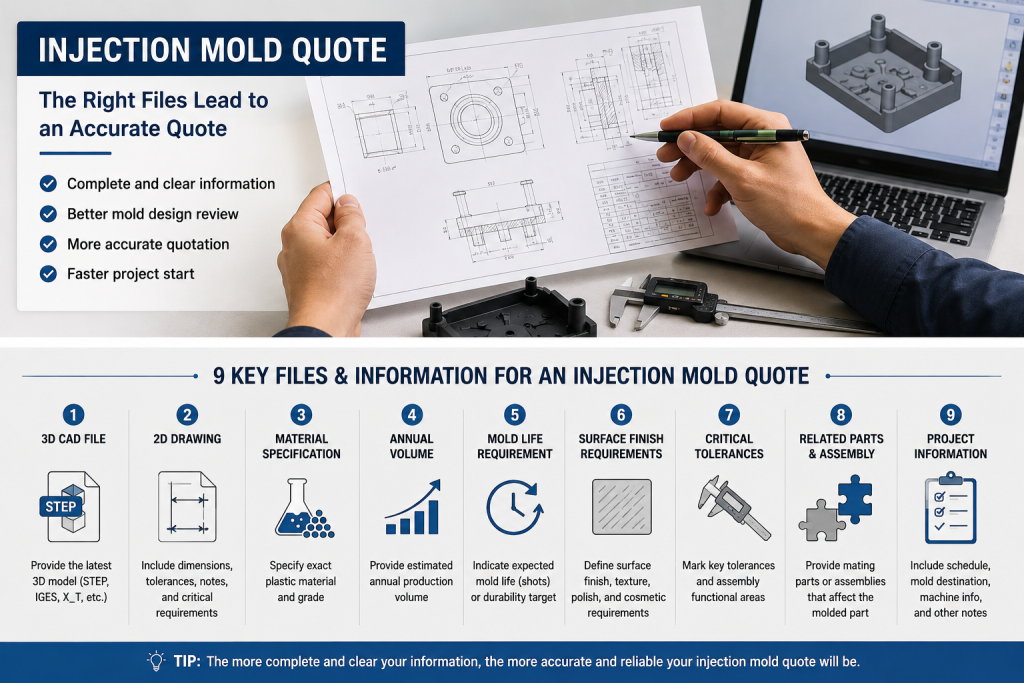
An accurate injection mold quote depends on the quality of the files and project information you provide before the supplier starts reviewing the mold.
A 3D model may be enough for a rough estimate, but it is rarely enough for a reliable tooling quotation. Mold structure, material, tolerances, expected production volume, surface finish, and part function can all change the final mold design.
If those details are missing, the supplier has to make assumptions. That can result in a higher price to cover unknown risks, or a quotation that changes later after the project is reviewed in more detail.
For a useful injection mold quote, the goal is not to send as many documents as possible. The goal is to send the information that affects how the mold will actually be designed, built, tested, and used.
Below are nine items worth preparing before you send your RFQ.
1. Send a 3D CAD File for an Injection Mold Quote
The 3D CAD model is usually the first file a mold engineer opens.
It gives the supplier the basic geometry needed to review:
- Part size
- Wall thickness
- Ribs
- Bosses
- Undercuts
- Draft
- Side holes
- Shut-off areas
- Snap features
- Core and cavity shape
For most mold projects, neutral CAD formats are the safest choice.
Common options include:
- STEP or STP
- Parasolid X_T
- IGES or IGS
Native files such as SolidWorks, Creo, NX, or CATIA can also be useful, but they should not be the only format provided unless you already know the supplier can open that software version.
For quotation work, STEP is often a practical default.
Do not send only STL unless the project is very early.
STL is a mesh format. It may be fine for viewing or 3D printing, but it is less useful for detailed mold engineering because it does not provide the same clean surface and feature information as a proper solid CAD model.
Before sending the file, also check that it is the latest revision.
A mold supplier quoting from Rev. B while your engineering team has already moved to Rev. D is an easy way to create confusion before the project even starts.
2. Include a 2D Drawing for an Accurate Injection Mold Quote
The 3D model shows shape.
The 2D drawing tells the supplier what matters.
This distinction is important.
Two plastic parts can have nearly identical geometry but very different tooling requirements if one has loose general tolerances and the other has several tightly controlled assembly dimensions.
A useful 2D drawing should identify items such as:
- Critical dimensions
- General tolerances
- Datum structure
- Flatness requirements
- Hole positions
- Assembly dimensions
- Thread specifications
- Insert locations
- Cosmetic surfaces
- Notes that cannot be understood from the CAD model alone
If the drawing has inspection requirements, include those as well.
For example, a ±0.05 mm dimension near an assembly interface can affect steel conditions, process control, inspection method, and sometimes even mold construction.
That is why a supplier should not prepare an injection mold quote from the 3D geometry alone when a controlled drawing already exists.
If tolerances are still being defined, our Injection Molding Tolerances guide explains why material, geometry, and measurement method should be considered together.
3. Specify the Exact Plastic Material
Writing only “ABS,” “PC,” or “nylon” is better than providing nothing, but it may still be incomplete.
If you already know the resin grade, provide the exact grade.
For example:
- SABIC PC grade
- BASF PA66 GF30
- Covestro PC/ABS
- UL94 V-0 flame-retardant ABS
- Medical-grade PP
Material affects much more than resin price.
It can influence:
- Shrinkage
- Mold steel selection
- Gate design
- Runner design
- Venting
- Mold temperature
- Wear
- Cooling
- Surface finish
- Expected dimensional stability
Glass-filled materials, for example, may increase mold wear.
Flame-retardant materials may need different processing and steel considerations.
A transparent PC housing can require a very different polishing and gate strategy from a standard black ABS cover, even if both parts are similar in size.
Providing the exact resin grade also helps the supplier prepare a more reliable injection mold quote, especially when the material affects shrinkage, wear, or polishing requirements.
If the material has not been finalized, say so.
You can provide two or three candidate materials and ask the supplier to quote based on the most likely option.
That is better than leaving the mold maker to guess.
4. Production Volume Affects Your Injection Mold Quote
Production volume has a direct effect on the tooling solution.
A mold expected to produce 5,000 parts over its lifetime does not necessarily need the same steel, cooling system, cavity layout, or hot runner system as a mold expected to produce 1,000,000 parts.
When requesting an injection mold quote, provide at least an estimated annual volume.
For example:
- 10,000 parts per year
- 80,000 parts per year
- 300,000 parts per year
- 1 million parts per year
If demand is uncertain, give a range.
You can write:
“Estimated annual volume: 50,000–100,000 parts.”
That is enough to help the mold supplier make a more reasonable tooling recommendation.
Production volume may influence decisions such as:
- Single-cavity or multi-cavity mold
- Mold steel
- Hot runner or cold runner
- Automation level
- Cooling layout
- Replaceable wear inserts
- Expected maintenance requirements
Without volume information, the supplier may quote a technically workable mold that is not economically suitable for the actual production plan.
5. Mold Life Requirements Affect the Injection Mold Quote
Annual volume and mold life are related, but they are not the same thing.
A customer producing 100,000 parts per year may expect the tool to run for two years.
Another may expect the same mold to remain in production for ten years.
If you have a mold-life target, include it in the RFQ.
Examples include:
- 100,000 shots
- 300,000 shots
- 500,000 shots
- 1 million shots
This helps the supplier decide whether the mold should use:
- Pre-hardened steel
- Hardened tool steel
- Replaceable inserts
- Wear-resistant components
- More robust slides or lifters
- Higher-grade mold components
A lower tooling price may look attractive, but it means little if the tool was designed for a shorter life than the project actually requires.
For custom tooling projects, our Injection Mold service covers mold engineering, mold manufacturing, trial molding, and tooling support for production applications.
6. Surface Finish Requirements for an Injection Mold Quote
Appearance requirements can change tooling cost significantly.
If a surface is cosmetic, tell the supplier before quotation.
Do not wait until T1.
Useful information may include:
- SPI polish level
- VDI texture
- Mold-Tech texture
- Gloss level
- Matte finish
- High polish
- Laser texture
- Visible weld-line restrictions
- Gate-mark restrictions
- Ejector-mark restrictions
It also helps to identify which surfaces are critical.
A full Class-A appearance standard on every face of a housing is very different from having one cosmetic front surface while the internal and rear areas remain functional.
Marking cosmetic surfaces directly on a drawing, screenshot, or PDF is usually clearer than writing a general note such as “surface must look good.”
This information helps the mold maker review:
- Gate location
- Parting-line position
- Ejector layout
- Draft angle
- Polishing requirements
- Insert split lines
- Venting
- Texture allowance
Without that information, the first injection mold quote may be based on a finish standard that does not match the final product requirement.
7. Identify Critical Tolerances Before the Injection Mold Quote Is Finalized
Not every dimension on a plastic part needs the same level of control.
That matters because tight tolerances can increase mold complexity, inspection work, sampling time, and adjustment requirements.
When preparing the RFQ, identify dimensions that actually affect function.
Typical examples include:
- Snap-fit engagement
- Bearing locations
- Gear center distances
- PCB mounting positions
- Connector openings
- Insert positions
- Screw boss locations
- Sealing surfaces
- Housing assembly gaps
If two molded halves assemble together, sending both models is much better than sending only one part.
The mold supplier can then review how dimensions accumulate across the assembly.
A dimension that looks unimportant on one component may become critical when several parts are assembled.
Critical tolerances should be identified before the injection mold quote is finalized because they may affect mold construction, inspection, and adjustment work.
This is one reason DFM should look beyond the individual mold cavity.
Our Injection Mold Design Guide explains how product geometry, gate position, shrinkage, cooling, and mold structure are reviewed before tooling begins.
8. Send Related Parts When They Affect the Molded Component
This point is often overlooked.
The supplier may be quoting one molded part, but that part may interact with:
- Another plastic housing
- A PCB
- A metal bracket
- A gasket
- A switch
- A display
- A connector
- A screw
- A bearing
- A purchased component
If those interfaces affect dimensional or functional requirements, send them.
The files do not always need to be complete manufacturing drawings.
Sometimes a simplified assembly model is enough.
For example, if a plastic enclosure has four screw bosses that must align with a PCB, the supplier should understand the PCB mounting pattern.
If a snap feature must lock into another plastic cover, the mating geometry matters.
If a connector must pass through a rectangular opening, the mold maker needs to know how much clearance is acceptable.
These details allow the supplier to identify tooling risks earlier instead of discovering them after samples are molded.
9. Project Information Needed for an Injection Mold Quote
Some of the most important quotation details are not visible in the CAD model at all.
A short project note or RFQ sheet should include them.
Useful information includes:
- Target mold completion date
- Expected T1 timing
- Mold destination
- Production location
- Injection molding machine requirements
- Required mold standard
- Preferred hot runner brand
- Mold base standard
- Electrical requirements
- Spare-part requirements
- Packaging requirements
- Trial quantity
- Sample approval process
Mold destination is especially important.
A tool staying in the supplier’s molding factory may be designed differently from a mold that will later be shipped to the United States, Germany, Mexico, or another production site.
The receiving factory may have specific requirements for:
- Mold dimensions
- Locating rings
- Nozzle radius
- Water fittings
- Electrical connectors
- Hot runner controller compatibility
- Eyebolts
- Mold clamps
- Safety switches
If the mold will be transferred later, that should be discussed before the injection mold quote is finalized.
For customers that want the same supplier to handle tooling and ongoing molding, our Injection Molding Production service supports projects from mold validation through repeat plastic-part production.
What If Some Injection Mold Quote Information Is Missing?
You do not need to have every project detail finalized before requesting a quotation.
Early-stage projects often still have open questions.
That is normal.
The important thing is to separate confirmed requirements from assumptions.
For example:
Confirmed
- STEP file attached
- Material: PC/ABS
- Annual volume: approximately 80,000 parts
- Front face is cosmetic
Not confirmed
- Final resin grade
- Texture specification
- Mold production location
- Exact annual volume
This makes the quotation easier to understand.
The supplier knows which items can be priced confidently and which items may need revision later.
It is much better than allowing hidden assumptions to become part of the quotation.
What Should You Avoid Sending?
More information is not always better.
Old revisions, duplicated drawings, outdated screenshots, and contradictory specifications can make an RFQ harder to review.
Before sending the files, remove anything that is no longer valid.
A clean RFQ package is usually better than a folder containing 30 files with no explanation.
You should also avoid sending:
- Only screenshots of the product
- Only STL files when proper CAD is available
- Multiple CAD revisions without identifying the current one
- A drawing with tolerances that do not match the latest CAD
- Generic material names when an exact grade has already been selected
- Production volumes that are no longer realistic
The mold supplier should not have to determine which file is correct.
How to Prepare a Complete Injection Mold Quote Package
A complete request does not need to look complicated.
For many projects, a clean package may contain only:
01_Product_STEP.stp
Latest 3D model.
02_Product_Drawing.pdf
Dimensions, tolerances, cosmetic notes, and critical requirements.
03_Assembly_STEP.stp
Related parts where needed.
04_Project_Requirements.pdf
Material, annual volume, mold life, finish, target schedule, mold destination, and other project information.
A clear RFQ package makes the injection mold quote easier to review and reduces the number of assumptions the supplier has to make.
That package gives the supplier enough information to review the part properly without burying the important details in dozens of files.
Better Information Produces a Better Injection Mold Quote
A quotation is only as useful as the information behind it.
A 3D model can tell the supplier what the part looks like, but it cannot explain production volume, cosmetic expectations, mold life, critical tolerances, or where the tool will eventually run.
That information affects both mold cost and mold design.
Before requesting an injection mold quote, prepare the latest 3D CAD file, 2D drawing, resin specification, annual volume, mold-life target, surface requirements, critical dimensions, assembly information, and project requirements.
You do not need every detail to be final.
But the more clearly confirmed requirements and open assumptions are separated, the easier it is for the mold supplier to prepare a quotation that remains valid when the project moves into tooling.